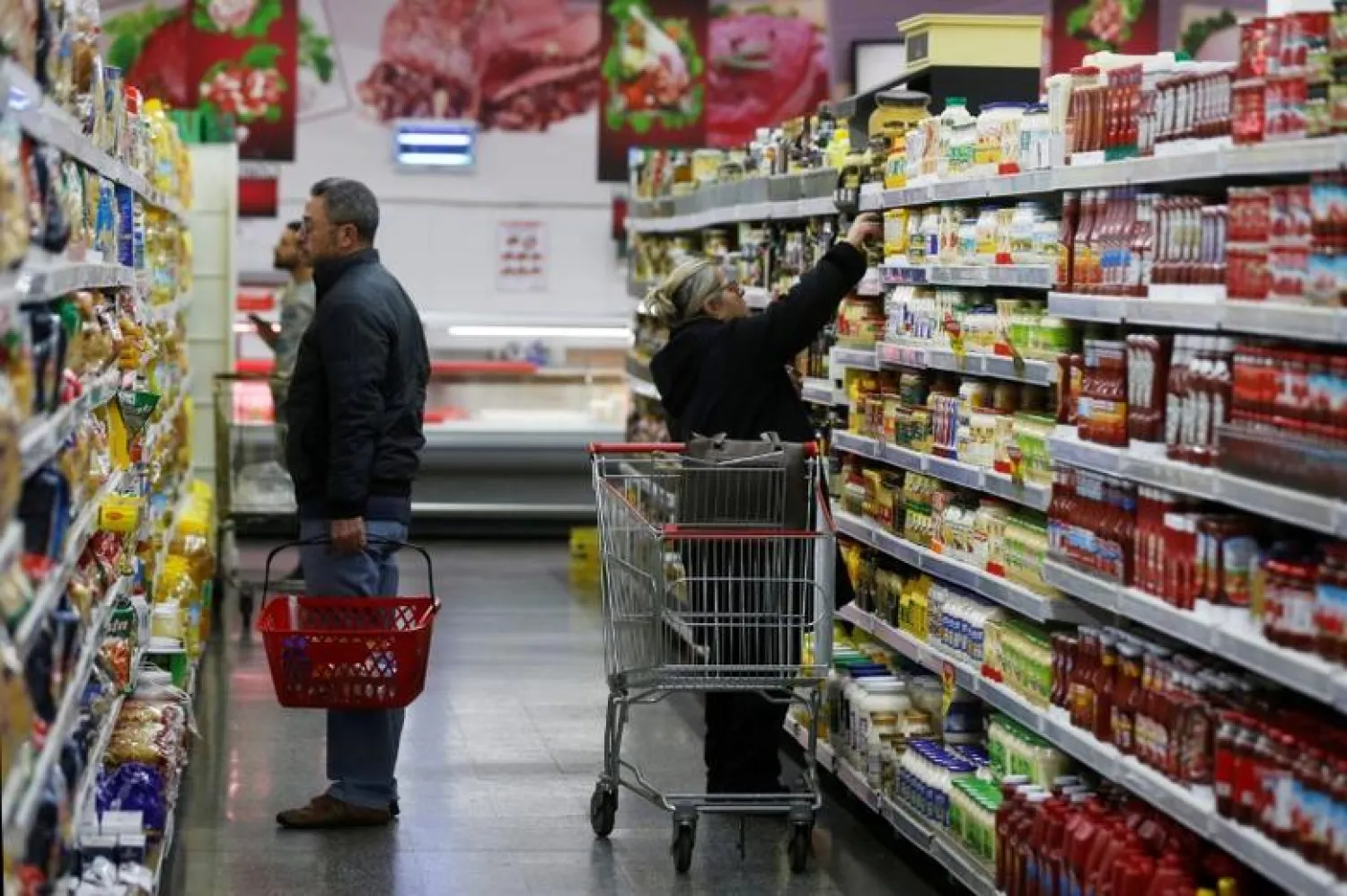
Lebanon: Food Prices Soar, Increasing By 100% in 2 Weeks

Lebanon: Food Prices Soar, Increasing By 100% in 2 Weeks
TT

Lebanon: Food Prices Soar, Increasing By 100% in 2 Weeks

Lebanon: Food Prices Soar, Increasing By 100% in 2 Weeks

Food prices in Lebanon are rising on a daily basis as a result of the constant change of the dollar exchange rate.

Prices of foodstuffs have risen by 72 percent since May, said the head of the Consumer Protection Association, Zuhair Berro, but added that the last two weeks have registered an increase by 100 percent.

In remarks to Asharq Al-Awsat, he said: “The rise in prices was evident despite the presence of a food basket subsidized by the Ministry of Economy,” noting that low prices were observed only in Egyptian rice and sugar.

A number of owners of small grocery stores, who were interviewed by Asharq Al-Awsat, confirmed that the subsidized products were not provided to merchants or were available only in very small quantities.

The reason for the rise in prices is due to two main factors, said the head of the food importers union, Hani Bohsali.

“The first is the presence of goods on the market that were imported before the subsidy decision, and therefore are sold on the basis of the daily exchange rate and change continuously. The second is linked to the quantities of products imported on the basis of subsidies that are not sufficient for the market’s need,” he explained.

Bohsali noted that many importers “did not submit import orders because of the very difficult conditions, including the need to pay the price of the goods to the supplier company, and then placing a guarantee in the bank with the value of these goods in Lebanese pounds.”

He said, however, that basic foodstuffs would “remain available on the market”, ruling out the stopping of imports “as long as the dollar is accessible.”

“The quantity of imports, especially for non-essential foodstuffs, has decreased significantly in the recent period. This is due to two reasons: the dollar shortage and the decline in purchasing power, as many traders stopped importing non-essential food items because their prices has become very high with the rise of the dollar,” Bohsali underlined.


World Food Prices Dip in October, but Remain Higher Than a Year Ago

A worker carries loaves of bread for sale at a bakery in the capital city of Cairo, Egypt November 4, 2026. (Reuters)
TT

World Food Prices Dip in October, but Remain Higher Than a Year Ago

A worker carries loaves of bread for sale at a bakery in the capital city of Cairo, Egypt November 4, 2026. (Reuters)

World food prices edged lower in October as weaker import demand contributed to monthly declines in cereal, dairy and meat prices, but were still nearly 6% higher than a year earlier, the United Nations' Food and Agriculture Organization said on Friday.

The FAO Food Price Index, which tracks monthly changes in international prices for a basket of food commodities, ‌averaged 133.9 points ‌in October, down from a revised ‌135.6 ⁠in September.

The index ⁠was 5.9% higher than a year earlier, but remained 16.4% below its March 2022 peak.

FAO's cereal price index fell 4.5% from September and was 12.6% lower than a year ago, as wheat and maize quotations declined. Wheat prices eased on weak import demand ⁠and improved production prospects, especially in Argentina.

"Expectations of ‌easing constraints on Black ‌Sea export flows added to the downward pressure on prices, ‌although continued disruptions to Black Sea logistics limited the decline," ‌FAO said in a statement.

Maize prices also eased after reaching a three-year high in September, pressured by the US harvest, expectations of ample supplies in South America and renewed ‌prospects of easing tensions in the Black Sea region.

Vegetable oil prices edged up 0.3%, ⁠as ⁠higher soybean and sunflower oil prices more than offset a fall in rapeseed oil prices.

Sugar prices rose 6.6%, their fourth straight monthly increase, to the highest level since December 2024, after rainfall disrupted harvesting in Brazil. They were now 28.8% above a year ago.

The dairy index fell 1.1%, as lower butter and cheese prices linked to ample supplies and subdued demand outweighed gains in milk powder.

The meat index declined 1.2%, while still slightly above its year-earlier level, as ovine and bovine meat prices fell.


Copper Falls, Set for Worst Week Since March on AI Rout

Copper at the Aurubis copper smelting and refining plant in Hamburg, Germany. (Reuters)
TT

Copper Falls, Set for Worst Week Since March on AI Rout

Copper at the Aurubis copper smelting and refining plant in Hamburg, Germany. (Reuters)

Copper dropped on Friday and was set for its biggest weekly drop in London since March, as a rout in technology stocks battered markets.

Benchmark three-month copper on the London Metal Exchange was down 1.3% at $13,663 a metric ton by 0700 GMT. That placed it on track to fall 3.44% in the week, Reuters said.

The most-traded copper contract on the Shanghai Futures Exchange fell 1.08% to 106,830 yuan ($16,018.17) a ton.

The weakness reflects worries over AI investment, ‌with copper increasingly ‌influenced by "sentiment towards data center expansion," said ‌Craig ⁠Lang, principal analyst ⁠at CRU.

Technology shares were battered after Democratic wins in the US midterms fueled concerns that new regulatory oversight could cap the AI buildout.

On the other hand, supply constraints cushioned copper's decline.

"I would be cautious about calling this a sustained correction, given ongoing mine supply challenges and exceptionally tight ⁠metal availability outside the US," Lang said.

Copper stocks ‌in SHFE-monitored warehouses <CU-STX-SGH> fell by ‌over 24% this week to just 33,848 tons — the lowest ‌in almost three years. The closely watched Yangshan copper ‌premium <SMM-CUYP-CN>, a gauge of appetite for imports into key consumer China, increased to $210 a ton on Thursday, matching its record high.

Smelters in the country are facing a double squeeze of negative treatment ‌charges and lower sulfuric acid prices.

Meanwhile, warehouse inventories outside the US have been drawn ⁠down as ⁠material was pulled into the country ahead of a potential tariff on imports of refined copper.

"These physical constraints should provide some support against weaker investor sentiment," Lang said.

Among LME metals, aluminium lost 0.54%, zinc lost 1.42%, lead lost 0.45%, nickel dipped 0.23% and tin gained 0.83%.

On the SHFE, aluminium nudged down only 0.04%, zinc lost 1.35%, lead was little changed, down only 0.03%, nickel rose 2.14% and tin dropped 3.45%.

SHFE inventories were down across the board this week, led by sharp drops in aluminium <AL-STX-SGH> and lead <PB-STX-SGH>.


Emerging Economies Set to Match Advanced Nations’ Renewable Capacity Additions, IEA Says

Workers walk at Kalyon Karapinar solar power plant in Karapinar, Konya province, Türkiye, Oct. 14, 2026. (AP)
TT

Emerging Economies Set to Match Advanced Nations’ Renewable Capacity Additions, IEA Says

Workers walk at Kalyon Karapinar solar power plant in Karapinar, Konya province, Türkiye, Oct. 14, 2026. (AP)

Emerging ‌and developing economies outside China are expected to add as much new renewable energy capacity as advanced economies for the first time over the next five years, driven by the current energy crisis, the International Energy Agency said on Friday.

Gas and oil prices have soared this year as the US-Iran war disrupts traffic through the Strait of Hormuz, a key route for global oil and gas trade.

Global renewable energy ‌capacity is forecast ‌to increase by almost 4,800 gigawatts ‌between ⁠2026 and 2031, ⁠the IEA said in its annual outlook.

Emerging and developing economies are expected to add about 1,100 GW, roughly the same as advanced economies, with China adding around 2,550 GW, the agency said.

Capacity growth in Southeast Asia, Africa and the Middle East is ⁠expected to triple over the period, ‌led mainly by solar installations, ‌the IEA said.

China will remain the biggest contributor to ‌global renewable energy growth, although its share is ‌forecast to fall to 53% by 2031 from 60% in 2025.

India is emerging as the world's second-fastest deployer of renewables and is expected to more than double its contribution ‌to global growth by 2031 to nearly 8.5%.

Grid connection delays remain ⁠a major ⁠challenge, with projects awaiting connections worldwide rising 60% over the past year, equivalent to four times the wind and solar capacity connected to grids during the same period.

Grid constraints are expected to slow growth in advanced economies, with annual additions in Europe through 2031 forecast to remain broadly in line with 2025 levels.

Renewable energy is expected to meet 6% of global transport energy demand by 2031, while higher fuel-blending mandates prompted the IEA to raise its biofuels forecast by 40% from last year's report.