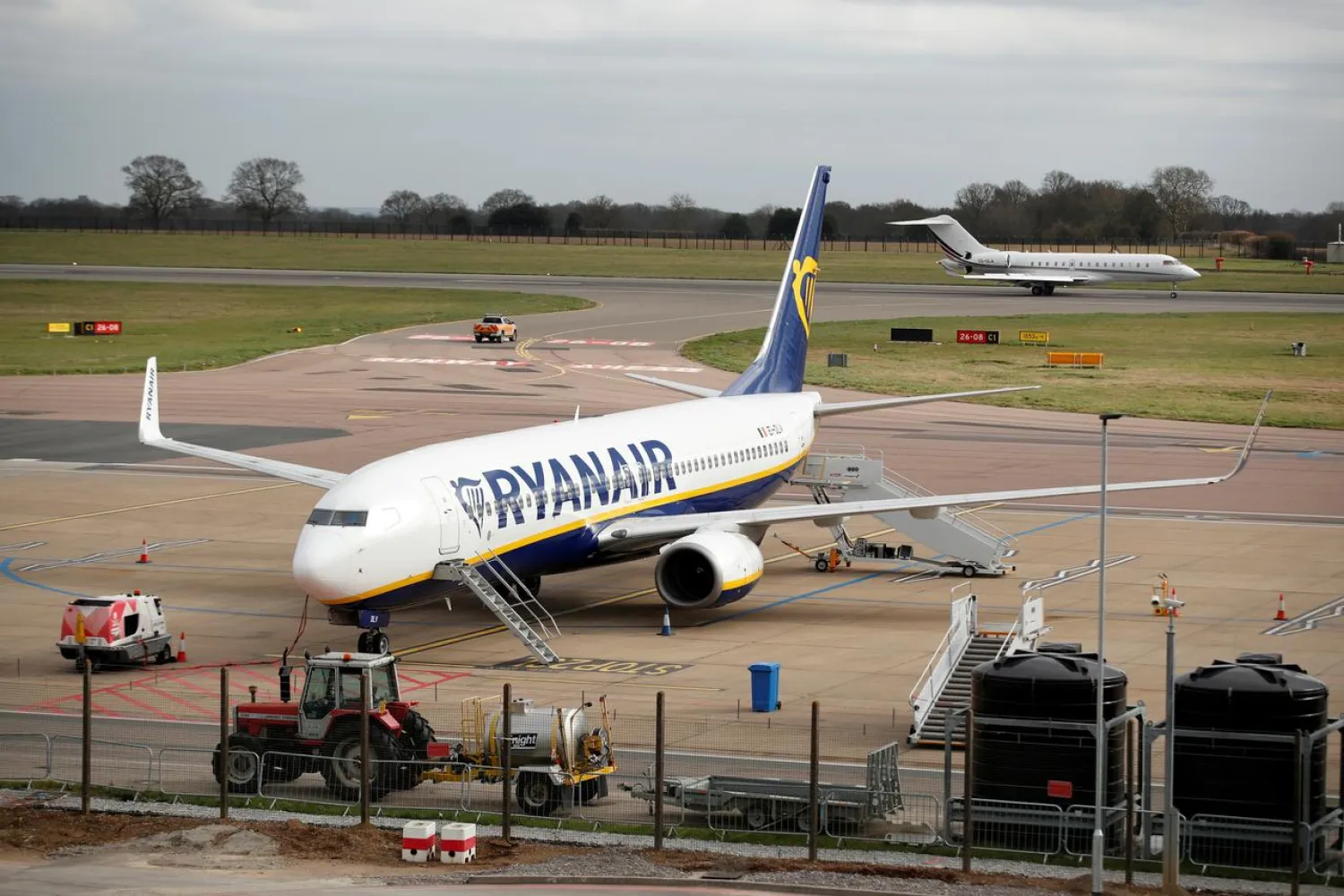
Ryanair Q1 Loss Smaller Than Expected, Wary of COVID Second Wave

Photo: REUTERS
Photo: REUTERS
TT

Ryanair Q1 Loss Smaller Than Expected, Wary of COVID Second Wave

Photo: REUTERS
Photo: REUTERS

Ryanair, Europe's largest low-cost airline, reported a narrower than expected loss in its fiscal first quarter on Monday and said it was impossible to say whether it might turn an annual profit due to the impact of the COVID-19 pandemic.

The Irish airline posted an after-tax loss of 185 million euros ($216.54 million) for the three months to June 30, its first-ever loss in the quarter, but less than the 232 million euros forecast in a company poll of analysts.

"Given the current uncertainty, Ryanair cannot provide any FY21 profit after tax guidance at this time," Group Chief Executive Michael O'Leary said in a statement, referring to its financial year which ends on March 31, 2021.

"A second wave of COVID-19 cases across Europe in late autumn (when the annual flu season commences) is our biggest fear right now," he added.

The Irish low-cost carrier said the quarter, in which passenger numbers were down by around 99%, was "the most challenging in Ryanair´s 35-year history".

Revenue was down 95% to 125 million euros while costs were down by 85%, it said.

But it said its cash burn had effectively ended, with its cash balance up to 3.9 billion euros at the end of June from 3.8 billion at the end of March.

At the end of the quarter, Ryanair moved from a skeleton service to flying around 40% of its usual schedule.

It hopes to fly 60% of its normal schedule in August and 70% in September and expects to post a smaller loss in the current quarter.

The airline's planes should be around 70% full in July and August, O'Leary said in a pre-recorded video presentation.

Ryanair hopes to accept delivery of its first 737 MAX-200 from Boeing Co before the end of 2020 and potentially up to 40 MAXs ahead of summer 2021, he added.

Its shares closed on Friday at 10.91 euros, down 25% since the start of the year. That is worse than Hungarian budget rival Wizz, down just 11%, but far better than most other European carriers, including Britain's easyJet, down 59%. ($1 = 0.8543 euros)


Saudi Air Navigation: Virtual Towers Boost Efficiency, Open Control and Maintenance Roles to Saudi Women

Virtual tower operations center – Air Navigation Services (Asharq Al-Awsat) 
TT

Saudi Air Navigation: Virtual Towers Boost Efficiency, Open Control and Maintenance Roles to Saudi Women

Virtual tower operations center – Air Navigation Services (Asharq Al-Awsat) 

Saudi Arabia is accelerating digital transformation in aviation as virtual air traffic control towers enter live operations, marking a first for the Middle East. Saudi Air Navigation Services Company said the technology is among its flagship digital initiatives to enhance air traffic efficiency and prepare Saudi airspace for rapid growth.

The company has also successfully enabled Saudi women to work in air traffic control and navigation systems maintenance after completing specialized training programs.

Eng. Ahmed Al-Zahrani, Chief Strategy and Sustainability Officer, told Asharq Al-Awsat that virtual towers are a cutting-edge global technology adopted as part of the company’s broader transformation drive.

Al-Zahrani explained that a virtual tower replaces the traditional structure with a digital system built on high-definition cameras and advanced target-tracking technologies at the airport. Controllers can perform their duties without direct line-of-sight, using zoom and data overlays unavailable in conventional towers, such as flight number, passenger count, origin, and destination.

The initiative has moved beyond theory: the company has already launched the region’s first virtual tower at AlUla International Airport, operated remotely from King Abdulaziz Airport in Jeddah. The project has also won the Ministry of Transport and Logistics Services’ Innovation Award.

Al-Zahrani said that virtual towers raise controller efficiency by enabling oversight of multiple airports from a single center, while improving safety and operational performance through clearer imagery and richer data.

Beyond technology, readiness depends on continuity. The company operates two primary air traffic control centers in Riyadh and Jeddah; if one is disrupted, the other can seamlessly manage Saudi airspace without service interruption.

Since its launch in June 2016, the company has aimed to rank among regional leaders in air traffic management. Today, it is one of the region’s foremost providers and is pursuing global leadership.

Air traffic continues to expand. By the end of November, flights totaled 921,095, up 5.7% year on year. A daily record was set on June 19, 2025, with 3,673 flights, averaging 153 per hour.

On workforce development, Al-Zahrani said women have begun work as controllers and maintenance specialists, demonstrating strong performance. The company employs about 2,000 staff, over 97% Saudi nationals, and 100% Saudis in air traffic control roles.

Sustainability underpins operations across environmental efficiency, social impact through national talent empowerment, and governance via integrity and compliance. On cybersecurity, the company adheres to top international standards and recently earned the global SOC-CMM certification, measuring operations readiness across people, processes, technology, services, and business integration.


Delayed US Data Expected to Show Solid Growth in 3rd Quarter

Investment in artificial intelligence is expected to be a source of continued momentum for the US economy in 2026. ANDREW CABALLERO-REYNOLDS / AFP/File
TT

Delayed US Data Expected to Show Solid Growth in 3rd Quarter

Investment in artificial intelligence is expected to be a source of continued momentum for the US economy in 2026. ANDREW CABALLERO-REYNOLDS / AFP/File

The US economy is expected to post another solid economic growth reading Tuesday, but the much-delayed figures likely will not settle debate on the labor market, AI and other variables.

Forecasters expect Tuesday's third-quarter gross domestic product (GDP) report to show 3.2 percent growth, according to consensus estimates from MarketWatch and Trading Economics.

That represents a bit of a moderation from the 3.8 percent second-quarter gain following a first-quarter with negative growth. Tuesday's release comes nearly two months after it was originally scheduled due to the US government shutdown, Reuters reported.

The report reflects a much improved US macroeconomic outlook compared with earlier in 2025, when worries about President Donald Trump's aggressive trade policy changes weighed on sentiment.

But by the latter stages of 2025, Trump's administration had negotiated agreements with China and other major economies that prevented enactment of the most onerous tariffs.

Meanwhile, an AI investment boom by Chat GPT-maker OpenAI, Google and other tech giants continued to pick up momentum, keeping the US stock market near record levels.

Pantheon Macroeconomics estimates that US growth in the third quarter came in at a "brisk-looking" 3.5 percent that nonetheless "will overstate the economy's true condition," the research firm said in a note.

A slowing job market and muted retail sales trends are among the factors consistent with "steady but unspectacular GDP growth" looking ahead to 2026, said Pantheon, which predicted the Federal Reserve would cut interest rates further in the new year.

"The risks remain skewed towards a faster cadence or larger decline in rates," said Pantheon, pointing to the Fed's impending leadership change with the 2026 departure of Chair Jerome Powell.

Consumer caution?

The US central bank on December 10 announced an interest rate cut for the third straight meeting.

While inflation remains well above the Fed's two percent target, Powell and other policymakers have described the weakening employment market as the greater concern at the moment.

The Fed's median 2026 GDP forecast is 2.3 percent, up from 1.7 percent projected in 2025, according to a summary of the central bank's outlook.

White House officials have said Trump could nominate Powell's successor in January.

Polling shows declining support for Trump as consumer prices have stayed at an elevated level.

But Kevin Hassett, a White House economic advisor considered the favorite for the Fed post, told Fox News over the weekend that consumers would soon see better times.

"I think that the American people are going to see it in their wallets... they're going to see that President Trump's policies are making them better," said Hassett, who mentioned an expected boost from higher tax refunds in 2026.

But Pantheon argued the economic benefit from tax refunds may be contained, noting that "the relatively low level of consumer confidence suggests many households will save a high share of the windfall."

A December 18 outlook piece from S&P Global Ratings said AI investment would likely buoy the economy but could be offset by political uncertainty under Trump.

"US trade policy uncertainty has settled down, but not US policy drama overall," S&P said.

"Statutory US tariff rates may not move much in 2026, but uncertainty around laws, norms, investment rules, military actions and geopolitics more generally will remain elevated," S&P said. "This uncertainty will likely dampen investment and discretionary consumption."


Cluster2 Company Launches Direct Flights from Muscat to Saudi Arabia's Taif

 Three direct flights will take place per week between Muscat and Taif via Oman Air - SPA
Three direct flights will take place per week between Muscat and Taif via Oman Air - SPA
TT

Cluster2 Company Launches Direct Flights from Muscat to Saudi Arabia's Taif

 Three direct flights will take place per week between Muscat and Taif via Oman Air - SPA
Three direct flights will take place per week between Muscat and Taif via Oman Air - SPA

The Cluster2 Company, operator of Taif International Airport, announced the launch of three direct flights per week between Muscat and Taif via Oman Air, starting January 31, SPA reported.

The launch of international flights through the cluster’s airports comes as part of its ongoing commitment to improving the passenger experience and expanding international travel options, while continuing to build strategic partnerships with global airlines to enhance air connectivity in the Kingdom.