PM’s Call for Elections Sparks Unprecedented Political Race in Iraqhttps://english.aawsat.com/home/article/2424821/pm%E2%80%99s-call-elections-sparks-unprecedented-political-race-iraq
PM’s Call for Elections Sparks Unprecedented Political Race in Iraq
An Iraqi woman shows her ink-stained finger before a national flag after having cast her vote in the parliamentary election, in the capital Baghdad's Karrada district. (AFP)
PM’s Call for Elections Sparks Unprecedented Political Race in Iraq
An Iraqi woman shows her ink-stained finger before a national flag after having cast her vote in the parliamentary election, in the capital Baghdad's Karrada district. (AFP)
Hours after Iraqi Prime Minister Mustafa al-Kadhimi called for general elections to be held on June 6, 2021, parliament Speaker Mohammed al-Halbousi called for holding “earlier” elections.
Both calls appear “unprecedented” constitutionally and politically.
Kadhimi made true on his electoral pledge to hold polls in compliance with the 2019 protest movement demands. He took everyone by surprise when he set the date of the elections, even though parliament has yet to complete the electoral law and other relevant regulations, such as determining electoral districts.
Moreover, Iraq is confronted with numerous challenges, such as the coronavirus outbreak and a stifling economic crisis sparked by the collapse in oil prices.
While Kadhimi’s call is seen as justified by the protesters, several observers and experts suspect that some political powers will seek to abort the polls, despite their declared statements of support.
The PM has effectively thrown the ball in parliament’s court. With the elections set, the parliament is, according to the constitution, obligated to dissolve itself. Halbousi, by calling for “earlier” elections, has in turn thrown the court in everyone’s court, including the government, the premier and political blocs and their leaders.
The speaker has called for holding an open emergency session for the legislature to set the procedures to hold the elections.
“Successive government have not implemented their agendas, which has prompted the continuation of popular protests,” he remarked in declaring his call for “earlier” elections. “Everyone must assume their responsibilities before the people.”
A member of Halbousi’s parliamentary bloc, MP Yehya Ghazi, stated that some arrangements needed to be complete before heading to polls.
Speaking to Asharq Al-Awsat, he highlighted legal aspects of the preparations and the need to implement article 64 of the constitution that calls for dissolving the parliament, which is seen as a main precursor to staging the elections.
The parliament must be dissolved two months before the elections and such a move requires an agreement among the political blocs, he explained.
Former member of the Independent High Electoral Commission, Miqdad Sharifi said that it appears that Kadhimi and Halbousi are in a form of “competition” over the elections.
He explained to Asharq Al-Awsat that the PM was being pressured by political forces to hold the polls, while the blocs that represent these forces at parliament are holding back from approving the electoral law.
This consequently is an “embarrassment” to the premier, he added.
Furthermore, Sharifi said it was not feasible to hold the elections in June 2021 given the stifling high temperatures in Iraq at the time which would discourage voters from heading out to polls stations.
“It appears to me that setting such a date was mainly aimed at pressuring blocs to approve the electoral law and not at actually holding the polls,” he speculated.
Aden Governor After Escaping Airport Missile Attack: Hostilities Will Not Deter People of Yemenhttps://english.aawsat.com/arab-world/5332849-aden-governor-after-escaping-airport-missile-attack-hostilities-will-not-deter
Aden Governor After Escaping Airport Missile Attack: Hostilities Will Not Deter People of Yemen
Aden Governor Abdulrahman Sheikh tours Aden airport before the Houthi militia attack. (Saba)
Aden Governor Abdulrahman Sheikh narrowly escaped a ballistic missile strike on Wednesday when it landed near the city's international airport shortly after he left the facility during a routine inspection tour.
Sheikh, who also serves as Yemen's minister of state, had visited Aden International Airport to inspect runway rehabilitation work before continuing to other sites across the city. Shortly after his departure, he learned of the attempt to target him.
Speaking to Asharq Al-Awsat, Sheikh said he had been inspecting the third phase of the airport's rehabilitation project, carried out by the Saudi Development and Reconstruction Program for Yemen. Work on the runway was between 70% and 80% complete, he said.
The attack did not interrupt his schedule.
Sheikh continued his tour, inspecting public service projects and visiting various security departments.
Such threats have become part of daily life for officials in the interim capital, Aden, since the war in 2015 and the Houthi coup, forcing authorities to weigh security risks against the need to maintain services and advance reconstruction.
Sheikh said local authorities take precautions against Houthi drone and ballistic missile attacks, including avoiding prolonged stays at inspection sites and keeping official movements unannounced.
He revealed that security agencies had busted several Houthi sleeper cells in Aden and other provinces as part of efforts to protect the city and its vital facilities.
The governor insisted that attacks would not deter Yemenis from performing their duties or halt efforts to improve conditions in Aden.
Beyond security threats, Aden faces mounting pressure to provide essential services, with shortages of cooking gas, strains on electricity supplies and continued demand for medicines and medical equipment.
Sheikh described the overall situation as reassuring despite difficulties securing some basic necessities.
He attributed the cooking gas shortage to disrupted supplies from Marib province, which have been affected by the war, and rising demand that has outpaced available quantities.
Electricity remains another major challenge, with exceptional circumstances placing further pressure on the sector and threatening services that residents depend on.
Healthcare facilities also require regular deliveries of medicines and medical supplies to sustain operations and meet patients' needs.
Sheikh praised support from the Saudi Development and Reconstruction Program for Yemen, the Joint Forces and the King Salman Humanitarian Aid and Relief Center, highlighting their contributions to the regular supply of medicines and medical equipment.
He said local authorities would continue to oversee development projects and maintain essential services despite security and economic challenges.
For Aden, the missile strike underscored the risks confronting a city struggling to rebuild amid persistent threats.
The attack came moments after the governor left the airport, but his inspection tour went ahead, reflecting the authorities' determination to keep reconstruction and public services moving despite the obstacles posed by the Houthis, stressed Sheikh.
Emboldened Israeli Settlers Lead a Surge of Attacks on Palestinians’ Olive Harvesthttps://english.aawsat.com/arab-world/5332827-emboldened-israeli-settlers-lead-surge-attacks-palestinians%E2%80%99-olive-harvest
A Palestinian woman picks olives during the harvest season in a Palestinian-owned olive grove in the village of Turmus Ayya, northeast of Ramallah in the Israeli-occupied West Bank, on October 20, 2026. (AFP)
TT
TT
Emboldened Israeli Settlers Lead a Surge of Attacks on Palestinians’ Olive Harvest
A Palestinian woman picks olives during the harvest season in a Palestinian-owned olive grove in the village of Turmus Ayya, northeast of Ramallah in the Israeli-occupied West Bank, on October 20, 2026. (AFP)
Attacks by Jewish settlers have surged this year during the Palestinians’ annual olive harvest in the occupied West Bank.
Scenes of Palestinians, journalists and diplomats beaten by masked men spotlight how settlers have been establishing themselves deeper in Palestinian communities, emboldened by Prime Minister Benjamin Netanyahu ’s government. At least four Palestinians have been killed this season, whether by settlers or Israeli soldiers.
The violence has brought new international criticism at a time when Netanyahu faces a razor-thin race in next Tuesday's legislative elections. But the prime minister is doubling down. After a West Bank shooting attack blamed on Palestinian gunmen that killed two Israeli soldiers on Friday, Netanyahu praised settlers as “heroic” and vowed to “destroy the terror infrastructure and establish more and more settlements.”
Here’s a look at the olive harvest and the tensions around it:
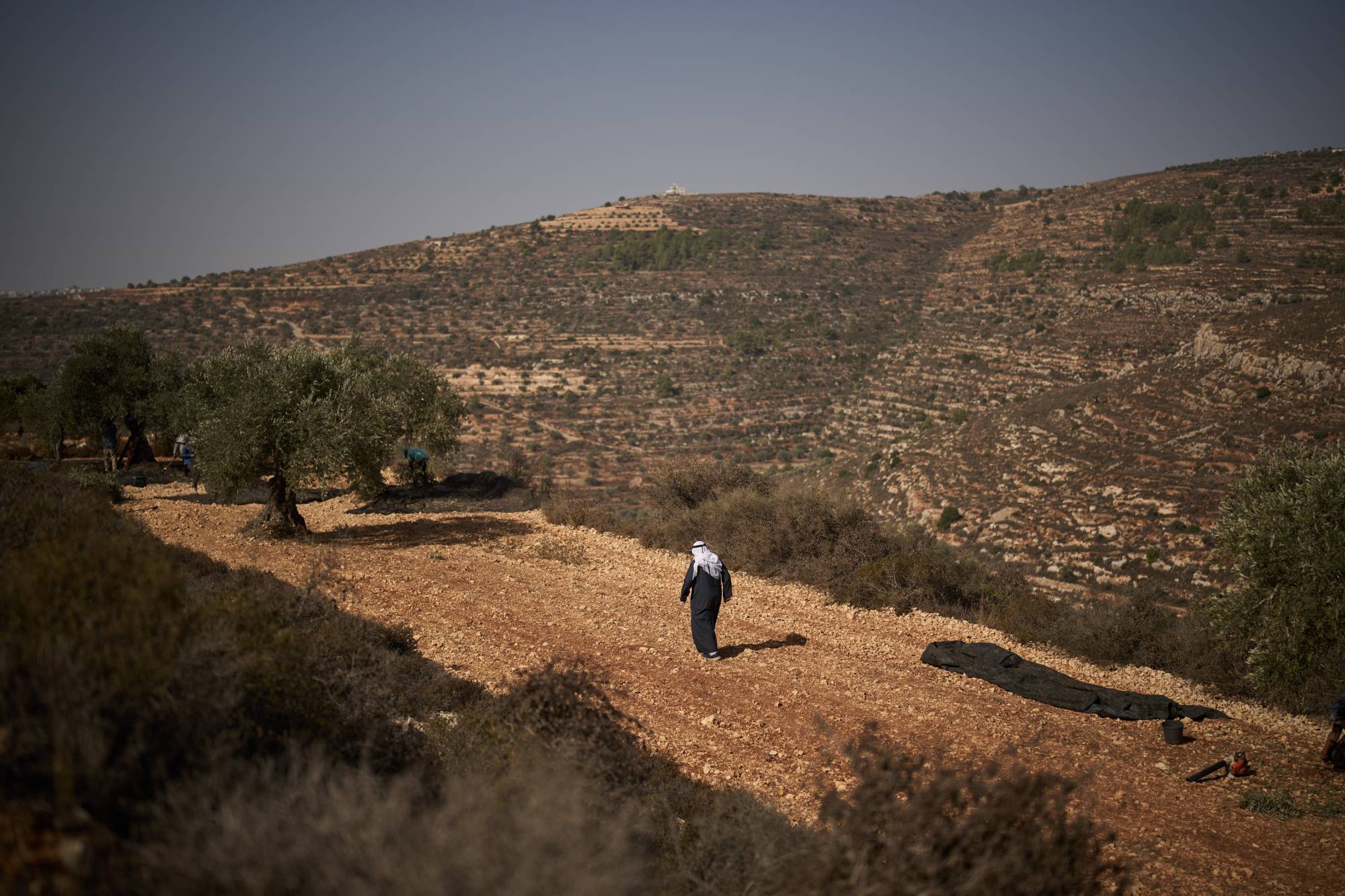
Palestinian Kamal Haloum walks in an olive grove during the olive harvest in the West Bank village of Al-Mazraa al-Sharqiya, Friday, Oct. 23, 2026. (AP)
Palestinians’ ties to the land are challenged
Olive groves across the West Bank represent both heritage and needed income. The harvest traditionally has been a joyous occasion for Palestinians to gather and be thankful for another year.
“In the past, harvesters would enjoy a month of singing and fixing tea and coffee in their groves. Now the journey is full of pain and risk,” said Abbas Milhem of the Palestinian Farmers’ Union.
But the harvest has become a time of friction as Palestinians spread out and, simply by picking olives, assert their ties to the land that many Israeli settlers say should belong to Israel instead.
Olive trees have been destroyed and olives stolen in over 325 incidents of settler violence this harvest season, which began in late September, Israeli rights group Yesh Din says. Over 130 of those incidents involved physical assaults on harvesters.
Yesh Din and the farmers’ union call this harvest the most violent in recent history.
One Palestinian, Abel Atif Bazaari, said last week outside the village of Burqa near Nablus that olives are more than just a crop. He ran his fingers along a branch. “Protected, respected. I think in all religions, olives are respected,” he said. “This is the identity of the Palestinians.”
His cousin, a security guard, was killed when responding to an attack on the family's land this season. Bazaari was hurt. A bandage covered his temple near his blackened left eye. They have paused the harvest, he said. The land has been in the family for over a century.
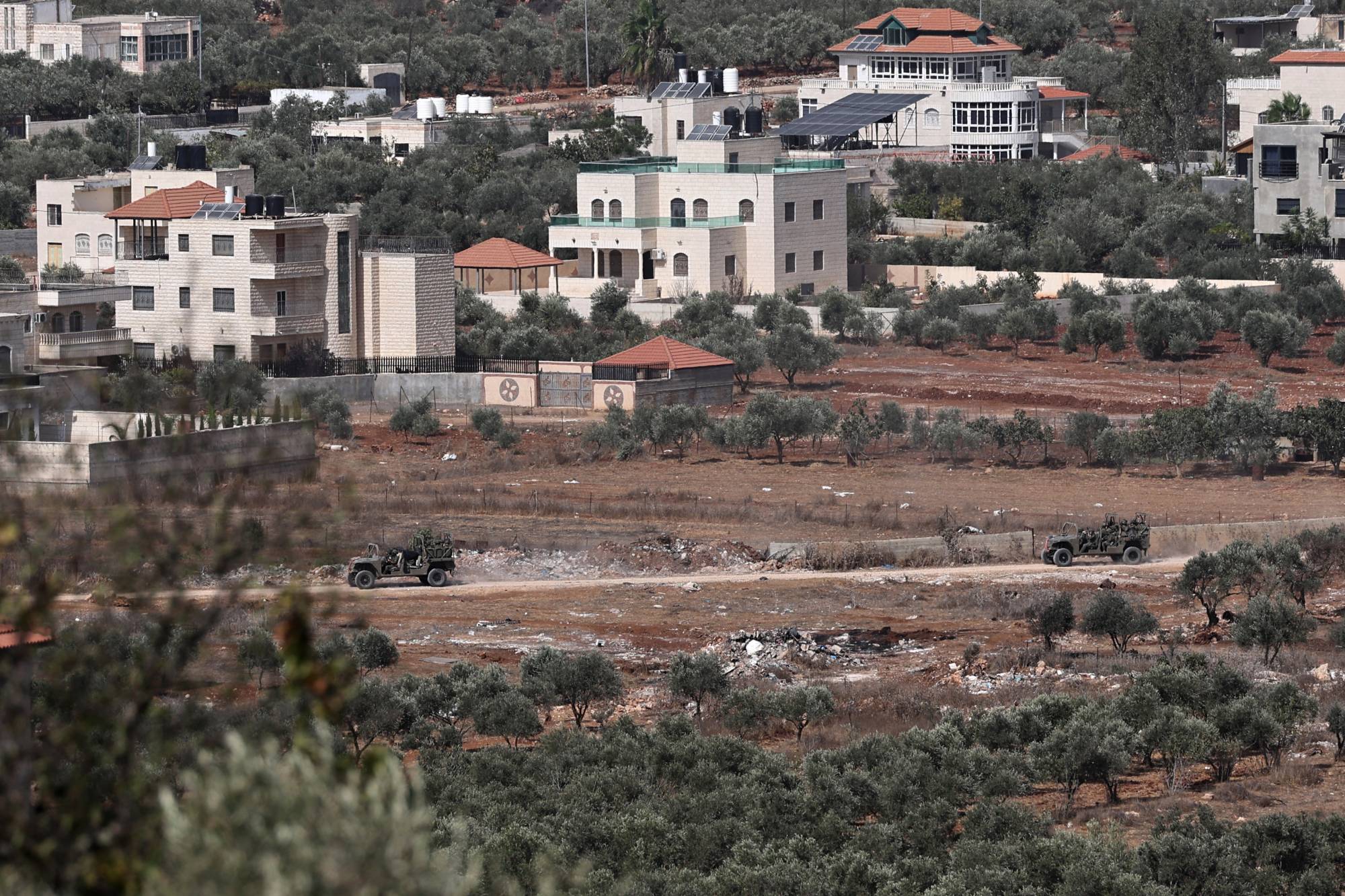
Israeli military vehicles patrol an area during the olive harvest in the town of Turmus Ayya, in the West Bank, 23 October 2026. (EPA)
West Bank outposts have surged under Netanyahu
Since 2023, Israeli settlers have erected more than 180 new outposts in the West Bank, most of them close to Palestinian communities and often on their farmland, according to Peace Now, a watchdog group. Settlers from those outposts have largely been behind intensifying attacks on Palestinians since the war in Gaza began with the Hamas-led assault on Israel on Oct. 7, 2023.
On Wednesday, a joint statement by activists and rabbis from the United States, Israel and the West Bank called the attacks on the harvest and Palestinian farmers part of “ethnic cleansing” in the territory. Israel has denied allegations, previously made by Britain as well, of ethnic cleansing.
The outposts — often made up of a few mobile homes — are not authorized, but the military rarely takes action against them. Palestinians trying to fend off the settlers have been accused of throwing rocks or chunks of concrete.
Netanyahu’s government relies on the support of far-right parties and has dramatically expanded settlements as a way to strengthen Israel’s grip on the West Bank and prevent any potential Palestinian state. Far-right Finance Minister Bezalel Smotrich, a settler leader who is in charge of settlement policy, has sought to steer funding to unauthorized outposts.
Most of the international community views all settlements as illegal and an obstacle to peace. “The clear goal is to drive communities off their land,” UN Secretary-General Antonio Guterres said Thursday of settler attacks.
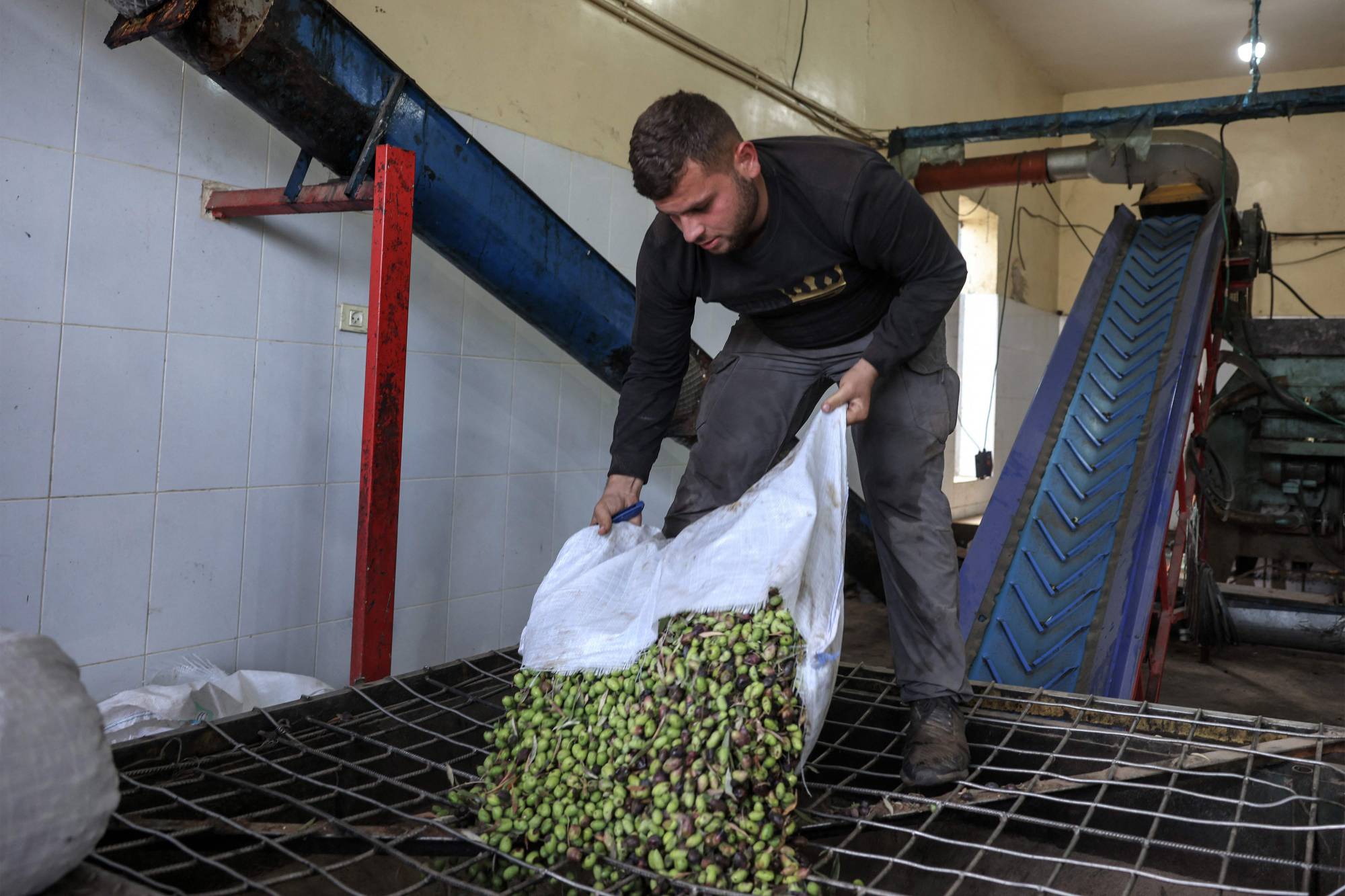
A Palestinian worker unloads freshly harvested olives for processing at an olive press in Turmus Ayya, northeast of Ramallah in the Israeli-occupied West Bank, on October 20, 2026. (AFP)
Outsiders visit in solidarity and are attacked
The olive harvest draws activists, diplomats, rabbis, journalists and others who seek to show solidarity with Palestinians and document attacks and intimidation.
Sometimes they are attacked, too.
A photographer for The Washington Post, Heidi Levine, is recovering after settlers last Friday beat her so badly that several vertebrae were broken and a finger was nearly detached. The following day, masked settlers wielding metal bars attacked a French mayor among a group of diplomats from France, Belgium and Poland at another harvest.
On Wednesday, a US congressional candidate from New York, Brad Lander, was among a group of American rabbis and others detained by Israeli troops at a harvest before being released hours later.
Rights groups say settlers are rarely punished, though several were arrested after last week’s high-profile attacks. Police said most were later released as investigations continue.
It’s becoming harder for Palestinians to reach their land. Peace Now says they have been required to coordinate with Israel’s military to access more of their privately owned farmland than previously. The West Bank is a patchwork of areas under varying levels of Palestinian civil and Israeli military control.
Some of those who coordinate with the military are still attacked, Milhem with the farmers’ union said. He estimated that roughly 110,000 Palestinian families depend on privately owned groves for income that reaches into the millions of dollars in all.
“Palestinian farmers do not — and should not — need permits to harvest their own olive fields,” Lander said Thursday on X, adding that Wednesday’s visit was meant to “call attention to the horrors of the occupation.”
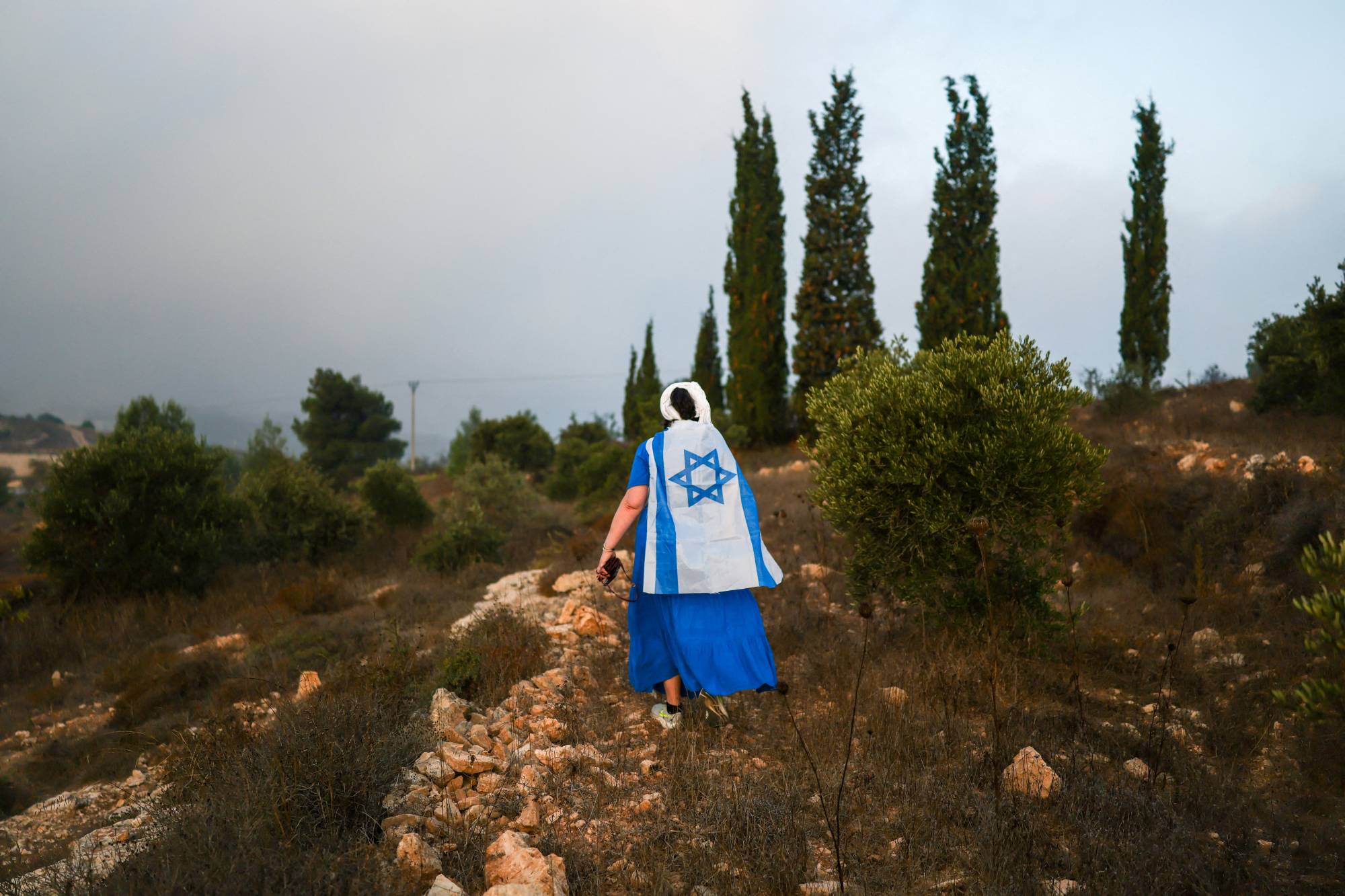
A Jewish settler walks towards olive trees owned by Palestinians due to be harvested, near the Israeli settlement Neve Daniel, in the Israeli-occupied West Bank, October 12, 2026. (Reuters)
‘Handful of criminals’
Settler attacks on Palestinians rarely bring an outcry in Israel, but some Israeli senior politicians and officials have spoken out after Levine was beaten.
Netanyahu’s main rival in the elections, Gadi Eisenkot, said on X that “a handful of criminals is burning up the last shreds of legitimacy left to the state of Israel.” Eisenkot has backed settlement building in the West Bank but says he would shut down the unauthorized outposts.
Levine told the AP that Israeli President Isaac Herzog told her “he’s ashamed for what happened: ‘These people are a stain on Israeli society.’” Herzog has denounced settler attacks against Palestinians in the past.
Netanyahu, meanwhile, has questioned the circumstances around some attacks on the olive harvest and alleged a “coordinated campaign to smear Israel” following the weekend attack on diplomats.
He has blamed overall attacks in the West Bank on a small number of troublemakers.
Italy Calls for Release of Five Activists Held by Israel in West Bankhttps://english.aawsat.com/arab-world/5332821-italy-calls-release-five-activists-held-israel-west-bank
Italy's Foreign Minister Antonio Tajani (R) speaks to media after the meeting of the top diplomats of the R4 mechanism and the European E3 mechanism, in Istanbul on October 23, 2026. (AFP)
TT
TT
Italy Calls for Release of Five Activists Held by Israel in West Bank
Italy's Foreign Minister Antonio Tajani (R) speaks to media after the meeting of the top diplomats of the R4 mechanism and the European E3 mechanism, in Istanbul on October 23, 2026. (AFP)
Italy has called for the immediate release of five Italian activists, all women, held by Israeli forces in the West Bank, Foreign Minister Antonio Tajani said on Friday.
Italian foreign ministry sources said the women were detained on Thursday by Israeli police in Kiryat Arba along with other international activists, while seeking to protect Palestinian farmers during the olive harvest.
"What happened is unacceptable, they were not committing any crime," Tajani told reporters on the sidelines of an international summit in Istanbul, adding he hoped they would be released in a matter of hours.
The women were expected to be transferred to Israel's immigration authority on Friday pending expulsion and repatriation procedures, Israeli authorities told Italian diplomats earlier in the day, according to the sources.
لم تشترك بعد
انشئ حساباً خاصاً بك لتحصل على أخبار مخصصة لك ولتتمتع بخاصية حفظ المقالات وتتلقى نشراتنا البريدية المتنوعة