


Families of Lebanese Blast Victims Plead for Outside Inquiry

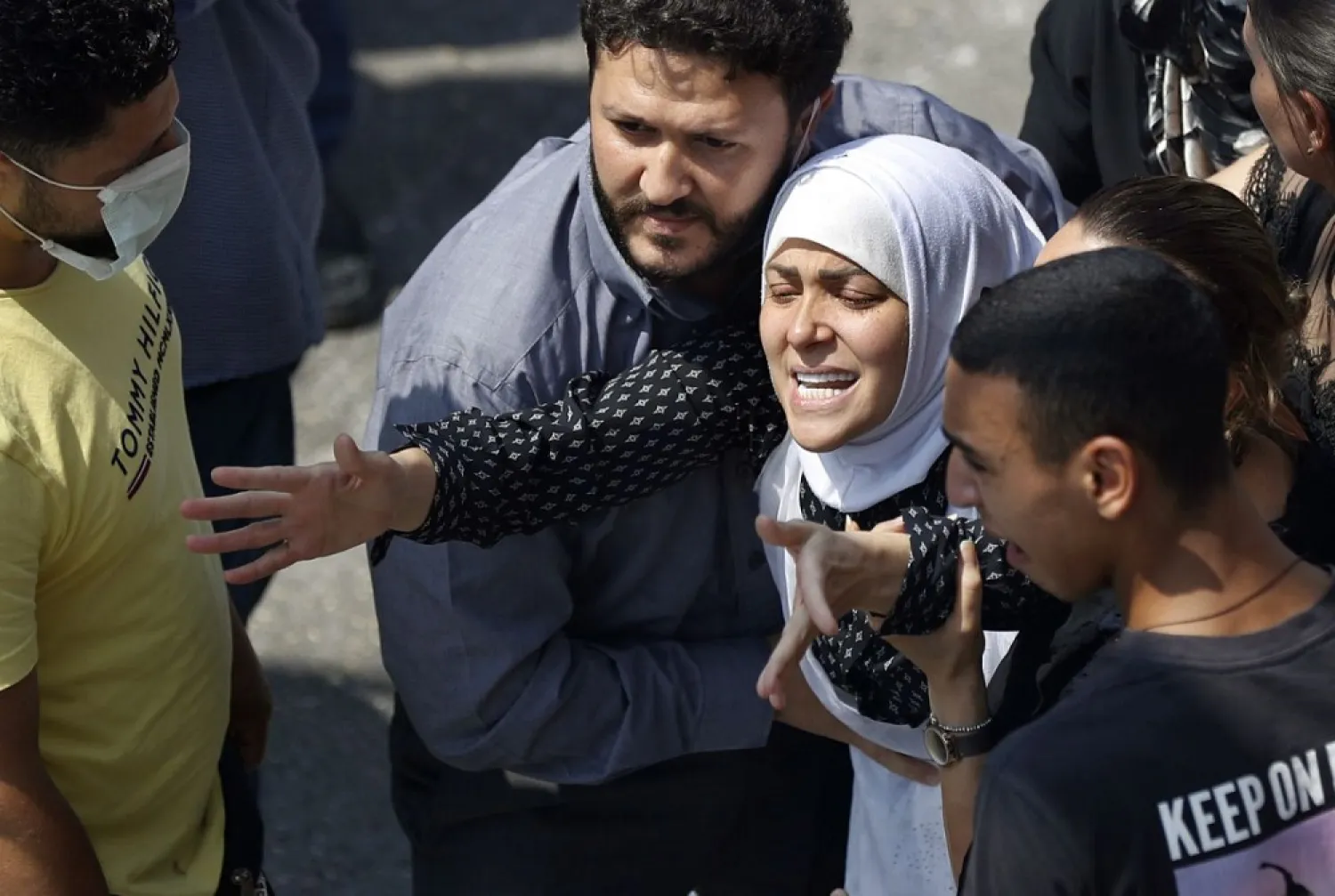
The wife of Rami Kaaki, one of ten firefighters who were killed in the blast, tries to reach her husband's coffin during his funeral, at the firefighter headquarters in Beirut, Lebanon, Aug. 11, 2020. (AP)
TT

Families of Lebanese Blast Victims Plead for Outside Inquiry

The wife of Rami Kaaki, one of ten firefighters who were killed in the blast, tries to reach her husband's coffin during his funeral, at the firefighter headquarters in Beirut, Lebanon, Aug. 11, 2020. (AP)

Lebanon’s judicial investigation of the Beirut port explosion started with political wrangling over the naming of a lead investigator, military threats to jail leakers and doubts over whether a panel appointed along sectarian lines could be fully impartial.

So for many Lebanese, their greatest hope for credible answers about the blast that wrecked much of their capital may lie with outsiders. Families of the dead and survivors on Friday asked the UN Security Council for an international investigation. Others pin their hopes on the French forensic police who have joined the probe and FBI investigators are expected to take part.

“We are not lawyers or politicians, we are families and people, our appeal today is to the people of the international community," said Paul Najjar, a survivor of the explosion. “Is it acceptable today that people would find their homes shattered, their families killed, their hopes and their dreams killed as well, with no justice, in all impunity?”

French teams have pressed ahead at their work, sending divers into the underwater crater, taking explosives samples and preparing recommendations for both French and Lebanese magistrates. Among the French judicial police on the case are men and women who responded after the 2004 tsunami in Japan, the 2010 earthquake in Haiti, and the November 2015 and Bastille Day 2016 terror attacks in France.

The Beirut explosion lies at the crossroads of a disastrous accident and a crime scene. It still was not known what sparked the fire that ignited nearly 3,000 tons of ammonium nitrate that were stored for years in Beirut’s port next to densely populated residential areas. Documents have emerged that show the country’s top leadership and security officials were aware of the stockpile.

Search and rescue crews flew in from around the world in the immediate aftermath and found themselves looking at a scene that was both familiar and yet strangely alien.

“In an earthquake, it’s easier because we can understand ... how it moves. But in this case, we didn’t have enough elements to understand what happened,” said Alberto Boanini, a member of the Italian rescue team. The team has seen its share of quakes and forest fires, but nothing quite like the port in Beirut, where he said it was hard to fathom what could level it so completely.

Many Lebanese want the probe taken out of the hands of their own government, having learned from past experience that the long-entrenched political factions, notorious for corruption, won’t allow any results damaging to their leadership to come to light. The explosion killed more than 175 people, injured at least 6,000 and left tens of thousands homeless.

Paris sent judicial police because a French architect was among the dead, and French law gives jurisdiction for an investigation if a citizen dies abroad under questionable circumstances.

But the French investigators work only at the invitation of the Lebanese, and their orders are confidential.

French officials say they have the access they need but will not say whether their inquiry extends to questioning witnesses or requesting documents. They hand over their findings to the Lebanese, but keep a mirror copy for a French inquiry. The FBI is also joining at Lebanese authorities’ invitation.

Top Lebanese officials, including President Michel Aoun, have rejected calls for an independent probe, describing it as “a waste of time” and suggesting it would be politicized. Nonetheless, Nada Abdelsater-Abusamra, a lawyer representing victims, said a letter was submitted to the UN Security Council asking for an international investigation.

In its last decision before resigning under pressure, six days after the explosion, Prime Minister Hassan Diab’s government referred the port explosion case to the Higher Judicial Council, Lebanon’s highest justice authority, to carry out the investigation.

An argument then ensued with the outgoing justice minister over the investigation’s lead judge. After public wrangling, they compromised on Judge Fadi Sawwan, a former military investigating judge.

The Council itself is made up of 10 people, eight of whom are appointed according to the interests of the various political factions and religious sects in line with Lebanon’s sectarian power-sharing system.

The authorities have so far arrested at least 19 people, including the head of the Customs Department and his predecessor, as well as the head of the port.

Lebanese say they want to see investigations into top officials who knew about the ammonium nitrate.

“They will blame the small guys while the ones who are really responsible will get away with their crime, that’s what will happen,” said Jad, a 38-year-old computer engineer who declined to give his full name in line with his company’s regulations not to discuss politics.

“If this time there is no credible, serious investigation that will lead to the punishment of everyone responsible for this disaster, it is goodbye Lebanon. No one will ever want to live in this country again,” he said, standing on a bridge overlooking the decimated port.

Lebanese forensics expert Omar Nachabe said the public infighting about the name of the lead investigator is a bad sign that casts doubt on the credibility of any local investigation.

“If I am a Lebanese citizen, my capital (city) has been destroyed. I want a quick and serious investigation, yet the government has not shown until now that it is up to the task,” he told the local channel LBCI.

Explosions have marked a grim timeline in Lebanon’s modern history and have killed presidents, prime ministers and countless journalists and activists during the country’s 1975-90 civil war and beyond.

Almost none of the perpetrators were ever arrested or tried, and the truth was invariably buried. Lebanese had high hopes that the UN-backed tribunal investigating the 2005 killing of Prime Minister Rafik Hariri would be a chance to end impunity in Lebanon. But it took 15 years and was marred by doubts, politics and more deaths. The tribunal is to issue verdicts Tuesday.

International involvement in the investigation might bring some truth, but bringing justice is more complicated. Dov Jacobs, an international legal scholar based in the Netherlands, said the shooting down of Malaysia Airlines Flight 17 over eastern Ukraine six years ago might be the closest analogy.

In that case, international experts had full access to the site, and international prosecutors charged three Russians and a Ukrainian with involvement in bringing down the plane and the murder of all on board. The men are on trial in a Dutch court in absentia, since none have been extradited.

But in Lebanon, Jacobs said, “the investigation itself is a tool of political influence. It’s one of those frustrating moments where immediate calls for justice are faced with a wall which is the political reality on the ground.”



UN: At Least 15 Children Killed in Sudan Drone Strike

The war in Sudan, ongoing since mid-April 2023, has caused extensive destruction across the country (AFP)
TT

UN: At Least 15 Children Killed in Sudan Drone Strike

The war in Sudan, ongoing since mid-April 2023, has caused extensive destruction across the country (AFP)

A drone strike on a displacement camp in Sudan killed at least 15 children earlier this week, the United Nations reported late on Wednesday.

"On Monday 16 February, at least 15 children were reportedly killed and 10 wounded after a drone strike on a displacement camp in Al Sunut, West Kordofan," the UN children's agency said in a statement.

Across the Kordofan region, currently the Sudan war's fiercest battlefield, "we are seeing the same disturbing patterns from Darfur -- children killed, injured, displaced and cut off from the services they need to survive," UNICEF's Executive Director Catherine Russell said.


MSF Will Keep Operating in Gaza 'as Long as We Can'

(FILES) A Palestinian man walks on his crutches to the Doctors Without Borders or Medecins Sans Frontieres (MSF) clinic, in the al-Rimal neighborhood of Gaza City on new year's Eve, December 31, 2025. (Photo by Omar AL-QATTAA / AFP)
TT

MSF Will Keep Operating in Gaza 'as Long as We Can'

(FILES) A Palestinian man walks on his crutches to the Doctors Without Borders or Medecins Sans Frontieres (MSF) clinic, in the al-Rimal neighborhood of Gaza City on new year's Eve, December 31, 2025. (Photo by Omar AL-QATTAA / AFP)

The head of Doctors Without Borders in the Palestinian territories told AFP the charity would continue working in Gaza for as long as possible, following an Israeli decision to end its activities there.

In early February, Israel announced it was terminating all the activities in Gaza by the medical charity, known by its French acronym MSF, after it failed to provide a list of its Palestinian staff.

MSF has slammed the move, which takes effect on March 1, as a "pretext" to obstruct aid.

"For the time being, we are still working in Gaza, and we plan to keep running our operations as long as we can," Filipe Ribeiro told AFP in Amman, but said operations were already facing challenges.

"Since the beginning of January, we are not anymore in the capacity to get international staff inside Gaza. The Israeli authorities actually denied any entry to Gaza, but also to the West Bank," he said.

Ribeiro added that MSF's ability to bring medical supplies into Gaza had also been impacted.

"They're not allowed for now, but we have some stocks in our pharmacies that will allow us to keep running operations for the time being," he said.

"We do have teams in Gaza that are still working, both national and international, and we have stocks."

In December, Israel announced it would prevent 37 aid organizations, including MSF, from working in Gaza from March 1 for failing to submit detailed information about their Palestinian employees, drawing widespread condemnation from NGOs and the United Nations.

It had alleged that two MSF employees had links with Palestinian militant groups Hamas and Islamic Jihad, which the medical charity has repeatedly and vehemently denied.

MSF says it did not provide the names of its Palestinian staff because Israeli authorities offered no assurances regarding their safety.

Ribeiro warned of the massive impact the termination of MSF's operations would have for healthcare in war-shattered Gaza.

"MSF is one of the biggest actors when it comes to the health provision in Gaza and the West Bank, and if we are obliged to leave, then we will create a huge void in Gaza," he said.

The charity says it currently provides at least 20 percent of hospital beds in the territory and operates around 20 health centers.

In 2025 alone, it carried out more than 800,000 medical consultations, treated more than 100,000 trauma cases and assisted more than 10,000 infant deliveries.


Egyptian-Turkish Military Talks Focus on Strengthening Partnership

The Commander of the Egyptian Air Force during his meeting with the Turkish Air Force chief in Cairo on Wednesday (Egyptian military spokesperson)
TT

Egyptian-Turkish Military Talks Focus on Strengthening Partnership

The Commander of the Egyptian Air Force during his meeting with the Turkish Air Force chief in Cairo on Wednesday (Egyptian military spokesperson)

Senior Egyptian and Turkish air force commanders met in Cairo on Wednesday for talks focused on strengthening military partnership and expanding bilateral cooperation, in the latest sign of warming defense ties between the two countries.

The meeting brought together the Commander of the Egyptian Air Force, Lt. Gen. Amr Saqr, and his Turkish counterpart, Gen. Ziya Cemal Kadioglu, to review a range of issues of mutual interest amid growing cooperation between the two air forces.

Egypt’s military spokesperson said the talks reflect the Armed Forces’ commitment to deepening military collaboration with friendly and partner nations.

Earlier this month, Egypt and Türkiye signed a military cooperation agreement during talks in Cairo between Egyptian President Abdel Fattah el-Sisi and his Turkish counterpart, President Recep Tayyip Erdogan.

Sisi highlighted similar viewpoints on regional and international issues, while Erdogan noted that enhanced cooperation and forthcoming joint steps would help support regional peace.

Cairo and Ankara also signed an agreement last August on the joint production of vertical take-off and landing (VTOL) drones. Production of unmanned ground vehicles has also begun under a partnership between the Turkish firm HAVELSAN and Egypt’s Kader Factory.

During the talks, Saqr underscored the importance of coordinating efforts to advance shared interests and expressed hope for closer ties that would benefit both air forces.

Kadioglu, for his part, stressed the depth of bilateral partnership and the strong foundations of cooperation between the two countries’ air forces.

According to the military spokesperson, Kadioglu also toured several Egyptian Air Force units to review the latest training and armament systems introduced in recent years.

Military cooperation between Egypt and Türkiye has gained momentum since 2023, following the restoration of full diplomatic relations and reciprocal presidential visits that reflected positively on the defense sector.

In September last year, the joint naval exercise “Sea of Friendship 2025” was held in Turkish territorial waters, aimed at enhancing joint capabilities and exchanging expertise against a range of threats.