Picture of Young Lebanese Girl Yara Goes Viral on Social Media

In a three-dimensional scene, Jad Gharib captured a touching photo of Yara, a Lebanese child - Yara's scars were shaped into a map of wounded Lebanon.
TT

Picture of Young Lebanese Girl Yara Goes Viral on Social Media

In a three-dimensional scene, Jad Gharib captured a touching photo of Yara, a Lebanese child - Yara's scars were shaped into a map of wounded Lebanon.

The photo of the young Lebanese girl, Yara, turned her into an icon overnight after the Beirut explosion. The 4-year-old girl was struck in the face during the explosion while she was at her family’s home in the Karantina neighborhood. With a stitched face and scars reflecting the traces of the crime, she stood before Jad Gharib’s lens, showing her pain and agony while smiling.

“Everything happened so quickly that I did not look back, nor did I look into at what happened in my house in Mar Mikhael,” said Gharib in an interview with Asharq Al-Awsat. I just remember taking my camera and running to examine the roads and alleys of the stricken area, after I was shocked by the terrifying consequences of the explosion.

As a photographic engineer of heritage buildings and installations, Gharib, who used to highlight the importance of Beirut’s architecture, added: “When one of my friends called to ask me to take a look at the face of the child Yara, I hesitated. However, my friend insisted, explaining to me that he had spoken to them and asked for permission. When I saw her at first glance, I was heartbroken. Yara’s face was like a map of wounds and scars.”

Yara, who was wounded in her face, had been playing and dancing when Gharib arrived at her residence in the Karantina neighborhood, which had been badly damaged by the explosion. He asked her to allow him to photograph her and she greeted, smiling.

“She was a living example of an innocent childhood, unaware of the severity of her injury in reality. And based on her childish thinking, she considered her wounds very similar to those that she usually inflicts on her foot or hand while playing outside her house,” explains Gharib.

As soon as Jad posted Yara’s picture on his two accounts (Facebook and Instagram), activists shared it on social media.

“Artists and media professionals from Lebanon, Arab countries and other foreign countries have shared Yara’s image, which was a big surprise to me. I simply wanted to shine a ray of light on the children of Beirut in the aftermath of the explosion, and the woes that struck them because of it, hoping to help in alleviating their pain,” he noted.

The Lebanese photographer, who was also injured in the blast, received about 40 calls from plastic sergeants asking him to contact the girl to have her face operated.

“An Australian charity first took it upon themselves to treat Yara’s wounds. However, another association (INARA) took charge of this case from A to Z, willing to adopt Yara and her family’s case and help them in all aspects.

Gharib goes on to say: “My message reached humanity as a whole, and I was able to draw the world’s attention to a wounded childhood in Beirut. And I am happy that I have contributed to opening the door for several injured children to get help in treating their wounds and doing cosmetic and other surgeries free of charge through generous donations.”

Maya Diab was among the many artists who engaged with the image of Yara. After seeing her, she launched a humanitarian initiative in which she announced her intention to restore the faces of children deformed by the Beirut explosion.

The image of Yara inspired many. Photographer Evan Debs modified the photo taken by Jad Ghorayeb to transform her scars and wounds into a map of Lebanon to indicate the wound of an entire nation. While one of them gave Yara the title “Miss Lebanon.”

Spy Scandal and Midterm Defeat Heat Up Trump’s Asia Visit

US President Donald Trump waves as he attends a midterm campaign rally at Salina Regional Airport in Salina, Kansas, US, November 1, 2026. (Reuters)
TT

Spy Scandal and Midterm Defeat Heat Up Trump’s Asia Visit

US President Donald Trump waves as he attends a midterm campaign rally at Salina Regional Airport in Salina, Kansas, US, November 1, 2026. (Reuters)

US President Donald Trump heads to Asia this week, reeling from a midterm election drubbing and Chinese spy allegations that have raised the stakes for his latest face-to-face with Beijing's powerful leader, Xi Jinping.

Trump will first visit Manila for meetings with Southeast Asian and other regional leaders on Tuesday before jetting to Shenzhen for the Asia-Pacific Economic Cooperation (APEC) forum, where he will meet the Chinese president and hold three-way discussions with Xi and Russia's Vladimir Putin.

With a fragile trade-war truce between the US and China extended to early next year, and more Trump-Xi talks due in December at the G20 in Miami, some analysts had initially billed the Shenzhen meeting as a low-stakes summit.

But a backlash against Trump's Republican Party in this month's midterms and criticism that his administration failed to act on intelligence that Nvidia CEO Jensen Huang, who has close ties to Trump, had an affair with a suspected Chinese spy, have muddied those expectations.

"With less reason to worry about market reactions or electoral fallout, (Trump) may be more willing to consider disruptive measures," said Ruby Osman, a senior policy adviser on China at the Tony Blair Institute, a London-based think tank.

Washington has already signaled such willingness ahead of the meeting, urging China to live up to its commitments ‌made under the truce ‌agreed between Trump and Xi a year ago.

Chinese analysts say they are particularly concerned that the Nvidia saga, including ‌allegations that ⁠restricted semiconductors were ⁠diverted to Chinese customers, will now harden US attitudes towards China.

US House Speaker Mike Johnson said last week there was growing consensus in Congress on further limiting Chinese access to advanced chips after the scandal, and Democrats are expected to press hard on the issue when they take over the House and Senate majorities in January.

China has said the United States has fabricated the spy narrative to justify a technological blockade.

Zhu Feng, director of the Institute of International Studies at Nanjing University, said the spat could also speed up "the decoupling of AI" between the world's two superpowers even as they try to cooperate on mitigating the technology's risks.

Trump is not expected to directly raise the spy allegations with Xi, one senior US administration said on condition of anonymity, adding that the Nvidia situation "should not really have any bearing on the trip".

TRUMP'S LEGACY

Rather than picking fresh fights with China, Trump may want to ⁠focus on legacy-building endeavors such as denuclearization agreements with Beijing and Moscow, or securing another meeting with North Korea's secretive ‌leader, Kim Jong Un.

Trump sees the unprecedented summit with Xi and Putin as possibly providing movement towards ‌an agreement on nuclear arms control. But that is a non-starter for China, which has far fewer warheads than the others, Chinese analysts said.

Trump may also seek to enlist Putin ‌and Xi's support in setting up a future meeting with Kim, who has close ties to the Chinese and Russian leaders.

The president will be focused on "building his ‌legacy," said Victor Cha at the Center for Strategic and International Studies, a US think tank. A big part of that is his North Korea diplomacy, which he has devoted a lot of time to over his two terms, Cha added.

The proposed three-way meeting has drawn comparisons, particularly in Russia, with the 1945 Yalta Conference between the US, Britain and the Soviet Union that formalized spheres of influence, set the stage for the post-World War Two order and became shorthand for great-power deals imposed on smaller countries.

Such a framing is particularly worrisome for Ukraine, engaged in a ‌four-year war with Russia. Trump is not expected to raise Ukraine at the meeting, the senior US official said.

'A LOT TO LOSE'

Xi could also seek to take advantage of Trump's political weakness after his election humbling, analysts ⁠say.

Top of Beijing's wish list is ensuring ⁠that the US president doesn't approve a $14 billion arms package to Taiwan, which China claims as its own. Trump has said he is holding the arms back as a "negotiating chip" with China.

But with China's export engine humming, simply buying time may be enough for Beijing, said Jonathan Czin, a foreign policy analyst at the Brookings Institution, a US-based think tank.

"Xi just needs Trump to remain reluctant to revert toward a more competitive posture toward China for as long as possible. China will take whatever time it can get to fortify itself for the next round in the contest," said Czin, who formerly worked at the Central Intelligence Agency and as director for China at the US National Security Council.

Beijing will be acutely aware that whoever succeeds Trump when his term ends in two years time, may be less accommodating, said Czin and Osman.

Trump's Democratic predecessor, Joe Biden, repeatedly angered China with comments over human rights issues and a pledge that the US would defend Taiwan if Beijing attacked. Many of Trump's potential Republican successors, such as Secretary of State Marco Rubio, are also seen as more hawkish on China.

Both leaders will also be wary of reigniting a trade row that threatened to tank the global economy and financial markets last year, said Kurt Tong, a former senior State Department official now with the Asia Group think tank.

Despite the frustration the US has voiced on Chinese implementation of the terms of the truce, Tong expects it will be further extended beyond its January 10 expiration.

"The two sides are quite incentivized to maintain this fragile stability ... despite also having some disagreements," added senior China analyst Chim Lee at the Economist Intelligence Unit.

"They both have quite a lot to lose."


‘A Moral Red Line’? World on Cusp of Autonomous Weapons Revolution

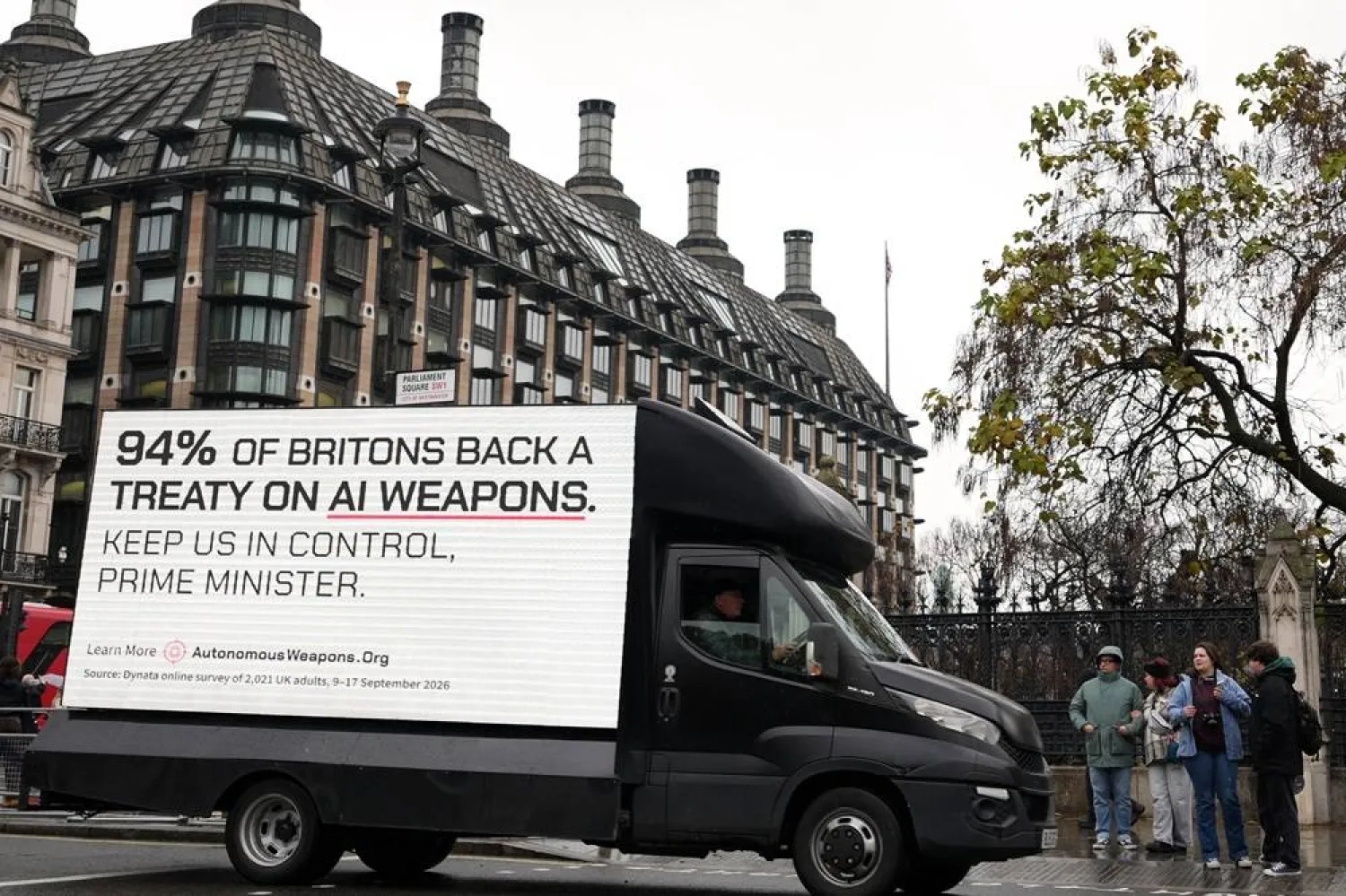
Pedestrians look on as a van, displaying a screen asking for a Treaty on AI Weapons, drives through Westminster in London, Wednesday, Nov. 11, 2026. (AP)
TT

‘A Moral Red Line’? World on Cusp of Autonomous Weapons Revolution

Pedestrians look on as a van, displaying a screen asking for a Treaty on AI Weapons, drives through Westminster in London, Wednesday, Nov. 11, 2026. (AP)

Lethal autonomous weapons powered by artificial intelligence are set to revolutionize warfare but there is no proper regulatory or legal framework governing the new technology.

A conference starting Monday at the United Nations in Geneva will discuss how to establish curbs and prohibitions on such weapons, called killer robots by some.

But some analysts doubt the discussions at the Convention on Certain Conventional Weapons (CCW) will keep pace with the fast-changing weapons.

AFP looks at three key questions ahead of the conference.

- What are LAWS? -

Lethal Autonomous Weapons Systems (LAWS) "can identify, select, and engage a target without the intervention of a human operator in the execution of these tasks," said Jean-Marc Rickli, head of global and emerging risks at the Geneva Centre for Security Policy.

Autonomous weapons have long existed. An anti-personnel mine "is an autonomous weapon in the sense that it explodes when someone steps on it," said Laure de Roucy-Rochegonde of the Centre for Geopolitics of Technology at the French Institute of International Relations (IFRI).

But with the proliferation of AI-enhanced drones, such weapons are now "capable of selecting and engaging a target that was not predetermined, adapting to their environment without human intervention," said Rickli.

So the critical issue for potential regulators lies in determining the level of human control over the decision to employ such a weapon.

The United States refers to an "appropriate levels of human judgement" in the use of autonomous weapons.

France maintains that a human must remain in the decision-making loop and bans "lethal autonomous weapons systems" (LAWS) but permits "partially autonomous" systems known as PLAWS.

"The human role is always ensured through what is termed 'appropriate control' by a military commander -- a concept that varies in scope depending on the system's criticality and the operational context," said Rear Admiral Vincent Sebastien, deputy director of the French defense ministry's Agency for Defense Artificial Intelligence (AMIAD).

- The ethical issues?

"We are now dangerously close to crossing a moral red line: the autonomous targeting of humans by machines," UN Secretary General Antonio Guterres, and International Committee of the Red Cross president Mirjana Spoljaric warned in a joint statement in August.

But analysts said the Geneva discussions, while important, will touch only part of the issue.

Today, the diminishing role of humans is being driven by the growing use of AI in analysis and targeting.

Rickli said the scope of the agenda in Geneva is "very narrow".

"It fails to encompass the full range of issues surrounding AI on the battlefield" -- an area where its use is expanding, particularly in target generation.

He said this was seen in the US-Israeli war against Iran this year "where the Americans engaged as many as 1,000 targets per day" inside Iran.

"There are a host of problems and unacceptable risks associated with targeting and decision-support systems," added de Roucy-Rochegonde. "Part of this debate concerns systems that are already widely deployed on the battlefield."

"What kind of human supervision is required to ensure that the operator is genuinely exercising their own judgement rather than simply providing a rubber stamp for the machine's recommendations?" she asked.

- How quickly is the situation changing?

The autonomous weapons to be discussed in Geneva are not yet in widespread use, although analysts have noted that they have been deployed by Russia in its invasion of Ukraine, as well as US attacks in Iran.

But the spread is inevitable.

"Autonomy will very quickly become a reality on the battlefield," warned rear admiral Sebastien.

"Autonomous weapon systems are not part of a distant future -- a race towards greater autonomy in weapons systems is already well underway," Guterres and Spoljaric said in their statement.

Yet significant doubts and dangers remain, Dario Amodei, head of the AI giant Anthropic, warned this year: "Today, frontier AI systems are simply not reliable enough to power fully autonomous weapons."

But ultimately, the incentive for major powers is too strong.

Swarms of autonomous drones -- which "aim to neutralize an adversary through saturation" -- would be highly effective, and some states view them as a crucial strategic advantage, said Rickli.

In January, the Chinese defense ministry described swarms of autonomous drones as the "new face of warfare."

"In an era of sharp military competition, the first state to normalize fully autonomous lethal strikes will reset expectations for everyone else," said Gerald Mako, a research affiliate of Cambridge University in the Small Wars Journal.


In Taiwan, Jensen Huang’s ‘Flawless’ Image Damaged by Affairs

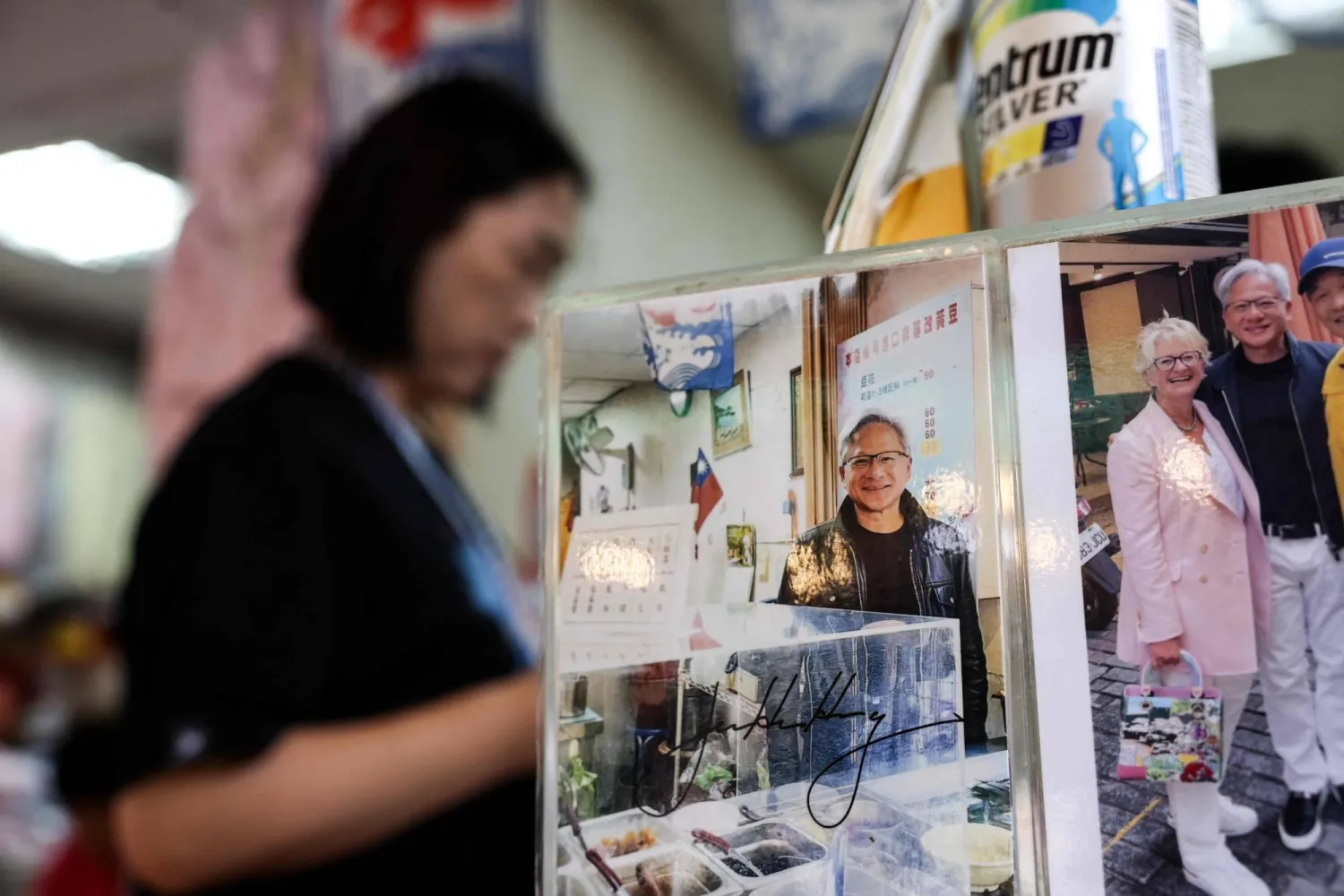
Photos of Nvidia CEO Jensen Huang during a previous visit are displayed at a local snack shop in Taipei on November 13, 2026. (AFP)
TT

In Taiwan, Jensen Huang’s ‘Flawless’ Image Damaged by Affairs

Photos of Nvidia CEO Jensen Huang during a previous visit are displayed at a local snack shop in Taipei on November 13, 2026. (AFP)

Taiwan-born Jensen Huang, the former boss of Nvidia, was feted like a rock star on visits to his birthplace, posing for selfies with fans and being mobbed by journalists.

His spectacular downfall might change that.

Huang's once "flawless" image in Taiwan has been shattered by revelations of two extramarital affairs -- including one with a woman accused of being a Chinese spy -- that forced him to resign from the company he founded.

"I thought he had the persona of a devoted husband, and it turns out he's kind of a scumbag," Ivan Liang, 28, told AFP during his lunch break on Friday.

Huang has been a source of pride and inspiration for many Taiwanese. While other tech titans kept a low profile, Huang was chatty and charming in public, readily signing autographs and posing for photos.

"I definitely think my perception of him has changed because, after all, he originally had that 'nation's dad' image," said Leo Fu, a 42-year-old import distributor.

"I feel like that image of him has probably taken a hit in the eyes of the general public in Taiwan."

Dessert shop owner Jane Hsieh, 70, still has fond memories of Huang visiting her store on multiple occasions for one of her traditional tofu puddings.

"Before this, he felt like such a flawless person," Hsieh told AFP in her shop where photos of her and her husband posing with the leather-jacketed Huang, his wife Lori, and son Spencer, are proudly displayed.

"It's just a shame because he gave everyone the impression that he was a really great guy, and he was always very polite when he came here," she said.

While her feelings about Huang have changed as a result of the affairs, Hsieh said she would not remove the photos from her shop.

"Why kick someone when they're down?" she said.

- 'Pretty outrageous' -

At the Chinese restaurant where one of Huang's lovers -- identified as suspected Chinese spy Alice Huang -- was filmed kissing him on the cheek in May 2025, a plate signed by Huang on the same night is still on display.

Staff were reluctant to talk about the infamous evening to AFP on Friday, only saying they were always focused on serving their customers.

"I think it's pretty outrageous," 38-year-old Chen Yu-ting, who works in finance, said of Huang's affair with someone believed to have spied for Beijing.

"If the other person really was trying to use him, it seems like he was just way too easily deceived," she said.

"Given his status, he really should be paying much closer attention to the people around him and who he associates with."

While Huang's affairs have tarnished his reputation, some Taiwanese are more concerned about the impact the scandal could have on Taiwan's economy and stock market.

Huang has generated huge amounts of wealth for the island at the centre of the global artificial intelligence (AI) technology boom.

Nvidia's advanced chips critical to the AI buildout are made by Taiwanese tech titan TSMC and have helped drive Taiwans' stocks to record highs and push its economy into double-digit growth.

Ivan Liang, who works in imports and exports, said he was "very worried".

"The market crashed... a few days ago, and then Nvidia's stock price just kept dropping and dropping and dropping," Liang said.

"I don't trade US stocks myself, but the US and Taiwan stock markets definitely move in tandem and affect each other," he said.

"Whatever he does is none of my business -- I only care about my money."