

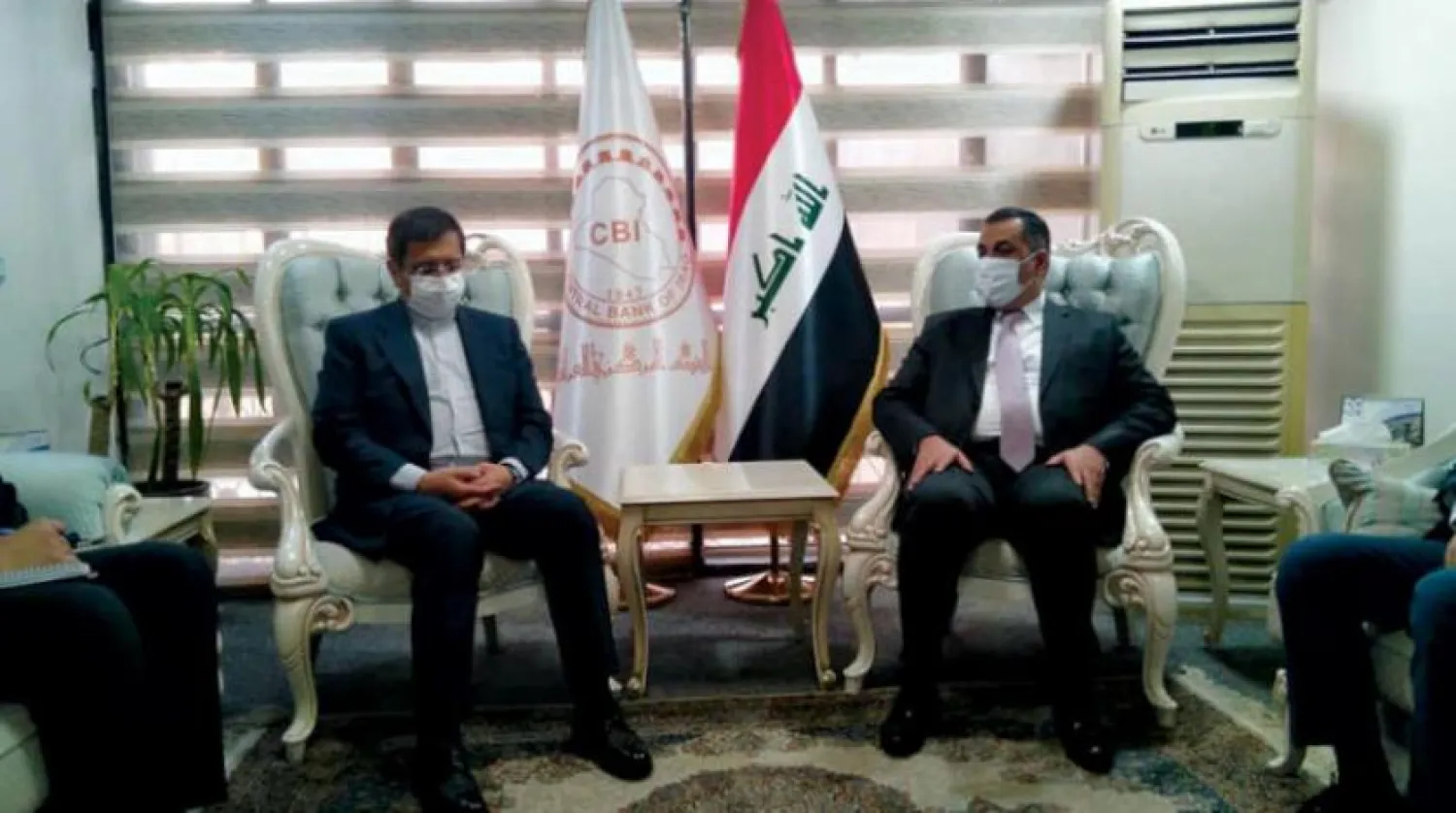

Iran Central Bank Announces Deal to Unlock Funds in Baghdad

Governor of Central Bank of Iran (CBI) Abdolnaser Hemmati holds talks with his Iraqi counterpart, Mustafa Ghalib Mukheef, in Baghdad on Monday, October 12, 2020 (IRNA)
TT

Iran Central Bank Announces Deal to Unlock Funds in Baghdad

Governor of Central Bank of Iran (CBI) Abdolnaser Hemmati holds talks with his Iraqi counterpart, Mustafa Ghalib Mukheef, in Baghdad on Monday, October 12, 2020 (IRNA)

Iran’s central bank chief said on Monday an agreement has been reached with Iraqi officials to unlock Iranian funds.

Governor of Central Bank of Iran (CBI) Abdolnaser Hemmati arrived in Baghdad on Monday for a one-day visit to develop banking and trade cooperation.

His remarks were made following talks with Governor of Iraq's Central Bank Mustafa Ghalib Mukheef and Chief of the Trade Bank of Iraq Salem Jawad Abdul Hadi al-Jalabi.

The official Iraqi and Iranian sides said the visit comes in line with bilateral banking cooperation. However, economists say the move aims to reduce the effects of the US sanctions against Tehran.

IRNA quoted Hemmati as saying that he had reached an agreement with officials of Iraq’s Central Bank and the Trade Bank of Iraq on the release of Iran’s financial assets to buy essential goods for the country.

He noted that his country has “significant” financial resources in Iraqi banks. The financial resources are Iran’s revenues derived from the export of electricity and gas to the neighboring country.

Hemmati also met with Iraqi Prime Minister Mustafa al-Kadhimi, who promised to follow up the implementation of the agreement during this week, IRNA reported.

Referring to its positive talks with Iraqi officials, the Governor expressed hope that the agreement would help both countries take positive steps toward developing economic and banking relations.

Fars News Agency of the Iranian Revolutionary Guard Corps said Mukheef proposed that both countries set up a joint committee to explore means to resolve financial issues.

Last week, the US Treasury Department’s Office of Foreign Assets Control (OFAC) sanctioned 18 major Iranian banks.

Secretary Steven T. Mnuchin said this action reflects the commitment to stop illicit access to US dollars.

“Our sanctions programs will continue until Iran stops its support of terrorist activities and ends its nuclear programs,” he stressed, adding that sanctions will continue to allow humanitarian transactions to support the Iranian people.

Commenting on the Iranian official’s visit, Economist and Professor at the Iraqi University Abdulrahman al-Mashhadani said it is very obvious that Iranians are looking for a way out of the crisis created by the US sanctions.

He told Asharq Al-Awsat that the new sanctions against Tehran have affected major Iranian banks that finance the country’s import and export processes.

Facing such a major issue forced Iran to seek, through the Iraqi banking sector, to circumvent these sanctions, especially that it is known to have many banks in Iraq that secretly operate to serve their interests, Mashhadani noted.

Monetary Policy Professor at Baghdad University Ihsan Jaber agreed with Mashhadani that the visit was aimed at facing US sanctions through Iraq.

Jaber told Asharq Al-Awsat that this visit is not beneficial to Iraq, and it may have dire consequences if the US discovers that Iraq has become a conduit for Iranian funds.

The US Treasury has previously enlisted some of the Iraqi banks for their dealings with the IRGC, Lebanese Hezbollah and other groups, he stressed.



Few People Left at Syria Camp that Held ISIS Families, Former Director Says

Children, part of a group of detainees, look through a fence at al-Hol camp after the Syrian government took control of it following the withdrawal of Syrian Democratic Forces (SDF), in Hasaka, Syria, January 21, 2026. REUTERS/Khalil Ashawi
TT

Few People Left at Syria Camp that Held ISIS Families, Former Director Says

Children, part of a group of detainees, look through a fence at al-Hol camp after the Syrian government took control of it following the withdrawal of Syrian Democratic Forces (SDF), in Hasaka, Syria, January 21, 2026. REUTERS/Khalil Ashawi

Fewer than 1,000 families remain at a camp where relatives of suspected ISIS militants had been held in Syria's northeast, the camp's former director said on Wednesday, with thousands having fled last month as government forces seized control of the area from Kurdish-led fighters.

Al-Hol, near the Iraqi border, was one of the main detention camps for relatives of suspected ISIS militants who were detained during the US-backed campaign against the terrorist group in Syria.

Control of the camp changed hands last month when government forces under President Ahmed al-Sharaa seized swathes of the northeast from the Kurdish-led Syrian Democratic Forces, including several jails holding ISIS militants. The US military said last week it had completed a mission to transfer 5,700 adult male ISIS detainees to Iraq.

Jihan Hanna, the former director who still coordinates with international agencies and the Syrian government, told Reuters the remaining families were Syrian nationals and were being transferred to a camp in Aleppo. Most of the camp’s foreign nationals had fled, she said.

The Syrian government did not immediately respond to requests for comment.

According to the latest camp data obtained by Reuters, dated January 19 - a day before the government took control of the camp - its population was 6,639 families comprising 23,407 people, mostly Syrians and Iraqis, as well as 6,280 foreigners from more than 40 nationalities.

UNHCR, the UN refugee agency, said it had observed "a significant decrease in the number of residents in al-Hol camp in recent weeks," adding in a statement to Reuters that there were no confirmed figures on the remaining population.

"Over the weekend the camp administration advised UNHCR not to enter the camp due to the unrest and anxiety in the camp," UNHCR added.

The Syrian government accused the SDF of withdrawing from al-Hol on January 20 without any coordination.

The SDF, in a statement that day, said its forces had been "compelled to withdraw from al-Hol camp and redeploy to areas surrounding cities in northern Syria that are facing increasing risks and threats."

A Syrian government security source said most people in the camp fled that day during a five-hour period when it was unguarded, and that some had left with men who came to take their relatives to unknown destinations.

The security source and a source from a non-governmental organization working there said a section of the camp that housed its most dangerous residents, known as the annex, was empty.

The security source said the escapees had spread throughout Syria and that security authorities, working in cooperation with international partners, had established a unit to "follow up on the matter and pursue those who are wanted."

Some have left Syria.

In Lebanon, the army has questioned more than a dozen Lebanese who crossed illegally from Syria after leaving al-Hol, a Lebanese security source said.

The Syrian government’s Directorate of International Cooperation said on Tuesday that hundreds of people, mostly women and children, had been transferred from al-Hol to a newly prepared camp near the town of Akhtarin in northern Aleppo.


Deep-sea Fish Break the Mold with Novel Visual System

A close-up showing the shiny silver-green photophores (light organs) on the lower head of the deep-sea fish Maurolicus muelleri from the Red Sea, seen in this photograph released on February 11, 2026. Dr. Wen-Sung Chung/Handout via REUTERS
TT

Deep-sea Fish Break the Mold with Novel Visual System

A close-up showing the shiny silver-green photophores (light organs) on the lower head of the deep-sea fish Maurolicus muelleri from the Red Sea, seen in this photograph released on February 11, 2026. Dr. Wen-Sung Chung/Handout via REUTERS

For more than a century, biology textbooks have stated that vision among vertebrates - people included - is built from two clearly defined cell types: rods for processing dim light and cones for bright light and color. New research involving deep-sea fish shows this tidy division is, in reality, not so tidy.

Scientists have identified a new type of visual cell in deep-sea fish that blends the shape and form of rods with the molecular machinery and genes of cones. This hybrid type of cell, adapted for sight in gloomy light conditions, was found in larvae of three deep-sea fish species in the Red Sea, Reuters reported.

The species studied were: a hatchetfish, with the scientific name Maurolicus mucronatus; a lightfish, named Vinciguerria mabahiss; and a lanternfish, named Benthosema pterotum. The hatchetfish retained the hybrid cells throughout its life. The other two shifted to the usual rod-cone dichotomy in adulthood.

All three are small, with adults measuring roughly 1-3 inches (3-7 cm) long and the larvae much littler. They inhabit a marine realm of twilight conditions, with sunlight struggling to penetrate into the watery depths.

The vertebrate retina, a sensory membrane at the back of the eye that detects light and converts it into signals to the brain, possesses two main types of light-sensitive visual cells, called photoreceptors. They are named for their shape: rods and cones.

"The rods and cones slowly change position inside the retina when moving between dim and bright conditions, which is why our eyes take time to adjust when we flick on the light switch on our way to the restroom at night," said Lily Fogg, a postdoctoral researcher in marine biology at the University of Helsinki in Finland and lead author of the research published in the journal Science Advances.

"We found that, as larvae, these deep-sea fish mostly use a mix-and-match type of hybrid photoreceptor. These cells look like rods - long, cylindrical and optimized to catch as many light particles - photons - as possible. But they use the molecular machinery of cones, switching on genes usually found only in cones," Fogg said.

The researchers examined the retinas of fish larvae caught at depths from 65 to 650 feet (20 to 200 meters). In the type of dim environment they inhabit, rod and cone cells both are usually engaged in the vertebrate retina, but neither works very well. These fish display an evolutionary remedy.

"Our results challenge the longstanding idea that rods and cones are two fixed, clearly separated cell types. Instead, we show that photoreceptors can blend structural and molecular features in unexpected ways. This suggests that vertebrate visual systems are more flexible and evolutionarily adaptable than previously thought," Fogg said.

"It is a very cool finding that shows that biology does not fit neatly into boxes," said study senior author Fabio Cortesi, a marine biologist and neuroscientist at the University of Queensland in Australia. "I wouldn't be surprised if we find these cells are much more common across all vertebrates, including terrestrial species."

All three species emit bioluminescence using small light-emitting organs on their bodies, mostly located on the belly. They produce blue-green light that blends with the faint background light from the sun above. This strategy, called counterillumination, is a common form of camouflage in the deep sea to avoid predators.

"Small fish like these fuel the open ocean. They are plentiful and serve as food for many larger predatory fishes, including tuna and marlin, marine mammals such as dolphins and whales, and marine birds," Cortesi said.

These kinds of fish also engage in one of the biggest daily migrations in the animal kingdom. They swim near the surface at night to feed in plankton-rich waters, then return to the depths - 650 to 3,280 feet (200 to 1,000 meters) - during daytime to avoid predation.

"The deep sea remains a frontier for human exploration, a mystery box with the potential for significant discoveries," Cortesi said. "We should look after this habitat with the utmost care to make sure future generations can continue to marvel at its wonders."


King Salman Directs Disbursement of over SAR3 Billion as Ramadan Assistance for Social Security Beneficiaries

Custodian of the Two Holy Mosques King Salman bin Abdulaziz. (SPA)
TT

King Salman Directs Disbursement of over SAR3 Billion as Ramadan Assistance for Social Security Beneficiaries

Custodian of the Two Holy Mosques King Salman bin Abdulaziz. (SPA)

Custodian of the Two Holy Mosques King Salman bin Abdulaziz Al Saud, upon the recommendation of Prince Mohammed bin Salman bin Abdulaziz Al Saud, Crown Prince and Prime Minister, has directed the disbursement of more than SAR3 billion in Ramadan assistance to social security beneficiaries, SPA reported.

The directive reflects the leadership’s commitment to addressing the needs of beneficiary families and ensuring their requirements are met during the holy month of Ramadan.

The generous assistance includes SAR1,000 for the head of each household and SAR500 for each dependent. The amounts are expected to be deposited directly into the beneficiaries’ bank accounts within the coming hours.

Minister of Human Resources and Social Development Ahmed Al-Rajhi expressed his gratitude and appreciation to the Custodian of the Two Holy Mosques and the Crown Prince for this generous gesture toward social security beneficiaries and for their continued attention to citizens’ needs during Ramadan.