


Ceasefire Efforts in Libya Stumble at Tripoli Militias’ Refusal to Disband

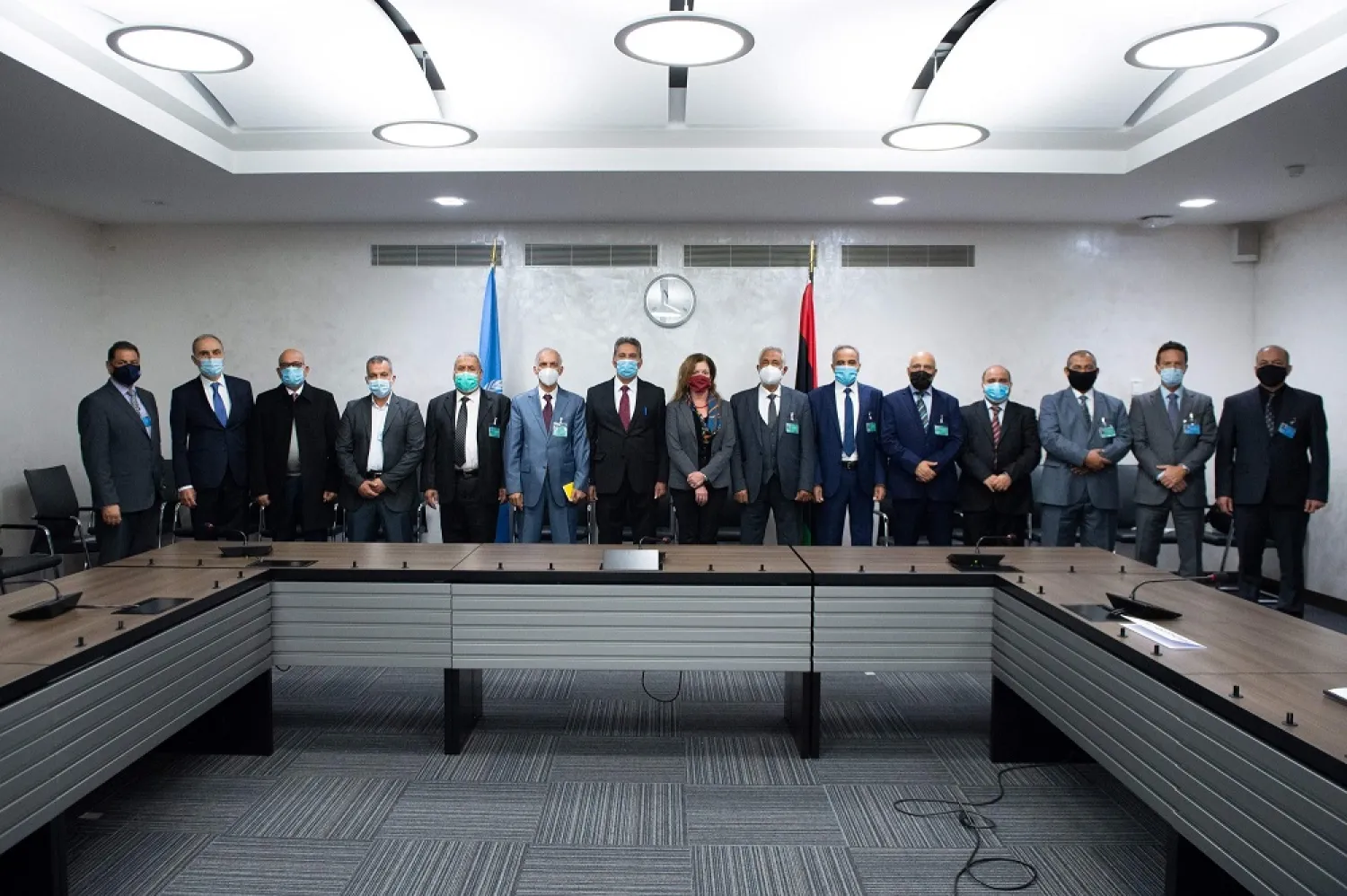
UN envoy to Libya Stephanie Williams and representatives of the rival factions in the Libya conflict, Geneva, Oct. 19, 2020. (AFP)
TT

Ceasefire Efforts in Libya Stumble at Tripoli Militias’ Refusal to Disband

UN envoy to Libya Stephanie Williams and representatives of the rival factions in the Libya conflict, Geneva, Oct. 19, 2020. (AFP)

The United Nations and its Security Council have threatened to sanction parties obstructing the implementation of the ceasefire that was agreed last week by delegations from the east-based Libyan National Army (LNA) and Tripoli-based Government of National Accord (GNA).

Despite the warning, informed sources in the capital Tripoli revealed that the ceasefire may stumble at efforts to disband militias that are loyal to the GNA.

Speaking on condition of anonymity, they said that GNA Interior Minister Fathi Bashagha had devised a plan to disarm the militias and other armed factions that are loyal to the government.

These efforts have been met with refusal by faction leaders, who have rejected Bashagha’s labeling them as militias even though the minister enjoys the support of the American administration and United Nations mission in Libya.

The sources predicted that clashes will intensify in coming days between the militias and GNA.

Bashagha has sought to restructure the militia by merging them in some security units.

The sources added that the militia loyalties are split between those allied to the minister and others that support Defense Minister Salah al-Namroush. Both officials have sought to bolster military and security ties with Turkey.

Bashagha had said that the Geneva ceasefire deal was doomed to fail, describing it as “fragile”. He said its success hinges on foreign countries ceasing their support to the LNA.

The UN Security Council on Tuesday ratified the ceasefire, calling on the LNA and GNA to "implement the agreement in full," diplomats said.

The declaration is to be followed up soon by a UN resolution, diplomatic sources said, according to AFP.

"The members of the Security Council welcomed the permanent ceasefire agreement" signed in Geneva under the aegis of the UN, and called on "the Libyan parties to abide by their commitments."

The Security Council also called on the two sides "to show the same determination in reaching a political solution" when they meet to discuss the issue further on November 9 in Tunisia, the declaration added.

It also cited the need for countries and parties to respect the arms embargo slapped on Libya in 2011 and to end any outside intervention in the country's internal affairs.

Meanwhile, Haftar met on Monday with the LNA delegation that had taken part in the UN-brokered talks. He also met with a delegation of Tuareg tribe elders. He stressed before them the importance of tribes in the ongoing war the LNA was waging to protect the country and rid it of “terrorist and extremist groups.”



Strike in Darfur Kills Senior Figure in RSF-backed Government

Osama Hassan, a leader in the “Taasis” coalition, who was killed in a strike on his home in the city of Nyala (Taasis coalition). 
TT

Strike in Darfur Kills Senior Figure in RSF-backed Government

Osama Hassan, a leader in the “Taasis” coalition, who was killed in a strike on his home in the city of Nyala (Taasis coalition). 

A senior figure in a Sudanese coalition that formed a government backed by the Rapid Support Forces (RSF) was killed in a strike by the Sudanese army on his home in Nyala, South Darfur, late Tuesday, while Health Minister Alaaeldin Naqd and others survived.

Mohamed Hassan al-Taishi, prime minister of the “Taasis” government, said in a statement that an army drone targeted Osama Hassan, a member of the coalition’s leadership body, killing him instantly and seriously wounding four of his aides, two of them critically.

Al-Taishi strongly condemned the killing, describing it as “the beginning of a dangerous pattern of political assassinations targeting civilian and democratic leaders”.

He said targeting the home of a civilian political leader in a populated area constituted “a flagrant violation of international and humanitarian law and moral norms” and undermined any real chance for a ceasefire or a peaceful settlement.

He called on the international community, rights groups and the United Nations to open “an independent, transparent and urgent international investigation” to establish the circumstances of the attack and hold those responsible accountable.

Major blow

The killing of Hassan in Nyala, a stronghold of the Taasis administration, is seen as one of the most significant blows dealt to the RSF, raising expectations the conflict could enter a new phase marked by the targeting of leaders on both sides.

Hassan headed the Democratic Alliance for Social Justice party and was considered a leading candidate for the youth and sports portfolio in the Taasis administration.

Pro-army media outlets reported his death shortly before it was officially confirmed by Taasis authorities.

RSF reaction

The presidential council of the Taasis government, headed by RSF commander Mohamed Hamdan Daglo, known as Hemedti, also mourned Hassan.

In a statement posted on Facebook, it said he was targeted by a Turkish-made Akinci drone that struck his home.

The council described Hassan as “a prominent national figure who contributed effectively to the struggle and was a staunch defender of the causes of freedom and justice, and an example of steadfastness in principle”.

The Sudanese army rarely claims direct responsibility for strikes it carries out on cities in Darfur controlled by the RSF, while the group maintains strict silence regarding its losses.

Since the outbreak of war in April 2023, the Sudanese army and the RSF have exchanged near-daily drone attacks.


Surging Terrorism by Israeli Settlers in West Bank Condemned but Unpunished

While so-called "Jewish terrorism" has drawn widespread condemnation both in Israel and abroad, little has been done to curb it. JAAFAR ASHTIYEH / AFP
TT

Surging Terrorism by Israeli Settlers in West Bank Condemned but Unpunished

While so-called "Jewish terrorism" has drawn widespread condemnation both in Israel and abroad, little has been done to curb it. JAAFAR ASHTIYEH / AFP

Violence by extremist Israeli settlers against Palestinians in the occupied West Bank has reached unprecedented levels since the start of the war with Iran, with NGOs and opposition figures denouncing an environment of impunity.

While so-called "Jewish terrorism" has drawn widespread condemnation both in Israel and abroad, little has been done to curb it, said AFP.

Assaults by violent settlers against Palestinians have been carried out for years, often to the indifference of mainstream Israeli society.

But the recent surge has prompted criticism from influential rabbis, settler leaders and even military chief Lieutenant General Eyal Zamir, who described the attacks as "morally and ethically unacceptable".

According to Reem Cohen, a researcher at the Tel Aviv-based Institute for National Security Studies (INSS), "there has been an increase in acts of Jewish terrorism since the start of the war with Iran", along with a rise in "the severity of the acts".

In an interview with AFP, Cohen, who authored a report on the issue in January, denounced the impunity enjoyed by the perpetrators.

"The Israeli government and security forces... have not responded with determination," Cohen wrote in his report.

One of the first measures taken by Defense Minister Israel Katz upon assuming office in 2024 was to cancel administrative detention -- a form of virtually unlimited custody -- for Israeli suspects of violent crimes in the West Bank. It was maintained for Palestinians.

At least six Palestinians have been killed in the West Bank since the beginning of March in violence attributed to extremist settlers.

That figure for the whole of 2024 stood at five, according to UN data.

"Jewish terrorism against Palestinians in the West Bank has evolved from marginal, local incidents into a widespread phenomenon that occurs as part of a fight for control of the territory and an increasing effort to uproot Palestinian presence," Cohen wrote.

- 'Ideological support' -

Israel has occupied the West Bank since 1967. Excluding east Jerusalem, more than 500,000 Israelis now live there in settlements considered illegal by the UN, among some three million Palestinians.

Settlement building in the territory has continued under every Israeli government since the occupation began.

But it has accelerated significantly under the current coalition of Prime Minister Benjamin Netanyahu, which contains far-right parties and is considered one of the most right-wing in Israeli history.

It has surged even more since the October 7, 2023 attack by the Palestinian movement Hamas that triggered the Gaza war.

After the outbreak of the second intifada, the Palestinian uprising in the early 2000s, groups of radicalized settlers living outside formal settlements, known as the "hilltop youth", pursued what they called a "price tag" policy, carrying out random revenge attacks on Palestinians after every anti-Israeli assault.

Since October 7, such violence has become a daily occurrence, "with the ideological support of certain members of the government", Cohen said, in a reference to far-right ministers Itamar Ben Gvir and Bezalel Smotrich.

During the ongoing war with Iran, the head of the left-wing Democrats party, Yair Golan, accused the government of "supporting Jewish terrorism" and harming Israel's security by forcing the army to "put out fires (the government had) lit" in the West Bank.

Videos posted on social media, sometimes by the perpetrators themselves, show hundreds of young men -- often masked and armed with sticks or automatic weapons -- entering Palestinian villages to sow terror.

- 'Hilltop barbarians' -

Violent settlers have with increased frequency torched Palestinians' homes, uprooted their olive trees and killed their cattle.

In a recent investigation into these groups, which operate mainly in rural areas near the cities of Nablus in the northern West Bank and Hebron in the south, the Israeli daily Yedioth Ahronoth called them "hilltop barbarians".

Since October 7, settlers have established more than 175 farms and outposts in the West Bank with the tacit consent of Israeli authorities.

Though illegal under Israeli law, these outposts are meant to create facts on the ground and receive protection from the army, according to the NGO Peace Now.

The hardcore "hilltop youth" reject all authority and espouse a theocratic and anti-democratic vision of Jewish sovereignty over the West Bank -- with any means to achieve it deemed legitimate.

According to several Israeli media outlets, Netanyahu recently requested that the army take action against the extremists, whom he publicly condemned in November, saying they were not representative of the settler movement.

According to the INSS, "90 percent of settler violence cases in the West Bank are closed without indictments", and Israeli soldiers, instead of arresting the culprits, at times take part in the assaults.


Lebanon's Hezbollah Claims Drone, Rocket Attacks on Northern Israel

Smoke billows from an area targeted by an Israeli airstrike on the southern Lebanese village of Khiam on August 25, 2024, amid escalations in the ongoing cross-border tensions as fighting continues between Israel and Hamas militants in the Gaza Strip. (Photo by Rabih DAHER / AFP) AFP - RABIH DAHER
TT

Lebanon's Hezbollah Claims Drone, Rocket Attacks on Northern Israel

Smoke billows from an area targeted by an Israeli airstrike on the southern Lebanese village of Khiam on August 25, 2024, amid escalations in the ongoing cross-border tensions as fighting continues between Israel and Hamas militants in the Gaza Strip. (Photo by Rabih DAHER / AFP) AFP - RABIH DAHER

Lebanese militant group Hezbollah said its fighters launched drones and rockets at northern Israel on Thursday, with the Israeli military's Home Front Command saying air raid sirens were activated across the border.

In separate statements, the Iran-backed group claimed rocket fire targeting Israeli troops in border areas and a drone attack targeting a village, reported AFP.

Sirens were activated in those areas, according to the Israeli Home Front Command, with no reports of any casualties or damage.