

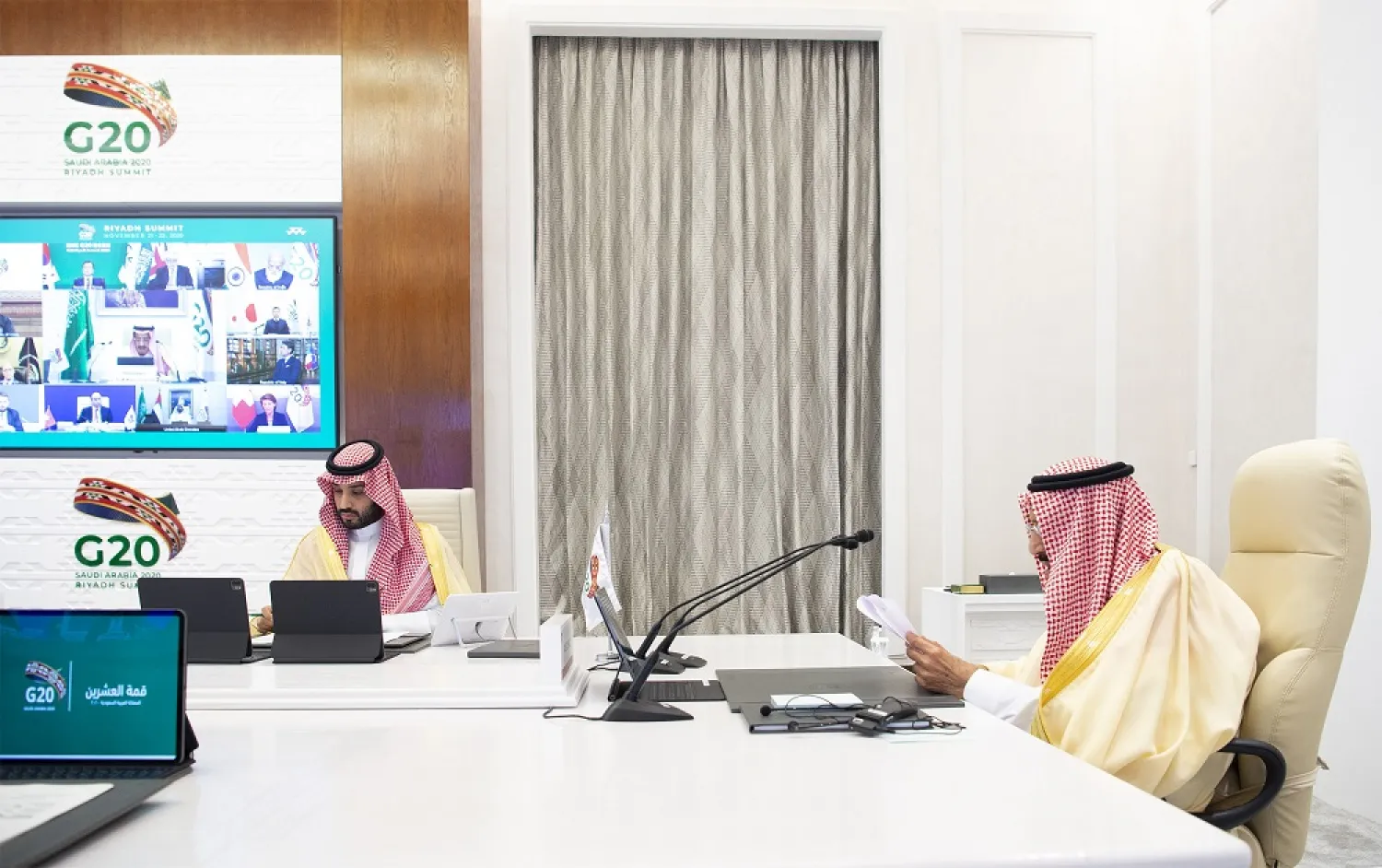

G20 Leaders Say they Will Ensure Fair Access to COVID-19 Vaccine

Saudi King Salman and Crown Prince Mohammed bin Salman at the closing session of the G20 Leaders Summit in Riyadh. (G20 Saudi Arabia via Twitter)
TT

G20 Leaders Say they Will Ensure Fair Access to COVID-19 Vaccine

Saudi King Salman and Crown Prince Mohammed bin Salman at the closing session of the G20 Leaders Summit in Riyadh. (G20 Saudi Arabia via Twitter)

Leaders of the world's 20 biggest economies said on Sunday they would ensure an affordable and fair distribution of COVID-19 vaccines, drugs and tests around the world so that poorer countries were not left out, according to a final summit communique.

After their two-day virtual summit in Saudi Arabia, they said they supported a global project for vaccines, tests and therapeutics - called Access to COVID-19 Tools (ACT) Accelerator - and its COVAX facility to distribute vaccines.

"We will spare no effort to ensure their affordable and equitable access for all people, consistent with members’ commitments to incentivize innovation," the leaders declared. "We recognize the role of extensive immunization as a global public good."

“We stand united in our conviction that coordinated global action, solidarity, and multilateral cooperation are more necessary today than ever to overcome the current challenges and realize opportunities of the 21st century for all by empowering people, safeguarding the planet and shaping new frontiers,” they stressed.

“While the global economy experienced a sharp contraction in 2020 due to the impact of the COVID-19 pandemic, global economic activity has partially picked up as our economies gradually reopened and the positive impact of our significant policy actions started to materialize,” they noted.

“However, the recovery is uneven, highly uncertain and subject to elevated downside risks, including those arising from renewed virus outbreaks in some economies, with some countries reintroducing restrictive health measures,” they remarked.

“We underscore the urgent need to bring the spread of the virus under control, which is key to supporting global economic recovery. We are determined to continue to use all available policy tools as long as required to safeguard people’s lives, jobs and incomes, support the global economic recovery, and enhance the resilience of the financial system, while safeguarding against downside risks,” they declared.

“The G20 Action Plan sets out key principles and commitments to drive forward international economic cooperation as we navigate this crisis and take steps to support the recovery and achieve strong, sustainable, balanced and inclusive growth,” they continued.

Moreover, they said they were committed to implementing the Debt Service Suspension Initiative (DSSI) including its extension through June 2021, allowing DSSI-eligible countries to suspend official bilateral debt service payments.

“Given the scale of the COVID-19 crisis, the significant debt vulnerabilities and deteriorating outlook in many low-income countries, we recognize that debt treatments beyond the DSSI may be required on a case-by-case basis,” the leaders continued.

“The social and economic impact of the pandemic makes it even more urgent to accelerate efforts to end poverty and tackle inequalities and work to ensure that no-one is left behind.”

They noted that the pandemic “continues to have disproportionate economic and social impact on the most vulnerable segments of society, reinforcing the need to enhance access to opportunities for all. We will continue our efforts to reduce inequalities, reaffirming our previous commitments to promote inclusive growth.”

“Tackling the devastating impact of the pandemic on labor markets remains our priority as millions of workers continue to face job and income loss,” they vowed.

On the empowerment of women, they stated that they have been “disproportionately affected by the crisis, we will work to ensure that the pandemic does not widen gender inequalities and undermine the progress made in recent decades.”

“Recalling relevant UN declarations, processes, and calls to action to empower women and girls, we reaffirm the importance of women’s and girls’ empowerment as a cross-cutting issue in all aspects of our policies and recognize that women are a key driver of economic growth.”

On trade, the G20 leader said: “Supporting the multilateral trading system is now as important as ever. We strive to realize the goal of a free, fair, inclusive, non-discriminatory, transparent, predictable, and stable trade and investment environment, and to keep our markets open.”

On climate, they said: “Preventing environmental degradation, conserving, sustainably using and restoring biodiversity, preserving our oceans, promoting clean air and clean water, responding to natural disasters and extreme weather events, and tackling climate change are among the most pressing challenges of our time. As we recover from the pandemic, we are committed to safeguarding our planet and building a more environmentally sustainable and inclusive future for all people.”

“We stress our continued resolve to ensure a stable and uninterrupted supply of energy to achieve economic growth as we respond to the challenges brought about by the pandemic,” they stressed.

“We endorse the Circular Carbon Economy (CCE) Platform, with its 4Rs framework (Reduce, Reuse, Recycle and Remove), recognizing the key importance and ambition of reducing emissions, taking into account system efficiency and national circumstances,” they announced. “The CCE is a voluntary, holistic, integrated, inclusive, pragmatic, and complementary approach to promote economic growth while enhancing environmental stewardship through managing emissions in all sectors including, but not limited to, energy, industry, mobility and food.”

“In advance of the United Nations Framework Convention on Climate Change (UNFCCC) COP26 in Glasgow and the UNCBD COP15 in Kunming, we reiterate our support for tackling pressing environmental challenges, such as climate change and biodiversity loss, as we promote economic growth, energy security and access for all, and environmental protection. Signatories to the Paris Agreement who confirmed at Osaka their determination to implement it, once again, reaffirm their commitment to its full implementation,” they added.

They said they were determined to support African countries in overcoming the coronavirus crisis, including by exploring more sustainable financing options. Debt relief for Africa will be an important theme of the Italian presidency of the G20 in 2021.

The leaders thanked Saudi Arabia for hosting a successful Riyadh Summit and its contribution to the G20 process. “We look forward to our next meetings in Italy in 2021, Indonesia in 2022, India in 2023 and Brazil in 2024,” they added.



France Records 1,000 Excess Deaths During Record-breaking Heatwave

Tourists with umbrellas walk in Paris during a heat wave, Saturday, June 27, 2026. (AP Photo/Aurelien Morissard)
TT

France Records 1,000 Excess Deaths During Record-breaking Heatwave

Tourists with umbrellas walk in Paris during a heat wave, Saturday, June 27, 2026. (AP Photo/Aurelien Morissard)

France has recorded 1,000 excess deaths during the blistering heatwave sweeping Europe, the public health agency said on Sunday, warning that the true figure was likely to be higher.

Detailing its preliminary count of excess deaths, Sante Publique said most of the fatalities involved older people and that it expected the mortality rate to rise as more information became available about ⁠deaths in residential ⁠care and homes.

Europeans have been enduring blistering conditions during a heatwave that has been linked to dozens of deaths - shattering records, disrupting power generation and damaging infrastructure.

Scientists have said the heatwave, which ⁠began on June 20, was the worst recorded in Europe, where the climate is changing faster than the global average.

The heatwave has been moving east. But while France's weather agency said the extreme heat had diminished in most parts of the country, some areas in the northeast were still under a ⁠heatwave ⁠advisory, Reuters reported.

Rooftops are seen during a heat wave in Lyon, central France, Saturday, June 27, 2026. (AP Photo/Laurent Cipriani)

Health Minister Stephanie Rist told La Tribune newspaper that the impact of the heatwave could linger for as long as 10 days after the weather had ebbed.

"The episode is not finished," she told broadcaster BFM.

Most of the deaths involved people aged 65 and older, though the health effects of the extreme heat affected all categories of the population, Sante Publique said.


Trump's Iran Deal Faces Wide Criticism and Some Fear it Could Cost Republicans the Midterm

A sign protesting the Iran war and its impact on gas prices is seen during a protest outside of the US Capitol (AFP)
TT

Trump's Iran Deal Faces Wide Criticism and Some Fear it Could Cost Republicans the Midterm

A sign protesting the Iran war and its impact on gas prices is seen during a protest outside of the US Capitol (AFP)

US President Donald Trump’s interim agreement to end the war with Iran has dragged down his approval rating and garnered criticism across the political spectrum — even from his own supporters.

Recent interviews with 18 Americans who voted for Trump in 2024, a group that Reuters has interviewed monthly since he returned to office, show that most have doubts about the deal, which has reopened the Strait of Hormuz while temporarily lifting US oil sanctions on Iran and authorizing a $300 billion fund for its reconstruction.

“We need to truly weaken the Iranian regime instead of this, ‘beat them up a little bit and then step back and let them rebuild’,” said Terry Alberta, 65, a pilot in Michigan.

Overall, only a quarter of Americans believe the war with Iran was worth the costs, and a majority worry that the truce with Tehran is unlikely to last, according to the latest Reuters/Ipsos poll.

Many of the Trump voters feared his unpopular concessions to Iran would make it harder for Republicans to retain control of Congress in November's midterm elections, although those most critical of the deal had already begun to lose faith in the president before the war.

Six in the group believed he still had plans to bring down the Iranian government.

The group largely supported the war during its early days, believing US strikes were necessary to deplete Iran's stockpile of long-range missiles and cripple its nuclear program.

Lack of Trust in Tehran

Nearly four months later, with Iran politically emboldened and many of its military capabilities still intact, 14 of the voters criticized some aspects of the memorandum of understanding announced on June 14.

Most were skeptical that Tehran could be trusted to honor any agreement and dismayed by the prospect of granting it billions of dollars to rebuild.

The $300 billion fund will be a private investment vehicle rather than a government-funded plan, though exact details have not been released.

Juan Rivera, 26, said Trump “criticized his predecessors about negotiating with terrorists, and he’s basically done the same exact thing.”

Trump’s Midterm Endorsement now ‘Kiss of Death?’

Rivera still plans to support mostly Republican candidates in the midterms. But he said that when he volunteered recently to canvass Latino voters in his community near San Diego, many fellow Trump supporters were so disappointed by the president's handling of the war, among other issues, that they felt unmotivated to back his party in November.

“A lot of people say: ‘Why should I vote when the president's not doing what he promised?’” Rivera recalled.

Asked for comment, a White House spokesperson told Reuters that Trump's achievement “on the battlefield and at the negotiating table is nothing short of remarkable and will strengthen American security for many years.”

Steve Egan, 65, a promotional product distributor in Tampa, soured on Trump in early 2025 after tariff-triggered price hikes hurt his business. From the outset, Egan was skeptical of the president's rationale for the war and upset that it further jacked up the price of gas and other goods.

“Right now it doesn't seem like it's been worth it to go through all that,” he said, noting that the stated goal of regime change “didn't happen.”

His opinion of the president is now so low, Egan said, that Trump's endorsement would be “the kiss of death” for him when deciding which candidates to vote for in the midterms.

Brandon Neumeister, 37, a Pennsylvania state corrections worker and former National Guardsman, said the conflict seemed only to have benefited oil companies. Even before the war, though, Neumeister said he was unlikely to vote in November because he was disgusted with politics.

Robert Billups, 35, of ⁠Washington state, was cautiously optimistic the peace deal would hold. But he believed the war had spawned more hostility toward the United States rather than making the country safer.

Vice President JD Vance, tasked with leading US negotiations with Iran, has fallen in his esteem, and Billups said he no longer feels preferential toward Republican candidates. Come November, “whoever has a better strategy this time, I'm gonna vote for them regardless of their party,” he said.

‘A Bigger Plan’

Though Trump has been adamant about wanting to end the war, six ⁠of his more loyal voters expressed hope that he still had secret plans to bring Iran to heel.

Kate Mottl, 63, a secretary at a municipal office in the Chicago suburbs, said that “destroying” the regime in Tehran seemed like the only way to avert future conflict.

It would be “very disappointing” if Trump refrained from further military intervention, Mottl said, adding that she believed “there’s a bigger plan here.”

Rich Somora, 62, an engineer in North Carolina, agreed that Trump probably had more aggressive ⁠plans up his sleeve. “I can't imagine that he would have gone through all this and not found out a way to get rid of those mullahs,” he said.

According to diplomats and analysts, however, the war has only strengthened the grip of Iran’s clerical rulers. If they remain in power for another month, Somora said, he'll start to worry.

In Prescott, Arizona, 74-year-old retiree Joyce Kenney said she supported lifting sanctions and believed restoring Iran's ability to trade with other countries would ensure its leaders honored the truce.

But the reconstruction fund was a bridge too far: “That's not our responsibility,” she said.


Iran, US Continue Escalating Attacks

This aerial photograph shows boats anchored off Oman's northern Musandam Peninsula near the Strait of Hormuz on June 27, 2026. (Photo by AFP)
TT

Iran, US Continue Escalating Attacks

This aerial photograph shows boats anchored off Oman's northern Musandam Peninsula near the Strait of Hormuz on June 27, 2026. (Photo by AFP)

Iran and the US continued their attacks in the Gulf as ​each accused the other of violating an interim deal signed less than two weeks ago to end their four-month-old war.

Shortly after President Donald Trump warned the US might "militarily complete the job", Iran early on Sunday launched missiles and drones on US military sites in Kuwait and Bahrain, continuing a series of escalating attacks.

The US military said earlier it had struck Iran again, hours after a tanker was hit in the Strait of Hormuz, the world's most important energy shipping route, which Iran had largely cut off for most of the conflict.

The 14-point US-Iran interim agreement was meant to halt the fighting, which the US and Israel started on February 28, and reopen the strait to shipping while talks began on more deep-seated issues, such as Iran's nuclear program.

One round of mediated talks, led by ‌Vice President JD Vance ‌and Iran's Parliamentary Speaker, Mohammad Baqer Qalibaf, was held in Switzerland a week ago and Washington ​then ‌waived ⁠sanctions on Tehran, ​but ⁠the fighting and recriminations have since resumed and intensified.

"There may come a point when we are no longer able to be reasonable, and will be forced to militarily complete the job that we very successfully started," Trump posted on social media. "If that happens, the Islamic Republic of Iran will no longer exist!"

About an hour after Trump's post, the Kuwaiti army said its air defenses were responding to "hostile" missile and drone attacks, while sirens sounded in Bahrain, according to that country's interior ministry.

US Central Command said earlier that its forces had carried out fresh strikes after a Panama-flagged tanker was attacked by ‌an Iranian drone on Saturday.

"Iran was given a chance to honor the ceasefire agreement but elected not to," Central Command said in a statement, adding the strikes were "in direct response to continued Iranian aggression against commercial shipping" and targeted Iranian military surveillance, communications, air defense, drone storage and mine-laying facilities.

Iranian state broadcaster IRIB said explosions were heard in Sirik in southern Iran, without providing further details.

The Guards said "America's blind shots at Sirik will not resolve our dominance over the Strait ‌of Hormuz. But our shots at violators will remind the rest of the vessels of the clear passage route."