Qatari Vehicles Start Crossing Border into Saudi Arabia

A file photo taken on June 23, 2017, shows a general view of the Qatari side of the Abu Samrah border crossing with Saudi Arabia. (File/AFP)
TT

Qatari Vehicles Start Crossing Border into Saudi Arabia

A file photo taken on June 23, 2017, shows a general view of the Qatari side of the Abu Samrah border crossing with Saudi Arabia. (File/AFP)

Qatari vehicles crossed into Saudi Arabia through a land border on Saturday for the first time since Arab states severed diplomatic and transport ties with Doha in mid-2017, Saudi state TV said, following a deal this week to restore relations.

"It's good the crisis has been resolved, and the warm welcome we had, and the happiness we see in our brothers," the driver of the second car to pass through the Abu Samra-Salwa crossing told Ekhbariya TV.

Saudi Arabia on Tuesday announced an end to the dispute with Qatar.

Also, a UAE official this week said travel and trade links could resume within a week of the deal.

Qatar Airways on Thursday began re-routing some of its flights through Saudi airspace, Reuters reported.

Etihad airways, Abu Dhabi's carrier, also intends to recommence services between Abu Dhabi and Doha, a spokesperson said on Saturday.

Measures to contain the spread of the new coronavirus are in place on both sides of the Saudi-Qatar land border.

All arrivals into Qatar crossing at Abu Samra must present a negative COVID-19 test, take a new test at the border and quarantine for one week in one of a number of selected hotels.


Saudi Arabia, Arab and Islamic Countries Condemn Israel’s 'State Land' Decision in West Bank 

The West Bank village of al-Ram is pictured behind Israel's controversial separation barrier from the outskirts of Jerusalem on February 16, 2026. (AFP)
TT

Saudi Arabia, Arab and Islamic Countries Condemn Israel’s 'State Land' Decision in West Bank 

The West Bank village of al-Ram is pictured behind Israel's controversial separation barrier from the outskirts of Jerusalem on February 16, 2026. (AFP)

The foreign ministers of Saudi Arabia, Jordan, the United Arab Emirates, Qatar, Indonesia, Pakistan, Egypt, and Türkiye strongly condemned on Tuesday Israel's decision to designate lands in the occupied West Bank as so-called "state land".

They also slammed it for approving procedures for the registration and settlement of land ownership across extensive areas of the occupied West Bank for the first time since 1967.

They condemned the moves as “a grave escalation aimed at accelerating illegal settlement activity, land confiscation, entrenching Israeli control, and applying unlawful Israeli sovereignty over the Occupied Palestinian Territory and undermining the legitimate rights of the Palestinian people.”

These measures are “a flagrant violation of international law and international humanitarian law, particularly the Fourth Geneva Convention, as well as a violation of relevant United Nations Security Council resolutions, foremost among them Resolution 2334,” the FMs said in a statement.

“The decision also contradicts the advisory opinion issued by the International Court of Justice concerning the legal consequences arising from Israeli policies and practices in the Occupied Palestinian Territory, which underscored the illegality of measures intended to alter the legal, historical, and demographic status of the Occupied Palestinian Territory, the obligation to end the occupation, and the prohibition of the acquisition of territory by force,” they added.

“This step reflects an attempt to impose a new legal and administrative reality designed to consolidate control over the occupied land, thereby undermining the two-state solution, eroding the prospects for the establishment of an independent and viable Palestinian State, and jeopardizing the attainment of a just and comprehensive peace in the region,” they warned.

The foreign ministers reiterated their “categorical rejection of all unilateral measures aimed at altering the legal, demographic, and historical status of the Occupied Palestinian Territory.”

They stressed that such policies are “a dangerous escalation that will further heighten tensions and instability in the Occupied Palestinian Territory and the region as a whole.”

They called on the international community “to assume its responsibilities and take clear and decisive steps to halt these violations, ensure respect for international law, and safeguard the inalienable rights of the Palestinian people, foremost among them their right to self-determination, ending the occupation, and establishing their independent and sovereign State based on 1967 borders with East Jerusalem as its capital.”



Saudi Hajj and Umrah Minister Inspects Ramadan Service Readiness at Two Holy Mosques 

Saudi Minister of Hajj and Umrah and Board Chairman of the General Authority for the Care of the Affairs of the Two Holy Mosques Tawfig Al-Rabiah during the inspection tour on Monday. (SPA)
TT

Saudi Hajj and Umrah Minister Inspects Ramadan Service Readiness at Two Holy Mosques 

Saudi Minister of Hajj and Umrah and Board Chairman of the General Authority for the Care of the Affairs of the Two Holy Mosques Tawfig Al-Rabiah during the inspection tour on Monday. (SPA)

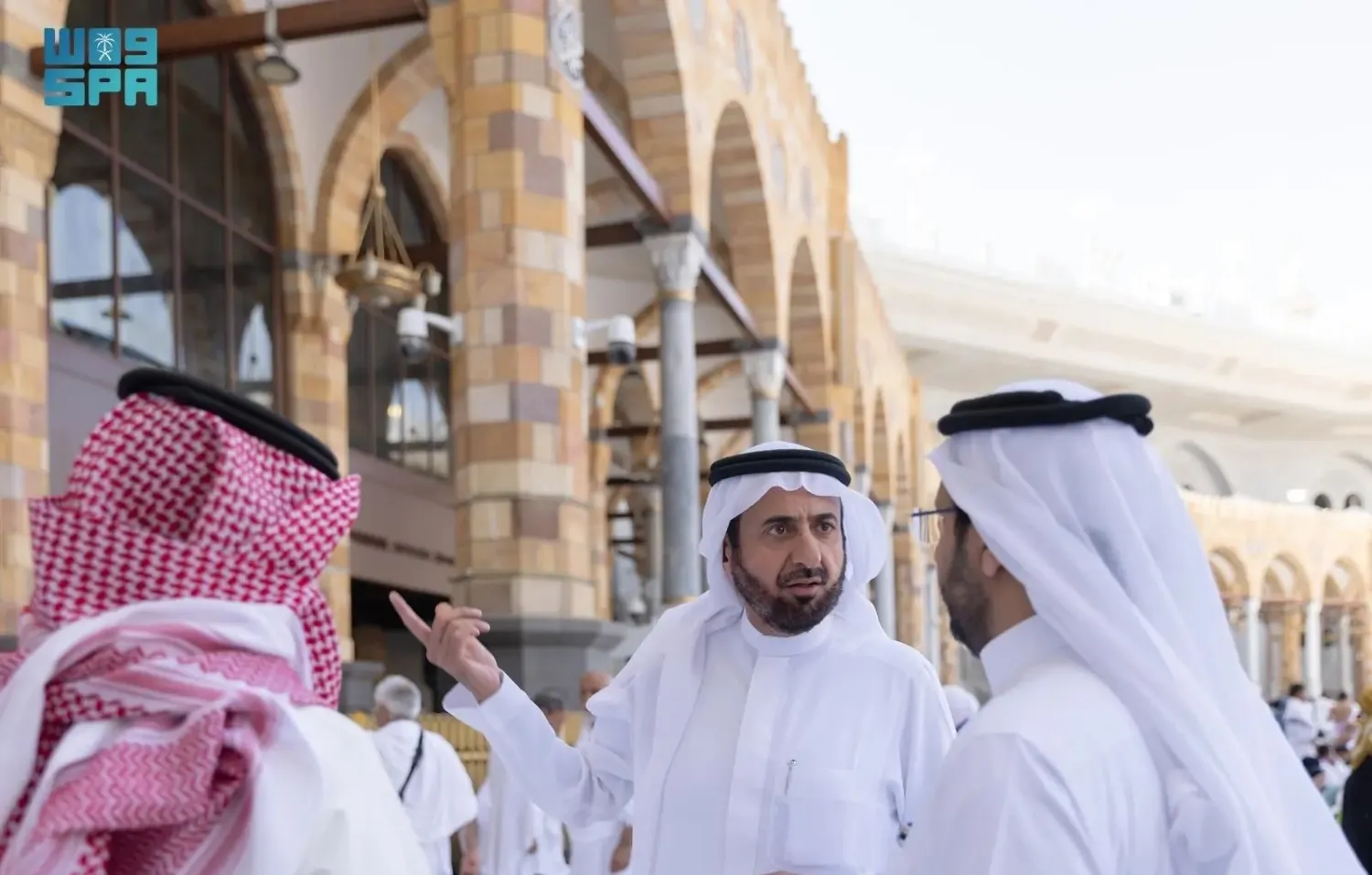
Saudi Minister of Hajj and Umrah and Board Chairman of the General Authority for the Care of the Affairs of the Two Holy Mosques Tawfig Al-Rabiah carried out on Monday a field inspection tour to assess operational and service readiness for the holy fasting month of Ramadan at the Grand Mosque, Prophet’s Mosque, and several other service sites in the holy city of Makkah.

Accompanied by the authority’s CEO Eng. Ghazi Al-Shahrani, the tour included a review of field operations, crowd management plans, and the flow of Umrah performers and worshippers.

It addressed coordination and integration mechanisms among relevant entities, as part of ongoing efforts by the ministry, the authority, and partner organizations serving pilgrims.

Al-Rabiah stressed that these efforts are carried out in line with the directives of the Kingdom's leadership and reflect the country's commitment to caring for the Two Holy Mosques and their visitors.

The level of readiness and the services provided during Ramadan are part of ongoing development efforts and they support the objectives of the Pilgrim Experience Program, part of Saudi Vision 2030, which aims to boost the quality of services and the overall experience of pilgrims, he added.


SDRPY, EU Sign Strategic Partnership to Improve Living Conditions in Yemen 

Officials are seen at the signing ceremony in Riyadh on Monday. (SPA)
TT

SDRPY, EU Sign Strategic Partnership to Improve Living Conditions in Yemen 

Officials are seen at the signing ceremony in Riyadh on Monday. (SPA)

The Saudi Development and Reconstruction Program for Yemen (SDRPY) and European Union announced on Monday the alignment of their efforts to improve livelihoods in Yemen.

These efforts focus on investment in economic recovery programs and reforms, job creation, strengthening state institutions, and boosting community resilience, including in the areas of food security, agriculture, electricity, water, and environmental sanitation.

Their strategic partnership is in line with efforts to strengthen international cooperation to support Yemen.

Supporting improved access to water in the Marib governorate is the first outcome of the strategic partnership.

The two parties signed in Riyadh an agreement with the SILA Foundation to implement a SAR9-million project, “Enhancing Water Security in Marib Governorate,” covering nine areas across the districts of Marib Al-Wadi, Marib City, and Harib. Over 350,000 people will benefit from the project.

The agreement reflects the parties’ commitment to joint action and continuous coordination to improve living conditions for all Yemenis.

The SDRPY and EU agreed to continue coordination and explore additional opportunities for cooperation in the water sector, as well as joint development projects and initiatives in other sectors.