Menfi Meets Libyan National Army Commander in First Visit to Benghazihttps://english.aawsat.com/home/article/2800486/menfi-meets-libyan-national-army-commander-first-visit-benghazi
Menfi Meets Libyan National Army Commander in First Visit to Benghazi
LNA commander Khalifa Haftar meets with new head of the Presidential Council Mohammad al-Menfi. (LNA general command)
Libyan National Army (LNA) commander Khalifa Haftar held talks on Thursday with new head of the Presidential Council Mohammad al-Menfi, who was making his first visit to Benghazi since his appointment last week.
A statement from Haftar’s press office said they “exchanged views” on various pending issues.
The LNA commander stressed that the armed forces support the peace process and are keen on preserving democracy, ensuring the peaceful transition of power and backing the new Presidential Council and interim government so that they can hold long-awaited elections in December.
Menfi arrived from Athens, where he had been living for the past three years, and immediately met with dozens of tribal elders, academics and activists inside the VIP lounge at Benina airport, which serves Benghazi.
His visit follows a UN-sponsored conference last week in which delegates from Libya's warring sides picked four leaders to guide the nation ahead of the December elections. The election of the Presidential Council was a major — if uncertain — step toward unifying the North African country.
The forum also chose Abdul Hamid Mohammed Dbeibeh as interim prime minister.
In a tweet, Menfi said: “Our objective is to achieve unity and true reconciliation and to collaborate with all in order to end the suffering.”
He urged “everyone to assume their responsibilities and rise up to the challenges.”
Meanwhile, the first and second deputies of the east-based parliament speaker urged the need to hold a confidence vote over the new government, which Dbeibeh is tasked with forming.
They suggested that the parliament meet with full quorum in a city chosen by the 5+5 joint military committee in order to ensure the safety of all lawmakers.
In a reference to a demand by some MPs for the ouster of Speaker Aguila Saleh, the two deputies also proposed that the next parliament session review amendments proposed by MPs.
The social council of Sirte tribes, meanwhile, urged the parliament to hold its vote of confidence in the city, which they added could serve as the headquarters of the new executive authority.
Escape Attempts, Assassination Plots Expose Rifts within Gaza’s Armed Gangs
Palestinians try to extinguish a fire in a vehicle destroyed by an Israeli airstrike south of Gaza City on Thursday. (EPA)
Reports of attempted assassinations, defections and deadly escape attempts have exposed growing tensions within Israeli-backed armed gangs operating in areas of Gaza under Israeli control, according to Palestinian faction sources, Hamas security officials and statements issued by local families.
The groups operate east of the so-called Yellow Line, the boundary separating Israeli-held territory from areas controlled by Palestinian factions, primarily Hamas.
Since the October 2025 ceasefire agreement, Israeli forces have carried out near-daily strikes and targeted killings, expanded the territory under their control and, in many operations, relied on local armed groups backed by drone and artillery support.
Failed assassination attempt
Two field sources from Palestinian factions monitoring the gangs told Asharq Al-Awsat that two gunmen from Jabalia, northern Gaza, attempted to assassinate Shawqi Abu Nasira, who leads a group based north of Khan Younis and east of Deir al-Balah.
One of the men was a former member of Hamas’ armed wing, the Al-Qassam Brigades, who had defected.
The attack, carried out about two weeks ago, failed for reasons that remain unclear to the Palestinian side, according to one source. Both suspects were subsequently arrested and handed over to officers from Israel’s Shin Bet security agency for questioning.
The second source maintained that the pair had acted independently, although their motives were unknown.
It was unclear whether the attempt stemmed from disputes with Abu Nasira and his associates or reflected a desire to reverse their defections and leave the gangs.
The incident comes amid reports of members abandoning their positions and returning to their families in areas west of the Yellow Line.
Internal disputes and defections
A security official from Gaza’s Hamas-run administration, who monitors the armed groups, reported growing internal friction, with some disagreements escalating into exchanges of gunfire between members and commanders.
Some disputes involved drug trafficking, while others arose from gunmen seeking to break away and return home.
Several members had contacted their families in recent months, asking them to coordinate with security agencies and clan leaders to secure permission to return and guarantees of safety, the official told Asharq Al-Awsat.
Others offered to act as informants for security bodies affiliated with the Palestinian factions or carry out attacks against the gangs.
The official cited an incident two months earlier in which a gunman attempted to assassinate Hussam al-Astal, who heads an armed group in southern Khan Younis.
According to the same source, five attempts to flee gang-controlled areas toward territory held by Palestinian factions were documented over the past two weeks.
All five men were killed by bombs dropped from quadcopter drones, the official revealed.
A field source in Rafah, southern Gaza, provided further details, reporting that Israeli drones had killed two young men three days earlier as they tried to escape from the gang formerly led by Yasser Abu Shabab, who was killed in late 2025.
The group is now headed by Ghassan al-Dahini.
Three other men were killed in two separate incidents while attempting to flee from southern and eastern Khan Younis, according to the source.
Entire families flee
In recent weeks, families in central and southern Gaza, including the Abu Shamkha, al-Assar and al-Shaer families, have issued statements mourning relatives killed while trying to return home after deciding to sever ties with the armed gangs.
Meanwhile, Hamas security forces were taken by surprise several weeks ago when entire families fled areas controlled by a group led by former Palestinian security officer Ashraf al-Mansi in northern Gaza.
Hundreds reached Hamas-controlled territory, where security personnel questioned them and established a camp to accommodate them.
The displaced families were subsequently placed under what the authorities described as “remote surveillance.”
Fear of Another War Weighs on Lebanon amid Regional Tensionshttps://english.aawsat.com/arab-world/5332629-fear-another-war-weighs-lebanon-amid-regional-tensions
Fear of Another War Weighs on Lebanon amid Regional Tensions
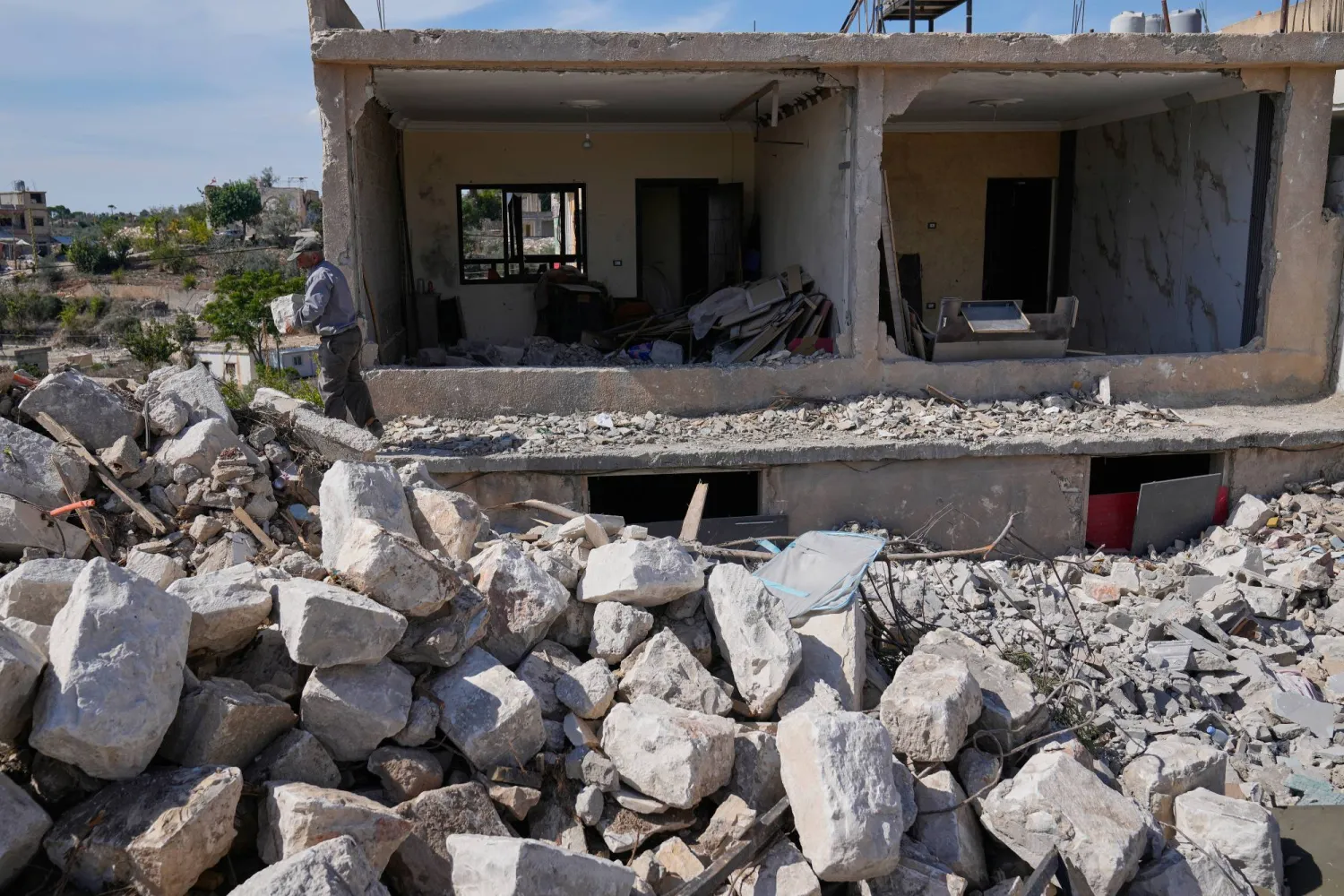
A man removes debris from his destroyed house, in Zawtar al-Gharbiyeh village, southern Lebanon, Tuesday, Oct. 20, 2026. (AP)
Lebanese people are once again confronting the possibility of war as mounting regional tensions raise fears that their country could be drawn into a wider conflict, either through Hezbollah’s involvement in a conflict involving Iran or renewed fighting with Israel.
The uncertainty is compounded by Washington’s unresolved decision on whether to resume military operations against Iran, Hezbollah’s silence over how it might respond and the Lebanese state’s inability to ensure the country remains outside the regional confrontation.
Deputy Prime Minister Tarek Mitri acknowledged “serious concerns” that a full-scale regional war could turn Lebanon into one of its battlegrounds, but cautioned that there was no concrete information pointing to such an outcome.
“We are still dealing with analysis and possibilities, not information,” he told Asharq Al-Awsat, noting that even those directly involved in mediation between Washington and Tehran lacked definitive answers.
Mitri denied that official delegations visiting Lebanon recently had advised authorities to prepare for war.
The decision to resume hostilities, he explained, would ultimately depend on US President Donald Trump, Iran’s response and Israel’s position.
“The war against Lebanon has not stopped in the first place. What we fear is that it will intensify again,” he said.
Asked about the government’s preparations for another round of fighting, Mitri pointed to its limited resources. “The state is doing everything it can on the relief front, but our capabilities are extremely limited.”
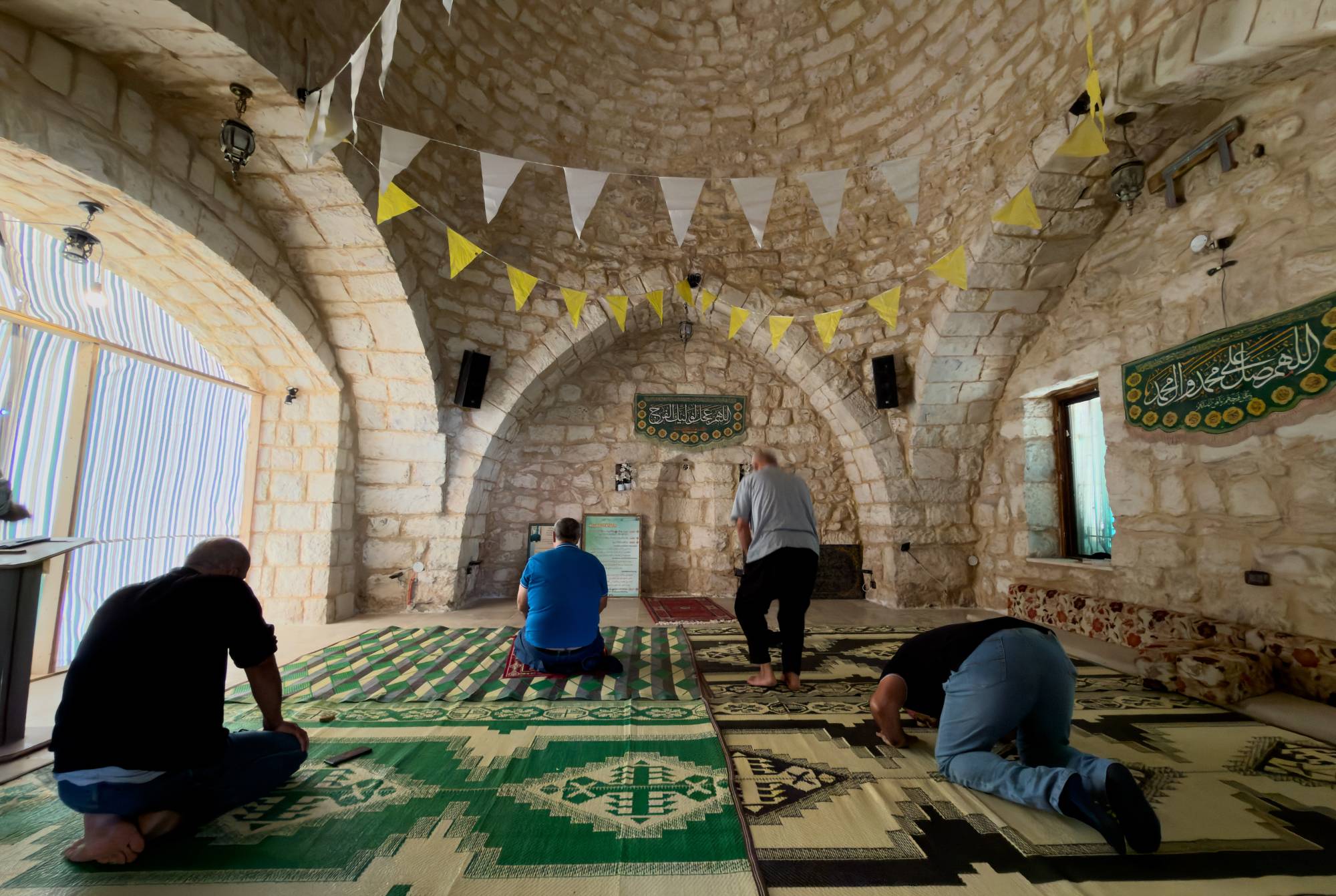
People pray inside a mosque in Zawtar al-Gharbiyeh village, southern Lebanon, Tuesday, Oct. 20, 2026. (AP)
Hezbollah remains silent
Iran-backed Hezbollah has given little indication of whether it would join a broader confrontation if Washington resumed its military campaign against Iran.
Reports suggest the group is making military and relief preparations in anticipation of renewed hostilities. Unconfirmed accounts have also said that Iran instructed Hezbollah to raise its military readiness.
Political analyst Qassem Kassir, who closely follows Hezbollah’s position, said the group had been preparing for the possibility of fresh Israeli attacks since the previous war ended.
“After every war, there is a review of what happened, lessons are drawn and preparations are made for any future confrontation,” he told Asharq Al-Awsat.
Such measures were only natural given Israel’s continuing attacks on Lebanon, he explained. But Kassir warned against drawing conclusions about Hezbollah’s intentions in the event of a US-Iranian confrontation, noting that even the likelihood of such a conflict remained uncertain.
“Even if war breaks out, many questions remain. What kind of war would it be? What would its repercussions be? How might it develop?” he wondered.
Hezbollah does not announce its decisions in advance, he explained. Its response would depend on the nature and scale of any fighting.
While preparations for different scenarios were to be expected, Kassir said there were no signs on the ground of an impending large-scale conflict.
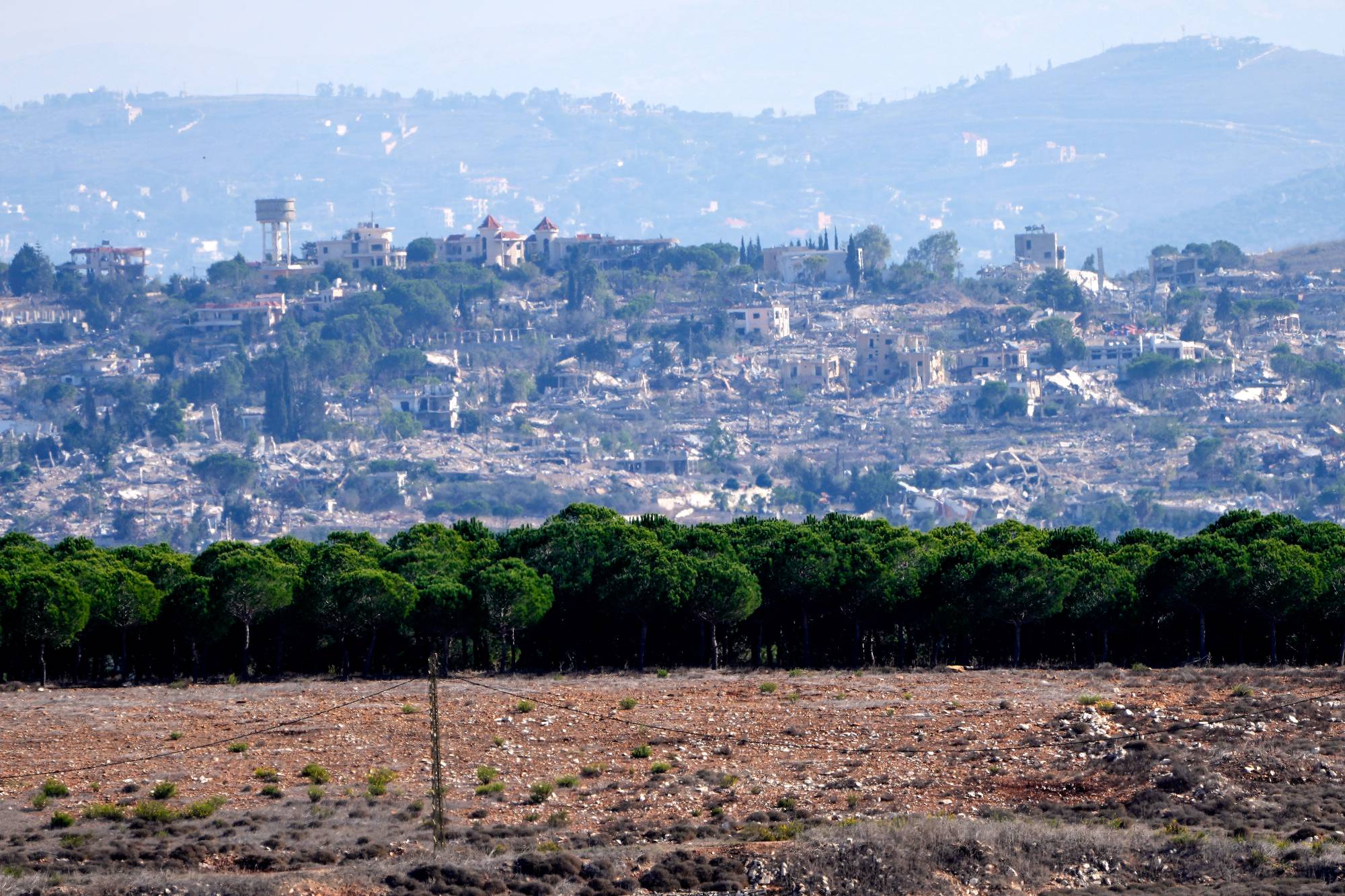
Demolished houses by Israeli forces in Kfar Tebnit village, are seen from Zawtar al-Gharbiyeh, southern Lebanon, Tuesday, Oct. 20, 2026. (AP)
Displacement fears
The anxiety is already shaping decisions among residents of South Lebanon and Beirut’s southern suburbs.
Those who can afford it continue to rent apartments in Mount Lebanon, the Iqlim al-Kharroub area and other locations considered safer when clashes between Hezbollah and Israel erupt.
For families who remain in vulnerable areas, the fear of returning to emergency shelters has become a constant concern.
Fatima M., 41, who works at a shopping center on the outskirts of Beirut’s southern suburbs, recalled taking refuge in Amchit, about 40 kilometers north of the capital, during earlier fighting.
“We are genuinely afraid of being displaced again,” she told Asharq Al-Awsat.
“I work in the southern suburbs, but the shelter where I stayed was in Amchit. We cannot endure any more tragedies or disasters. It is time for us to live in peace, like everyone else.”
Lebanon still has 63 shelters housing displaced people, including 44 educational institutions and 11 institutes and other facilities affiliated with the Education Ministry.
Ministry sources told Asharq Al-Awsat that buildings no longer used for teaching had been made available for emergency accommodation.
Political Talks Ease Tensions Over Seized Hezbollah Explosives in Lebanonhttps://english.aawsat.com/arab-world/5332626-political-talks-ease-tensions-over-seized-hezbollah-explosives-lebanon
Political Talks Ease Tensions Over Seized Hezbollah Explosives in Lebanon
Prime Minister Nawaf Salaf (The office of the Prime Minister)
Intensive political contacts ahead of Thursday’s Lebanese cabinet meeting helped defuse tensions over a shipment of Hezbollah explosives seized in Dahr al-Baydar, amid a dispute over whether the case should be referred to the country’s highest criminal court.
Justice Minister Adel Nassar has insisted on referring the case to the Judicial Council, a move opposed by Parliament Speaker Nabih Berri and Hezbollah amid concerns over its potential repercussions for Lebanon.
The dispute unfolded as President Joseph Aoun praised security agencies for their efforts to maintain order, while Prime Minister Nawaf Salam reaffirmed the state’s exclusive authority over weapons and decisions of war and peace.
“No one can impose any limits on us other than those set by law,” Salam declared, stressing that national security and public safety must take precedence.
Aoun calls for restraint
Opening the cabinet session, Aoun welcomed Berri’s position that the Lebanese Army was a “red line,” along with his commitment to civil peace, dialogue and understanding.
He described these principles as essential to protecting Lebanon amid mounting regional tensions.
“The challenges facing the region are enormous, and I hope they do not lead to escalation or an explosion,” Aoun warned.
He urged political leaders and ministers to exercise wisdom and restraint to shield Lebanon, already burdened by severe economic difficulties, from any further regional upheaval.
Salam: State monopoly on arms is nonnegotiable
Salam reiterated that the state’s monopoly on weapons and its exclusive authority to decide on war and peace were established principles no longer open to debate.
He grounded that position in Lebanon’s constitution, its laws, the Taif Agreement, UN Security Council Resolution 1701 and the November 2024 cessation-of-hostilities agreement.
Under the latter agreement, he explained, only the Lebanese Army, Internal Security Forces, General Security, State Security, Customs and municipal police are authorized to carry weapons.
Salam maintained that Hezbollah was being asked only to honor commitments it had already accepted, “nothing more, nothing less.”
He recalled that the government had instructed the army to prepare a plan to establish the state’s monopoly on arms, welcomed the plan last September and reaffirmed in March the need to complete its implementation across Lebanon.
“No one, whoever they may be, has the authority or jurisdiction to reconsider this except the Council of Ministers,” he emphasized.
Turning to explosives seized in Dahr al-Baydar and Qasr, the prime minister warned that storing or transporting weapons outside legally authorized institutions, regardless of the justification, violated the law and government decisions and endangered public safety.
Such violations warranted security investigations, judicial prosecution and the harshest penalties against those responsible, he argued.
“Nothing can take precedence over the country’s safety and the security of its citizens,” Salam declared.
Efforts to contain dispute
Nassar’s push to refer the explosives case to the Judicial Council has the backing of ministers from the Lebanese Forces and Kataeb parties.
However, reports indicated that Berri had received assurances the referral would not proceed following intensified contacts aimed at containing the disagreement.
On Wednesday evening, the speaker announced that ministers representing Hezbollah and its Shiite ally, the Amal Movement, would attend the cabinet session.
The political maneuvering came amid reports that Hezbollah could respond to a referral by mobilizing supporters in the streets.
The Judicial Council is an exceptional criminal court with jurisdiction over specified offenses, including crimes against the internal or external security of the state and certain offences that threaten public safety.
Cases do not automatically fall under its authority. Referral requires a cabinet decree issued on the justice minister’s recommendation, making the decision a politically sensitive matter within the government.
لم تشترك بعد
انشئ حساباً خاصاً بك لتحصل على أخبار مخصصة لك ولتتمتع بخاصية حفظ المقالات وتتلقى نشراتنا البريدية المتنوعة