

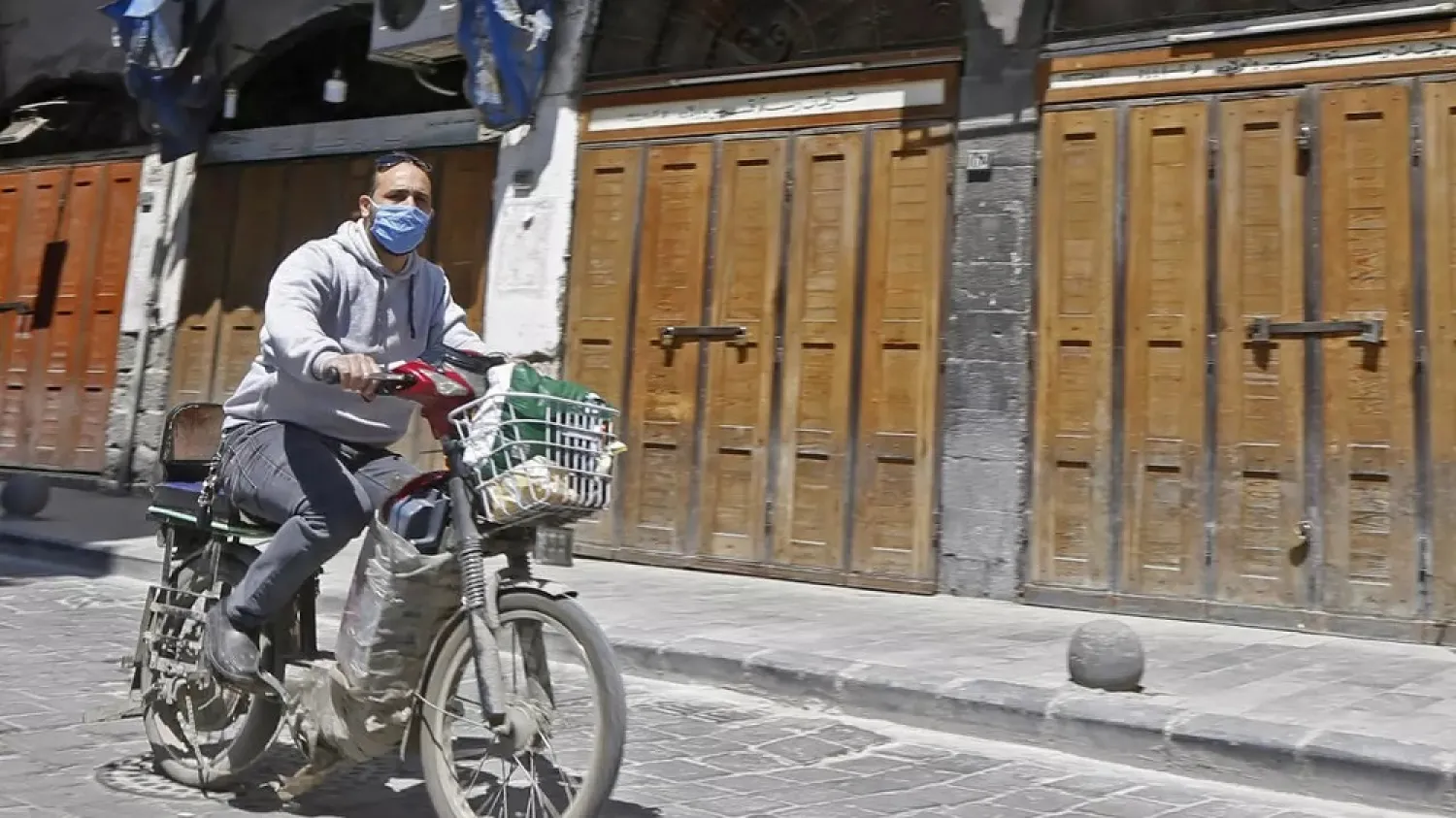

Syria Grapples with Third COVID-19 Wave

A Syrian man, wearing a protective face mask to protect against the coronavirus (COVID-19) pandemic, rides his motorcycle down a street near the Old City of the capital Damascus on April 14, 2020. (AFP)
TT

Syria Grapples with Third COVID-19 Wave

A Syrian man, wearing a protective face mask to protect against the coronavirus (COVID-19) pandemic, rides his motorcycle down a street near the Old City of the capital Damascus on April 14, 2020. (AFP)

The Syrian Health Ministry warned on Monday that it has registered a spike in coronavirus infections and a rise in hospitalized cases.

The spike demands a greater commitment to precautionary measures, especially as countries are grappling with new variants of the virus, it said in a statement.

Meanwhile, authorities have continued their COVID-19 inoculation drive. The second day of the campaign saw the vaccination of frontline health workers.

Last week, Syrian officials said Damascus had received vaccinations from a “friendly country” that it did not name.

On Monday, Health Minister Hassan Ghobash told the Syrian national news agency, SANA, that the most vulnerable groups will be vaccinated, including health workers at isolation centers, and priority will be given to the elderly due to limited supplies of the doses.

He underlined the need for people to comply with the preventive measures, especially wearing masks and social distancing, as they have proven to be most effective in curbing the pandemic.

Syria has witnessed a spike in infections. It confirmed 15,642 cases, 1,032 fatalities and 9,880 recoveries.

Few days ago, former Dean of the Faculty of Medicine at the University of Damascus, Dr. Naboug al-Awa had warned of a third COVID-19 wave in the country and said the high number of daily infections is possibly linked to the spread of a new variant.

However, Essam Amin, director of Damascus' Mowasat Hospital said there is no clinical information proving that a new variant was spreading in the country.

He said the rise in infections may be linked to the cold weather, which is forcing people to stay indoors.

Meanwhile, the Sweida health directorate said it registered an increase in infections, the third such spike since the outbreak.



Palestinian Child Dies After Stepping on Mine in West Bank

Israeli troops conduct a military raid in the village of Al-Yamoun, west of Jenin, West Bank, 17 February 2026. (EPA)
TT

Palestinian Child Dies After Stepping on Mine in West Bank

Israeli troops conduct a military raid in the village of Al-Yamoun, west of Jenin, West Bank, 17 February 2026. (EPA)

A Palestinian child died after stepping on a mine near an Israeli military camp in the occupied West Bank on Tuesday, the Palestinian Red Crescent said, with an Israeli defense ministry source confirming the death.

"Our crews received the body of a 13-year-old child who was killed after a mine exploded in one of the old camps in Jiftlik in the northern Jordan Valley," the Red Crescent said in a statement.

A source at COGAT, the Israeli defense ministry's agency in charge of civilian matters in the Palestinian territories, confirmed the death to AFP and identified the boy as Mohammed Abu Dalah, from the village of Jiftlik.

Israel's military had previously said in a statement that three Palestinians were injured "as a result of playing with unexploded ordnance", without specifying their ages.

It added that the area of the incident, Tirzah, is "a military camp in the area of the Jordan Valley", near Jiftlik and close to the Jordanian border.

"This area is a live-fire zone and entry into it is prohibited," the military said.

Jiftlik village council head Ahmad Ghawanmeh told AFP that three children, the oldest of whom was 16, were collecting herbs near the military base when they detonated a mine.

Jiftlik as well as the nearby Tirzah base are located in the Palestinian territory's Area C, which falls under direct Israeli control.

Israel has occupied the West Bank since 1967.

Much of the area near the border with Jordan -- which Israel signed a peace deal with in 1994 -- remains mined.

In January, Israel's defense ministry said it had begun demining the border area as part of construction works for a new barrier it says aims to stem weapons smuggling.


Hezbollah Rejects Disarmament Plan and Government’s Four-Month Timeline

29 July 2024, Iran, Tehran: Then Hezbollah deputy leader Sheikh Naim Qassem is pictured during a meeting in Tehran. (Iranian Presidency/dpa)
TT

Hezbollah Rejects Disarmament Plan and Government’s Four-Month Timeline

29 July 2024, Iran, Tehran: Then Hezbollah deputy leader Sheikh Naim Qassem is pictured during a meeting in Tehran. (Iranian Presidency/dpa)

Hezbollah rejected on Tuesday the Lebanese government's decision to grant the army at least four months to advance the second phase of a nationwide disarmament plan, saying it would not accept what it sees as a move serving Israel.

Lebanon's cabinet tasked the army in August 2025 with drawing up and beginning to implement a plan to bring all armed groups' weapons under state control, a bid aimed primarily at disarming Hezbollah after its devastating ‌war with ‌Israel in 2024.

In September 2025 the cabinet formally ‌welcomed ⁠the army's plan to ⁠disarm the Iran-backed Shiite party, although it did not set a clear timeframe and cautioned that the military's limited capabilities and ongoing Israeli strikes could hinder progress.

Hezbollah Secretary-General Sheikh Naim Qassem said in a speech on Monday that "what the Lebanese government is doing by focusing on disarmament is a major mistake because this issue serves the goals of Israeli ⁠aggression".

Lebanon's Information Minister Paul Morcos said during a press ‌conference late on Monday after ‌a cabinet meeting that the government had taken note of the army's monthly ‌report on its arms control plan that includes restricting weapons in ‌areas north of the Litani River up to the Awali River in Sidon, and granted it four months.

"The required time frame is four months, renewable depending on available capabilities, Israeli attacks and field obstacles,” he said.

Hezbollah lawmaker Hassan ‌Fadlallah said, "we cannot be lenient," signaling the group's rejection of the timeline and the broader approach to ⁠the issue of ⁠its weapons.

Hezbollah has rejected the disarmament effort as a misstep while Israel continues to target Lebanon, and Shiite ministers walked out of the cabinet session in protest.

Israel has said Hezbollah's disarmament is a security priority, arguing that the group's weapons outside Lebanese state control pose a direct threat to its security.

Israeli officials say any disarmament plan must be fully and effectively implemented, especially in areas close to the border, and that continued Hezbollah military activity constitutes a violation of relevant international resolutions.

Israel has also said it will continue what it describes as action to prevent the entrenchment or arming of hostile actors in Lebanon until cross-border threats are eliminated.


Syria Starts Evacuating ISIS-linked Al-Hol Camp

TOPSHOT - Members of Syrian security forces march through the entrance of the Al-Hol camp in the desert region of Hasakeh province on January 21, 2026. (Photo by OMAR HAJ KADOUR / AFP)
TT

Syria Starts Evacuating ISIS-linked Al-Hol Camp

TOPSHOT - Members of Syrian security forces march through the entrance of the Al-Hol camp in the desert region of Hasakeh province on January 21, 2026. (Photo by OMAR HAJ KADOUR / AFP)

Syrian authorities began evacuating remaining residents of the ISIS group-linked Al-Hol camp in the country's northeast on Tuesday, as they empty the formerly Kurdish-controlled facility, two officials told AFP.

Fadi al-Qassem, the official appointed by the government with managing Al-Hol's affairs, told AFP that the camp "will be fully evacuated within a week, and nobody will remain", adding that "the evacuation started today".

A government source told AFP on condition of anonymity that "the emergencies and disaster management ministry is working now to evacuate Al-Hol camp" and take residents to a camp in Akhtarin, in the north of Aleppo province.