


France Limits Access for People Causing Lebanon’s Political Stalemate

A view shows the site of the August 4 explosion at Beirut port, Lebanon February 18, 2021. REUTERS/Mohamed Azakir/File Photo
TT

France Limits Access for People Causing Lebanon’s Political Stalemate

A view shows the site of the August 4 explosion at Beirut port, Lebanon February 18, 2021. REUTERS/Mohamed Azakir/File Photo

France has started to put in place measures limiting access to French territory for people blocking the political process in Lebanon, French Foreign Minister Jean-Yves Le Drian said on Thursday.

Le Drian also said in a statement that France is taking similar measures for people involved in corruption in Lebanon.

Premier-designate Saad Hariri has not been able to form a cabinet six months after he was chosen for the post amid deep disagreements between him and President Michel Aoun.

One of the main points of difference includes Aoun’s rejection of Hariri’s plan to choose some Christian members of the new government.

The Free Patriotic Movement, which is headed by Gebran Bassil, who is also Aoun’s son-in-law, has also accused Hariri of trying to orchestrate a majority for his own supporters.

Hariri was nominated in October to form a cabinet after Hassan Diab’s government resigned in the wake of the Beirut port blast, which killed 200 people and damaged large swathes of the city.

Lebanon is experiencing its worst economic and financial crisis in its modern history following decades of widespread corruption. Since late 2019, the local currency has lost 90% of its value, and more than half of the country's population now lives in poverty, according to the World Bank.

With the European Union, Paris has been working on creating a sanctions regime for Lebanon that could ultimately see asset freezes and travel bans.

However, that is likely to take time. As part of efforts to raise pressure on key Lebanese actors, France intends to stop issuing visas to certain officials, diplomats have said.

"On a national basis, we have started to implement restrictive measures in terms of access to French territory against personalities involved in the current political blockage, or involved in corruption," Le Drian said in remarks alongside his Maltese counterpart.

Le Drian gave no names and it was not clear if the actual measures were already in place.

"It’s not just words in the air," said a French diplomat.

They (Lebanese officials) can reassure themselves that it’s not just threats."

Two diplomats said a list of names had been put together and people were being made aware.

"We reserve the right to adopt additional measures against all those who hinder the way out of the crisis and we will do so in coordination with our international partners," Le Drian added.

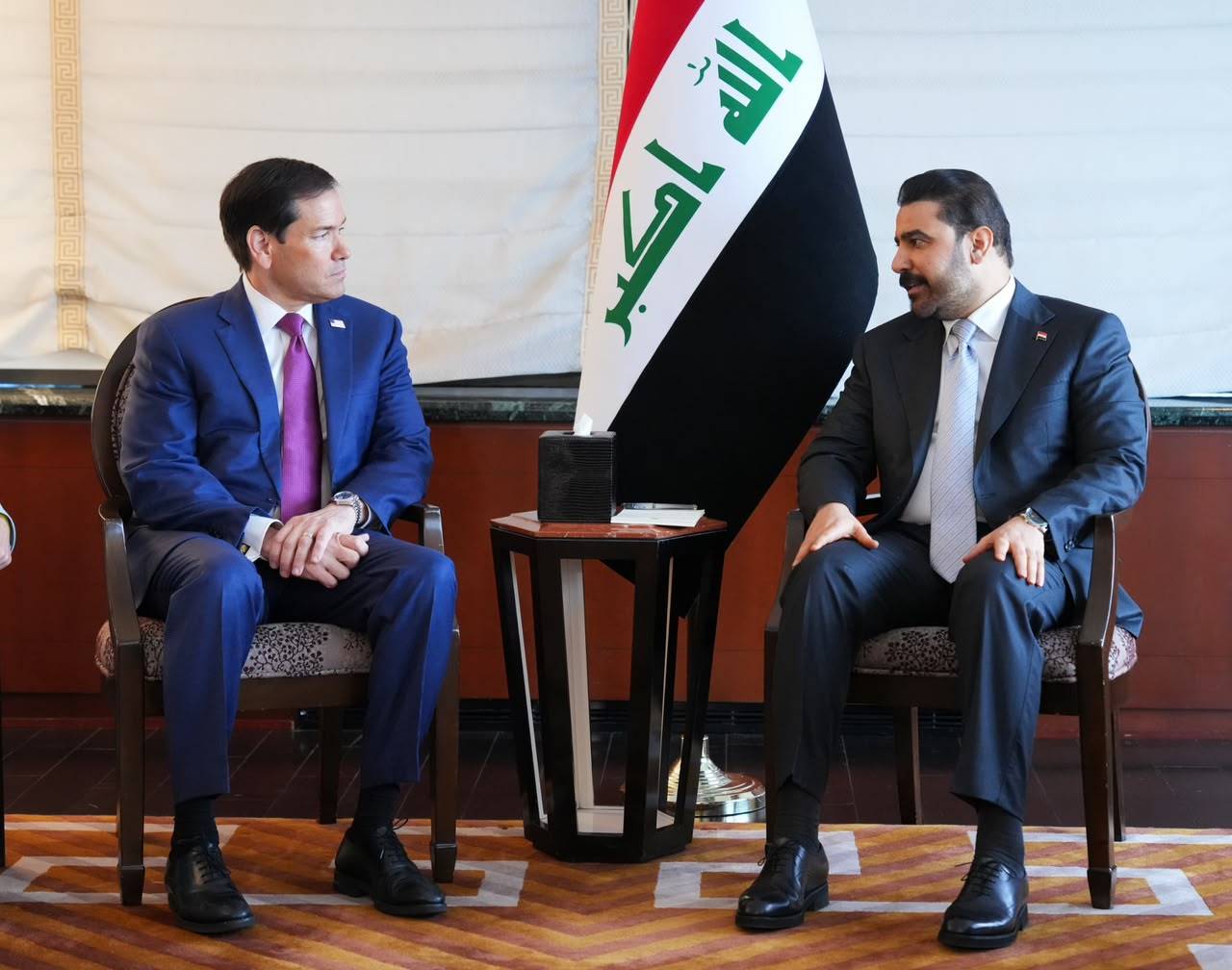

Meeting between al-Zaidi, Trump Raises Questions in Baghdad

Iraqi Prime Minister Ali al-Zaidi meets with US President Donald Trump in New York on September 23, 2026. (Iraqi government)
TT

Meeting between al-Zaidi, Trump Raises Questions in Baghdad

Iraqi Prime Minister Ali al-Zaidi meets with US President Donald Trump in New York on September 23, 2026. (Iraqi government)

A meeting between US President Donald Trump and Iraqi Prime Minister Ali al-Zaidi in New York has raised questions due to the complete absence of the Iraqi delegation, coming just one day after Baghdad’s announcement that it would complete the plan to impose state monopoly over arms in June 2027.

The plan was supposed to be complete by the end of September, but it was postponed to next year.

A photograph released by the Iraqi government's media office on Wednesday showed al-Zaidi alone during the meeting, which was attended by Trump alongside senior US administration officials, including US Secretary of State Marco Rubio and Treasury Secretary Scott Bessent.

Al-Zaidi's office said that he discussed with Trump efforts by Iraq and the US to boost regional and international security and stability.

The government offered no explanation about the absence of the Iraqi delegation, which included the ministers of foreign affairs, finance, and electricity, and other officials.

Iraqi observers said al-Zaidi attended the meeting alone due to American suspicions that the discussions may be leaked to other delegation members, who are members of the Iran-aligned Coordination Framework coalition.

An Iraqi politician close to the State Administration coalition said the way the meeting was held “reflects American unease, especially by Trump, over the stalled process to impose state monopoly over weapons.”

According to official statements, September 30 will not mark the completion of the arms control process, but it will instead serve as the launching point for a new phase extending until June 2027.

Iraqi Prime Minister Ali al-Zaidi meets with US Secretary of State Marco Rubio in New York. (Iraqi government)

Al-Zaidi has evidently managed to convince the Americans to grant an additional grace period for the arms control plan, particularly after the new deadline was backed by US envoy to Iraq Tom Barrack.

Independent Iraqi politician Salah al-Arbawi said it remains to be seen whether the timetable that will be announced at the end of the month will tip the balance in favor of any political parties in the dispute over the factions’ weapons.

In remarks to Asharq Al-Awsat, he said the political parties must handle the factions’ weapons “rationally and calmly.”

He noted that al-Zaidi has managed to restore his control over the plan after it encountered obstacles in recent weeks.

Experts believe that recent discussions on the amendment of the arms control plan could turn into an opportunity to improve Iraqi-American relations.

Researcher Abbas Abboud said that the Iraqi-American relationship is being “restructured” by Barrack.

Baghdad’s relations with Washington’s allies in the region hinge on “decoupling Iraq from Iran”, he told Asharq Al-Awsat.

US Secretary of State Marco Rubio had issued a direct warning to Baghdad to "disarm the militias to avoid the balkanization of Iraq."

Rubio underlined US support for al-Zaidi's government in its efforts to consolidate state authority, urging the need to dismantle armed factions.


Lebanon PM Tells Iran President Country Cannot Be Arena for Regional Wars

Lebanese Prime Minister Nawaf Salam and Iranian President Masoud Pezeshkian meet on the sidelines of the UN General Assembly in New York. (NNA)
TT

Lebanon PM Tells Iran President Country Cannot Be Arena for Regional Wars

Lebanese Prime Minister Nawaf Salam and Iranian President Masoud Pezeshkian meet on the sidelines of the UN General Assembly in New York. (NNA)

Lebanese Prime Minister Nawaf Salam told Iranian President Masoud Pezeshkian on Thursday that his country did not want to be an arena for regional wars, after Tehran-backed Hezbollah drew it into the Middle East conflict.

Lebanon has repeatedly accused Iran of interfering in its affairs, especially since the start of the latest war, saying that Tehran was using it as a "bargaining chip" in talks with the United States.

Salam's office said in a statement that he met with Pezeshkian on the sidelines of the United Nations General Assembly in New York.

Salam "stressed that Lebanon has paid a heavy price in terms of its security, stability and economy, and that it does not want to become an arena for regional conflicts or a venue for the exchange of messages between others", it said.

Hezbollah dragged Lebanon into the broader Middle East war, which began with Israeli-US strikes on Iran, by attacking Israel in support of Tehran on March 2.

Israel responded with major airstrikes and a ground invasion that killed more than 4,300 people.

The war followed a 2023-2024 conflict between Hezbollah and Israel, which started when the group attacked Israel in support of its ally Hamas in the Gaza Strip.

Violence declined following a June framework agreement between Lebanon and Israel and a wider US-Iran deal, but Israel has continued to carry out attacks on its northern neighbor.

Salam said his country looked forward "to turning a new page" in its ties with Iran.

He called for "building a sound state-to-state relationship based on mutual respect for each country's sovereignty and independence, non-interference in each other's affairs and shared interests".

Salam said the priority was for "Israel to fully withdraw from Lebanese territory and cease its attacks, and for Lebanon to move forward with extending the authority of the Lebanese state over all of its territory".

He said Lebanon needed to ensure "that weapons are held exclusively by the state", in a jab at Hezbollah, which has so far refused to lay down its arms.

In an interview with AFP last week, Lebanese President Joseph Aoun said bilateral relations "must be based on mutual respect and non-interference".


US to Hand Over Center at Baghdad Airport, Says Iraqi FM

A man walks past a billboard displaying the Iraqi flag in Baghdad's central Tahrir Square on September 22, 2026. (AFP)
TT

US to Hand Over Center at Baghdad Airport, Says Iraqi FM

A man walks past a billboard displaying the Iraqi flag in Baghdad's central Tahrir Square on September 22, 2026. (AFP)

The United States will transfer to Iraq a diplomatic and logistics hub at Baghdad airport that was repeatedly targeted by Iran-backed groups during the Middle East war, the foreign ministry said Thursday.

It said an agreement was signed with the US charge d'affaires Steven Fagin "to hand over the diplomatic support center affiliated with the US embassy at Baghdad International Airport to the Iraqi government".

The move, it added, was part of efforts to end the US-led coalition's military presence in Iraq, with the remaining troops set to complete their exit by September 30.

For years, Iran-backed armed groups that have long called for the withdrawal of foreign troops have targeted US facilities and coalition forces in Iraq.

During the Middle East war, those groups targeted US sites more than 600 times, including the Baghdad airport facility.

An Iraqi security official and a diplomatic source told AFP earlier this month that US troops have already evacuated the site.

Baghdad and Washington agreed in 2024 to end the coalition's mission against the ISIS group in Iraq.

Coalition forces are now only present at Erbil airport after having withdrawn from other bases.

The coalition's presence, especially after the defeat of ISIS, has been a persistent point of friction between Iraqi authorities and Tehran-backed factions in the country.

Since taking office this year, Prime Minister Ali al-Zaidi has pledged to reinforce the state's monopoly on arms and ensure that armed factions hand over their arms to the state.

Authorities say that ending the coalition's mission removes a key justification used by those groups to keep their weapons.
