


Spain Deploys Army in Ceuta to Patrol Border with Morocco after Migrants Break in

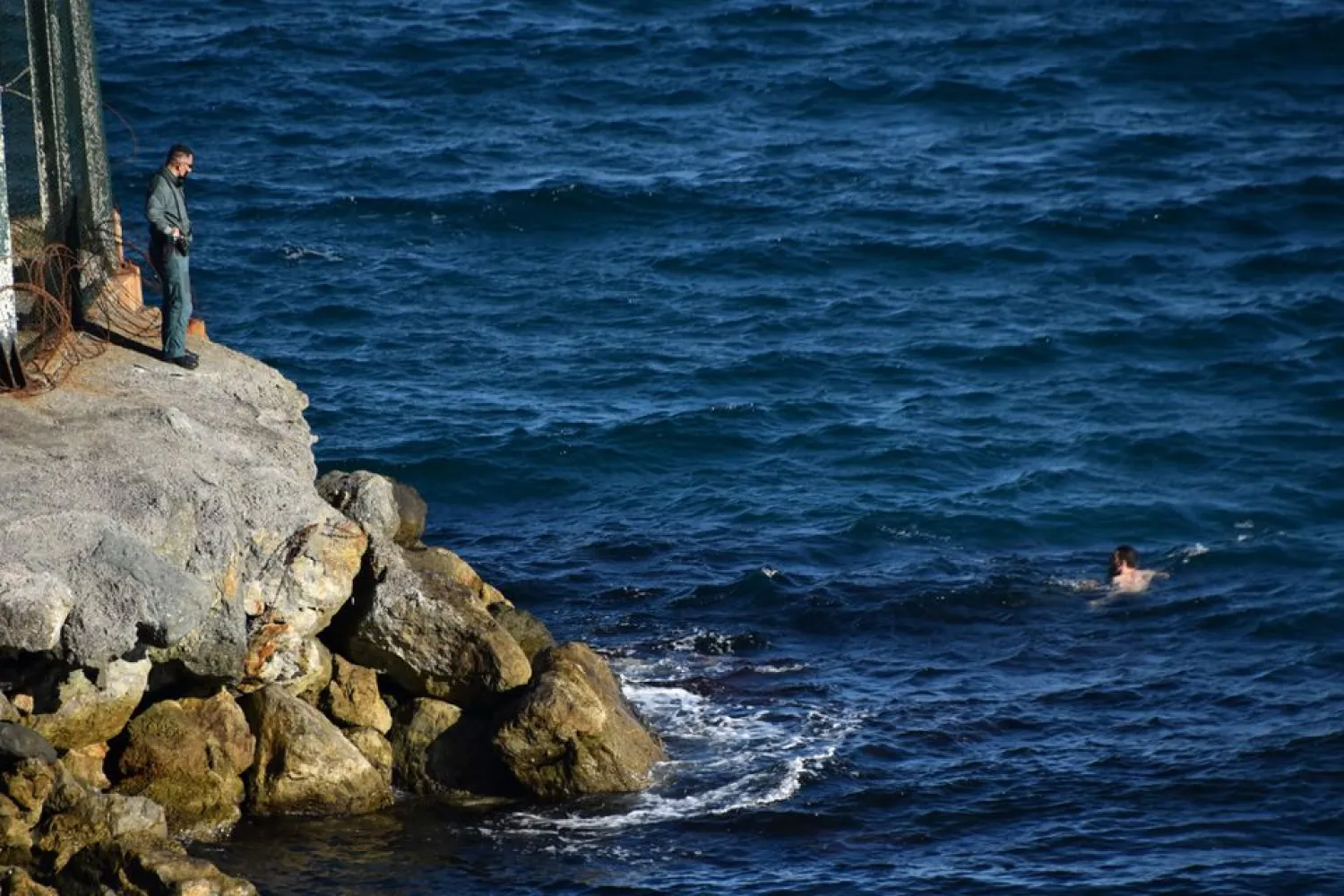
A migrant crosses the Spanish-Moroccan border in the presence of a Spanish civil guard in Ceuta, Spain, May 17, 2021. (Reuters)
TT

Spain Deploys Army in Ceuta to Patrol Border with Morocco after Migrants Break in

A migrant crosses the Spanish-Moroccan border in the presence of a Spanish civil guard in Ceuta, Spain, May 17, 2021. (Reuters)

The Spanish government has deployed troops to Ceuta to patrol the border with Morocco after thousands of migrants swam into the northern African enclave, a source from the Interior Ministry said on Tuesday.

Soldiers will patrol the border along with Spanish police.

"This starts immediately," the source said, without specifying how many troops will be deployed.

A spokesman for Ceuta's government delegation said soldiers will work with police in sensitive locations within the enclave to maintain order on the streets.

As many as 6,000 Moroccans, including about 1,500 minors, swam into Ceuta on Monday and Tuesday, Interior Minister Fernando Grande-Marlaska said.

One person died in the attempt, a Spanish government delegation spokesman said.

The adult arrivals are being transferred to a local football stadium to be handed back to Morocco. Minors are being sent to an industrial building.

Ceuta, with a population of 80,000, is an enclave located on the northern tip of Morocco across from Gibraltar.

The Spanish enclaves of Ceuta and nearby Melilla on Morocco's northern coast have long been a magnet for African migrants trying to reach Europe in search of a better life.

Spanish TV channel 24h reported on Tuesday morning that as many as 85 migrants climbed the border fence to break into Melilla, which is located about 300km east of Ceuta on the Moroccan shore.

The arrival of the migrants took place at a time of increased tension between Spain and Morocco over the fate of Brahim Ghali, the leader of the Western Sahara's Polisario Front, who is in hospital in Spain.

Morocco's Foreign Ministry issued a strongly worded statement last month deploring what it said was the decision of Spain to admit Ghali under a false identity without informing Morocco, adding that the situation would have repercussions for relations between the countries.

The United States in December recognized Moroccan sovereignty over the Western Sahara territory, which is also claimed as an independent state by the Polisario Front.

Ghali is hospitalized in Spain, a Spanish diplomatic source told Reuters.

Ghali was accepted into Spain on humanitarian grounds, Spanish Foreign Minister Arancha Gonzalez Laya told Cadena SER radio on Monday evening.



Glitch Delays Restart of World's Biggest Nuclear Plant in Japan

Local Japanese authorities have approved the restart of the world's biggest nuclear power facility, the Kashiwazaki-Kariwa Nuclear Power Plant, for the first time since the 2011 Fukushima disaster. STR / JIJI Press/AFP
TT

Glitch Delays Restart of World's Biggest Nuclear Plant in Japan

Local Japanese authorities have approved the restart of the world's biggest nuclear power facility, the Kashiwazaki-Kariwa Nuclear Power Plant, for the first time since the 2011 Fukushima disaster. STR / JIJI Press/AFP

A technical glitch pushed back the restart of the world's biggest nuclear reactor in Japan, its operator said on Monday, a day before local media reported it would go online.

Tokyo Electric Power Company (TEPCO) said it would need another day of two to check the equipment at the Kashiwazaki-Kariwa plant, which media reports said was set to restart on Tuesday.

The plant was taken offline when Japan pulled the plug on nuclear power after a colossal earthquake and tsunami sent three reactors at the Fukushima plant into meltdown in 2011.

The Kashiwazaki-Kariwa facility would be the first nuclear plant that Fukushima operator TEPCO restarts since the disaster.

The company has never publicly announced a date to switch on the plant.

TEPCO has decided to run more checks after detecting a technical issue on Saturday related to an alarm linked to one of the reactors at Kashiwazaki-Kariwa, company spokesman Isao Ito told AFP.

The alarm issue had been fixed by Sunday, he added.

After the final checks, the utility will explain to nuclear authorities what had happened and proceed to restart the plant, the spokesman said, without providing an exact timeline.

More than a decade since the Fukushima accident, Japan now wants to revive atomic energy to reduce its dependence on fossil fuels, achieve carbon neutrality by 2050 and meet growing energy needs from artificial intelligence.

But it is a divisive issue, with many residents worried about nuclear safety.

About 50 people gathered Monday outside TEPCO's headquarters in the capital Tokyo, chanting "No to the restart of Kashiwazaki-Kariwa!"

"TEPCO only mentions a possible delay. But that's not enough," said Takeshi Sakagami, president of the Citizens' Nuclear Regulatory Watchdog Group.

"A full investigation is needed, and if a major flaw is confirmed, the reactor should be permanently shut down," he said at the rally.

The reactor has cleared the nation's nuclear safety standard.

Prime Minister Sanae Takaichi has voiced her support for the use of nuclear power.

Japan is the world's fifth-largest single-country emitter of carbon dioxide, and is heavily dependent on imported fossil fuels.


Trump Says 'World Is Not Secure' Unless US Controls Greenland

Danish soldiers walk in front of Joint Arctic Command in Nuuk, Greenland, January 16, 2026. REUTERS/Marko Djurica
TT

Trump Says 'World Is Not Secure' Unless US Controls Greenland

Danish soldiers walk in front of Joint Arctic Command in Nuuk, Greenland, January 16, 2026. REUTERS/Marko Djurica

President Donald Trump told the Norwegian prime minister in a message published Monday that the world would not be secure unless the US controlled the Danish autonomous territory of Greenland.

"The World is not secure unless we have Complete and Total Control of Greenland," Trump said in the message to Jonas Gahr Store.

The authenticity of the message was confirmed to AFP by Store's office.


Death Toll in Spanish Train Collision Rises to at Least 39 as Rescue Efforts Continue

Members of the Spanish Civil Guard, along with other emergency personnel, work next to one of the trains involved in the accident, at the site of a deadly derailment of two high-speed trains near Adamuz, in Cordoba, Spain, January 19, 2026. (Reuters)
TT

Death Toll in Spanish Train Collision Rises to at Least 39 as Rescue Efforts Continue

Members of the Spanish Civil Guard, along with other emergency personnel, work next to one of the trains involved in the accident, at the site of a deadly derailment of two high-speed trains near Adamuz, in Cordoba, Spain, January 19, 2026. (Reuters)

Spanish police said Monday that at least 39 people are confirmed dead in a high-speed train collision the previous night in the south of the country, and rescue efforts were continuing.

Video and photos showed twisted train cars lying on their sides under floodlights. Passengers reported climbing out of smashed windows, with some using emergency hammers to break the windows, according to Salvador Jiménez, a journalist for Spanish broadcaster RTVE, who was on board one of the derailed trains.

He told the network by phone Sunday that “there was a moment when it felt like an earthquake and the train had indeed derailed.”

The crash occurred when the tail end of a train carrying some 300 passengers on the route from Malaga to the capital, Madrid, went off the rails at 7:45 p.m. It slammed into an incoming train traveling from Madrid to Huelva, another southern Spanish city, according to rail operator Adif.

The collision took place near Adamuz, a town in the province of Cordoba, about 370 kilometers (about 230 miles) south of Madrid.

Spanish police said 159 people were injured, of whom five were in critical condition. A further 24 were in serious condition, authorities said. Transport Minister Óscar Puente said the death toll was not final.

In Adamuz, a sports center was turned into a makeshift hospital and the Spanish Red Cross set up a help center offering assistance to emergency services and people seeking information. Members of Spain’s civil guard and civil defense worked on site throughout the night.

Puente early Monday said the cause of the crash was unknown.

He called it “a truly strange” incident because it happened on a flat stretch of track that had been renovated in May. He also said the train that jumped the track was less than 4 years old. That train belonged to the private company Iryo, while the second train, which took the brunt of the impact, was part of Spain’s public train company, Renfe.

According to Puente, the back part of the first train derailed and crashed into the head of the other train, knocking its first two carriages off the track and down a 4-meter (13-foot) slope. He said the worst damage was to the front section of the Renfe train.

When asked by reporters how long an inquiry into the crash’s cause could take, he said it could be a month.

Spanish Prime Minister Pedro Sánchez expressed his condolences to the victims' families. “Tonight is a night of deep pain for our country,” he wrote on X.

Spain has the largest rail network in Europe for trains moving over 250 kph (155 mph), with more than 3,100 kilometers (1,900 miles) of track, according to the European Union.

The network is a popular, competitively priced and safe mode of transport. Renfe said more than 25 million passengers took one of its high-speed trains in 2024.

Train services Monday between Madrid and cities in Andalusia were canceled.

Spain’s worst train accident this century occurred in 2013, when 80 people died after a train derailed in the country’s northwest. An investigation concluded the train was traveling 179 kph (111 mph) on a stretch with an 80 kph (50 mph) speed limit when it left the tracks.