

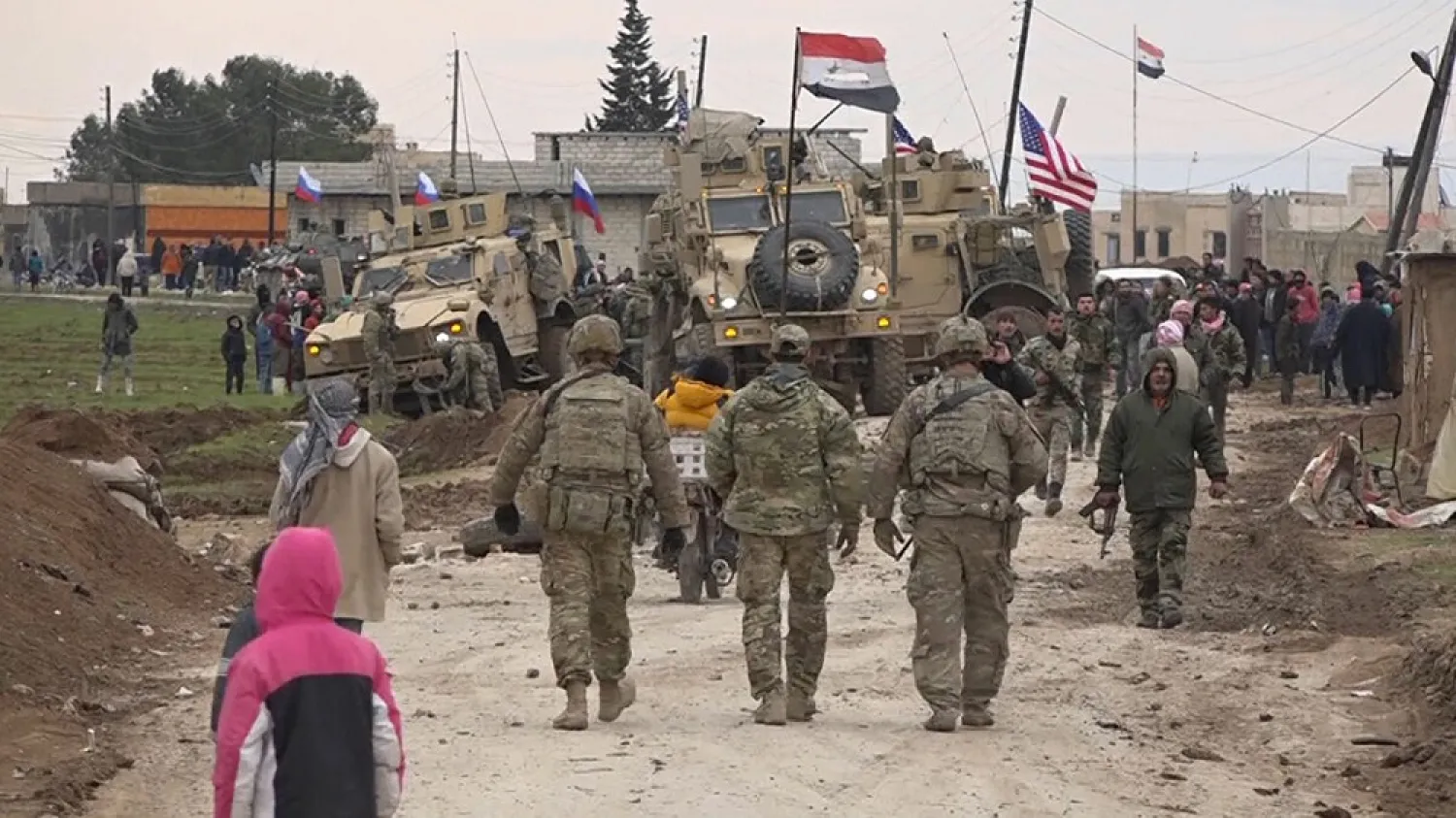

The Putin-Biden Summit and Syrian Relief

American and Russian forces deployed in the region east of the Euphrates. (AFP)
TT

The Putin-Biden Summit and Syrian Relief

American and Russian forces deployed in the region east of the Euphrates. (AFP)

“Syrian relief” is one of the four clear elements of US President Joe Biden’s policy in Syria. The priorities include military survival in the region east of the Euphrates River to ensure the defeat of ISIS and the continuation of pressure on Damascus over its use of chemical weapons, in addition to rhetorical support for the implementation of United Nations Security Council Resolution 2254 and diplomatic efforts to prevent “normalization” with the Syrian government.

But cross-border humanitarian aid prevailed over all others and became the window through which the Biden administration looks out onto the Syrian scene.

The United States is hoping that Biden will obtain the approval of Russian President Vladimir Putin when they meet in Geneva on June 16, and that the latter will not veto the extension of Security Council Resolution 2533, which allows for the provision of the cross-border aid.

The only common point that was reiterated in official statements of members of Biden’s team during their contacts with their counterparts and allies was humanitarian aid and ensuring its access to the Syrians. During a donors’ conference in Brussels in March, Biden assigned US Ambassador to the United Nations Linda Thomas-Greenfield to represent his government and announce additional aid, bringing the total value to about USD 13 billion during the ten years of the Syrian conflict.

Moreover, Secretary of State Antony Blinken chaired a meeting of the Security Council devoted to humanitarian aid in March, to give impetus to this file. He also raised this issue when he met his Russian counterpart, Sergei Lavrov, last month in preparation for the Putin-Biden summit.

The US further made its intentions clear when Thomas-Greenfield visited Turkey where she met on Wednesday with spokesman of the Turkish President Ibrahim Kalin in Ankara. Turkey is the gateway to northern Syria, where more than 3.5 million displaced people and Syrian citizens live.

The Security Council adopted Resolution 2165 in 2014 and provided for the delivery of aid to Syria “across the borders” of Turkey, Iraq and Jordan. However, in July last year, Russia agreed on the opening of one crossing, “Bab al-Hawa”, between Turkey and Idlib, to put pressure on western countries to focus their work in Damascus and government-controlled areas.

But the Biden administration has set its sight on the reopening of three crossings: two with Turkey, and a third between the region east of the Euphrates and Iraq. US diplomats have launched a campaign to provide support for this effort.

The Kremlin, however, recently began sending signals of an intention to use a “veto” against the decision to extend the mandate for aid through a single border crossing. The White House responded by providing “incentives” to soften the Russian position.

In parallel to mobilizing support among allies, Washington sent signs of encouragement to Moscow, which included a series of steps, mainly refraining from issuing any new sanctions under the Caesar Act, providing exemptions on the transfer of medicine and food and allowing the delivery of humanitarian aid from Arab countries to Damascus.

The American administration has also recently canceled a waiver that was granted to the Delta Crescent Energy company to invest in oil in the areas east of the Euphrates, which are controlled by the US-backed Kurdish Syrian Democratic Forces. The US Army also strengthened its presence east of the Euphrates.

So far, Washington has not received any clear indications about Moscow’s decision. But they will be revealed at the upcoming Geneva summit, if time allows the participants to discuss Syria. Then Biden will determine whether Putin appreciates the “humanitarian incentives” offered by Washington or will challenge the reinforced military deployment near his forces east of the Euphrates.



Costs to Lebanon of Latest Israel-Hezbollah War

 Sukaina al-Muhtadi, 22, who returned to her village following the announcement of an initial ceasefire agreement between the United States and Iran, search for her belongings between the rubble of her destroyed house in Nabatieh town, southern Lebanon, Tuesday, June 16, 2026. (AP)
Sukaina al-Muhtadi, 22, who returned to her village following the announcement of an initial ceasefire agreement between the United States and Iran, search for her belongings between the rubble of her destroyed house in Nabatieh town, southern Lebanon, Tuesday, June 16, 2026. (AP)
TT

Costs to Lebanon of Latest Israel-Hezbollah War

 Sukaina al-Muhtadi, 22, who returned to her village following the announcement of an initial ceasefire agreement between the United States and Iran, search for her belongings between the rubble of her destroyed house in Nabatieh town, southern Lebanon, Tuesday, June 16, 2026. (AP)
Sukaina al-Muhtadi, 22, who returned to her village following the announcement of an initial ceasefire agreement between the United States and Iran, search for her belongings between the rubble of her destroyed house in Nabatieh town, southern Lebanon, Tuesday, June 16, 2026. (AP)

Lebanon has suffered the deadliest spillover of the regional war ‌triggered by the US-Israeli strikes on Iran more than three months ago, which is set to end with a deal between Washington and Tehran.

The conflict spread to Lebanon on March 2, when Iran-backed group Hezbollah fired on Israel in support of Tehran, triggering an Israeli air and ground campaign.

Here are some of the main costs for Lebanon.

CASUALTIES

From March 2 until June 14, the night the US-Iran deal was announced, at least 3,783 people were killed and 11,699 wounded in Lebanon, according to the country's health ministry. The death toll included 247 children, 363 women and 133 healthcare workers. The ministry's figures do not distinguish between civilians and combatants, and Hezbollah has not said how many of its fighters were killed.

The toll surpasses the 3,468 killed in Iran as of late April, when a US-Iran ceasefire was reached.

It is also ‌higher than the ‌ministry's figures for the last Israel-Hezbollah conflict, which lasted from October 2023 ‌to November ⁠2024. That war ⁠saw 3,768 people killed, the vast majority of whom were killed after Israel went on the offensive in September 2024.

At least 28 Israeli soldiers have been killed in Lebanon in the latest war, according to a Reuters tally of Israeli military announcements, while four civilians have been killed in Hezbollah attacks. That compares with 73 Israeli soldiers and 45 civilians in northern Israel in the 2023-2024 war.

DESTRUCTION

Israel's airstrikes have damaged and destroyed buildings across Lebanon. Most of the damage has been concentrated in the south, but buildings were also ⁠destroyed in the capital and its southern suburbs.

Israeli troops occupying a southern swathe ‌of the country have also flattened dozens of villages there, ‌saying their aim is to keep residents of northern Israel safe from attacks by Hezbollah fighters embedded in civilian ‌areas.

Buildings damaged in the south within the first month of the war included hospitals, power stations ‌and water pumping stations.

A man who returns to his village following the announcement of an initial ceasefire agreement between the United States and Iran, flashes victory sign as he stands on the rubble of his destroyed house in Nabatieh town, southern Lebanon, Tuesday, June 16, 2026. (AP)

The latest figures from Lebanon's National Council for Scientific Research, which cover the period from March 2 until May 17, show that more than 68,000 housing units across the country have been damaged or destroyed. Nearly 30,000 of those units are in the three southernmost districts of Lebanon, and more than 8,000 in Beirut and ‌its southern suburbs.

In a report published this month, the United Nations Development Program said that in Beirut and the southern suburbs alone, the damage ⁠amounted to $365 million.

DISPLACEMENT

More than ⁠1.2 million people have been displaced by Israel's airstrikes and evacuation warnings across Lebanon since March 2, according to Lebanese authorities.

They include hundreds of thousands of people who fled Beirut's southern suburbs, which Israel's military ordered entirely evacuated for the first time during this war.

Even after the announcement of the US-Iran deal, many displaced did not return home - either because they had no homes to return to or because they were skeptical the ceasefire would hold in Lebanon.

ECONOMIC IMPACT

Lebanon's authorities have not yet assessed the full scale of the war's economic impact, but have said that it derailed the country's recovery from a series of recent crises, including the 2023-2024 war, the Beirut port blast of 2020 and the financial collapse of 2019.

Finance Minister Yassine Jaber told Reuters in May that the war could see Lebanon's economy contract by at least 7% this year.

The 2024 war cost Lebanon at least $8.5 billion in physical damage and economic losses, according to the World Bank. Lebanon's real GDP contracted by 7.1% in 2024, the World Bank said, leading to a cumulative GDP decline of nearly 40% since 2019.


Gaza Tailor Turns Waste Fabrics Into Dresses for Girls

Palestinian dressmakers add skirt hoops to a child's gown, at a workshop where dresses are created including evening and wedding gowns despite limited resources and old dresses are recycled, in the city of Khan Yunis in the southern Gaza Strip on June 13, 2026. (Photo by BASHAR TALEB / AFP) /
TT

Gaza Tailor Turns Waste Fabrics Into Dresses for Girls

Palestinian dressmakers add skirt hoops to a child's gown, at a workshop where dresses are created including evening and wedding gowns despite limited resources and old dresses are recycled, in the city of Khan Yunis in the southern Gaza Strip on June 13, 2026. (Photo by BASHAR TALEB / AFP) /

A young Gazan girl twirls across the floor of a dressmaker's shop, her white dress billowing around her as a shy smile spreads across her face.

Trimmed with delicate tulle and topped with a soft veil, the dress looks fit for a celebration.

Few would guess that parts of it are from discarded fabric or an old gown salvaged from the ruins of the Israel-Hamas war in Gaza.

The dress is the work of 24-year-old tailor Amir al-Rantisi, who has made it his mission to provide elegant dresses for special occasions for young girls and women in southern Gaza's Khan Yunis area.

He does this by recycling used fabrics and old dresses.

"When I go to Gaza (City) to get the fabric, I take it from a place that's been destroyed, from old fabric that's available, which was probably damaged by shrapnel or burnt," Amir told AFP.

"I select pieces from it, and I make dresses from those pieces. I also take old dresses and recycle them."

Palestinian women shop for dresses in the city of Khan Yunis in the southern Gaza Strip on June 13, 2026. (Photo by BASHAR TALEB / AFP)

Outside the shop, his colorful creations in satin, organza and tulle hang from makeshift mannequins fashioned from iron poles -- vivid splashes of color against a backdrop of grey concrete and blackened buildings.

Several elegant long gowns are displayed on cement mannequins outside the shop, while colorful frocks sway gently from a clothesline stretched across the storefront, allowing customers to inspect the garments with ease.

Inside the workshop, neat rows of ready-to-wear dresses line the walls. Nearby, a customer dressed in a black abaya carefully examines a small dress, considering its intricate details.

The workshop itself hums with activity. On a table beside a collapsed wall, piles of old dresses sit waiting to be given new life as festive creations.

His mother, Nisreen al-Rantisi, works alongside him in the workshop, while another assistant tailor attentively takes the measurements of a young girl.

As Nisreen sorts through the colorful fabrics, selecting the perfect materials for the next creation, the assistant tailor deftly guides his scissors through a length of cloth, skillfully shaping it into what will soon become a beautifully crafted dress.

A Palestinian dressmaker sits at a sewing machine as he assembles a gown in the city of Khan Yunis in the southern Gaza Strip on June 13, 2026. (Photo by BASHAR TALEB / AFP)

Keeping the business running, however, requires constant improvisation.

"We suffer greatly from power outages," said mother Nisreen al-Rantisi.

"Sometimes, we have orders or work that we can't complete."

Amir has found a way to tackle that too.

He has rigged an old bicycle pedal to his sewing machine, a makeshift solution to keep working through the frequent power cuts that plague the devastated Gaza Strip.

But it is difficult and inconvenient, said his mother.

"Sewing is done manually; one person has to sew while the other has to do the rest," she said.

Meanwhile, the cost of supplies has soared.

With imports into Gaza severely restricted and shortages widespread, even basic materials have become difficult to obtain.

"This spool of black thread is no longer available, and even if it's available, it used to cost seven shekels ($2.40), but now it's 50," said Amir.

Israel controls all entry points into the territory, and the number of trucks carrying foreign aid and private sector goods remains far too low to ease war-inflated prices or shortages, according to NGOs on the ground.

Yet, as the little girl spins once more in her white dress, her eyes wide with joy, Amir's work offers a rare reminder of how residents of Gaza are finding ways to create and celebrate despite the hardships of war.


Netanyahu and Trump on Collision Course as US, Iran Agree to Halt War

Israeli Prime Minister Benjamin Netanyahu holds a news conference in Jerusalem, 15 June 2026, following the announcement of a US-Iran mediated preliminary framework to end regional military hostilities. (EPA)
TT

Netanyahu and Trump on Collision Course as US, Iran Agree to Halt War

Israeli Prime Minister Benjamin Netanyahu holds a news conference in Jerusalem, 15 June 2026, following the announcement of a US-Iran mediated preliminary framework to end regional military hostilities. (EPA)

Benjamin Netanyahu bet that his joint war alongside Donald Trump would topple Iran's clerical rulers and bolster himself ahead of elections at home, as the architect of a US-Israeli alliance that would reshape the Middle East.

Instead, Israel's longest-serving prime minister is on a collision course with Trump as the US president seeks to extricate himself from the war, with both men's goals unmet and Israeli military operations tied down in Lebanon.

For now, Israeli officials have been cautious in public for fear of angering their most important ally, known for being prickly towards critics.

But in private conversations, the frustration is clear. The preliminary agreement is "terrible for Israel," said one senior Israeli official, giving a frank assessment on condition of anonymity. "And there is no one in the Israeli leadership who views it otherwise, from the prime minister to the chief of staff."

Washington says that over the next 60 days, when a ceasefire is in place, it will negotiate full terms that will address US and Israeli concerns, especially over Iran's nuclear program.

But Israeli officials told Reuters they thought the negotiating period under the deal was likely to be extended, tying Israel's hands from taking military action, while its concerns remain unresolved.

Netanyahu and Trump have repeatedly clashed over Israel's refusal to constrain its pursuit of Iran-backed Hezbollah in Lebanon, where a cessation of hostilities is a key Iranian demand.

At the start of the month, Trump described ‌Netanyahu as "[expletive] crazy" in ‌an angry phone call, ordering him not to strike Beirut while the US was seeking a deal with Iran.

Netanyahu called ‌off attacks ⁠that day, but ⁠struck Beirut's southern suburbs a week later, provoking Iranian missile strikes on Israel and a public rebuke of both sides from Trump.

Hours before the US and Iran announced their interim deal, Israel hit the Lebanese capital again on Sunday, after rockets were launched at Israel from Lebanon, fire Trump described as "small and meaningless".

Netanyahu said that Israel has emerged "strong and steady," with a leadership that stands firm and wise. At a press conference in Jerusalem late on Monday, he acknowledged that he and Trump have sometimes had their differences.

"He is the president of the United States, I am the prime minister of Israel. We many times see eye-to-eye and there are times when we see eye-to-eye less so. I am in charge of Israel's security interests," Netanyahu said.

Netanyahu, facing autumn elections he is projected to lose, may be more willing to defy Trump as he contends with an Israeli public that opinion polls show has grown skeptical of the US president's commitment to Israel's security.

"This is ⁠a pretty stark moment of divergence of interests," said Dan Shapiro, a former US ambassador to Israel under the Obama administration, now ‌with the Atlantic Council think tank.

"He will try to not openly oppose (the deal), so as not to get into ‌a brawl with Trump," said Shapiro. "But he will indicate Israel is not bound by it, and Israel reserves its rights."

ISRAEL SAYS IT'S NOT BOUND BY US-IRAN PACT

The memorandum of understanding between the US ‌and Iran is expected to be signed on Friday in Switzerland. While precise terms were not immediately known, mediator Pakistan said the pact called for a permanent halt to military ‌operations on all fronts, including in Lebanon.

Netanyahu said that Israel would keep its forces in southern Lebanon and maintain “freedom of action” against Hezbollah attacks.

"Iran wanted us to withdraw from it but I stood firm," he told reporters.

"We are keeping our freedom of action and we are keeping the security zone to protect (Israel's) northern citizens," he said.

The interim deal would reopen the Strait of Hormuz oil chokepoint while leaving the fate of Tehran's nuclear program to be resolved during a 60-day negotiation period towards a final deal.

Two other issues that Netanyahu and Trump had both declared as justifications for the war at its outset - curbing Iran's missile ‌program and ending its support for regional armed groups - are not thought to be on the agenda during those talks.

Three Israeli officials said Israel sees it as very likely the 60-day pact will be extended to 90 days, with the US maintaining ⁠its deployment of military assets in the region ⁠as it negotiates a broader deal.

Two other Israeli officials said that Israel was caught by surprise last week when Trump first said that a deal with Iran was close. They acknowledged that Israel has had little success in influencing the talks.

All of the officials spoke on condition of anonymity because they weren't authorized to speak publicly.

NETANYAHU UNABLE TO SELL THIS AGREEMENT TO ISRAELI PUBLIC, ANALYST SAYS

Netanyahu, who often clashed with Washington under the administrations of Democrats Barack Obama and Joe Biden, has long portrayed himself to the Israeli public as being uniquely adept in dealing with the Republican Trump.

During Trump's first term, Israel secured major policy changes from Washington, which moved its embassy to Jerusalem and backed the Abraham Accords that brought Israel formal diplomatic ties with the UAE and Bahrain.

On Iran, Trump ditched a nuclear agreement negotiated under Obama that Israel had long complained was too soft.

During elections in 2019, Netanyahu displayed massive campaign billboards in Tel Aviv and Jerusalem showing him and Trump smiling and shaking hands.

But now, the US-Iran pact undermines Netanyahu's case that a close relationship with Trump sets him apart from other candidates for prime minister, said Jonathan Rynhold, a political scientist at Bar-Ilan University, near Tel Aviv.

"(Netanyahu) will be unable to sell this agreement to the Israeli public," Rynhold said. "The best that he can hope for is that they fail to reach an agreement and the war restarts to Israel's advantage in 60 days."

According to a poll released on Friday by the Israel Democracy Institute, just 41% of Jewish Israelis think their security is a central consideration for Trump, down from 64% in March.

Eli Cohen, Netanyahu's energy minister, said that Israel would be prepared to act alone if Iran rebuilds its nuclear and missile capabilities, though he said the chances of Tehran taking that step during Trump's tenure were low.

"If Iran tries to renew its nuclear and ballistic missile programs - we will be there and act," Cohen told Israel's public broadcaster Kan.