


Hundreds Arrested in 'Staggering' Global Crime Sting

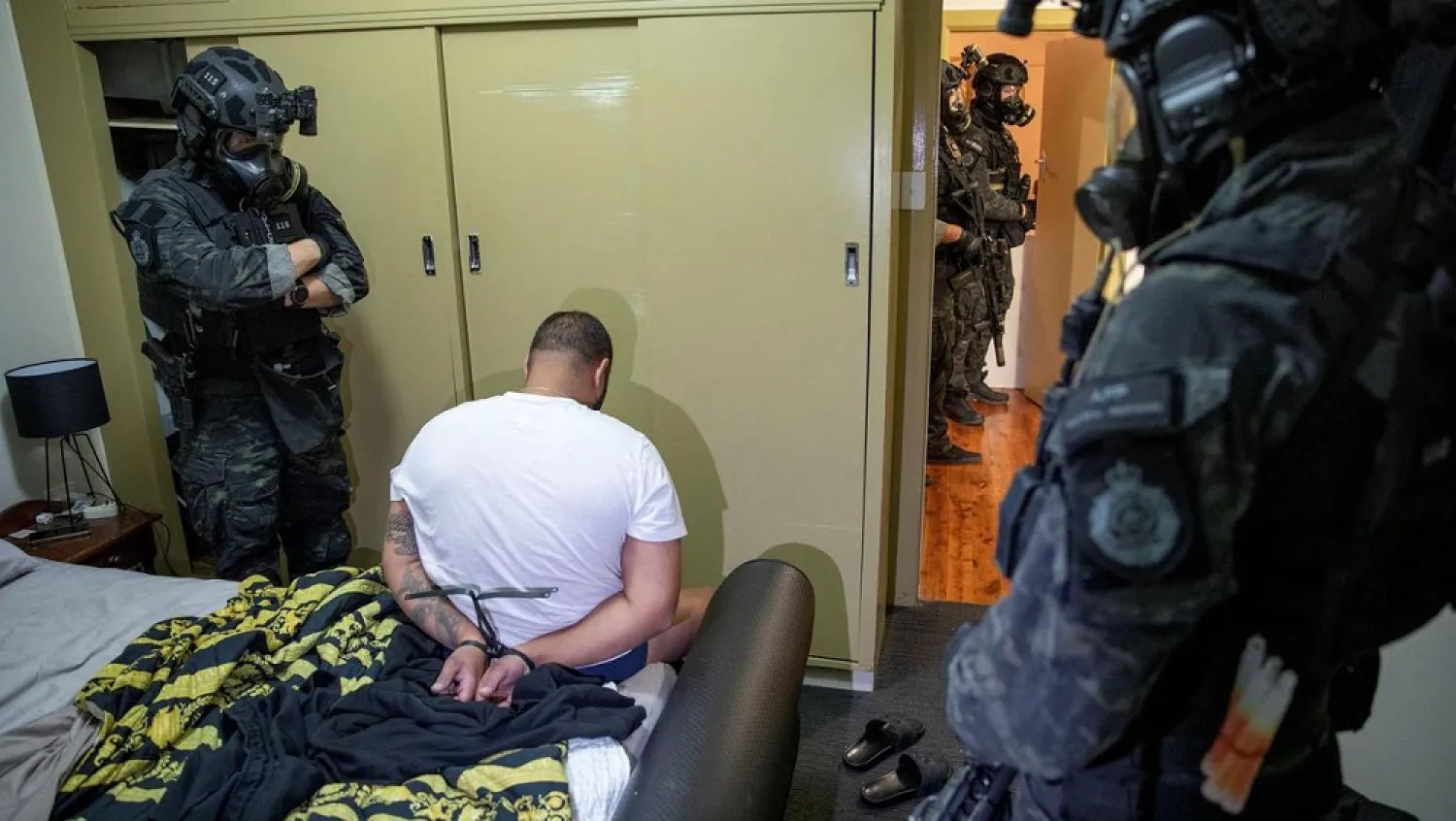
A person is detained by Australian Federal Police after its Operation Ironside against organized crime. (Reuters Australian Federal Police)
TT

Hundreds Arrested in 'Staggering' Global Crime Sting

A person is detained by Australian Federal Police after its Operation Ironside against organized crime. (Reuters Australian Federal Police)

Police arrested more than 800 people worldwide in a huge global sting involving encrypted phones that were secretly planted by the FBI, law enforcement agencies said Tuesday.

Cops in 16 countries were able to read the messages of global underworld figures as they plotted drug deals, arms transfers and gangland hits on the compromised ANOM devices.

Mafia groups, Asian crime syndicates, motorcycle gangs and other organized crime syndicates around the world were all monitored using the spiked phones as part of Operation "Trojan Shield".

The sting, jointly conceived by Australia and the US Federal Bureau of Investigation, prevented around 100 murders, foiled several large-scale narcotics shipments and led to seizures of weapons and cash, they added.

"The results are staggering," FBI Assistant Director Calvin Shivers told reporters at the headquarters of the EU's police agency Europol HQ in The Netherlands.

Shivers said the FBI had provided criminal syndicates in over 100 countries with the devices over the last 18 months "that allowed us to monitor their communications".

Europol hailed the "exceptional" operation, which saw around 12,000 of the ANOM devices distributed worldwide to criminals who thought they were chatting in secret.

"This information led over the last week to hundreds of law enforcement operations on a global scale from New Zealand to Australia to Europe and the USA, with impressive results," said Jean-Philippe Lecouffe, Deputy Director Operations at Europol.

"More than 800 arrests, more than 700 locations searched, more than eight tons of cocaine."

Police also seized 22 tons of cannabis, two tons of methamphetamine, 250 firearms, 55 luxury vehicles and over $48 million (39 million euros) in various currencies and cryptocurrencies, Europol said.

'Heavy blow'
Australian police said the supposedly hardened encrypted devices were handed out to operatives within the mafia, Asian crime syndicates, drug cartels and outlaw motorcycle gangs as part of the elaborate FBI-led plot.

Australian Prime Minister Scott Morrison said Tuesday had "struck a heavy blow against organized crime -- not just in this country, but one that will echo around organized crime around the world".

The operation began after global police work in the past two years disrupted two other major encrypted phone networks used by criminals, Encrochat and SkyGlobal.

"The closure of those two encrypted communication platforms created a significant void in the encrypted communication market," said New Zealand police.

To fill the void, "the FBI operated its own encrypted device company, called 'ANOM'", the New Zealand police added.

The FBI's Shivers said this enabled them to "turn the tables" on criminals.

"We were actually able to see photographs of hundreds of tons of cocaine that were concealed in shipments of fruit, we were able to see hundreds of kilos of cocaine that were concealed in canned goods," Shivers said.

Showing the massive global scale of the sting, Australia said more than 200 people had been charged already.

Sweden said it had arrested 155 people, Germany detained 70 suspects, the Netherlands 49, and New Zealand 35 as a result of the operation.

Most of the 27 million ANOM messages obtained by the sting were in Dutch, German and Swedish, Dutch police said.

"Criminals assumed that the service was safe and touted it among themselves as the platform you should use, because it would be absolutely reliable. Nothing could have been further from the truth," Dutch police said in a statement.

'They came to us'
According to unsealed court documents, the FBI worked with insiders to develop and distribute ANOM devices through the Phantom Secure network of existing criminal customers, unloading 50 -- mostly to Australia -- as a "beta test".

The devices are said to have had no email, call or GPS services and could only message other ANOM phones.

They could only be bought on the black market -- for around $2,000 -- and required a code from an existing user to access.

"We didn't hand them out, people actually came to us seeking those devices," Shivers said.

Australian agencies helped get the phones in the hands of underworld "influencers" -- including an Australian fugitive drug boss on the run in Turkey -- in a bid to gain trust.

The cover appeared to be blown in March 2021 when a blogger detailed ANOM security flaws and claimed it was a scam linked to Australia, the United States and other members of the FiveEyes intelligence sharing network. The post was later deleted.

ANOM's website -- which once offered "military grade" encryption services and devices with special features like "light and dark" display themes -- was unavailable Tuesday, with a message from authorities that the "domain has been seized".



Trump Threatens Strait of Hormuz Blockade after US-Iran Ceasefire Talks End without Agreement

US President Donald Trump makes a fist upon arrival at Miami International Airport in Miami, on April 11, 2026. Trump is traveling to Florida to attend a UFC event and spend the weekend at his Mar-a-Lago residence. (Photo by Jim WATSON / AFP)
TT

Trump Threatens Strait of Hormuz Blockade after US-Iran Ceasefire Talks End without Agreement

US President Donald Trump makes a fist upon arrival at Miami International Airport in Miami, on April 11, 2026. Trump is traveling to Florida to attend a UFC event and spend the weekend at his Mar-a-Lago residence. (Photo by Jim WATSON / AFP)

President Donald Trump on Sunday said the US Navy would “immediately” begin a blockade to stop ships from entering or leaving the Strait of Hormuz, after US-Iran peace talks in Pakistan ended without an agreement.

Trump sought to exert strategic control over the waterway responsible for the transportation of 20% of global oil supplies before the war, hoping to take away Iran’s key source of economic leverage in the fighting.

The president added that he has “instructed our Navy to seek and interdict every vessel in International Waters that has paid a toll to Iran. No one who pays an illegal toll will have safe passage on the high seas.”

Trump also said the US was ready to “finish up” Iran at the “appropriate moment," stressing that Tehran's nuclear ambitions were at the core of the failure to end the war.

Face-to-face talks ended earlier Sunday after 21 hours, leaving a fragile two-week ceasefire in doubt.

US officials said the negotiations collapsed over what they described as Iran’s refusal to commit to abandoning a path to a nuclear weapon, while Iranian officials blamed the US for the breakdown of the talks without specifying the sticking points.

Neither side indicated what will happen after the 14-day ceasefire expires on April 22. Pakistani mediators urged all parties to maintain it. Both said their positions were clear and put the onus on the other side, underscoring how little the gap had narrowed throughout the talks, The AP news reported.

“We need to see an affirmative commitment that they will not seek a nuclear weapon, and they will not seek the tools that would enable them to quickly achieve a nuclear weapon,” Vice President JD Vance said after the talks.

Iran’s parliament speaker Mohammad Bagher Qalibaf, who led Iran in the negotiations, said it was time for the United States “to decide whether it can gain our trust or not.”

He did not mention the core disputes in a series of social media posts, though Iranian officials earlier said the talks fell apart over two or three key issues, blaming what they called US overreach.

Pakistani Foreign Minister Ishaq Dar said his country will try to facilitate a new dialogue between Iran and the US in the coming days.

“It is imperative that the parties continue to uphold their commitment to cease fire,” Dar said.

The deadlock — and Vance’s take-it-or-leave-it proposal that Iran end its nuclear program — mirrored February’s nuclear talks in Switzerland. Though Trump has said the subsequent war was meant to compel Iran’s leaders to abandon nuclear ambitions, each side's positions appeared unchanged in negotiations following six weeks of fighting.

An Iranian diplomatic official, speaking on the condition of anonymity because of the sensitivity of the closed-door talks, denied that negotiations had failed over Iran's nuclear ambitions.

“Iran is not seeking to acquire nuclear weapons, but it has the right to nuclear energy for peaceful purposes,” they said, reiterating Iran's longstanding negotiating position.

There was no word on whether they would resume, though Iran said it was open to continuing the dialogue, Iran’s state-run IRNA news agency reported.

“We have never sought war. But if they try to win what they failed to win on the battlefield through talks, that’s absolutely unacceptable,” 60-year-old Mohammad Bagher Karami said in downtown Tehran.


Australia Pledges Cyclone Aid to Pacific Neighbors

Australian servicemen stand on HMAS Canberra, ahead of the Kakadu International Fleet Review, a biennial maritime exercise marking 125 years of the Australian Navy, in Sydney, Australia, March 21, 2026. REUTERS/Hollie Adams
TT

Australia Pledges Cyclone Aid to Pacific Neighbors

Australian servicemen stand on HMAS Canberra, ahead of the Kakadu International Fleet Review, a biennial maritime exercise marking 125 years of the Australian Navy, in Sydney, Australia, March 21, 2026. REUTERS/Hollie Adams

Australia pledged Au$2.5 million ($1.7 million) in aid to Pacific neighbors Papua New Guinea and the Solomon Islands Sunday, after tropical cyclone Maila caused devastating floods and landslides that killed 11.

In Bougainville, an autonomous region of Papua New Guinea that is seeking independence, school was cancelled this week after the cyclone destroyed critical infrastructure including roads and bridges and severely disrupted food supply chains, the region's government said in a statement Saturday.

Eleven people were killed in the region, including eight in a landslide.

Access to Panguna, home to a gold and copper mine that was once among the world's largest, had been cut.

The Bougainville autonomous region president, Ishmael Toroama, urged the population to "not lose hope" in a statement Friday.

The weather system began to weaken Saturday and has since been downgraded to a tropical low.

Australia's Foreign Minister Penny Wong pledged Au$1 million for Papua New Guinea to respond to the cyclone's impact in Bougainville and Milne Bay.

Another Au$1.5 million will be provided to Solomon Islands, where severe impacts have been felt in remote communities across Western and Choiseul provinces.


Russia, Ukraine Trade Accusations on Easter Truce Violations

People cry as they hold hold photos of their missed relatives as Ukrainian soldiers return from captivity during a POW exchange between Russia and Ukraine in Chernyhiv region, Ukraine, Saturday, April 11, 2026. (AP Photo/Efrem Lukatsky)
TT

Russia, Ukraine Trade Accusations on Easter Truce Violations

People cry as they hold hold photos of their missed relatives as Ukrainian soldiers return from captivity during a POW exchange between Russia and Ukraine in Chernyhiv region, Ukraine, Saturday, April 11, 2026. (AP Photo/Efrem Lukatsky)

The Russian Defense Ministry said on Sunday that Ukrainian troops are violating the Easter ⁠truce while Russian ⁠forces are observing the ⁠declared ceasefire.

Civilians, including a child, were injured in a Ukrainian drone attack on Russia’s Kursk region, ⁠the ⁠Ministry was quoted as saying by Russian news agencies.

Moscow accused Ukraine of 1,971 violations, while the Ukrainian army said that Russia has violated the truce in place for Orthodox Easter nearly 2,300 times since it came into effect.

"As of 7:00 a.m. on 12 April, 2,299 ceasefire violations were recorded. Specifically: 28 enemy assault actions, 479 enemy shellings, 747 strikes by attack drones... and 1,045 strikes by FPV drones," the Ukrainian military's general staff said in a post on Facebook.

"There were no missile strikes, guided aerial bomb strikes, or Shahed-type UAV strikes," it added.