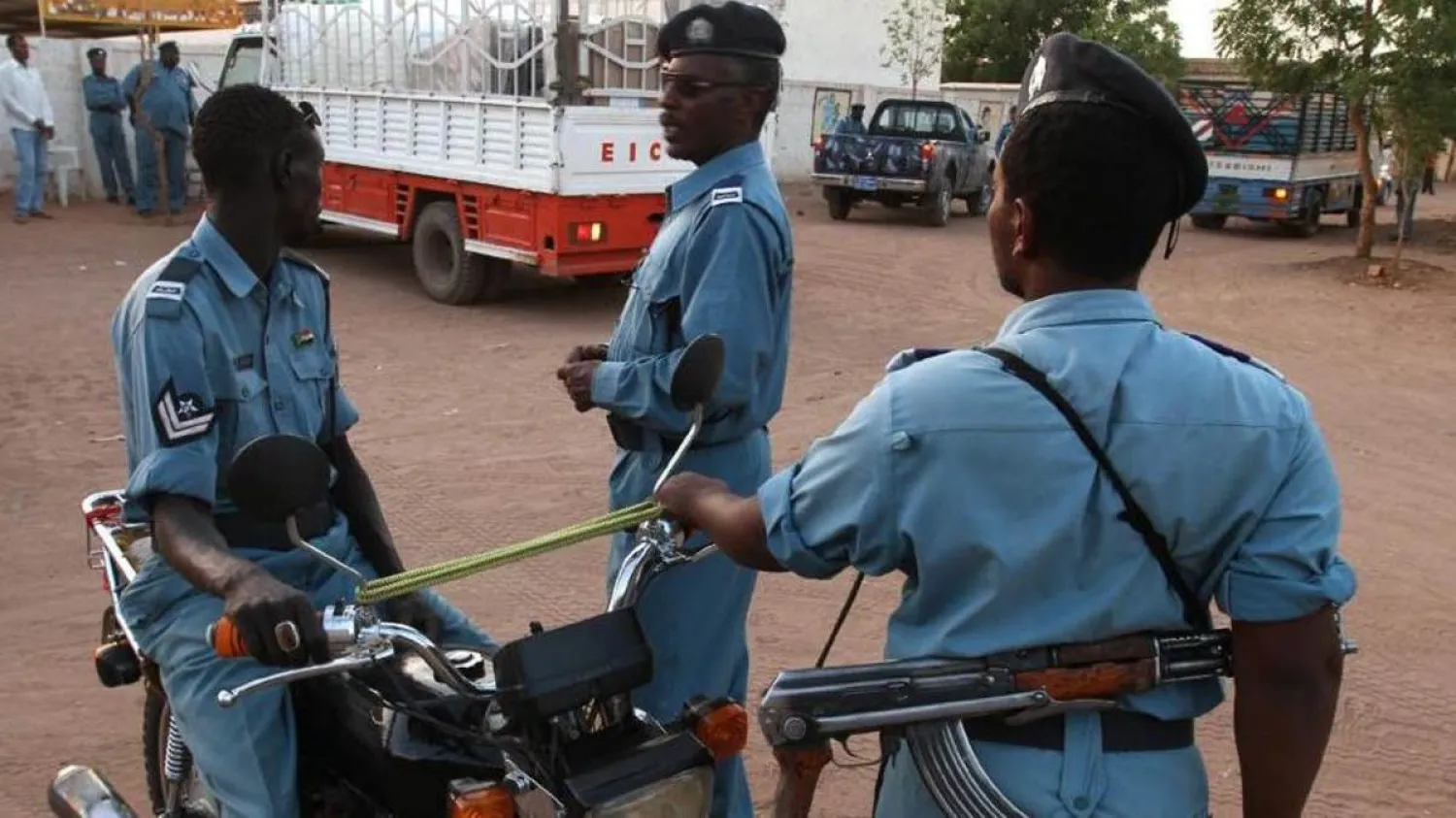
Sudan Interior Minister Vows to Combat Insubordination among Police Forces

Sudanese police officers stand guard in Khartoum on April 10, 2010. (AFP)
TT

Sudan Interior Minister Vows to Combat Insubordination among Police Forces

Sudanese police officers stand guard in Khartoum on April 10, 2010. (AFP)

Sudan’s Interior Minister Lt. Gen. Izz-Eddin Al-Sheikh vowed to fight insubordination within the police after a group of officers protested against low wages and deteriorating living conditions.

During a general meeting arranged on Monday by Al-Sheikh and the director-general of the police forces in the capital’s Tahrir Square, some police officers were given an ultimatum of either resigning or continuing to serve.

“Any police officer who does not want to work must submit his resignation,” Al-Sheikh told them firmly.

“The country will not break down for any individual, especially since the police force has a glorious and extensive history,” the minister explained, adding that the force’s “march forward will not be set back for a single person.”

“Both the government and the Interior Ministry attach great importance to the police force and will announce pay raises for all personnel,” revealed Al-Sheikh.

He moved on to welcome unhappy officers regardless of their choices of either staying or leaving and called on the force to practice the highest levels of discipline, duty, and respect for the leadership and state.

At the meeting, attended by Khartoum Governor Ayman Nimr and a host of senior police officials, Al-Sheikh reaffirmed a commitment to provide officers with the means to live decently and that a salary increase was on the horizon.

However, the wage hike needs to take into consideration the economic conditions and challenges facing the country.

“Police forces are disciplined and will continue their duties despite the difficulties facing the country,” reaffirmed Al-Sheikh.

On Monday, Nimr held an emergency meeting in which he ordered paying a bonus to all officers on the occasion of the Eid al-Adha holiday, which will be observed in mid-July.

Police Forces Director General Lt.-Gen. Khaled Mahdi Ibrahim reiterated a keenness for preserving the rights of officers, such as “providing them with legal protection, so they can perform their duties in maintaining security and protecting the homeland.”


A Blast in Gaza Wounds Soldier and Israel Accuses Hamas of Ceasefire Violation

A woman sits next to her tent on an alley of a makeshift tent camp for displaced Palestinians in Deir al-Balah, central Gaza Strip, Tuesday, Dec. 23, 2025. (AP Photo/Abdel Kareem Hana)
TT

A Blast in Gaza Wounds Soldier and Israel Accuses Hamas of Ceasefire Violation

A woman sits next to her tent on an alley of a makeshift tent camp for displaced Palestinians in Deir al-Balah, central Gaza Strip, Tuesday, Dec. 23, 2025. (AP Photo/Abdel Kareem Hana)

An explosive device detonated in Gaza on Wednesday, injuring one Israeli soldier and prompting Israel to accuse Hamas of violating the US-backed ceasefire. It was the latest incident to threaten the tenuous truce that has held since Oct. 10 as each side accuses the other of violations.

The blast came as Hamas met with Turkish officials in Ankara to discuss the second stage of the ceasefire. Though the agreement has mostly held, its progress has slowed, The AP news reported.

All but one of the 251 hostages taken in the Hamas-led attack on Oct. 7, 2023, that sparked the war have been released, alive or dead, in exchange for Palestinian prisoners and detainees. The ceasefire's second phase has even bigger challenges: the deployment of an international stabilization force, a technocratic governing body for Gaza, the disarmament of Hamas and further Israeli troop withdrawals from the territory.

Israel vows to ‘respond accordingly’ Israel's military said the explosive detonated beneath a military vehicle as soldiers were “dismantling” militant infrastructure in the southern city of Rafah. The lightly injured soldier was taken to a hospital, the military said.

Prime Minister Benjamin Netanyahu in a statement called the incident a violation of the ceasefire and said Israel would "respond accordingly.”

Israel previously launched strikes in Gaza in response to alleged ceasefire violations. On Oct. 19, Israel said two soldiers were killed by Hamas fire and it responded with a series of strikes that killed over 40 Palestinians, according to local health officials.

Hamas accuses Israel of violating the ceasefire by not allowing enough aid into the territory and continuing to strike civilians. Palestinian health officials say over 370 Palestinians have been killed by Israeli fire since the truce.

On Friday, Israeli troops fired over the ceasefire line in northern Gaza, killing at least five Palestinians, including a baby, according to a local hospital that received the casualties.

Turkish Foreign Minister Hakan Fidan met with a Hamas delegation led by Khalil al-Haya to discuss the ceasefire's second phase, according to ministry officials.

Fidan reaffirmed Türkiye's efforts to defend the rights of Palestinians and outlined ongoing efforts to address shelter and other humanitarian needs in Gaza, the officials said.

The Hamas delegation said they had fulfilled the ceasefire’s conditions but that Israel’s continued attacks were blocking progress toward the next stage. They also asserted that 60% of the trucks allowed into Gaza were carrying commercial goods rather than aid.

According to the officials, the meeting also discussed reconciliation efforts between the Palestinian factions and the situation in the Israeli-occupied West Bank, stressing that Israel’s actions there were “unacceptable.”


Algeria Passes Law Declaring French Colonisation a Crime

Members of the committee drafting the law criminalizing colonialism (File Photo/ Algerian Parliament)
TT

Algeria Passes Law Declaring French Colonisation a Crime

Members of the committee drafting the law criminalizing colonialism (File Photo/ Algerian Parliament)

Algeria's parliament unanimously approved on Wednesday a law declaring France's colonisation of the country a crime, and demanding an apology and reparations.

Standing in the chamber, lawmakers wearing scarves in the colors of the national flag chanted "long live Algeria" as they applauded the passage of the bill, which states that France holds "legal responsibility for its colonial past in Algeria and the tragedies it caused".

The vote comes as the two countries are embroiled in a major diplomatic crisis, and analysts say that while Algeria's move is largely symbolic, it is still politically significant, AFP reported.

Parliament speaker Brahim Boughali told the APS state news agency before the vote that it would send "a clear message, both internally and externally, that Algeria's national memory is neither erasable nor negotiable".

The legislation lists the "crimes of French colonisation", including nuclear tests, extrajudicial killings, "physical and psychological torture", and the "systematic plundering of resources".

It states that "full and fair compensation for all material and moral damages caused by French colonisation is an inalienable right of the Algerian state and people".

France's rule over Algeria from 1830 until 1962 remains a sore spot in relations between the two countries.

The period was marked by mass killings and large-scale deportations, all the way up to the bloody war of independence from 1954-1962.

Algeria says the war killed 1.5 million people, while French historians put the death toll lower at 500,000 in total, 400,000 of them Algerian.

French President Emmanuel Macron has previously acknowledged the colonisation of Algeria as a "crime against humanity", but has stopped short of offering an apology.

Asked last week about the vote, French foreign ministry spokesman Pascal Confavreux said he would not comment on "political debates taking place in foreign countries".

Hosni Kitouni, a researcher in colonial history at the University of Exeter in the UK, said that "legally, this law has no international scope and therefore is not binding for France".

But "its political and symbolic significance is important: it marks a rupture in the relationship with France in terms of memory," he said.


Türkiye, Hamas Discuss Gaza Ceasefire Deal’s Second Phase, Turkish Source Says

Palestinian children play next to tents in a makeshift camp for displaced people set up on the beach in Gaza City, Tuesday, Dec. 16, 2025. (AP)
TT

Türkiye, Hamas Discuss Gaza Ceasefire Deal’s Second Phase, Turkish Source Says

Palestinian children play next to tents in a makeshift camp for displaced people set up on the beach in Gaza City, Tuesday, Dec. 16, 2025. (AP)

Turkish Foreign Minister Hakan Fidan on Wednesday ​met with Hamas political bureau officials in Ankara to discuss the ceasefire in Gaza and advancing the ‌agreement to ‌its ‌second ⁠phase, ​a ‌Turkish Foreign Ministry source said according to Reuters.

The source said the Hamas officials told Fidan that they had fulfilled ⁠their requirements as ‌part of the ‍ceasefire ‍deal, but that Israel's ‍continued targeting of Gaza aimed to prevent the agreement from ​moving to the next phase.

The Hamas members ⁠also said humanitarian aid entering Gaza was not sufficient, and that goods like medication, equipment for housing, and fuel were needed, the source ‌added.