Morocco Slams Remarks Made by US State Department Spokesman

A Moroccan activist holds a banner with the image of Moroccan journalist Suleiman Raissouni, who was sentenced to five years in prison, as his supporters protest on July 10, 2021, in the capital Rabat demanding his release. (Photo by FADEL SENNA / AFP)
TT

Morocco Slams Remarks Made by US State Department Spokesman

A Moroccan activist holds a banner with the image of Moroccan journalist Suleiman Raissouni, who was sentenced to five years in prison, as his supporters protest on July 10, 2021, in the capital Rabat demanding his release. (Photo by FADEL SENNA / AFP)

Morocco’s Interministerial Delegation for Human Rights (DIDH) has described the US State Department spokesperson's statement on two controversial court cases as based on "one-sided" information coming exclusively from supporters of the accused.

DIDH issued a press release in response to Ned Price’s comments on a Casablanca court’s sentencing of journalist Suleiman Raissouni to five years in prison.

“This information knowingly obscured the point of view of the complainants and their defenses, going so far as to deny their very status of victim and their universally recognized right to lodge a complaint,” the Delegation said.

It also emphasized Morocco’s attachment to respecting the fundamental rights of all people, whatever their status, citing the independence of the judiciary in the country.

“Morocco remains deeply attached to the consolidation of the values of individual and collective freedoms, in particular the freedoms of expression and association, which are constantly developing,” DIDH concluded.

The State Department criticized Morocco for sentencing detained journalist Suleiman Raissouni to five years in prison and called for press freedoms to be protected.

"We believe the judicial process that led to this verdict contradicts the Moroccan system's fundamental promise of fair trials for individuals accused of crimes and is inconsistent with the promise of the 2011 constitution and King Mohammed VI's reform agenda," Price told reporters.

"Press freedom is foundational to prosperous and secure societies, and governments must ensure that journalists can safely perform their essential roles without fear of unjust attention, violence, or threats," he added.

On Friday, a court in Casablanca sentenced Raissouni to five years in prison and fined him 100,000 dirhams ($10,000).


Lebanon: 350 Hezbollah Members Killed Since Start of New Round of War

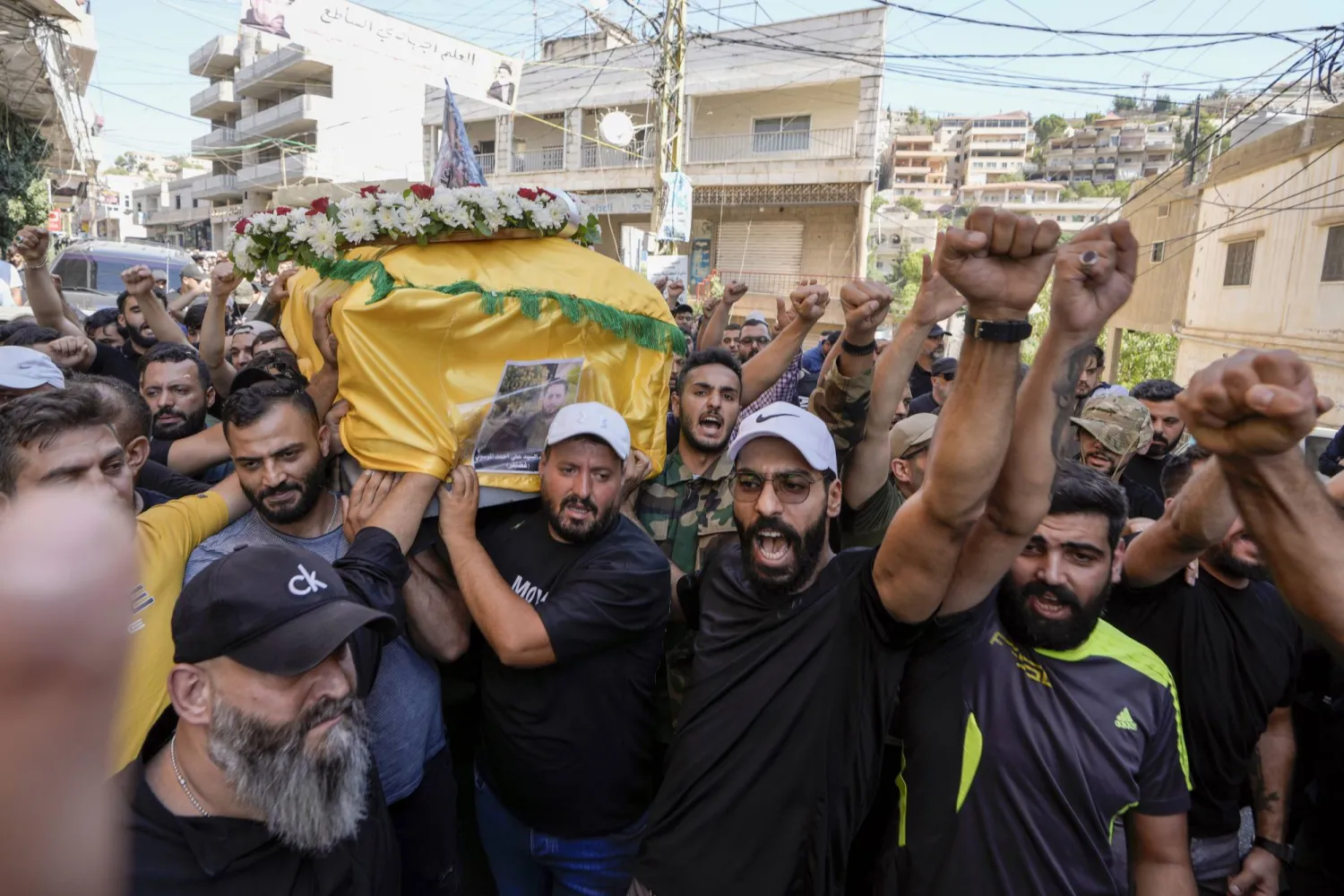
Mourners chant slogans as they carry the coffin of Ali Ahmad Mousawi, who was killed early Wednesday by an Israeli strike, during his funeral procession in Nabi Sheet village, in Lebanon's eastern Bekaa Valley, Wednesday, Aug. 21, 2024.   (AP Photo/Bilal Hussein)
Mourners chant slogans as they carry the coffin of Ali Ahmad Mousawi, who was killed early Wednesday by an Israeli strike, during his funeral procession in Nabi Sheet village, in Lebanon's eastern Bekaa Valley, Wednesday, Aug. 21, 2024. (AP Photo/Bilal Hussein)
TT

Lebanon: 350 Hezbollah Members Killed Since Start of New Round of War

Mourners chant slogans as they carry the coffin of Ali Ahmad Mousawi, who was killed early Wednesday by an Israeli strike, during his funeral procession in Nabi Sheet village, in Lebanon's eastern Bekaa Valley, Wednesday, Aug. 21, 2024.   (AP Photo/Bilal Hussein)
Mourners chant slogans as they carry the coffin of Ali Ahmad Mousawi, who was killed early Wednesday by an Israeli strike, during his funeral procession in Nabi Sheet village, in Lebanon's eastern Bekaa Valley, Wednesday, Aug. 21, 2024. (AP Photo/Bilal Hussein)

The war between Hezbollah and Israel has seen a shift in media handling, particularly regarding announcements of casualties. After initially adopting, at the start of the 2024 war, a policy of near-daily announcements, the group later gradually reduced such statements before halting them altogether. This approach continues in the current fighting, with obituary notices largely absent or confined to a limited local scope in the villages and towns from which the members originate, for security, psychological and political reasons.

From public obituaries to limited disclosure

In the first weeks of the 2024 war, Hezbollah issued successive statements naming those killed, publishing their photos and hometowns, alongside public funeral ceremonies. This approach later receded, with fewer statements issued before they nearly stopped entirely by late September 2024, when the announced toll stood at 450.

By the end of the war in November 2024, estimates put the death toll at about 4,000, including those killed in what is referred to as the “pager operation,” according to estimates rather than official figures from Hezbollah.

On Thursday, Israeli military spokesman Avichay Adraee said on X that forces from the 36th Division and the air force had “eliminated more than 20 Hezbollah members within 24 hours in southern Lebanon.”

350 members killed since start of war

Researcher Mohammad Chamseddine, from the International Information organization, told Asharq Al-Awsat the number of Hezbollah members killed so far was estimated at around 350, out of 1,001 deaths announced by Lebanon’s health ministry.

He said most were killed in the “Nabi Sheet landing” on March 7 and in clashes along the border, particularly in Khiam, where 53 members were killed. The estimates are based on the number of bodies transferred to hospitals across regions, excluding a very small number buried immediately, he added.

He said the majority of those killed were civilians or supporters rather than members, amid Israeli strikes targeting areas close to the group, while it has adopted strict measures to protect its members. Since September 2024, Hezbollah’s announcements have been limited to “senior figures,” as part of a policy aimed at reducing the impact on its support base as the toll rises.

Reducing security exposure

Retired brigadier general and military expert Hassan Jouni said Hezbollah’s decision not to announce the deaths of its members during the war was due to overlapping factors.

“The first is morale. Daily announcements, with rising casualties, have a negative impact on the support base and reflect losses that may be interpreted as an indicator of the enemy’s superiority,” he told Asharq Al-Awsat.

He also cited security considerations, saying such statements could reveal sensitive information about identities, family ties and places of residence that could be exploited using modern technology to identify and target specific communities.

“Missing without a trace”

Jouni also pointed to those classified as “missing without a trace,” whose fate remains unknown and whose deaths are not announced due to the uncertainty surrounding their status.

He said the nature and intensity of the fighting, along with Hezbollah’s decentralized structure, made it difficult to determine the fate of some individuals. Loss of contact does not necessarily indicate death, as individuals may still be alive or captured, he said, requiring caution before any official announcement.

After a ceasefire took effect on Nov. 27, 2024, estimates indicated around 1,500 individuals were classified by Hezbollah as of “unknown fate,” with families informed of lost contact. This was followed by the recovery of bodies and DNA testing to confirm identities before announcements were made.

Most bodies were returned and buried, while some families were informed their relatives remained “missing without a trace,” meaning no remains had been found or recovery was unlikely due to destruction caused by strikes on homes and villages. Their number is estimated at about 45.



Arab Parliament Condemns Iranian Attacks on Oil and Industrial Facilities in Gulf States

Arab Parliament Condemns Iranian Attacks on Oil and Industrial Facilities in Gulf States
TT

Arab Parliament Condemns Iranian Attacks on Oil and Industrial Facilities in Gulf States

Arab Parliament Condemns Iranian Attacks on Oil and Industrial Facilities in Gulf States

The Arab Parliament condemned the blatant Iranian attacks that targeted oil and industrial facilities in several Gulf states, describing them as a dangerous and unprecedented escalation, and a highly perilous development that threatens the security and stability of the region and exposes global energy security to grave risks.

In a statement, Arab Parliament Speaker Mohammed Al Yamahi affirmed that these hostile acts constitute a flagrant violation of the principles of international law and the Charter of the United Nations, which prohibit targeting civilian and economic facilities, SPA reported.

He also stressed that targeting oil and industrial infrastructure is not only an infringement upon the sovereignty of Arab states, but also a direct threat to the stability of global energy markets, undermining international efforts aimed at ensuring the security of supplies.

Additionally, Al Yamahi reiterated the Arab Parliament’s full solidarity with the Gulf Arab states and its support for all legitimate measures they take to protect their sovereignty, security, and safeguard their vital resources and facilities.


Arab Interior Ministers Council Condemns Iran’s Heinous, Repeated Aggression Against Arab States

Smoke rises in the Fujairah oil industry zone, caused by debris after interception of a drone by air defenses, according to the Fujairah media office, amid the US-Israel conflict with Iran, in Fujairah, United Arab Emirates, March 14, 2026. REUTERS/Staff
TT

Arab Interior Ministers Council Condemns Iran’s Heinous, Repeated Aggression Against Arab States

Smoke rises in the Fujairah oil industry zone, caused by debris after interception of a drone by air defenses, according to the Fujairah media office, amid the US-Israel conflict with Iran, in Fujairah, United Arab Emirates, March 14, 2026. REUTERS/Staff

The General Secretariat of the Arab Interior Ministers Council (AIMC) condemned and denounced Iran’s repeated and unlawful aggression against Arab states, as well as its deliberate hostile actions targeting civilian sites and vital energy and gas facilities in Saudi Arabia, United Arab Emirates, Bahrain, Qatar, Kuwait, Oman, and other Arab countries.

The AIMC General Secretariat said such actions constitute a flagrant violation of international laws and conventions and the principles of good neighborliness, warning that they represent a serious escalation that could expose regional and global economic interests to significant risks and threaten international peace and security, SPA reported.

In a statement issued from its headquarters in Tunis, the AIMC General Secretariat said it strongly condemns the ongoing terrorist aggression and systematic acts of sabotage by Iran, reaffirming its full solidarity with Arab states and its absolute support for all measures taken to repel such attacks and defend their security, sovereignty, and territorial integrity.

The general secretariat also commended the heroic roles of Arab armed forces, security services, and civil defense agencies in confronting these threats and countering attempts to undermine the security and stability of Arab countries, as well as the safety of their facilities, citizens, and residents.