


Chinese Govt Summons Gaming Firms, Says Will Crack Down on Ride-Hailing

A Rogue Warriors esports team member trains for the game “Arena of Valor” at his club in Shanghai, China September 3, 2021. Picture taken September 3, 2021. (Reuters)
TT

Chinese Govt Summons Gaming Firms, Says Will Crack Down on Ride-Hailing

A Rogue Warriors esports team member trains for the game “Arena of Valor” at his club in Shanghai, China September 3, 2021. Picture taken September 3, 2021. (Reuters)

China’s government on Wednesday summoned gaming firms including Tencent Holdings Ltd and NetEase Inc to ensure they implement new rules for the sector.

It also said it would crack down on illegal behavior in the ride-hailing industry.

Beijing last month moved to ban under-18s from playing video games for more than three hours a week in a tighter set of regulations for gaming as it looks to strengthen control over sectors of its economy such as tech, education and property.

Gaming firms were told by the government on Wednesday to implement measures such as curbing minors’ hours of access to their video games to protect their physical and mental health, the official Xinhua news agency reported.

Those that are found to have “inadequately” implemented the regulations will be severely punished, it said, adding that the firms present were also asked to resist engaging in improper competition and should instead focus on driving innovation.

Xinhua named the authorities involved as the ruling Communist Party’s Publicity Department, the National Press and Publication Administration, the Office of the Central Cyberspace Affairs Commission and the Ministry of Culture and Tourism.

Separately on Wednesday, the Transport Ministry said it would intensify a crackdown on illegal behavior in the ride-hailing industry and deal with online platforms that are still using noncompliant vehicles and drivers.

The statement comes after Chinese government regulators launched a cybersecurity probe into ride-hailing giant Didi Global Inc in July.

Meanwhile, the Cyberspace Administration of China said it has shut down and banned 1,793 so-called self-media accounts on online platforms since Aug. 27, when it announced a probe into the illegal release of financial information and badmouthing of financial markets.

The term “self-media” is mostly used describe independently operated accounts that produce original content but are not officially registered with the authorities.

The accounts closed include three with more than a million followers, while more than 47,000 pieces of “harmful information” have been cleaned up, the administration added.



Indian PM, President of Saudi Arabia’s SDAIA Discuss AI Cooperation 

Indian Prime Minister Narendra Modi and President of the Saudi Data and Artificial Intelligence Authority (SDAIA) President Dr. Abdullah Al-Ghamdi meet on the sidelines of the India AI Impact Summit 2026. (SPA)
TT

Indian PM, President of Saudi Arabia’s SDAIA Discuss AI Cooperation 

Indian Prime Minister Narendra Modi and President of the Saudi Data and Artificial Intelligence Authority (SDAIA) President Dr. Abdullah Al-Ghamdi meet on the sidelines of the India AI Impact Summit 2026. (SPA)

Indian Prime Minister Narendra Modi held talks with President of the Saudi Data and Artificial Intelligence Authority (SDAIA) President Dr. Abdullah Al-Ghamdi on the sidelines of the India AI Impact Summit 2026, reported the Saudi Press Agency on Friday.

Discussions focused on knowledge transfer and the exchange of expertise to accelerate digital development in both nations. They also tackled expanding bilateral cooperation in data and AI.

Al-Ghamdi commended India’s leadership in hosting the summit, noting that such international partnerships are essential for harnessing advanced technology to benefit humanity and achieve shared strategic goals.


India Chases 'DeepSeek Moment' with Homegrown AI

A handout photo made available by the Press Information Bureau (PIB) of Indian Prime Minister Narendra Modi speaking with global leaders at the AI Impact Summit 2026 at Bharat Mandapam in New Delhi, India, 19 February 2026.EPA/PRESS INFORMATION BUREAU HANDOUT HANDOUT
TT

India Chases 'DeepSeek Moment' with Homegrown AI

A handout photo made available by the Press Information Bureau (PIB) of Indian Prime Minister Narendra Modi speaking with global leaders at the AI Impact Summit 2026 at Bharat Mandapam in New Delhi, India, 19 February 2026.EPA/PRESS INFORMATION BUREAU HANDOUT HANDOUT

Fledgling Indian artificial intelligence companies showcased homegrown technologies this week at a major summit in New Delhi, underpinning big dreams of becoming a global AI power.

But analysts said the country was unlikely to have a "DeepSeek moment" -- the sort of boom China had last year with a high-performance, low-cost chatbot -- any time soon, AFP reported.

Still, building custom AI tools could bring benefits to the world's most populous nation.
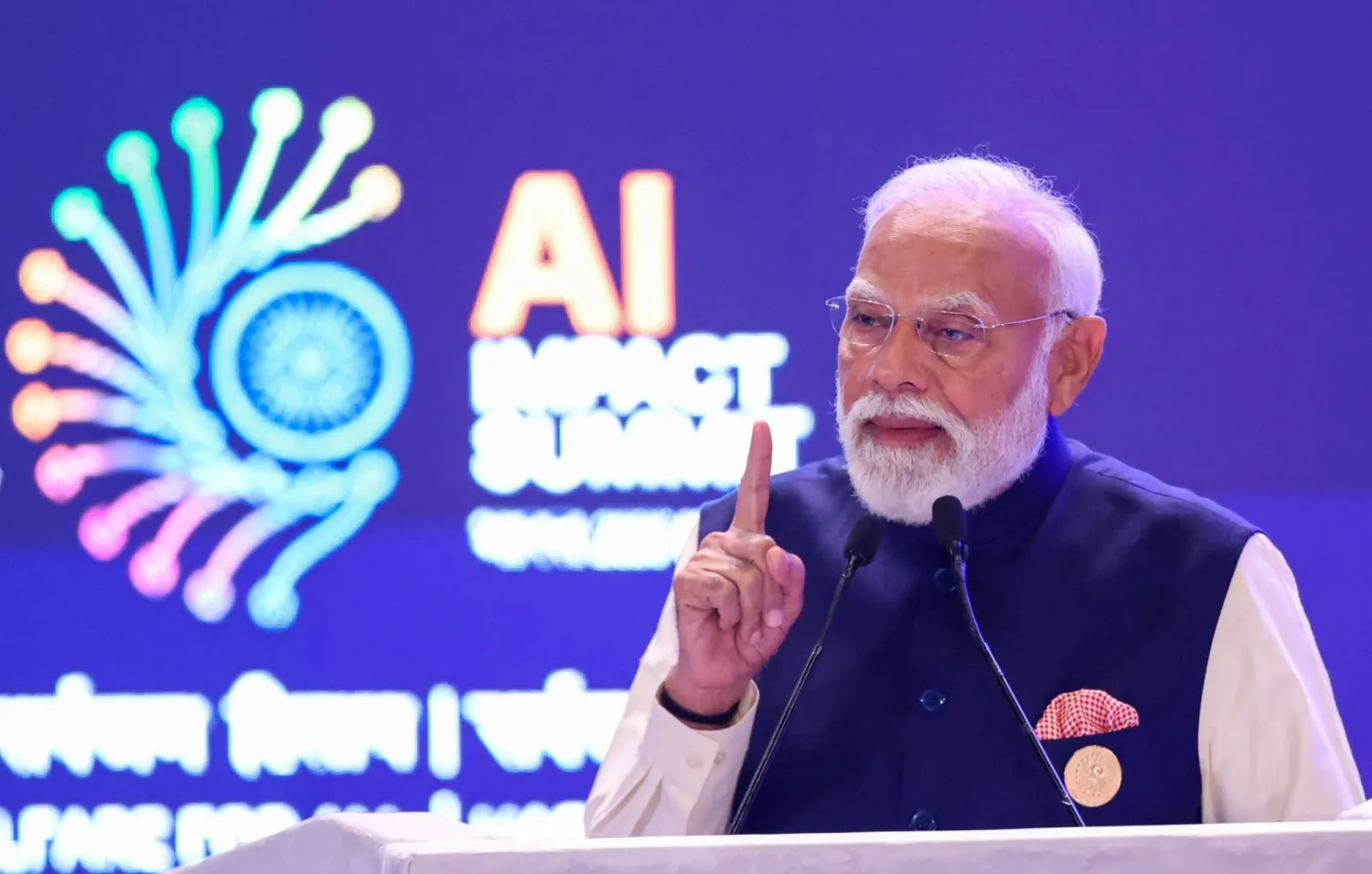
At the AI Impact Summit, Prime Minister Narendra Modi lauded new Indian AI models, along with other examples of the country's rising profile in the field.

"All the solutions that have been presented here demonstrate the power of 'Made in India' and India's innovative qualities," Modi said Thursday.

One of the startups making a buzz at the five-day summit was Sarvam AI, which this week released two large language models it says were trained from scratch in India.

Its models are optimized to work across 22 Indian languages, says the company, which received government-subsidized access to advanced computer processors.

The five-day summit, which wraps up Friday, is the fourth annual international meeting to discuss the risks and rewards of the fast-growing AI sector.

It is the largest yet and the first in a developing country, with Indian businesses striking deals with US tech giants to build large-scale data center infrastructure to help train and run AI systems.

On Friday, Abu Dhabi-based tech group G42 said the United Arab Emirates would deploy an AI supercomputer system in India, in a project "designed to lower barriers to AI innovation".

So-called sovereign AI has become a priority for many countries hoping to reduce dependence on US and Chinese platforms while ensuring that systems respect local regulations, including on data privacy.

AI models that succeed in India "can be deployed all over the world", Modi said on Thursday.

But experts said the sheer computational might of the United States would be hard to match.

"Despite the headline pledges, we don't expect India to emerge as a frontier AI innovation hub in the near term," said Reema Bhattacharya, head of Asia research at risk intelligence company Verisk Maplecroft.

"Its more realistic trajectory is to become the world's largest AI adoption market, embedding AI at scale through digital public infrastructure and cost-efficient applications," she said.

Another Indian company that drew attention with product debuts this week was the Bengaluru-based Gnani.ai, which introduced its Vachana speech models at the summit.

Trained on more than a million hours of audio, Vachana models generate natural-sounding voices in Indian languages that can process customer interactions and allow people to interact with digital services out loud.

Job disruption and redundancies, including in India's huge call center industry, have been one key focus of discussions at the Delhi summit.

Prihesh Ratnayake, head of AI initiatives at think-tank Factum, told AFP that the new Indian AI models were "not really meant to be global".

"They're India-specific models, and hopefully we'll see their impact over the coming year," he said.

"Why does India need to build for the global scale? India itself is the biggest market."
And Nanubala Gnana Sai at the Cambridge AI Safety Hub said that homegrown models could bring other benefits.

Existing models, even those developed in China, "have intrinsic bias towards Western values, culture and ethos -- as a product of being trained heavily on that consensus", Sai told AFP.

India already has some major strengths, including "technology diffusion, eager talent pool and cheap labor", and dedicated efforts can help startups pivot to artificial intelligence, he said.

"The end-product may not 'rival' ChatGPT or DeepSeek on benchmarks, but will provide leverage for the Global South to have its own stand in an increasingly polarized world."


Report: Nvidia Nears Deal for Scaled-down Investment in OpenAI

Nvidia chief executive Jensen Huang has insisted that the AI chip powerhouse is committed to a big investment in ChatGPT-maker OpenAI. Lionel BONAVENTURE / AFP
TT

Report: Nvidia Nears Deal for Scaled-down Investment in OpenAI

Nvidia chief executive Jensen Huang has insisted that the AI chip powerhouse is committed to a big investment in ChatGPT-maker OpenAI. Lionel BONAVENTURE / AFP

Nvidia is on the cusp of investing $30 billion in OpenAI, scaling back a plan to pump $100 billion into the ChatGPT maker, the Financial Times reported Thursday.

The AI-chip powerhouse will be part of OpenAI's new funding round with an agreement that could be concluded as early as this weekend, according to the Times, which cited unnamed sources close to the matter.

Nvidia declined to comment on the report.

Nvidia chief executive Jensen Huang has insisted that the US tech giant will make a "huge" investment in OpenAI and dismissed as "nonsense" reports that he is unhappy with the generative AI star.

Huang made the remarks late in January after the Wall Street Journal reported that Nvidia's plan to invest up to $100 billion in OpenAI had been put on ice.

Nvidia announced the plan in September, with the investment helping OpenAI build more infrastructure for next-generation artificial intelligence.

The funding round is reported to value OpenAI at some $850 billion.

Huang told journalists that the notion of Nvidia having doubts about a huge investment in OpenAI was "complete nonsense."

Huang insisted that Nvidia was going ahead with its investment in OpenAI, describing it as "one of the most consequential companies of our time".

"Sam is closing the round, and we will absolutely be involved in the round," Huang said, referring to OpenAI chief executive Sam Altman.

"We will invest a great deal of money."

Nvidia has become the coveted supplier of processors needed for training and operating the large language models (LLM) behind chatbots like OpenAI's ChatGPT or Google Gemini.

LLM developers like OpenAI are directing much of the mammoth investment they have received into Nvidia's products, rushing to build GPU-stuffed data centers to serve an anticipated flood of demand for AI services.

The AI rush, and its frenzy of investment in giant data centers and the massive purchase of energy-intensive chips, continues despite signs of concern in the markets.