


Syria Regime Forces Enter Daraa under Truce, Says Monitor

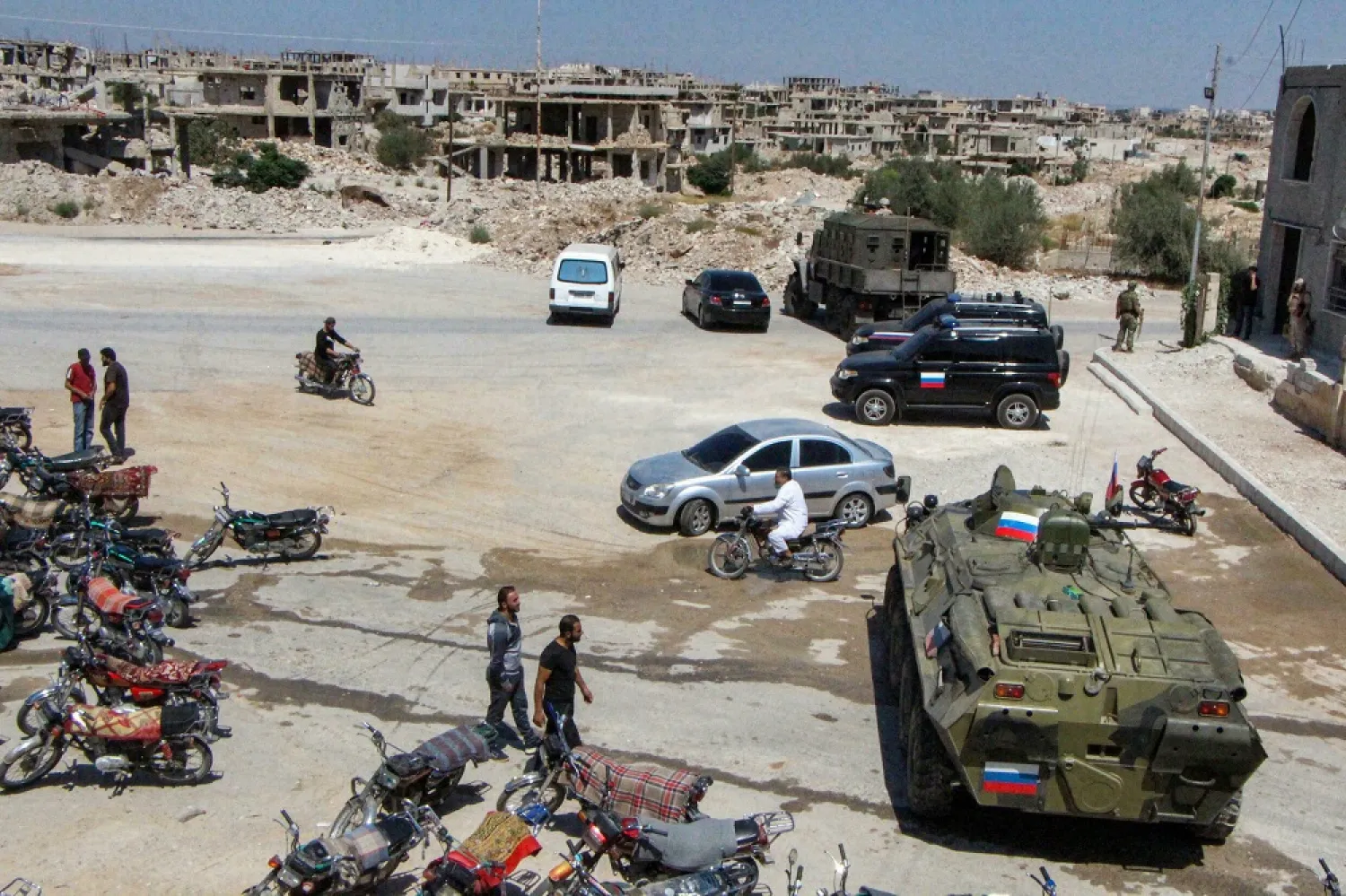
Russian military vehicles are pictured on September 6 in Daraa al-Balad to enforce a ceasefire as part of reconciliation efforts after months of siege by government forces. (AFP)
TT

Syria Regime Forces Enter Daraa under Truce, Says Monitor

Russian military vehicles are pictured on September 6 in Daraa al-Balad to enforce a ceasefire as part of reconciliation efforts after months of siege by government forces. (AFP)

Syrian regime forces Wednesday entered part of a southern city retaken from holdout opposition fighters under a ceasefire deal brokered by government ally Russia, official media and a war monitor said.

Daraa province and its capital of the same name, the cradle of Syria’s uprising, returned to government control in 2018 under a previous Moscow-backed ceasefire.

But the opposition remained in some areas, including the southern part of the city called Daraa al-Balad.

Regime forces have stepped up their shelling of that area since late July and imposed a crippling siege on its residents, sparking retaliation from fighters inside.

Russian mediation efforts throughout August led to the evacuation of dozens of opposition fighters to Syria’s opposition-held north, and a final ceasefire deal on Wednesday last week.

State news agency SANA said army units on Wednesday entered Daraa al-Balad.

They “hoisted the national flag and started setting up positions and combing the area towards announcing it free of terrorism,” it said, using its usual term for the opposition.

The latest version of the surrender deal provides for Russian military police to deploy around Daraa al-Balad and the Syrian army to set up checkpoints inside.

It will also allow fighters and young men who avoided mandatory military service to sign up to stay in the city.

Pro-Damascus radio broadcaster Sham FM reported that around 900 men had already signed up to do this.

Those who refuse the terms of the surrender are expected to be evacuated at a later date.

The Syrian Observatory for Human Rights, a Britain-based war monitor with sources inside Syria, said the army was expected to deploy at nine positions inside Daraa al-Balad.

It was also to inspect homes inside the former opposition neighborhood and continue registering people who wished to stay.

The Observatory and activists from Daraa however said dozens of opposition fighters were still present in a district and inside a displacement camp on the edges of Daraa al-Balad, awaiting the outcome of ongoing negotiations about their fate.

Activists now expect regime forces to seek to fully retake other patches of the Daraa countryside that have remained outside their control since the 2018 deal.

Although bombings and assassinations had remained rife around the province since then, the escalation in Daraa al-Balad this summer has been the most violent in three years.

It has killed 22 civilians including six children, as well as 26 members of the regime forces and 17 opposition fighters, the Observatory says.

The fighting has caused more than 38,000 people to flee the southern half of the city, the United Nations has said, amid international alarm over deteriorating living conditions inside.



Israeli Army Strikes South of Beirut as Hezbollah Launches Rockets at Israel

First responders and security forces work at the site of an Israeli airstrike that targeted a vehicle the Lebanese town of Jiyyeh, south of Beirut, on April 15, 2026. (AFP)
TT

Israeli Army Strikes South of Beirut as Hezbollah Launches Rockets at Israel

First responders and security forces work at the site of an Israeli airstrike that targeted a vehicle the Lebanese town of Jiyyeh, south of Beirut, on April 15, 2026. (AFP)

Two Israeli strikes on Wednesday hit vehicles south of Beirut, state media reported, while Hezbollah launched rockets at Israel, hours after Lebanon and Israel agreed to hold direct negotiations.

Israel is continuing its strikes on southern Lebanon in its war with Iran-backed Hezbollah, but has not targeted the Lebanese capital since a series of attacks across the country on April 8 that killed more than 350 people.

Lebanon's state-run National News Agency reported two separate Israeli strikes on two vehicles, one in the seafront town of Saadiyat and another on a coastal highway in neighboring Jiyyeh, around 20 kilometers (12 miles) south of Beirut and outside Hezbollah's traditional strongholds.

NNA also reported several other strikes across southern Lebanon.

The Israeli military meanwhile said it had detected "approximately 30 launches" by Hezbollah towards Israel since the early hours, a spokesman told AFP.

Hezbollah said it launched rockets at 10 northern Israeli areas.

The attacks come a day after Lebanon and Israel's ambassadors to the United States held their first direct talks in decades in Washington and agreed to hold further direct negotiations, with the Lebanese envoy calling for a ceasefire.

Hezbollah strongly rejected the talks.

Israeli attacks on Lebanon have killed more than 2,000 people and displaced more than a million since March 2, according to Lebanese authorities.


Damascus to Take Over Prisons under SDF Control

People gather as prisoners from the Syrian Democratic Forces (SDF) arrive after being released under an agreement between the SDF and the Syrian government, in Hasakeh, Syria, April 11, 2026. (Reuters)
TT

Damascus to Take Over Prisons under SDF Control

People gather as prisoners from the Syrian Democratic Forces (SDF) arrive after being released under an agreement between the SDF and the Syrian government, in Hasakeh, Syria, April 11, 2026. (Reuters)

Syrian authorities are set to take control of prisons run by the Syrian Democratic Forces (SDF), a government official said, as part of efforts to resolve the detainee issue under an agreement reached on January 29.

Ahmad al-Hilali, spokesman for the presidential team overseeing implementation of the deal, said all SDF-run prisons would be handed over to the justice and interior ministries.

He noted that detainees held by the SDF are being released without conditions, with a new batch expected next week.

“The SDF is committed to the full release of detainees linked to the uprising,” Hilali said, adding that the Justice Ministry would review the cases of those accused of criminal offenses.

He revealed that about 1,500 detainees had already been released, while around 500 others would have their cases examined.

Hilali said the transfer of prisons, particularly in Hasakeh province, would ensure that no detentions remain outside state oversight. He described the issue as humanitarian and said the SDF is moving toward integration into state institutions.

The presidential team, headed by Brig. Gen. Ziad al-Ayesh, arrived on Saturday at the Melbiya Regiment base in the Hasakeh countryside to oversee the release of a third batch of detainees under the agreement. The process included releases by both sides.

On Monday, the SDF freed a fourth group of detainees, according to Hasakeh’s media directorate, in a move carried out under the supervision of the presidential team, Syria TV reported.

Hilali said the government is moving to take over management of SDF-run prisons to end what he described as unregulated and ad hoc releases in recent months.

In a separate development, Hilali said a convoy carrying 800 families displaced from the Afrin region set off from Hasakeh province on Wednesday toward their home areas.

He described it as the largest organized return so far, reflecting progress in preparing conditions and basic services for returns, and underscoring what he said was the state’s commitment to addressing displacement.


International Airlines Resume Beirut Flights with US Assurances

Middle East Airlines aircraft sit on the tarmac at Beirut's Rafic Hariri airport on April 10, 2026. (AFP)
TT

International Airlines Resume Beirut Flights with US Assurances

Middle East Airlines aircraft sit on the tarmac at Beirut's Rafic Hariri airport on April 10, 2026. (AFP)

Beirut’s Rafic Hariri International Airport began recovering on Tuesday from the fallout of the Iran war, as international airlines resumed flights to the Lebanese capital after a roughly 40-day suspension caused by ongoing war, amid US pressure on Israel to spare the airport.

The airport schedule showed the arrival of a Qatar Airways aircraft and another operated by Iraq’s UR Airlines, for the first time since the outbreak of the war. The conflict had disrupted airport operations in Lebanon and several Arab countries and prompted European carriers to cancel services to Beirut.

Qatar Airways had previously announced it would operate one daily commercial flight to Beirut.

Mohammad Aziz, head of Lebanon’s Civil Aviation Authority, said the airport “was not closed; airlines themselves suspended flights to Beirut due to risks posed by military operations to aviation safety.”

Speaking to Asharq Al-Awsat, Aziz said he hoped all other carriers would soon resume flights, aiding the airport’s recovery. He added that airlines that halted services due to recent developments were likely to return.

A Qatar Airways plane carrying humanitarian aid landed in Beirut last Friday, before the airline resumed commercial flights on Tuesday alongside UR Airlines.

Their services join those of Lebanon’s national carrier, Middle East Airlines, which maintained operations throughout the war, as well as regular flights by Royal Jordanian and intermittent services by other carriers.

Aziz said no new guarantees or procedures had been introduced.

“The security assurances are the same ones the Lebanese state received through the United States to spare the airport any bombardment,” he said.

He added that agreements between the Civil Aviation Authority and airlines operating in Beirut remain in force. The airport stayed open, while canceled flights listed on schedules reflected airline decisions rather than any change in agreements.

Lebanon received assurances from the United States at the start of the war that Washington was pressing Israel not to target Beirut airport, the country’s only functioning airport.

Aziz said there had been no changes to takeoff and landing procedures, adding that security measures remain strict and in line with international safety standards to ensure the safety of passengers, facilities and flights.

Passenger traffic at Beirut airport has fallen by between 60 and 70 percent since the war began in late February, amid the closure of some regional airports and the suspension of European flights.

Aziz said traffic was “normal” in the sense that arrivals roughly matched departures. On Monday, 2,266 passengers departed Lebanon, compared with 2,241 arrivals, most traveling on Middle East Airlines.