

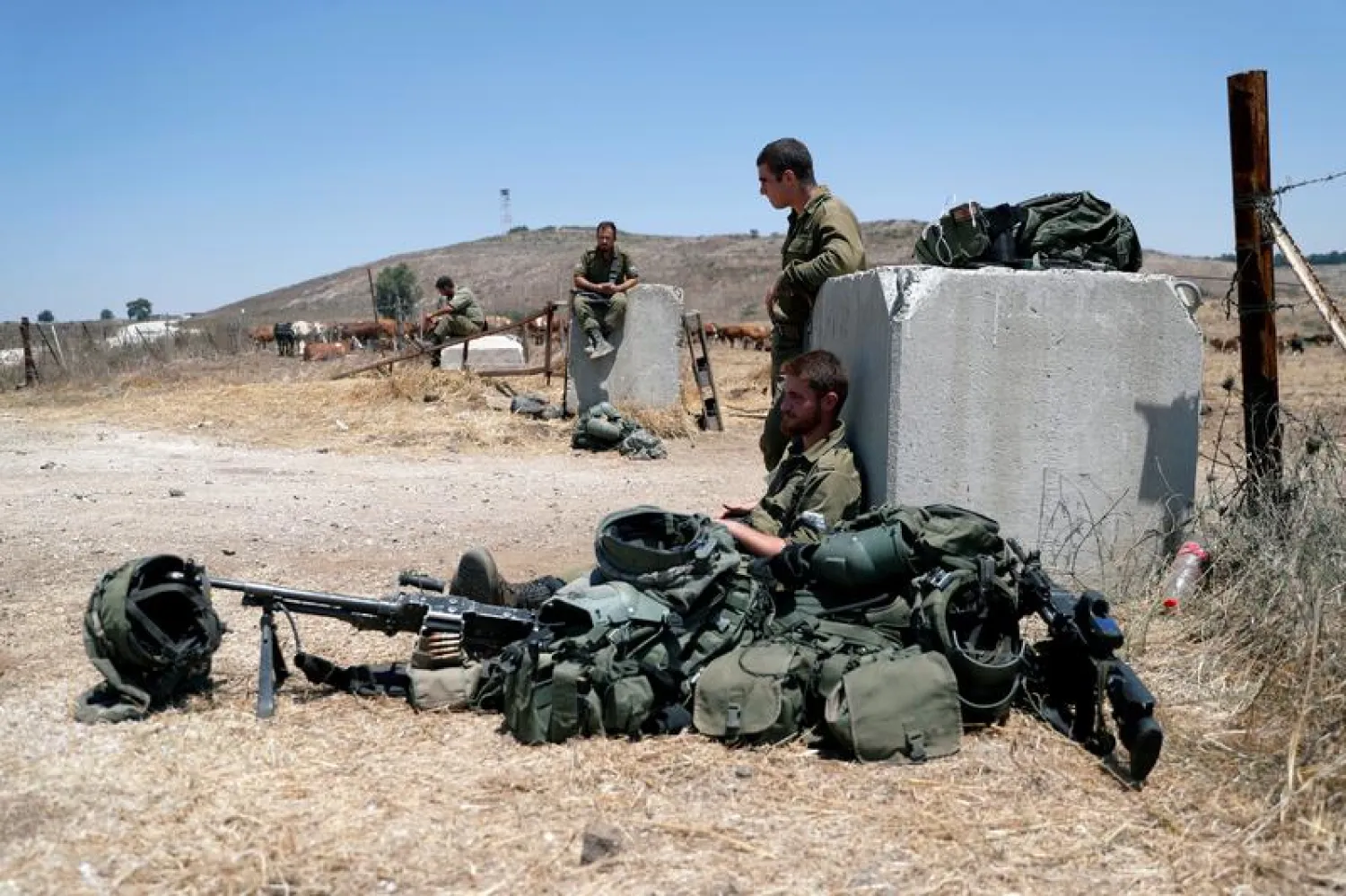

Israeli Army Prepares All Possible Scenarios to Strike Iran

Israeli soldiers near the border with Syria (Reuters)
TT

Israeli Army Prepares All Possible Scenarios to Strike Iran

Israeli soldiers near the border with Syria (Reuters)

The Israeli army is preparing for all possible scenarios to strike Iran, announced spokesman Brigadier General Ran Kochav.

Kochav told Kan Bet radio channel that the army enhanced its level of readiness, and that the military and operational spheres are at the forefront of both preventing Iran from entrenching itself in the northern arena and preventing it from becoming a nuclear threshold state.

Sources close to Foreign Minister Yair Lapid confirmed that Israel had sent clear messages about its position regarding the nuclear talks between the major powers and Iran in Vienna.

The sources said that Lapid believes the Iranians attended Vienna talks after a five-month hiatus only to remove US sanctions, with no intention of stopping or slowing their progress toward a military nuclear program.

According to sources in Tel Aviv, Defense Minister Benny Gantz will travel to Washington next week to join efforts with the United States to confront the Iranian nuclear threat and the rest of Tehran’s plans that threaten Israel and regional countries.

Lapid concluded Wednesday a visit to Britain and France where he met with French President Emmanuel Macron and British Prime Minister Boris Johnson.

“Sanctions on Iran must not be removed. Sanctions must be tightened, a credible military threat must be applied because only that will stop its nuclear race,” Lapid stated.

Prime Minister Naftali Bennett warned that Tehran seeks “to end sanctions in exchange for almost nothing” and keep its nuclear program intact while receiving billions of dollars once sanctions are lifted.

“Iran won’t just keep its nuclear program; from today, they’ll be getting paid for it,” Bennett cautioned.

Intelligence expert, Yossi Melman, quoted several Israeli officials who believe Israel lacks any real and credible capability to take military action.

Melman reported that the declarations by Bennett, Gantz, and Chief of Staff Aviv Kochavi about Israel’s readiness for a military strike are “empty and pointless rhetoric, as they well know. They are playing pretend.”

In his article in Haaretz newspaper, the expert noted the parties participating in the Vienna talks, including Iran, Russia, China, European countries, and the US, “are quite aware” of Israel’s inability to strike militarily.

“A leader who toys with the enemy and employs deception and psychological warfare is considered clever. A leader who toys with the public is a schemer. A leader who deludes himself is dangerous.”

He explained that even the brand-new F-35 stealth aircraft, which were designed precisely for the mission of carrying out an airstrike in Iran, would need to refuel midair – slowing down the operation and increasing the danger of exposure.

“It’s a shame that tens of billions of shekels are being wasted readying the air force for an attack that will not happen.”


North Produces Enough Nuclear Material a Year for 10-20 Weapons, Says S. Korea President

South Korean President Lee Jae Myung speaks during his new year press conference at the presidential Blue House in Seoul, South Korea, 21 January 2026. (EPA)
TT

North Produces Enough Nuclear Material a Year for 10-20 Weapons, Says S. Korea President

South Korean President Lee Jae Myung speaks during his new year press conference at the presidential Blue House in Seoul, South Korea, 21 January 2026. (EPA)

North Korea is producing enough nuclear material a year for up to 20 weapons, the South's President Lee Jae Myung said on Wednesday, warning that Pyongyang's ambitions could pose a global danger.

The North carried out its first atomic test in 2006 in violation of UN resolutions and is now believed to possess dozens of nuclear warheads.

"Even now, nuclear materials sufficient to produce 10 to 20 nuclear weapons a year are still being produced" in North Korea, Lee told reporters at a New Year news conference.

At the same time, the North is continuing to improve its long-range ballistic missile technology aimed at striking the US mainland, Lee added.

"At some point, North Korea will have secured the nuclear arsenal it believes it needs to sustain the regime, along with ICBM capabilities capable of threatening not only the United States but the wider world," he said, referring to intercontinental ballistic missiles.

"And once there is excess, it will go abroad -- beyond its borders. A global danger will then emerge," he said.

Pyongyang has for decades justified its nuclear and missile programs as a deterrent against alleged regime change efforts by Washington and its allies.

A pragmatic attitude was needed in addressing North Korea's nuclear issue, Lee said, adding the "Trump-style approach" could help in communicating with Pyongyang.

"The suspension of nuclear material production and ICBM development, as well as a halt to overseas exports, would also be a gain," he said.

"It would be a gain for everyone," he added, noting that he had laid out the argument to both US President Donald Trump and his Chinese counterpart Xi Jinping.

Since his inauguration in June, Lee has pushed for dialogue with the North without preconditions, a stark departure from the hawkish approach of his predecessor.

- 'Trump-style approach' -

While Pyongyang has snubbed Seoul's dialogue offers, Lee said Trump could pave the way forward with North Korean leader Kim Jong Un -- with whom the US leader has expressed his affinity over the years.

"President Trump is a somewhat unique figure, but I think that very trait can at times be a significant asset in resolving problems on the Korean peninsula," Lee said.

"The Trump style approach seems to help when it comes to talking with Kim ... I am willing to play the role of a pacemaker in that process."

Trump met Kim three times during his first term in efforts to reach a denuclearization deal.

But since his second summit in Hanoi fell through over differences about what Pyongyang would get in return for giving up its nuclear weapons, no progress has been made between the two countries.

Trump had expressed hopes for a meeting with Kim ahead of the APEC summit in South Korea in October, which went unanswered by the North Korean leader.

Recently North Korea accused the South of flying a drone into the border city of Kaesong.

Lee's office has denied it was behind the incursion but alluded it might have been carried out by civilians.

One man has claimed responsibility for the breach, telling local media that he had carried it out to measure radiation levels at a North Korean uranium processing facility.


Another Train Crashes in Spain, Killing at Least 1 Person

Emergency services personnel work at the site where a train crashed into a collapsed retaining wall between Gelida and Sant Sadurni d'Anoia, Barcelona, Spain, late 20 January 2026. (EPA)
TT

Another Train Crashes in Spain, Killing at Least 1 Person

Emergency services personnel work at the site where a train crashed into a collapsed retaining wall between Gelida and Sant Sadurni d'Anoia, Barcelona, Spain, late 20 January 2026. (EPA)

Commuter rail service in Spain's northeastern Catalonia region was suspended Wednesday after a Barcelona commuter train crashed the night before, Spanish authorities said.

At least one person died in the Barcelona-area crash, and 37 others were injured as crews worked at night to complete the rescue effort. The train hit a retaining wall that fell onto the tracks, authorities said.

The news late Tuesday of another train crash mere days after Spain’s worst railway disaster since 2013 left many Spaniards in disbelief.

Emergency workers were still searching for more victims in the wreckage from Sunday’s deadly high-speed crash in southern Spain that killed at least 42 people, injured dozens more and took place some 800 kilometers (497 miles) away.

Three days of national mourning were underway, and the cause of that crash was being investigated.

The victim of the Tuesday night crash was a trainee train driver, regional authorities said. Of the 37 people affected, five were seriously injured. Six others were in less serious condition, emergency service said. Most of the injured had ridden in the first train car.

The suspension of commuter trains Wednesday morning caused significant traffic jams on roads leading into Barcelona. Regional authorities in Catalonia asked people to reduce unnecessary travel and companies to allow remote work while the disruptions continued.

Spanish Prime Minister Pedro Sánchez acknowledged the Barcelona area crash, writing on X on Tuesday night: “All my affection and solidarity with the victims and their families.”

While Spain’s high-speed rail network generally runs smoothly, and at least until Sunday had been a source of confidence, commuter rail services are plagued by reliability issues. However, accidents causing injury or death are not common in either.

The commuter train crashed near the town of Gelida, located about 37 kilometers (23 miles) outside Barcelona.

Spain’s railway operator ADIF said the containment wall likely collapsed due to heavy rainfall that swept across the northeastern Spanish region this week.


EU Is at a Crossroads Towards More Independence, von der Leyen Says

European Commission President Ursula von der Leyen speaks at the European Parliament in Strasbourg, eastern France, on January 21, 2026. (AFP)
TT

EU Is at a Crossroads Towards More Independence, von der Leyen Says

European Commission President Ursula von der Leyen speaks at the European Parliament in Strasbourg, eastern France, on January 21, 2026. (AFP)

The EU needs to speed up its push for ​independence to defend itself in a fast-changing world, EU Commission President Ursula von der Leyen said on Wednesday.

"We are at a crossroads. Europe ‌prefers dialogue ‌and solutions – ‌but ⁠we are ​fully ‌prepared to act, if necessary, with unity, urgency and determination," von der Leyen said in a speech in European Parliament.

"In this ⁠increasingly lawless world, Europe needs ‌its own levers of ‍power," ‍she said.

"We know them: ‍A strong economy, a thriving single market and industrial base, a strong innovation and ​technology capacity, united societies and above a real capacity ⁠to defend ourselves."