Etihad Airways, Henan Province Airport Group Sign Deal to Boost Sino-Arab Cargo Ties

Etihad Airways, Henan Province Airport Group Sign Deal to Boost Sino-Arab Cargo Ties
TT

Etihad Airways, Henan Province Airport Group Sign Deal to Boost Sino-Arab Cargo Ties

Etihad Airways, Henan Province Airport Group Sign Deal to Boost Sino-Arab Cargo Ties

UAE's Etihad Airways and and Henan Province Airport Group agreed to establish a strategic partnership to strengthen aviation ties between the UAE and China.

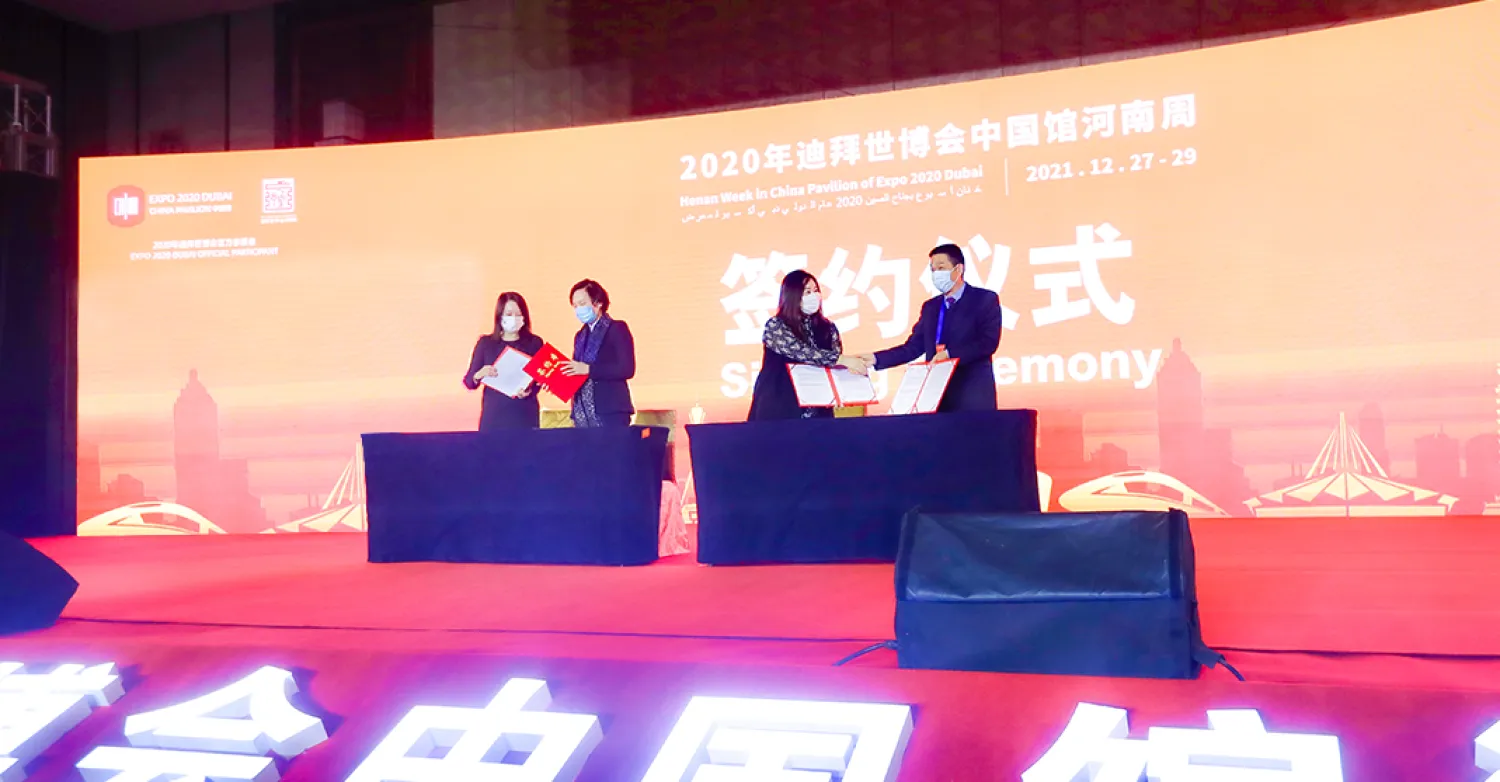
This follows the signing of a virtual Memorandum of Understanding (MOU) during the virtual "Zhengzhou Week" event hosted by Expo 2020 Dubai China Pavilion starting from 27 December 2021, state news agency WAM reported.

The MOU highlights Etihad’s plans for potential operation of regular cargo services between Abu Dhabi International Airport (AUH) and Zhengzhou Xinzheng International Airport (CGO) to create the "Air Silk Road" between Henan Province and the emirate of Abu Dhabi.

The MOU also outlines cooperation between the two parties to build the CGO airport into an air freight hub in the region, and to diversify product sales and cargo distribution channels at Zhengzhou Xinzheng International Airport.

Martin Drew, Senior Vice President Sales and Cargo, Etihad Airways said: "Etihad is very excited to see the potential to further expand its cargo footprint in China, and to create the ‘Air Silk Road’ between the emirate and Central China together with Henan Province Airport Group."

"This will greatly improve the diversification of product sales and cargo distribution channels in this region and strengthen economic and trade links between the UAE and China, and beyond"

For his part, Kang Xingzhen, Chairman of Henan Airport Group Co. Ltd. complimented the cooperation: "Today, we are very pleased to sign the MoU with Etihad Airways, a key airline player in the Middle East region with extensive network to Asia, the Middle East, Europe and Africa, to explore various opportunities under the ‘Air Silk Road’ aviation initiative inspired by the China-proposed ‘Belt and Road Initiative’.


Brazil's Lula Urges Trump to Treat All Countries Equally

Brazilian President Luiz Inacio Lula da Silva gestures during a press conference in New Delhi, India, February 22, 2026. REUTERS/Adnan Abidi
TT

Brazil's Lula Urges Trump to Treat All Countries Equally

Brazilian President Luiz Inacio Lula da Silva gestures during a press conference in New Delhi, India, February 22, 2026. REUTERS/Adnan Abidi

Brazil's President Luiz Inacio Lula da Silva on Sunday urged Donald Trump to treat all countries equally after the US leader imposed a 15 percent tariff on imports following an adverse Supreme Court ruling.

"I want to tell the US President Donald Trump that we don't want a new Cold War. We don't want interference in any other country, we want all countries to be treated equally," Lula told reporters in New Delhi.

The conservative-majority Supreme Court on Friday ruled six to three that a 1977 law Trump has relied on to slap sudden levies on individual countries, upending global trade, "does not authorize the President to impose tariffs".

According to AFP, Lula said he would not like to react to Supreme Court decisions of another country, but hoped that Brazil's relations with the United States "will go back to normalcy" soon.

The veteran leftist Brazilian leader is expected to travel to Washington next month for a meeting with Trump.

"I am convinced that Brazil-US relation will go back to normalcy after our conversation," Lula, 80, said, adding Brazil only wanted to "live in peace, generate jobs, and improve lives of our people".

Ties between Brazil and the United States appear to be on the mend after months of animosity between Washington and Brasilia.

As a result, Trump's administration has exempted key Brazilian exports from 40 percent tariffs that had been imposed on the South American country last year.

"The world doesn't need more turbulence, it needs peace," said Lula who arrived in India on Wednesday to attend a summit on artificial intelligence.

On Saturday, India and Brazil agreed to boost cooperation on critical minerals and rare earths and signed a raft of other deals after a meeting between Lula and Prime Minister Narendra Modi.


IMF Acknowledges Economic Turnaround in Pakistan

A man cuts meat at a local restaurant in Karachi (EPA)
TT

IMF Acknowledges Economic Turnaround in Pakistan

A man cuts meat at a local restaurant in Karachi (EPA)

The International Monetary Fund (IMF) has acknowledged a marked improvement in Pakistan's economic outlook, stating that policy efforts under its Extended Fund Facility (EFF) have helped stabilize the economy, contain inflation and rebuild confidence, as the country prepares for a fresh round of review talks later this month.

Speaking at a press briefing in Washington, IMF Communications Director Julie Kozack said an IMF staff team will visit Pakistan from February 25 for discussions on the Third Review under the Extended Fund Facility (EFF) and the Second Review under the Resilience and Sustainability Facility (RSF).

According to Pakistani newspaper, The Express Tribute, Kozack described Pakistan's fiscal performance in the 2025 financial year as “strong,” noting that the country has achieved a primary fiscal surplus of 1.3% of GDP, a figure that aligns with agreed program targets.

Last December, the IMF approved the release of $1.2 billion to Pakistan, giving the cash-strapped country a fresh boost as it works to recover from one of its worst economic crises in years.

The IMF will provide Pakistan $1 billion under its Extended Fund Facility and $200 million under its Resilience and Sustainability Facility.

Pakistan's central bank governor Jameel Ahmad told Reuters this week the recovery is broader and more durable than headline export data suggest.

The chief said he expects the economy to grow as much as 4.75% this fiscal year, pushing back against a recent downgrade by the IMF.

He said differences in projections were not unusual and reflected timing issues, including the IMF's incorporation of flood-related assessments in its latest outlook.

“All these sources and indicators, along with FY26-Q1 data, point to a broad-based recovery in all three sectors of the economy,” Ahmad said.

He added that the central bank believed that agricultural activity had remained resilient despite floods and “it is even performing better than its targets.”

Ahmad said financial conditions had eased significantly following a cumulative 1,150 basis point cut in the policy rate since June 2024, and that the full impact was still feeding through. This, he said, was supporting growth while preserving price and economic stability.

The central bank last month held its benchmark rate at 10.5%, defying expectations for a cut.

The State Bank of Pakistan (SBP) raised its FY26 growth forecast to 3.75–4.75% at its January meeting, 0.5 percentage point higher than its previous range, despite a contraction in exports in the first half of the year and a widening trade deficit.

The governor said differences in projections were not unusual and reflected timing issues, including the IMF's incorporation of flood-related assessments in its latest outlook.

While exports declined in the first half of the fiscal year, Ahmad said the fall reflected low global prices and border disruptions rather than softer activity.
The divergence with the IMF comes at a delicate moment for Pakistan, which is emerging from a balance-of-payments crisis under a $7 billion IMF program.

Pakistan's previous growth spurts have often led to currency pressure and a decline in foreign exchange reserves, making the sustainability of the current rebound a key question for investors.

Ahmad said high-frequency indicators and 6% growth in large-scale manufacturing in July–November point to strengthening demand, while agriculture has remained resilient despite last year's floods.

“Additionally, if the government decided to tap global capital markets for any debt issuance, then that would be on the upside of our current assessment,” he said.

Pakistan plans to issue panda bonds, a yuan-denominated debt sold in China's domestic market around the upcoming Lunar New Year, as part of efforts to diversify external financing and broaden its investor base.

Ahmad said the central bank has been consistently purchasing dollars in the interbank market to strengthen foreign exchange buffers, with data published regularly.

He said that while economic stability has improved, structural reforms remain key to sustaining stronger growth and improving productivity.



India, Brazil Sign Agreement to Boost Cooperation on Rare Earths, Cut Dependence on China

Brazilian President Lula da Silva and Indian Prime Minister Narendra Modi before a meeting at Hyderabad House in New Delhi on February 21, 2026 (EPA)
TT

India, Brazil Sign Agreement to Boost Cooperation on Rare Earths, Cut Dependence on China

Brazilian President Lula da Silva and Indian Prime Minister Narendra Modi before a meeting at Hyderabad House in New Delhi on February 21, 2026 (EPA)

India and Brazil sealed a deal Saturday on critical minerals and rare earths following a meeting in New Delhi between Prime Minister Narendra Modi and Brazilian President Luiz Inacio Lula da Silva.

“The agreement on critical minerals and rare earths is a major step towards building resilient supply chains,” Modi said.

“Increasing investments and cooperation in matters of renewable energies and critical minerals is at the core of the pioneering agreement that we have signed today,” said Lula, who arrived in New Delhi on Wednesday for a summit on artificial intelligence, accompanied by a delegation of more than a dozen ministers as well as business leaders.

The details of the deal were not immediately available but a senior Indian foreign ministry official said official discussions were underway.

Brazil has the world's second-largest reserves of critical minerals, which are used in everything from electric vehicles, solar panels and smartphones to jet engines and guided missiles.

India, seeking to cut its dependence on top exporter China, has been expanding domestic production and recycling while scouting for new suppliers.

Main Trade Partner

“Brazil is India's largest trade partner in Latin America. We are committed to taking our bilateral trade beyond $20 billion in the coming five years,” Modi said. “Our trade is not just a figure, but a reflection of trust.”

Nine other agreements and memoranda of understanding were finalized on Saturday, covering digital cooperation, health, entrepreneurship and other fields.

Rishabh Jain, an expert with the Delhi-based Council on Energy, Environment and Water think tank, said India's growing cooperation with Brazil on critical minerals complements recent supply chain engagements with the United States, France and the European Union.

While these partnerships grant India access to advanced technologies, finance and high-end processing capabilities, “Global South alliances are critical for securing diversified, on-ground resource access and shaping emerging rules of global trade,” Jain told AFP.

India, the world's most populous nation, is the 10th largest market for Brazilian exports, with bilateral trade topping $15 billion in 2025.

Key Brazilian exports to India include sugar, crude oil, vegetable oils, cotton and iron ore.

Demand for iron ore has been driven by rapid infrastructure expansion and industrial growth in India, which is on track to become the world's fourth largest economy.