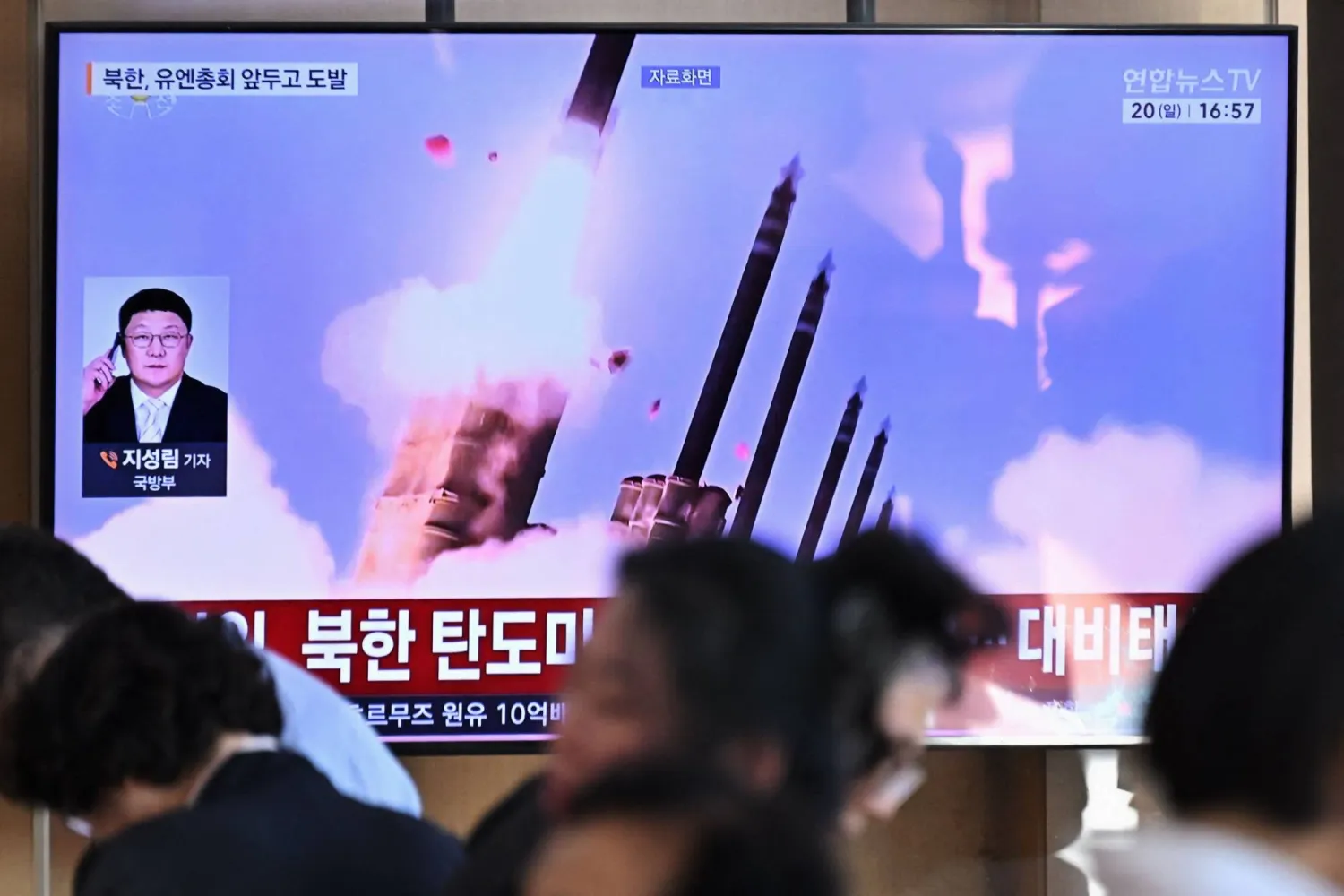
North Korea fired two projectiles into the sea off its eastern coast on Sunday, including at least one ballistic missile, South Korea's defense ministry said.
The incidents came days after Pyongyang reasserted its status as a nuclear-armed state and rejected a United Nations resolution demanding it halt its nuclear activities.
South Korea's military said the first launch at around 3:00 pm (0600 GMT) was a ballistic missile fired from near the city of Wonsan that flew around 450 kilometers (280 miles) into the East Sea, a body of water also called the Sea of Japan.
There were no immediate details on the second launch, which Seoul's defense ministry confirmed soon after 6:00 pm.
"Our military detected a ballistic missile launched from the Wonsan area of North Korea towards the East Sea," South Korea's Joint Chiefs of Staff said after the initial launch.
"South Korean and US authorities are conducting a detailed analysis to determine... exact specifications," it said, according to AFP.
The office of the Japanese prime minister said on X that both projectiles were suspected to be ballistic missiles.
Tokyo lodged a "stern protest" with North Korea over the launch and condemned it as a threat to regional peace and security, Japan's Kyodo news agency cited the government as saying.
South Korea's presidential National Security Office convened an emergency security meeting following the first launch and assessed its impact on national security, the presidential office said.
The government called on Pyongyang to "immediately cease" its ballistic missile launches, describing Sunday's firing as a "grave act" that violated UN Security Council resolutions.
The incidents came eight days after North Korea fired multiple short-range ballistic missiles towards the East Sea as part of what it later described as a joint firepower drill.
That exercise involved long-range artillery and missiles, with the weapons "hitting the targets with 100 percent hit accuracy", state media reported.
North Korea accused "hostile forces" of seeking to end the country's nuclear program during this week's General Conference of the International Atomic Energy Agency (IAEA).
A foreign ministry spokesperson said the IAEA resolution "has no effect on the DPRK's position as a nuclear weapons state", using the acronym for North Korea's official name.
The North's status as a nuclear power is "guaranteed by the actual nuclear deterrent and irreversibly and permanently fixed by the supreme law of the state", the spokesperson said.
Kim Yo Jong, the powerful sister of the North Korean leader, recently said the country's nuclear-armed status was "absolute", and called those hoping for its denuclearization "idiots".
US President Donald Trump said in August that North Korea possessed 57 "very powerful" nuclear weapons, while South Korea has put the figure at between 80 and 120.