


EU’s Russia Sanctions Effort Slows over Oil Dependency

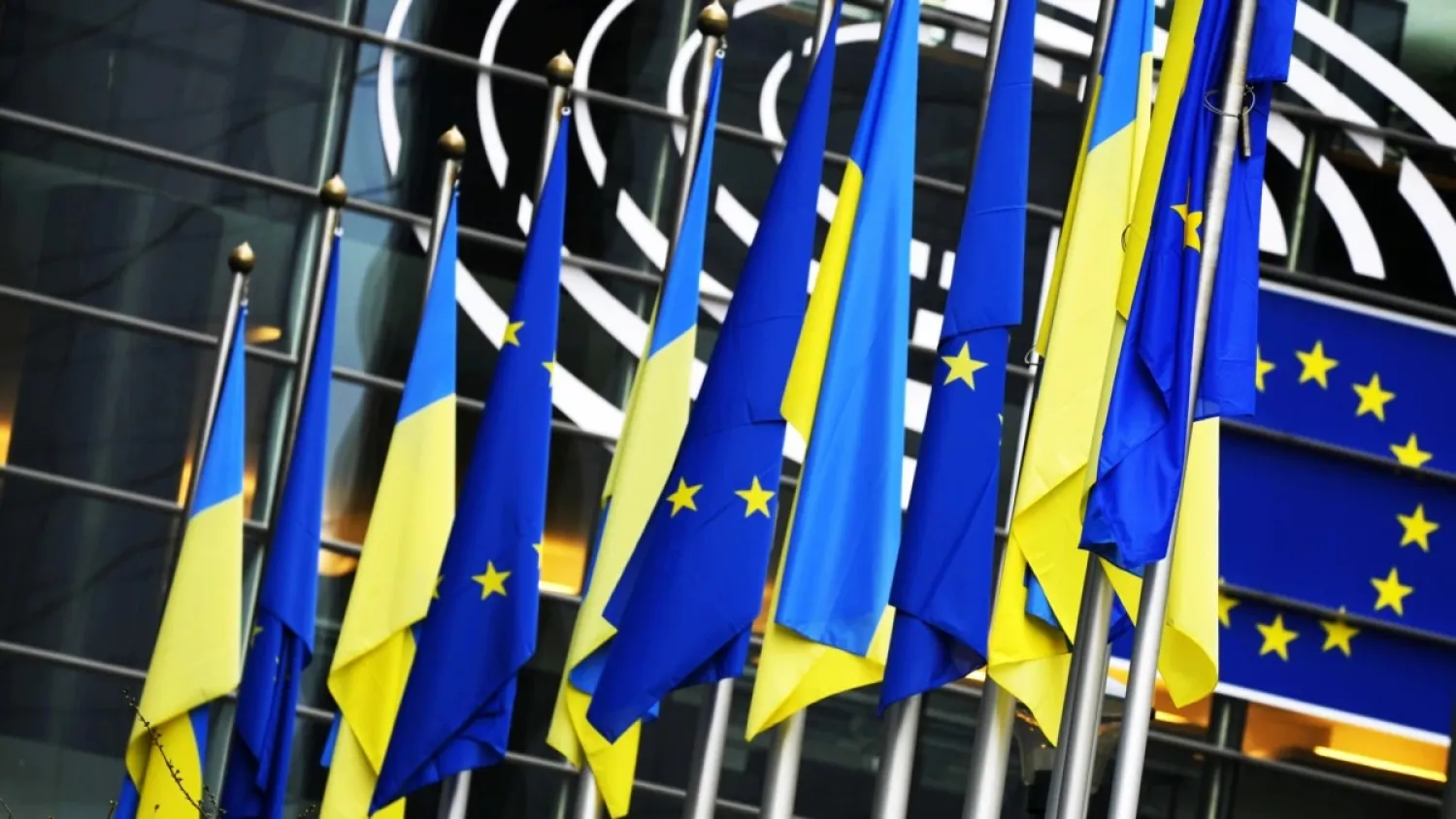
Ukrainian and European Union flags hang together on the exterior of the building at the European Parliament in Brussels. (AP)
TT

EU’s Russia Sanctions Effort Slows over Oil Dependency

Ukrainian and European Union flags hang together on the exterior of the building at the European Parliament in Brussels. (AP)

The European Union’s efforts to impose a new round of sanctions against Russia over the war in Ukraine appeared to be bogged down on Monday, as a small group of countries opposed a ban on imports of Russian oil.

Since Russia invaded on Feb. 24, the bloc has implemented five rounds of sanctions on Moscow. President Vladimir Putin, senior officials, more than 350 lawmakers and pro-Kremlin oligarchs were hit with asset freezes and travel bans. Banks, the transport sector and alleged propaganda outlets were targeted.

What could have taken years in the past has been achieved in less than three months - relative light speed for the 27-nation bloc. But limiting Russia’s energy income by weaning their dependency off its oil - not to mention gas supplies - is proving a tougher nut to crack.

The EU’s executive branch, the European Commission, proposed on May 4 a sixth package of war sanctions that included a ban on oil imports from Russia. European Commission President Ursula von der Leyen conceded at the time that securing the agreement of all "will not be easy."

Hungary is one of a number of landlocked countries that are highly dependent on Russian oil, along with the Czech Republic and Slovakia. Bulgaria also has reservations. Hungary gets more than 60% of its oil from Russia, and 85% of its natural gas.

"We will do our best in order to deblock the situation. I cannot ensure that it is going to happen because positions are quite strong," EU foreign policy chief Josep Borrell told reporters as he arrived to chair a meeting of the bloc’s foreign ministers in Brussels.

"Some member states face more difficulties because they are more dependent, because they are landlocked," Borrell said, and "they only have oil through pipelines, and coming from Russia."

Muddying the waters is Hungarian Prime Minister Viktor Orban’s relationship with Putin. Orban is widely considered to be one of the Russian leader’s closest European allies. He has only reluctantly supported previous EU sanctions, including a phased-in embargo on Russian coal.

Since taking office in 2010, Orban has deepened Hungary’s dependency on Russian energy and says its geography and energy infrastructure make an oil shutdown impossible. His EU partners are at odds over what they believe is driving his reluctance to target oil.

"The whole union is being held hostage by one member state," Lithuanian Foreign Minister Gabrielius Landsbergis said. He said that the European Commission's proposal offered members a phaseout of Russian oil until Dec 31, 2024, and that "everybody expected that this would be enough."

But his Irish counterpart, Simon Coveney, acknowledged that "these are difficult, difficult issues for some countries," and he added: "Let’s not focus on obstacles and negatives today."

At the same time, Coveney said, "we need to get on and do this. We need to send a very clear signal to the Kremlin and to Moscow that the cost of their continuing war in Ukraine, which is completely unjustifiable, will continue to increase."

For now, the ball is in Hungary’s court, as the most vocal member of those opposed. Officials have said that Orban appears to be seeking EU money for energy infrastructure investment. Any compromise is only likely to be found in his talks with von der Leyen, not between ministers.

The oil standoff raises questions about whether the EU has reached the limits of its unity on sanctions. Targeting Russia’s gas sector, on which many more countries are dependent, is likely to prove even tougher.

Officials said before Monday’s meeting that a political agreement is likely to be found on a fourth tranche of money to help supply weapons to Ukraine. It would bring to 2 billion euros ($2.1 billion) the total sum available to fund the purchase of arms and other nonlethal assistance.



US Judge Blocks Deportation of Columbia University Palestinian Activist

Mohsen Mahdawi at a press conference in Vermont last year - Photo by Alex Driehaus/AP
TT

US Judge Blocks Deportation of Columbia University Palestinian Activist

Mohsen Mahdawi at a press conference in Vermont last year - Photo by Alex Driehaus/AP

A US immigration judge has blocked the deportation of a Palestinian graduate student who helped organize protests at Columbia University against Israel's war in Gaza, according to US media reports.

Mohsen Mahdawi was arrested by immigration agents last year as he was attending an interview to become a US citizen.

Mahdawi had been involved in a wave of demonstrations that gripped several major US university campuses since Israel began a massive military campaign in the Gaza Strip.

A Palestinian born in the occupied West Bank, Mahdawi has been a legal US permanent resident since 2015 and graduated from the prestigious New York university in May. He has been free from federal custody since April.

In an order made public on Tuesday, Judge Nina Froes said that President Donald Trump's administration did not provide sufficient evidence that Mahdawi could be legally removed from the United States, multiple media outlets reported.

Froes reportedly questioned the authenticity of a copy of a document purportedly signed by Secretary of State Marco Rubio that said Mahdawi's activism "could undermine the Middle East peace process by reinforcing antisemitic sentiment," according to the New York Times.

Rubio has argued that federal law grants him the authority to summarily revoke visas and deport migrants who pose threats to US foreign policy.

The Trump administration can still appeal the decision, which marked a setback in the Republican president's efforts to crack down on pro-Palestinian campus activists.

The administration has also attempted to deport Mahmoud Khalil, another student activist who co-founded a Palestinian student group at Columbia, alongside Mahdawi.

"I am grateful to the court for honoring the rule of law and holding the line against the government's attempts to trample on due process," Mahdawi said in a statement released by his attorneys and published Tuesday by several media outlets.

"This decision is an important step towards upholding what fear tried to destroy: the right to speak for peace and justice."


Fire Breaks out Near Iran's Capital Tehran, State Media Says

Smoke rises from a fire caused by an explosion in Tehran (File photo - Reuters)
TT

Fire Breaks out Near Iran's Capital Tehran, State Media Says

Smoke rises from a fire caused by an explosion in Tehran (File photo - Reuters)

A fire broke out in Iran's Parand near the capital city Tehran, state media reported on Wednesday, publishing videos of smoke rising over the area which is close to several military and strategic sites in the country's Tehran province, Reuters reported.

"The black smoke seen near the city of Parand is the result of a fire in the reeds around the Parand river bank... fire fighters are on site and the fire extinguishing operation is underway", state media cited the Parand fire department as saying.


Pakistan PM Sharif to Seek Clarity on Troops for Gaza in US Visit

US President Donald Trump looks at Pakistan's Prime Minister Shehbaz Sharif speaking following the official signing of the first phase of the Gaza ceasefire agreement between Israel and Hamas, during a world leaders' summit on ending the Gaza war, in Sharm El-Sheikh, Egypt, October 13, 2025. REUTERS/Evelyn Hockstein/File Photo
TT

Pakistan PM Sharif to Seek Clarity on Troops for Gaza in US Visit

US President Donald Trump looks at Pakistan's Prime Minister Shehbaz Sharif speaking following the official signing of the first phase of the Gaza ceasefire agreement between Israel and Hamas, during a world leaders' summit on ending the Gaza war, in Sharm El-Sheikh, Egypt, October 13, 2025. REUTERS/Evelyn Hockstein/File Photo

Before Pakistan commits to sending troops to Gaza as part of the International Stabilization Force it wants assurances from the United States that it will be a peacekeeping mission rather than tasked with disarming Hamas, three sources told Reuters.

Pakistan's Prime Minister Shehbaz Sharif is set to attend the first formal meeting of President Donald Trump's Board of Peace in Washington on Thursday, alongside delegations from at least 20 countries.

Trump, who will chair the meeting, is expected to announce a multi-billion dollar reconstruction plan for Gaza and detail plans for a UN-authorized stabilization force for the Palestinian enclave.

Three government sources said during the Washington visit Sharif wanted to better understand the goal of the ISF, what authority they were operating under and what the chain of command was before making a decision on deploying troops.

"We are ready to send troops. Let me make it clear that our troops could only be part of a peace mission in Gaza," said one of the sources, a close aide of Sharif.

"We will not be part of any other role, such as disarming Hamas. It is out of the question," he said.

Analysts say Pakistan would be an asset to the multinational force, with its experienced military that has gone to war with arch-rival India and tackled insurgencies.

"We can send initially a couple of thousand troops anytime, but we need to know what role they are going to play," the source added.

Two of the sources said it was likely Sharif, who has met Trump earlier this year in Davos and late last year at the White House, would either have an audience with him on the sidelines of the meeting or the following day at the White House.

Initially designed to cement Gaza's ceasefire, Trump sees the Board of Peace, launched in late January, taking a wider role in resolving global conflicts. Some countries have reacted cautiously, fearing it could become a rival to the United Nations.

While Pakistan has supported the establishment of the board, it has voiced concerns against the mission to demilitarize Gaza's militant group Hamas.