


Training Courses on Counter-Terrorism Kick off in Rabat

Moroccan special forces stand guard at the entrance of a building during a counter-terrorism operation in Temara, on the outskirts of Rabat, Morocco September 10, 2020. REUTERS
TT

Training Courses on Counter-Terrorism Kick off in Rabat

Moroccan special forces stand guard at the entrance of a building during a counter-terrorism operation in Temara, on the outskirts of Rabat, Morocco September 10, 2020. REUTERS

The Rabat-based UNOCT Program Office for Counter-Terrorism and Training in Africa launched on Monday a series of specialized training courses on counter-terrorism, organized in collaboration with the Australian government.

This first session of a 10-week training, supervised by international experts, aims to bolster the specialized and technical capabilities of participants in the field of investigations and counter-terrorism.

Twenty-four participants representing law enforcement institutions from six African countries (Benin, Burkina Faso, Chad, Mali, Nigeria and Senegal) will take part in the first “basic level” training module, which will conclude on June 10.

The training modules will be delivered over the course of a year, according to the following schedule: basic module from May 23 until June 10, the intermediate module from September 5 until 23, the advanced level from November 21 until December 9, and the trainer level will take place in February 2023.

Speaking via videoconference, the Deputy Director of the United Nations Office of Counter-Terrorism, Mauro Miedico, said the Office, which is the first of its kind in Africa, aims to become a training, qualification and capacity-building hub in the fight against terrorism by organizing training sessions that are supervised by regional and international experts.

Holding the courses in Rabat reflects the kingdom and its partners’ commitment to the fight against terrorism and their contribution to maintain international peace and security.

Head of the UNOCT Office in Africa, Carlos Monteiro Reis, for his part, welcomed the development of this innovative program, stressing that several countries will benefit from this training program to enhance their skills in the fight against terrorism.

The UN official said the participants will be followed up to ensure they apply the skills acquired to serve the decision-makers in their countries and implement the programs and policies to combat terrorism.

He pointed out that the program will develop a platform for communication and exchange of experiences after the training.

For his part, the Director of Global Issues at the Ministry of Foreign Affairs, African Cooperation and Moroccans Abroad, Ismail Chekkori, said the training is a new step in the fight against terrorism and the establishment of peace in Africa.

He referred to the terrorist activities that threaten the stability and security of the continent and the importance of combining efforts to address them.



UN: Drone Attack Hits Sudan Aid Truck

Shops operate beneath a war-damaged building in Omdurman, on the outskirts of Khartoum, Sudan, Thursday, April 23, 2026. (AP Photo/Bernat Armangue)
TT

UN: Drone Attack Hits Sudan Aid Truck

Shops operate beneath a war-damaged building in Omdurman, on the outskirts of Khartoum, Sudan, Thursday, April 23, 2026. (AP Photo/Bernat Armangue)

A drone attack hit an aid truck in Sudan's North Darfur state, destroying all the supplies on board, the UN refugee agency said on Sunday, without identifying who was responsible.

Drone strikes by both the Sudanese army and the Rapid Support Forces (RSF), who have been locked in a brutal war since April 2023, have escalated in recent months, often killing dozens at a time.

The UNHCR-operated vehicle "came under drone attack" on Friday while transporting emergency shelter kits to Tawila, home to more than 700,000 displaced people who fled fighting elsewhere in the western Darfur region, AFP quoted the agency as saying.

The driver escaped unhurt, but all supplies were destroyed in the resulting fire, it added.

UNHCR condemned the attack, warning that it would "leave 1,314 families living in desperate conditions in Tawila without shelter" at a time when humanitarian needs are already overwhelming.

More than 127,000 people fled El-Fasher, North Darfur's capital and the army's last stronghold in the region, after it fell to paramilitary forces in October, with reports of mass killings, sexual violence, looting and rape following the takeover.

Fighting has since spread to neighboring Kordofan, now the main theatre of the war, and the southeastern Blue Nile state, raising fears of a longer and increasingly fragmented conflict.

According to the UN, nearly 700 civilians have been killed in drone strikes by both sides since January alone.

UNHCR voiced "deep concern" over the rising use of drones, calling repeated attacks on humanitarian operations "particularly abhorrent".

According to an assessment by the UN's Food and Agriculture Organization, 28.9 million people, around 62 percent of Sudan's population, are facing acute food insecurity.

That includes 10.2 million who face severe food insecurity, in particular in the wider Darfur region and South Kordofan state.

Famine was declared last year in El-Fasher and Kadugli, the capital of South Kordofan, with 20 other areas at risk in Darfur and Kordofan, a UN-backed assessment found.

The conflict has already killed tens of thousands, uprooted over 11 million and created the world's largest displacement and hunger crises.


Palestinian Leader's Loyalists Win Local Elections, including Some in Gaza

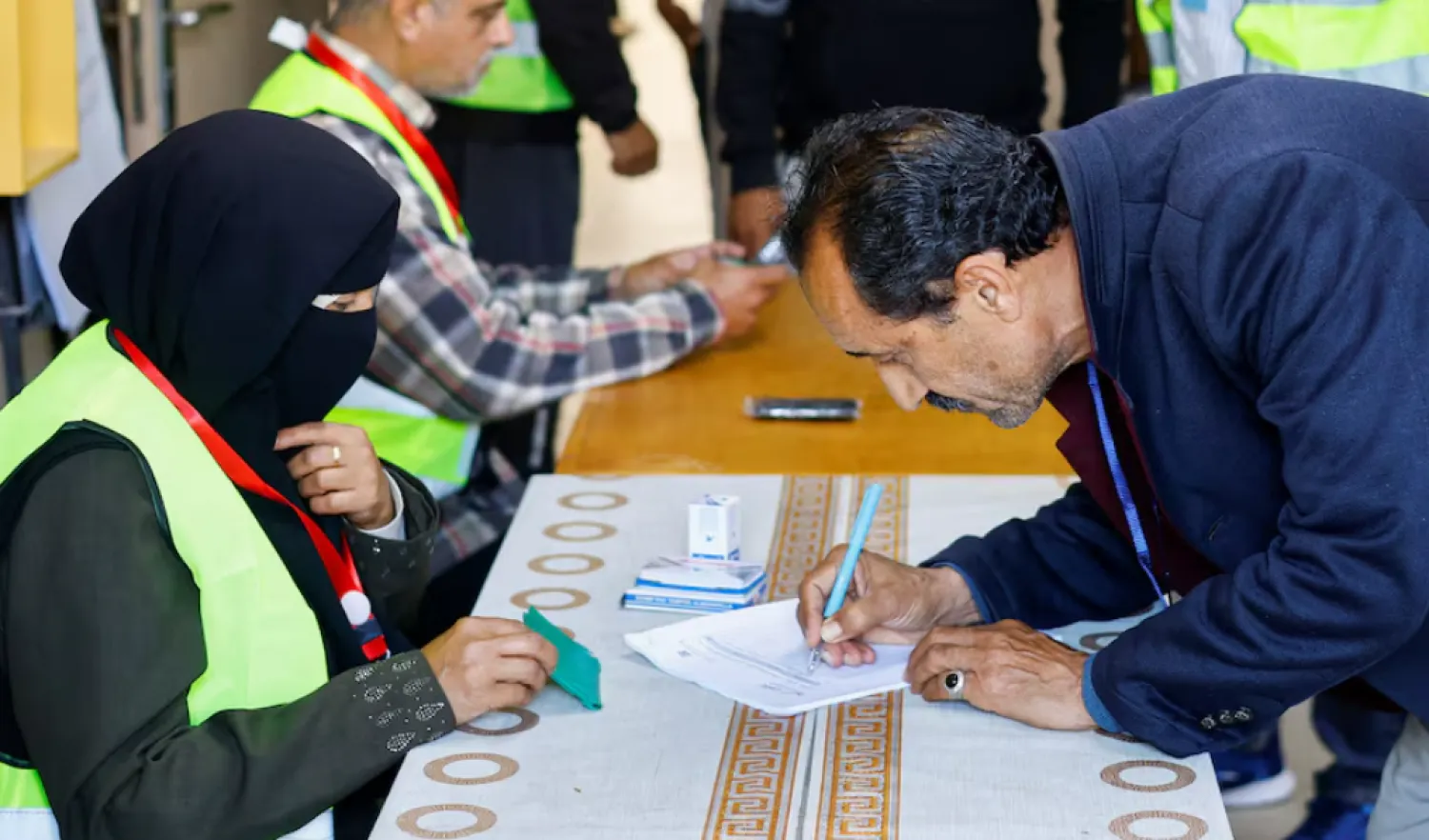
A Palestinian man votes during the municipal election at a polling station in Deir al-Balah, central Gaza Strip April 25, 2026. REUTERS/Mahmoud Issa
TT

Palestinian Leader's Loyalists Win Local Elections, including Some in Gaza

A Palestinian man votes during the municipal election at a polling station in Deir al-Balah, central Gaza Strip April 25, 2026. REUTERS/Mahmoud Issa

Loyalists of President Mahmoud Abbas won most races in Palestinian municipal elections, election officials said on Sunday, in a vote that for the first time in nearly two decades included a city in the Gaza Strip run by rival Hamas.

Saturday’s ballot marked the first elections of any kind in Gaza since 2006 and the first Palestinian polls since the Gaza war began more than two years ago with Hamas' cross-border attack on southern Israel.

Abbas' West Bank–based Palestinian Authority (PA) said the inclusion of the Gaza city Deir al-Balah, which suffered less damage than other areas of the coastal territory during the war, was intended to show that Gaza was an inseparable part of a future Palestinian state.

The elections, in which voter turnout was low, had been held "at a highly sensitive moment amid complex challenges and exceptional circumstances", Palestinian Prime Minister Mohammad Mustafa said as results were announced on Sunday.

But they represented "an important first step in a broader national process aimed at strengthening democratic life ... and ultimately achieving the unity of the land", he said.

POSSIBLE INDICATOR OF HAMAS SUPPORT

Hamas, which ousted the PA from Gaza in 2007, did not formally nominate candidates in Gaza and boycotted the race in the Israeli-occupied West Bank, where Fatah's victory was widely expected.

But some candidates on one of the Deir al-Balah lists were widely seen by residents and analysts as aligned with the movement, making the vote a potential indicator of support for the Islamist group.

Preliminary results showed that the list, known as Deir al-Balah Brings Us Together, won only two of the 15 seats contested in Gaza.

The Nahdat Deir al-Balah list, backed by Abbas' Fatah party and the Western-backed PA, secured six seats. The remaining seats were won by two other Gaza-based groups, Future of Deir al-Balah and Peace and Building, not affiliated with either faction.

Abbas loyalists swept the election in the West Bank, running unchallenged in many seats.

"By electing figures linked to Fatah, voters appear to be seeking unrestricted international support for municipal governance and a gradual political shift that could extend beyond the local level," said Palestinian political analyst Reham Ouda.

The recent war has left much of Gaza reduced to rubble, with many residents displaced and focused on survival. Israel has continued conducting strikes despite an October ceasefire.

In Gaza voter turnout reached just 23%, while in the West Bank it was 56%, according to Chairman of the Central Elections Commission Rami al-Hamdallah.

Al-Hamdallah said some of the ballot boxes and voting equipment did not make it into the enclave because of Israeli security restrictions, though those challenges were overcome.

Hamas' Gaza spokesperson, Hazem Qassem, downplayed the significance of the election results, saying that they had no impact on wider national issues.


Arab Parliament Condemns Attack Targeting Two Border Posts in Kuwait

Arab Parliament logo
TT

Arab Parliament Condemns Attack Targeting Two Border Posts in Kuwait

Arab Parliament logo

Arab Parliament Speaker Mohammed Al-Yamahi has condemned the blatant attack that targeted two sites at the northern land border posts of Kuwait using two explosive-laden drones coming from Iraq, SPA reported.

In a statement, Al-Yamahi stressed the Arab Parliament’s condemnation and categorical rejection of any infringement on the sovereignty of Kuwait or any attempt to undermine its security and stability.

He stressed the Arab Parliament’s full solidarity and support for Kuwait in confronting such attacks, reiterating its backing for all measures taken to protect its security and noting that the security of Kuwait is an integral part of Arab national security.