Ethiopia Urges Int'l Pressure on Tigray Region to Accept Peace Talks

Illustrative: Ethiopian government soldiers ride in the back of a truck on a road near Agula, north of Mekele, in the Tigray region of northern Ethiopia on May 8, 2021. (Ben Curtis/AP)
TT

Ethiopia Urges Int'l Pressure on Tigray Region to Accept Peace Talks

Illustrative: Ethiopian government soldiers ride in the back of a truck on a road near Agula, north of Mekele, in the Tigray region of northern Ethiopia on May 8, 2021. (Ben Curtis/AP)

Ethiopian ambassador to Sudan, Yibeltal Aemero, accused on Monday many parties, he refused to name, of interfering and supporting the Tigray People’s Liberation Front (TPLF) to fuel the conflict in his country.

In a press conference in Khartoum, the ambassador called on the international community and neighboring countries to exert pressure for bringing the Tigray Front to the peace negotiating table.

The ambassador confirmed that the Ethiopian Army had shot down last week a plane that crossed his country’s airspace from Sudan.

He spoke about a “well-known and immense external support” to the Tigray Front.

“This plane is evidence of an attempt to send weapons and ammunition to the TPLF by air,” he said.

Aemero stressed that his government calls on the international community and neighboring countries, which are negatively affected by the conflict, to put pressure on what he called “the terrorist Tigray Liberation Front,” and to force the group to sit down at the negotiating table, and stop the crimes it is committing against civilians.

He also said that Ethiopia is a great country that will not collapse as a result of external pressures or because of a rebellion group in a particular region.

The ambassador noted that his government does not want to engage in a third round of war despite the fact that the TPLF is not ready for negotiations.

He accused the group of setting preconditions to obstruct any solution to the crisis.

Aemero also accused the Tigray Front of recruiting underage children and sending them to the battlefields currently taking place in the Amhara and Afar regions in the north of the country.

“If the TPLF does not stop its crimes, the Ethiopian government will be forced to take appropriate measures to establish security and extend the hegemony of the state in all regions of the country,” he warned.

Fighting erupted between government forces and Tigrayan rebels in northern Ethiopia last Wednesday, shattering a five-month truce and dealing a blow to peace efforts.

Reports of fresh offensives were followed by Ethiopia's air force announcing it had downed a plane carrying weapons for the TPLF.

The government of Prime Minister Abiy Ahmed and the rebels have accused each other of undermining efforts to peacefully resolve the brutal 21-month war in Africa's second most populous nation, and traded blame over who was responsible for returning to combat.

Separately, Aemero expressed his country’s readiness to negotiate with Sudan and Egypt on the Grand Ethiopian Renaissance Dam (GERD) under the patronage of the African Union (AU).

“The third filling of the GERD had been successfully completed without harm to Sudan or negative effects on the two downstream countries,” he said.

Aemero added that Addis Ababa is convinced that all issues can be resolved through dialogue and negotiations.


Egypt Fuel Tanker Crash Ignites Massive Fire on Highway, At Least 31 Dead

People gather near the scene of a fuel tanker fire in the Warraq district near Imbaba, Giza Governorate, Egypt, 25 November 2026. EPA/MOHAMED HOSSAM
TT

Egypt Fuel Tanker Crash Ignites Massive Fire on Highway, At Least 31 Dead

People gather near the scene of a fuel tanker fire in the Warraq district near Imbaba, Giza Governorate, Egypt, 25 November 2026. EPA/MOHAMED HOSSAM

A crash involving a fuel tanker ignited a massive fire on a major highway surrounding Cairo on Wednesday, killing at least 31 people, Egyptian authorities said.

The blaze on Ring Road, a key artery that encircles the Egyptian capital, also injured at least 21 people and left more than two dozen cars and motorcycles charred, according to the latest figures released by the Health Ministry.

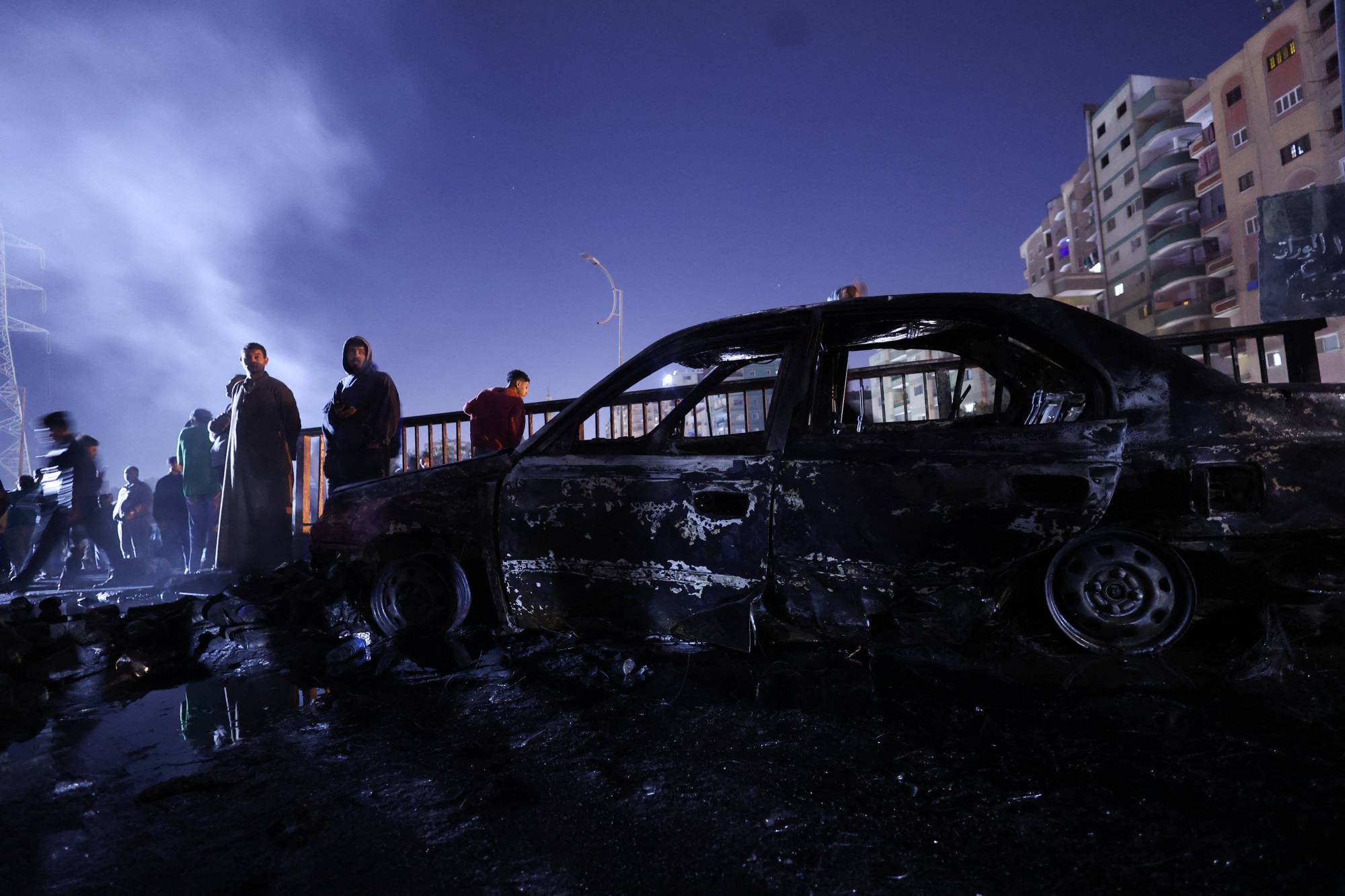
People stand next to the charred remains of a vehicle at the site where a vehicle carrying petroleum products overturned and caught fire on a major ring road in Cairo, Egypt, November 25, 2026. REUTERS/Amr Abdallah Dalsh

The stretch of the highway where the crash occurred was in Warraq, a densely populated neighborhood in Giza, part of the Greater Cairo area, according to the Health Ministry.

Egyptian President Abdel-Fattah el-Sissi expressed his condolences to the victims in a statement. The Public Prosecutor’s office said DNA investigations were underway to identify the victims.

Health Minister Khaled Abdel Ghaffar said the injured were taken to nearby hospitals. He said the death toll was preliminary, raising concerns it could rise further. Initial statements said 25 people were injured, but that figure was later revised to 21.

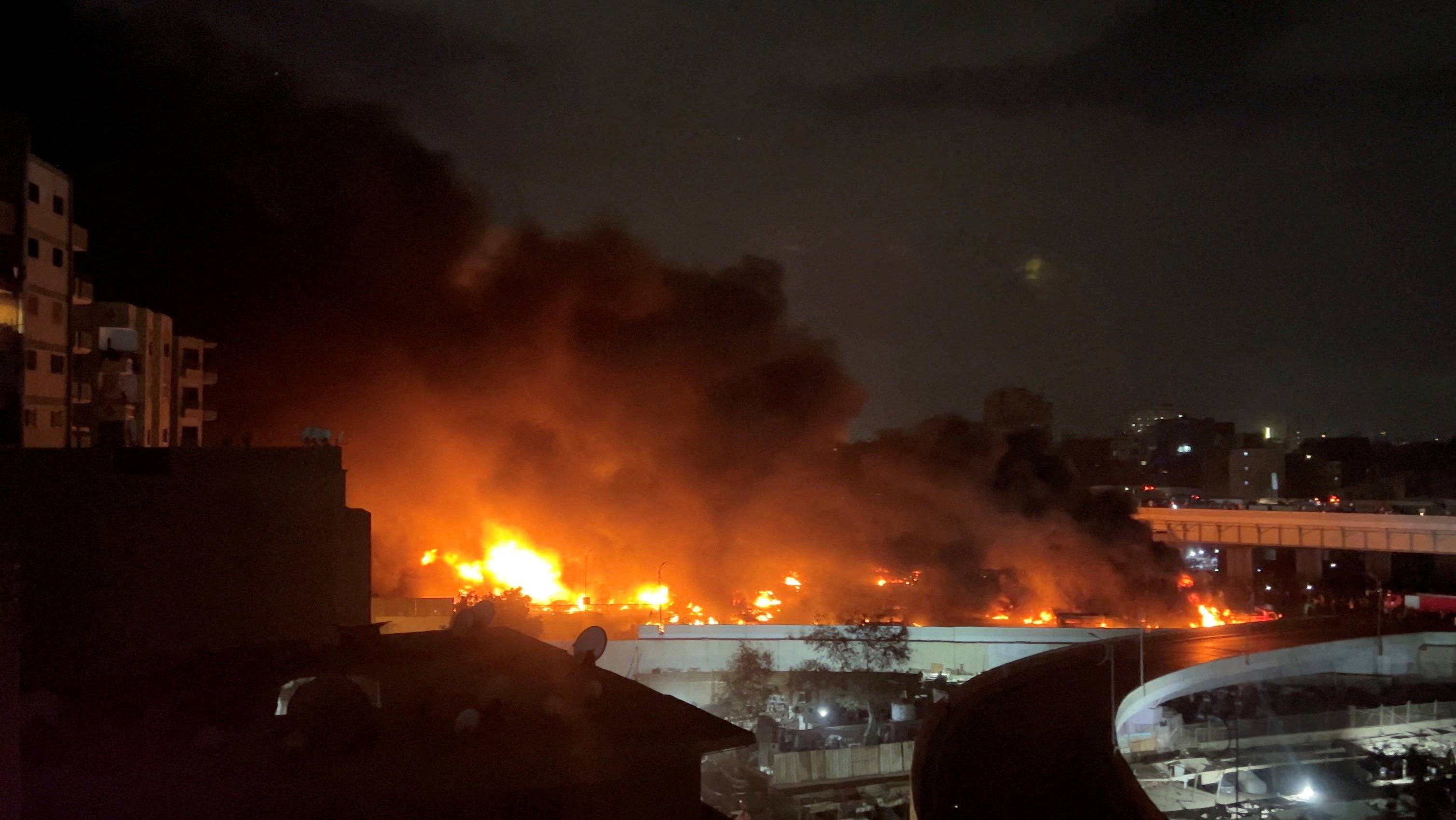
A fire burns at the site where a vehicle carrying petroleum products overturned and caught fire on a major ring road in the Warraq district, Giza, Egypt, November 25, 2026, in this screengrab obtained from social media video. Habiba Abd El Aziz/via REUTERS

A spokesperson for the Egyptian Cabinet told local media that Prime Minister Mostafa Madbouly had ordered an investigation into the causes of the accident.

He said the government was awaiting a full clarification before determining "future measures regarding the transport of petroleum products and ensuring safety and security during such transport operations.”


Al-Zaidi’s Crackdown Gains Legal Backing, No Plans to Send Troops to Kurdistan

Flames rise from flare stacks at oilfields in Kirkuk, Iraq, in October 2017. (Reuters)
TT

Al-Zaidi’s Crackdown Gains Legal Backing, No Plans to Send Troops to Kurdistan

Flames rise from flare stacks at oilfields in Kirkuk, Iraq, in October 2017. (Reuters)

Iraq’s government has secured legal backing for its decisions on border crossings in the Kurdistan Region and oilfields in disputed territories, vowing to press ahead with its anti-smuggling crackdown while ruling out a military deployment to the region.

An authorized government source said Baghdad had no plans to send troops into Kurdistan to tighten control over border crossings, stressing that smuggling would be tackled through constitutional mechanisms and coordination between federal authorities in Baghdad and regional authorities in Erbil.

The assurances followed mounting Kurdish fears of a federal military deployment after intelligence reports uncovered routes used to smuggle oil from Kirkuk and Sulaimaniyah in northern Iraq to Iran and onward to Afghanistan.

Kurdish platforms circulated videos purportedly showing Peshmerga units deploying along a road linking cities in the Kurdistan Region with other Iraqi provinces. The footage could not be independently verified.

Will Baghdad send troops to Kurdistan?

The Iraqi source dismissed reports that Prime Minister Ali al-Zaidi was mobilizing troops to seize control of the region’s official and unofficial border crossings.

“There are absolutely no such intentions ... It will not happen because there is no need for such action,” the source told Asharq Al-Awsat.

The source urged parties to the dispute to “avoid escalatory rhetoric and resort to official channels to find solutions consistent with existing laws.”

“The dispute between the region and the federal government is primarily over border crossings used for smuggling. These must be brought under control through cooperation between Baghdad and Erbil, in accordance with the constitution,” the source said.

While suggesting the crisis was headed toward a resolution, the source stressed that Baghdad insisted on having full knowledge of all activity at those crossings, as it does elsewhere in the country, where it has drawn up a comprehensive plan to secure crossings and stamp out all forms of smuggling.

Al-Zaidi on Tuesday ordered federal authorities to take control of border crossings administered by the Kurdistan Region following an oil-smuggling investigation at the state-run North Oil Company.

The move sparked anger in Erbil.

Kurdistan Democratic Party (KDP) leader Masoud Barzani sent a message to Baghdad urging adherence to constitutional principles and wisdom in resolving disputes, rejecting decisions driven by “personal whims.”

“Iraqi Kurdistan has legitimate and inherent rights and will not submit to decisions that violate the constitution,” Barzani said.

Kurdistan Regional Government (KRG) Prime Minister Masrour Barzani described Baghdad’s decisions as “unacceptable in any way,” but stressed that the door remained open for dialogue with the federal government to reach a mutual agreement.

‘Foreign dictates’

The Iraqi government rejected accusations that it was acting under “foreign dictates,” insisting that it exercised its constitutional powers and responsibilities with complete independence.

“Iraq is a fully sovereign, democratic federal state that derives its powers and the legitimacy of its institutions from the constitution and the will of its people,” it said in a statement.

The government said Iraqi decision-making was an exclusively national matter and that its actions within the country’s internationally recognized borders reflected its independent will and were grounded solely in its constitutional powers and legal responsibilities.

They were not a response to encouragement, dictates or instructions from any foreign party, it added.

The government stressed that it neither derived the legitimacy of its decisions from the positions or policies of other countries nor awaited anyone’s encouragement to exercise its constitutional and sovereign responsibilities.

Its actions, it said, were guided by Iraq’s interests, the rights of its people and the requirements of its security and stability.

The Kurdistan Region’s Council of Ministers on Wednesday renewed its criticism of what it called “military language and threats” in a statement issued in the name of the spokesperson for the commander-in-chief of the Iraqi armed forces.

It demanded the full implementation of Iraq’s constitution, particularly Article 140.

In a statement following a meeting chaired by Masrour Barzani, the council said Baghdad’s recent measures had dominated discussions.

It expressed concern and dismay over the spokesperson’s statement, describing it as a constitutional violation, an infringement of the region’s constitutional rights, a sign of disregard for federalism and an attempt to return Iraq to centralized rule.

The KRG called for the establishment of Iraq’s Federation Council and the reconstitution of the Federal Supreme Court in accordance with constitutional provisions to ensure representation of all segments of Iraqi society.

Legal backing

Al-Zaidi’s decisions on Kurdistan gained legal backing on Wednesday when Iraq’s Federal Supreme Court ruled that Baghdad could deploy federal forces to secure the country’s international borders, including those in territories administered by the Kurdistan Region.

The court said federal authorities could also oversee government departments operating at all border crossings, including those in Kurdistan.

State television reported that the court stressed the need for Baghdad to coordinate with regional and provincial governments on customs administration.

The court said establishing a unified national system to automate border crossings and customs operations, linking them electronically to relevant federal ministries and agencies nationwide, including in Kurdistan, and setting technical, financial and customs standards for their operation fell within federal jurisdiction.

These powers, it said, were part of the federal authorities’ mandate to formulate fiscal and customs policies and regulate trade across regional and provincial borders.

The court also affirmed that the federal government, together with the governments of producing regions and provinces, was responsible for managing extracted oil and gas, which belong to all Iraqis.

It upheld the constitutional and legal powers of the federal Oil Ministry and relevant federal oversight bodies to supervise, monitor and audit oil and gas fields, operations and contracts involving production, extraction, marketing and exports.

Iraq’s Supreme Judicial Council, meanwhile, called on the federal government, the KRG and all political forces concerned to abide by the country’s permanent constitution.

Joint committee for dialogue

In Baghdad, a KDP delegation led by Hoshyar Zebari, a member of the party’s Politburo executive committee, met Iraqi Parliament Speaker Haibat al-Halbousi on Tuesday evening.

Delegation member Abdul Mohsen al-Saadoun said on Wednesday that the talks focused on the prime minister’s recent decisions and statements concerning Kurdistan.

The delegation urged Halbousi, as head of the legislative branch, to fulfill his responsibilities and take a clear stand on any demand or violation at odds with the Iraqi constitution, Saadoun said.

“There must be a joint committee between Erbil and Baghdad so that any problem or new development can be addressed through dialogue,” he added.

Al-Zaidi’s decisions continued to fuel political tensions.

KDP member Vian Sabri told Asharq Al-Awsat that Baghdad had resorted to “escalatory rhetoric against the region to settle routine disputes that could be resolved through dialogue and in accordance with the constitution.”

“Viewing matters through the lens of control and centralization, and treating relations between Baghdad and Erbil as a contest in which one side seeks to impose its will on the other, are precisely what fuel Kurdistan’s fears and deepen mistrust,” she said.

Mahmoud Khoshnaw, a senior official in the Patriotic Union of Kurdistan (PUK), said what angered the Kurds about al-Zaidi’s decisions was that he had approached smuggling as though the region itself was involved in or supported the activity, when several issues needed clarification.

“The federal government’s recent decisions were ill-judged, particularly its use of military language in addressing the region, which could affect the extent of Kurdistan’s support for al-Zaidi,” Khoshnaw said.

Iraqi politician Khamis al-Khanjar proposed on Wednesday forming a high-level committee within the State Administration Coalition, which brings together Shiite, Kurdish and Sunni political forces, to resolve disputes between Baghdad and Erbil.

He also called for expediting the passage of an oil and gas law.


Lebanon Judge Issues Warrants for Five Detained Hezbollah Members

A Hezbollah supporter holds up a Hezbollah flag in Beirut, Lebanon, on July 26, 2025. (AP)
TT

Lebanon Judge Issues Warrants for Five Detained Hezbollah Members

A Hezbollah supporter holds up a Hezbollah flag in Beirut, Lebanon, on July 26, 2025. (AP)

A Lebanese judge on Wednesday issued arrest warrants for five Hezbollah members detained this month in the country's north and ordered three others to be brought in for questioning, a judicial official told AFP.

The move came as pressure mounts on the Iran-backed group to surrender its weapons, after it was weakened by two wars with Israel in recent years.

Lebanon's government decided last year to disarm the group after a November 2024 Israel-Hezbollah ceasefire. An Israel-Lebanon deal agreed this year after the latest war erupted also involves the group's disarmament.

The judicial source said that a judge on Wednesday questioned the five men for several hours, issued formal "arrest warrants against them" and ordered security forces to bring "three Hezbollah members connected with this cell" in for questioning.

Security forces had detained the five in a mountainous area between Batroun and Bsharre in northern Lebanon, a region far from Hezbollah's main strongholds, in possession of "maps and documents", a judicial official had previously told AFP.

Judicial proceedings were subsequently launched against them for allegedly "forming an armed group, recruiting members, equipping them and supplying them with weapons".

On Tuesday, Hezbollah lawmaker Hussein al-Hajj Hassan said that the five, and others arrested over a truckload of explosives seized last month, had been "unjustly and forcibly detained", accusing authorities of "committing grave and dangerous errors against their people".

In October, authorities seized half a ton of explosives that Hezbollah subsequently said "belong to the resistance" against Israel, demanding that the shipment be returned.