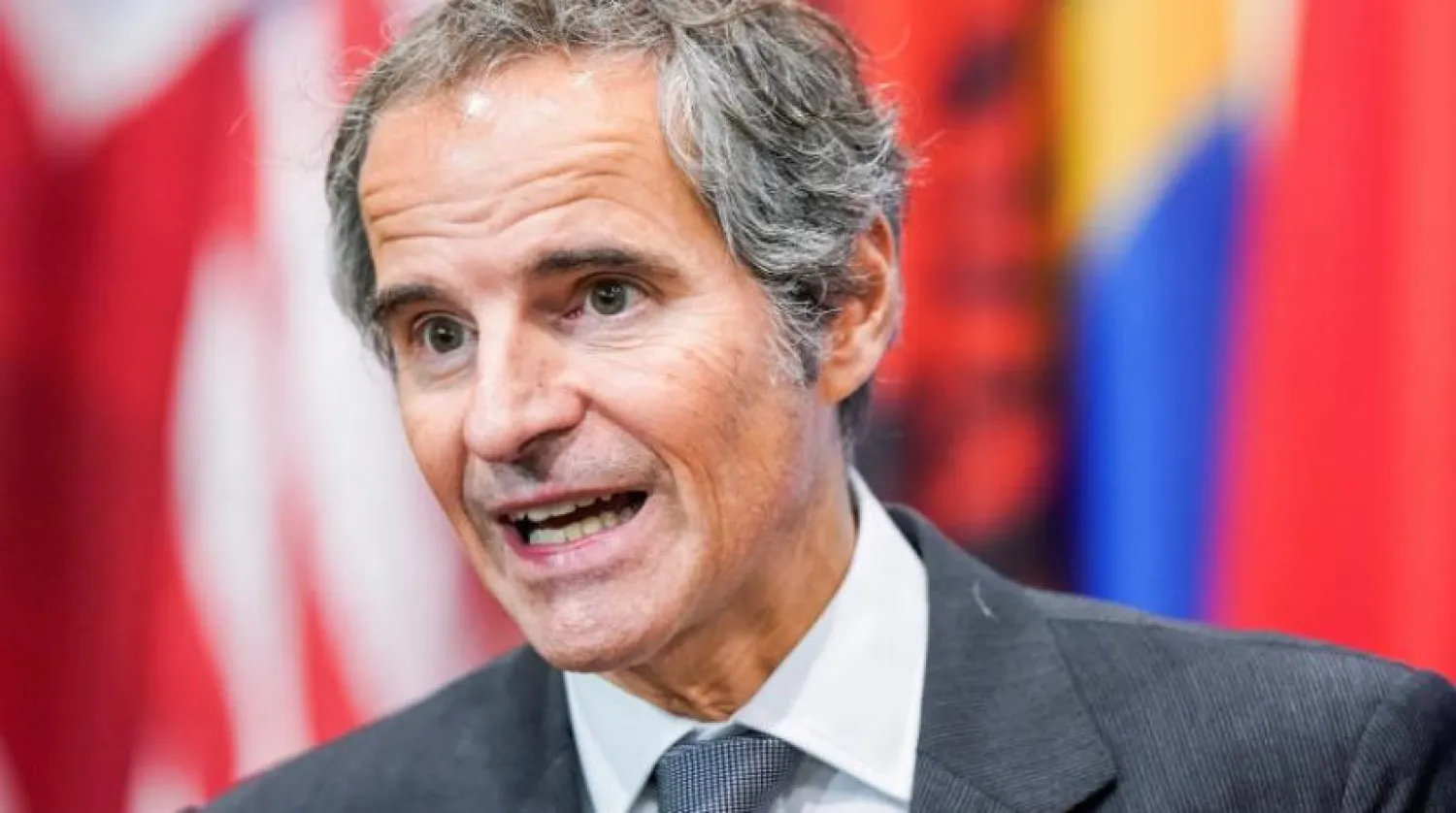
IAEA: No Sign of 'Undeclared Nuclear Activities' in Ukraine

Head of the International Atomic Energy Agency (IAEA) Rafael Grossi. Reuters
TT

IAEA: No Sign of 'Undeclared Nuclear Activities' in Ukraine

Head of the International Atomic Energy Agency (IAEA) Rafael Grossi. Reuters

The UN nuclear watchdog on Thursday said its inspectors had found no indications of "undeclared nuclear activities" at three locations in Ukraine during visits requested by Kyiv to address Russia's "dirty bomb" allegations.

"Our technical and scientific evaluation of the results we have so far did not show any sign of undeclared nuclear activities and materials at these three locations," said Rafael Grossi, head of the International Atomic Energy Agency (IAEA).

"We will report on the results of the environmental sampling as soon as possible," Grossi added, referring to samples collected by IAEA inspectors.

The inspections at the Institute for Nuclear Research in Kyiv, the Eastern Mining and Processing Plant in Zhovti Kody and the Production Association Pivdennyi Machine-Building Plant in Dnipro followed a written request from Ukraine.

"Over the past few days, the inspectors were able to carry out all activities that the IAEA had planned to conduct and were given unfettered access to the locations," the UN agency's statement said.

On Monday the UN nuclear watchdog said its inspectors had begun verification activities at two locations in Ukraine.

A request to visit a third site in Ukraine was later made by Kyiv after Russia made allegations about activities there too, an IAEA spokesman told AFP.

Russia accused Ukraine of preparing to use dirty bombs against Russian troops while Kyiv suspects Moscow might itself use a dirty bomb in a "false flag" attack, possibly to justify use of conventional nuclear weapons as ground troops run into setbacks.

A dirty bomb is a conventional bomb laced with radioactive, biological or chemical materials which are spread in an explosion.

Russian President Vladimir Putin had previously called for the IAEA to inspect Ukraine's nuclear sites "as fast as possible".


Surging Costs of Living Top US Voter Concerns

 Voting stickers are seen on spare parts boxes in a secure room at the Tom Green County Elections Office in San Angelo, Texas, US October 28, 2026. (Reuters)
Voting stickers are seen on spare parts boxes in a secure room at the Tom Green County Elections Office in San Angelo, Texas, US October 28, 2026. (Reuters)
TT

Surging Costs of Living Top US Voter Concerns

 Voting stickers are seen on spare parts boxes in a secure room at the Tom Green County Elections Office in San Angelo, Texas, US October 28, 2026. (Reuters)
Voting stickers are seen on spare parts boxes in a secure room at the Tom Green County Elections Office in San Angelo, Texas, US October 28, 2026. (Reuters)

Soaring prices for gas, medicine and other cost of living essentials are preoccupying Americans as they start to cast their ballots ahead of next week's midterm elections.

A whopping 84 percent of voters who have cast their ballots early listed the economy as their biggest concern this election cycle, according to a recent Pew Research Center survey.

Kyler Daugherty, a 43-year-old health care worker, summed up the sentiment as he filled up his gas tank in Fort Lauderdale, Florida.

"It's ridiculous. I mean, everything's gone up, from food to transportation to gas prices," he told AFP.

Fuel costs have skyrocketed around the world since the United States and Israel launched strikes on Iran in February.

US gas prices rose 9.1 percent in September alone, according to official figures, a headache for residents in a state like Florida, where most people rely on cars to get around.

"It affects transportation, it affects goods, it affects everything," Matthew Moore, a 63-year-old attorney, said after he cast his ballot early.

"We transport a lot by truck. Air prices have gone up. My tickets home for Christmas have doubled since last year," he said.

- Broken promises -

US President Donald Trump won reelection in 2024 in part because of his campaign promise to lower prices, which had also increased during the term of his predecessor Joe Biden.

"I didn't believe that promise then and I probably won't continue to believe (it)," said Melissa Reer, a 49-year-old social worker worried by her car and home insurance costs.

"But I think there's a lot more changes have to happen before prices can go down," she said.

William Galston, a senior fellow at the Brookings Institution think tank, said two of Trump's decisions this term have directly contributed to cost pressures: launching the war on Iran and slapping tariffs on trade partners.

"It's within the president's power to remove most of the tariffs that he's imposed. It's within the president's power to end the war that he began," Galston told AFP.

For some voters, however, it's too late.

"My vote was cast based upon my feelings about how they've handled the stewardship that the voters have given them," said Michael Childs, 62.

The White House for its part insists that Trump's policies are revitalizing the US economy and making life more affordable for Americans.

- Basic expenses -

But millions of households across the United States find it harder than ever to make ends meet.

"The financial hardship is creeping up in America, particularly the middle class," said Symeria Hudson, the CEO of United Way Miami, a nonprofit fundraising organization.

United Way's ALICE metric -- which stands for an Asset Limited, Income Constrained, Employed person -- measures working people whose income does not cover basic expenses, such as food, housing and health care.

Nearly 41 percent of the 132 million households in the United States fall below the threshold.

"We continue to encourage those policy makers to really understand the data," Hudson told AFP.

Many US voters are running out of ways to cut spending.

"I'm literally cutting back on certain meds because I'm like, 'I can't afford them.' I don't know what to do next," Daugherty said.


Rubio Hosts G20 Ministers as Iran, Ukraine Wars Divide Members

US Secretary of State Marco Rubio speaks ahead of a Memorandums of Understanding signing ceremony with Hungarian Foreign Minister Anita Orban (not pictured) on "energy infrastructure and regional energy security and on law enforcement cooperation and information exchange" at the Department of State in Washington, DC, USA, 29 October 2026. (EPA)
TT

Rubio Hosts G20 Ministers as Iran, Ukraine Wars Divide Members

US Secretary of State Marco Rubio speaks ahead of a Memorandums of Understanding signing ceremony with Hungarian Foreign Minister Anita Orban (not pictured) on "energy infrastructure and regional energy security and on law enforcement cooperation and information exchange" at the Department of State in Washington, DC, USA, 29 October 2026. (EPA)

US Secretary of State Marco Rubio will host his G20 counterparts, including Russia's Sergei Lavrov, for talks on Friday that are expected to be fractious, with wars in Ukraine and Iran and surging energy prices fanning discord.

The foreign ministers' meeting in Atlanta, Georgia, taking place just days before crucial US midterm elections, will set the stage for a December G20 leaders' summit in Miami at President Donald Trump's Doral resort.

Few breakthroughs are expected this week from the Group of 20 economies -- which include China, India, Russia, Japan, Germany and France -- as officials face divisions over Moscow's war on Ukraine and fallout from conflict with Iran.

Russia has been shunned by most of the West after its 2022 invasion of Ukraine, and Lavrov himself remains under international sanctions.

Rubio's encounter with Lavrov -- whose presence adds an additional layer of tension -- will be closely watched as Washington pursues diplomacy on Ukraine while seeking Moscow's cooperation on reining in fuel prices, a key campaign issue in the midterms.

"The G20 is no longer really a forum where foreign ministers can reach agreement on a statement," a diplomatic source said.

The source added that the US G20 presidency intends for Miami's summit to serve "more as a demonstration of American power -- and of US commitments to growth, deregulation, trade and business -- rather than as a summit with grand ambitions on substantive issues."

Instead of a final declaration, the source expects a chair summary drafted by the United States to be published from this week's meeting.

The Trump administration, which is set to hand the rotating G20 leadership to Britain, sees the platform as having strayed from its core mission.

Washington has pledged to return the grouping to its goal of driving economic growth, arguing that security and economic prosperity are "inextricably linked."

"Conversations in Atlanta will provide an opportunity to discuss energy and supply chain challenges as well as identify ways to collectively address the impact of geopolitical tensions on economic security," a US State Department official said.

They stressed the importance of energy access -- necessary for tech like artificial intelligence -- and flagged a "shared resolve to confront urgent crises and keep critical sea lanes open to commerce without threats or tolls."

- 'Test case' -

Global energy prices have rocketed since US-Israel strikes on Iran from late February triggered Tehran's blockage of the Strait of Hormuz.

"This is the last test case the G20 has, at least under the US G20 presidency, until Miami," Alisha Chhangani of the Atlantic Council told AFP. Its outcomes will affect how the December summit shapes up.

She expects Washington will seek to argue that security shocks are also economic shocks.

It will likely push for agreement on what "freedom of navigation" means within and beyond Hormuz, a crucial waterway for oil and gas transit, she said.

But this could face objections from China, which dissented against wording on free navigation in Hormuz and worldwide at an earlier gathering of finance ministers.

China's top diplomat Wang Yi will not be in Atlanta, and is instead sending his deputy, the US State Department said.

Meanwhile, the possibility of further escalation in the Middle East is mounting, with Israel threatening to strike Iran and Trump signaling he could attack after Tuesday's midterm elections.

- Lavrov attendance -

In Atlanta, Rubio is also due to cross paths with Lavrov, who has already reached Atlanta according to Russian state media.

It comes ahead of fresh negotiations between Moscow, Kyiv and Washington in November.

The appearance of Lavrov, who plans to argue against international sanctions at the gathering, will likely frustrate European ministers, Chhangani said.

It is not surprising, however, as Washington has welcomed Russian officials to this year's G20 events -- while excluding member South Africa -- and Trump has invited his Russian counterpart Vladimir Putin to Miami in December.

Trump has eased some sanctions on Moscow recently while touting a deal for Russia to sell diesel as prices soared, squeezing Americans.

The diplomatic source stressed that Russia's G20 presence "in no way legitimizes its actions."

All eyes will also be on US engagement with Brazil, whose foreign minister will be in attendance, after Washington granted entry to Flavio Bolsonaro following his defeat in Sunday's presidential election.


Netanyahu’s Party Claims Election 'Stolen' as Results Show Him Losing Majority

Israel's Prime Minister Benjamin Netanyahu prepares to address his supporters at the election night rally after the first exit polls were announced, in Jerusalem on early October 28, 2026, during Israel's legislative elections.  (Photo by Jewel SAMAD / AFP)
Israel's Prime Minister Benjamin Netanyahu prepares to address his supporters at the election night rally after the first exit polls were announced, in Jerusalem on early October 28, 2026, during Israel's legislative elections. (Photo by Jewel SAMAD / AFP)
TT

Netanyahu’s Party Claims Election 'Stolen' as Results Show Him Losing Majority

Israel's Prime Minister Benjamin Netanyahu prepares to address his supporters at the election night rally after the first exit polls were announced, in Jerusalem on early October 28, 2026, during Israel's legislative elections.  (Photo by Jewel SAMAD / AFP)
Israel's Prime Minister Benjamin Netanyahu prepares to address his supporters at the election night rally after the first exit polls were announced, in Jerusalem on early October 28, 2026, during Israel's legislative elections. (Photo by Jewel SAMAD / AFP)

Israeli Prime Minister Benjamin Netanyahu's party on Thursday amplified unsubstantiated allegations that Arab-led parties had “stolen” the election, potentially with foreign assistance, as final results showed his bloc had lost its majority in parliament.

The opposition accused Netanyahu of demonizing the Arab population after a historic showing by Arab-led parties in an attempt to delegitimize the election. If the rest of the opposition teams up with Arab parties, a rare and politically risky move, they could potentially form a majority government in parliament, the Knesset.

Results released by election officials early Friday showed Netanyahu's bloc winning 53 seats in the 120-member assembly, well below the 68 seats it had controlled at its peak in the previous parliament. His main opposition won 48 seats and Arab-led parties secured the other 19.

The count is complete, but the results still need to be certified and submitted to the country's president next Wednesday.

Commission to look into possible foreign interference Netanyahu's party, Likud, has been spreading claims of malfeasance by Arab-led parties since exit polls indicated the prime minister had suffered a setback in Tuesday's vote. But it ramped up the rhetoric after the head of Israel's election committee, Supreme Court Justice Noam Sohlberg, said that “serious suspicions” of foreign interference had been brought before him.

In a letter to the Shin Bet security agency, Sohlberg said he could not verify the claims. But given their serious nature, he asked the agency to investigate.

Netanyahu's party responded with an inflammatory statement: "The elections in Israel have been stolen!” it said, claiming — without evidence — that the alleged election interference was “aimed at facilitating a foreign takeover of the Knesset, the Islamization of Israel and toppling of the right wing government.”

As it announced its results early Friday, the election commission said the investigation was based on classified intelligence. In a video statement, the commission's acting director general, Dean Livne, did not elaborate, but warned that reports about the probe had been “entirely unfounded.”

“It does not affect the final results that will be submitted to the president, nor does it concern any particular sector of the population,” he said.

Netanyahu's opponents accuse him of undermining vote

Netanyahu's main rival, former military chief Gadi Eisenkot, said Likud was trying to delegitimize the results. “They are doing this because they lost,” he said.

Eisenkot ridiculed the accusation of foreign interference with a tongue-in-cheek statement.

Netanyahu has long faced accusations that former top aides of his accepted money from foreign parties.

By casting doubt on the vote, Netanyahu appeared to be positioning himself to block any potential alliance between his opponents and the Arab parties. Netanyahu has suggested that it would be treasonous for Eisenkot to join with Arab parties, who could potentially give Eisenkot the backing he needs to oust Netanyahu.

The Shin Bet, seeking to calm tensions, said its investigation was not meant to “cast aspersions” on an entire section of the population that "exercised its right to vote in a democratic and lawful manner.”

The elections committee also sounded a note of caution in a letter written to a concerned member of parliament. It said that even though an investigation was taking place, “allegations of systematic violations of electoral integrity are baseless.”

The committee wants findings from the Shin Bet within a week.

Netanyahu campaigned on anti-Arab sentiment

Even ahead of the vote, Netanyahu and Likud painted the Arab-led parties as a danger to Israel, which critics called an attempt to further marginalize Arab citizens. Arab citizens of Palestinian descent make up 20% of the population but are often viewed with suspicion because of their sympathies with other Palestinians.

Those campaign attacks, along with anger over the divisive Netanyahu and his far-right government, brought outraged Arabs to the polls like never before.

On Thursday, Yair Golan, head of the Democrats party, accused Netanyahu of “attempting to undermine the election results through an ugly delegitimization campaign directed against the will of the public — and against the Arab public in particular.”

“Netanyahu is working to steal the election,” the Arab-led Joint List party asserted Thursday.

The head of the Arab-led Ra’am party, Mansour Abbas, welcomed the investigation into election interference and said his party had nothing to do with the case, while accusing Netanyahu of a campaign of incitement.

President Isaac Herzog called it a “sensitive moment” and called for a full investigation. He warned that “we must not tarnish an entire community that sought to exercise its right to vote and take an active part in democracy.”

Difficult decisions are ahead as parties seek coalitions

The developments amplified the difficult decisions for the weeks ahead. Those include whether some Jewish and Arab parties would team up in a historic alliance, or whether some parties that campaigned on ousting Netanyahu would toss that aside and join forces with him.

While the race for a 61-seat majority needed to control the 120-seat Knesset plays out, Netanyahu remains in charge.

If Netanyahu loses office, that would set off a cascade of events that critics say he has desperately sought to avoid. He would be taken to account over yearslong corruption allegations, and an inquiry almost certainly would begin into the security failures that led to the devastating Hamas-led Oct. 7, 2023, attack.

Eisenkot has left door open to cooperation with Arab-led parties Even without a role in a coalition, Arab-led parties could assert their growing power by supporting other Netanyahu opponents in the next parliament. That could include electing a new speaker, giving them control of the agenda and potentially allowing them to advance and pass legislation before a new government is formed.

Eisenkot has indicated he is open, with conditions, to joining forces with the Arab-led parties. Ahmad Tibi, second on the Arab-led Joint List, told Army Radio the opposition bloc reached out to him to discuss replacing the Knesset speaker, and he told them the party would support the bloc’s candidate.

There were small rallies overnight in Tel Aviv, and in far more conservative Jerusalem, in support of a coalition that includes Arab-led parties. Until 2021, no Arab party had joined a coalition government, and that was brief.

If a new government cannot be formed after multiple attempts, Israel would face a new election early next year. On Wednesday, Herzog signaled he wanted to avoid that step – something Eisenkot has said as well.

New elections bring new questions, including whether Arab citizens would again go to the polls in large numbers and whether the tens of thousands of Israelis who flew home to vote would do it again. Many had said they took that step to save the country from Netanyahu.