

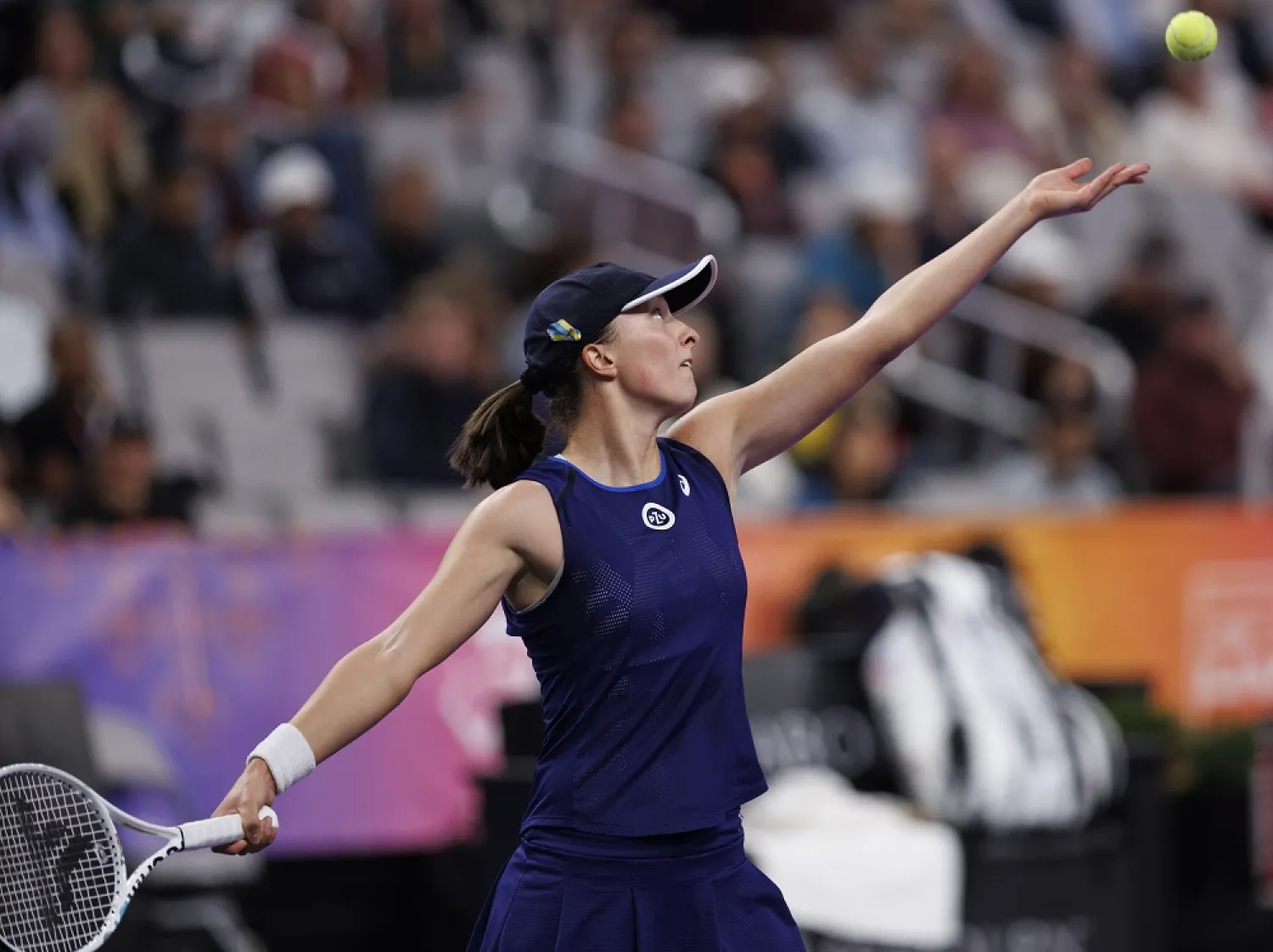

Iga Swiatek, Caroline Garcia Claim Semifinal Berths in WTA Finals

Iga Swiatek of Poland serves to Coco Gauff of the United States during their quarterfinals match in the WTA Finals held at Dickies Arena in Fort Worth, Texas, USA, 05 November 2022. (EPA)
TT

Iga Swiatek, Caroline Garcia Claim Semifinal Berths in WTA Finals

Iga Swiatek of Poland serves to Coco Gauff of the United States during their quarterfinals match in the WTA Finals held at Dickies Arena in Fort Worth, Texas, USA, 05 November 2022. (EPA)

Top-seeded Iga Swiatek of Poland dominated Coco Gauff of the US on Saturday to officially claim a semifinal berth in the championship match of the WTA Finals in Fort Worth, Texas.

The tourney featured the top eight players on the WTA Tour.

Swiatek, the top-rated player in the world, needed only 70 minutes to finish off Gauff, winning 6-3, 6-0. For winning the Tracy Austin Group at 3-0, she will take on Aryna Sabalenka (2-1) of Belarus, the runner-up in the Nancy Richey Group.

France's Caroline Garcia won Saturday's other match. She needed three sets, including a third-set tiebreaker, to dispose of Daria Kasatkina of Russia 4-6, 6-1, 7-6 (5). Garcia finished 2-1 in the Austin Group and will take on Maria Sakkari of Greece, who went 3-0 to win the Richey Group.

Swiatek, who dominated the match stats befitting the final score, broke away from a 3-3 tie in the first set by breaking Gauff twice in a row, the second time to clinch the first set.

The second set lasted only 28 minutes.

Gauff finished with four aces to none for Swiatek, but Swiatek led nearly every place else: 79 percent to 69 percent in first-serve percentage, 68 percent to 53 percent in first-serve points won and 70 percent to 40 percent in second-serve points won.

"It's the last tournament of the season, so I have kind of nothing to lose. I don't have to worry what I'm going to do next. So, yeah, for sure, I'm giving it 100 percent, physically and mentally," Swiatek said.

In the first match, both players had trouble holding serve. Kasatkina broke Garcia three times and Kasatkina lost hers twice, but the Russian held serve to clinch the first set 6-4.

Garcia recovered to hold serve throughout the second set while breaking Kasatkina, the second time to take a dominating 5-1 lead before clinching the set.

Each player lost her serve twice in the third set, and the service difficulties continued into the tiebreaker. They lost serve seven times, including four in a row at one point.

Garcia missed a chance to win the tiebreaker when Kasatkina down 6-4, broke her serve on match point. But Garcia returned the favor to win 7-5.

Garcia said that advancing in the tournament is "definitely a great achievement."

"I was already really proud to be in the Top 8. I don't really know if I realize that this is the semifinal tomorrow," Garcia said. "It proves that this year was definitely a good year. I started very far from the Top 10, the Top 8, and I make my way to it. Today, it's one more thing that proves my game style is working and I have to keep going that way."

Garcia finished with four aces to one for Kasatkina, and the Frenchwoman scored 42 winners to 16 for the Russian.



Algeria’s Luca Zidane Doubt for World Cup After Jaw Fracture

Luca Zidane. (AFP)
Luca Zidane. (AFP)
TT

Algeria’s Luca Zidane Doubt for World Cup After Jaw Fracture

Luca Zidane. (AFP)
Luca Zidane. (AFP)

Algeria goalkeeper Luca Zidane is a doubt for the World Cup after suffering a jaw and chin fracture while playing for his club Granada in Spain's second tier.

The son of former France great Zinedine Zidane was taken off with a concussion after colliding with an opponent during his team's 4-2 home defeat by Almeria on Sunday.

The 27-year-old is expected to miss the rest of the season and could be out for even longer if he needs surgery.

"The player, in consultation with the club's medical staff, will decide in the coming hours on the course of treatment to be followed," said the club in a statement late Monday.

Luca Zidane is Algeria's first-choice goalkeeper and their back-up options Anthony Mandrea and Melvin Mastil are also currently out injured.

Algeria's World Cup campaign begins on June 16 against reigning champions Argentina.


A Bird Leaves Nothing Behind: The Lesson Behind Japan’s World Cup Stadium Cleanups

Japan supporters clean the stands at the end of the World Cup group E football match between Germany and Japan, at the Khalifa International Stadium in Doha, Qatar, Wednesday, Nov. 23, 2022. (AP)
TT

A Bird Leaves Nothing Behind: The Lesson Behind Japan’s World Cup Stadium Cleanups

Japan supporters clean the stands at the end of the World Cup group E football match between Germany and Japan, at the Khalifa International Stadium in Doha, Qatar, Wednesday, Nov. 23, 2022. (AP)

If there's one country guaranteed to clean up at the World Cup, it's Japan.

Literally.

Scenes of Japanese football fans sweeping stadiums and picking up trash after a match first drew public attention in France in 1998 — Japan's first appearance in the World Cup.

The tradition has continued every four years. It happened at the World Cup in Qatar in 2022, and it's certain to continue when Japan opens play in June with group games in Arlington, Texas, and Monterrey, Mexico.

The cleanup astonishes non-Japanese who might be accustomed to leaving stadiums and stepping over half-eaten food, shredded paper wrappers, and cups — empty or with liquid dribbling out.

At the World Cup in Russia in 2018, Japanese players famously cleaned the dressing room after a loss and left a thank-you note in Russian. In 2022, fans left thank-you notes on rubbish bags written in Arabic, English and Japanese.

Why do Japanese behave this way? It's not that complicated. Beginning in elementary school, students are socialized to behave this way — in the classroom, in the school yard or on a playing field.

“Japanese sports fans at world events who clean up the stadium are behaving much the same way they did when they learned how to enjoy sports as school boys and girls,” Koichi Nakano, who teaches politics and history at Sophia University, told The Associated Press.

There is a phrase in Japanese that explains it.

“Tatsu tori ato wo nigosazu.”

The literal translation is: “A bird leaves nothing behind.”

Rendered in English the message is: “Return it the way you found it.”

Many Japanese elementary schools don’t have janitors, so the clean-up work is left to students. Office workers often dedicate time to sprucing up their areas.

Also, there are relatively few trash containers in public spaces in Japan, so people take their waste home with them. This keeps the sidewalks cleaner, saves the cost of emptying trash cans, and keeps away vermin.

“The way most ordinary soccer fans experience soccer at school is no different from other sports, and the emphasis is not just on physical education but also on moral education as well,” Nakano added.

Collective vs. the individual

Raised in Germany, Barbara Holthus is the deputy director of the German Institute for Japanese Studies in Tokyo. A sociologist, she agrees it's prudent not to put Japanese on a pedestal. Japan, like any country, has its own challenges and shortcomings.

“An academically sound explanation is that people in Japan just happen to be socialized different,” she told The AP. “If you grew up with a certain way of how things are being done, you apply that to even cleaning up a stadium afterwards.”

At work here is also the Japanese concept of “meiwaku,” which implies not causing trouble or annoying others. From the Japanese point of view, leaving rubbish piled up in a stadium would be a bother to others.

Japan is a relatively crowded place, and greater Tokyo alone has about 35 million people, almost the population of the entire state of California. People need to get along.

“Japanese learn early on that you don't want to inconvenience other people,” Holthus said.

She said the focus is often on the collective, compared with the West where the emphasis is on the individual and individual rights.

“You don’t want to bother people. It goes to all areas of life in Japan,” Holthus added. “We are raised (in the West) that we don’t have to clean up after ourselves in public spaces because there is going to be some kind of public service doing that.”

And because Japanese people have received widespread praise for the clean-up, the behavior has been reinforced.

“Now that the media has latched onto the story and lavished praise on Japanese fans, they have made it a point of pride to display those values and norms,” Jeff Kingston, who teaches history at Temple University in Japan, wrote in an email.

A Japanese tradition

The clean-up tradition is not limited to football’s marquee tournament. The same thing happened last year at the Under-20 World Cup in Chile as Japanese fans cleaned up after a match. And even more recently last month at Wembley Stadium in London where Japan defeated England 1-0 in an international friendly.

“It’s one of our traditions,” said Toshi Yoshizawa, who was leading the cleanup in Chile. “We grew up with the teaching that we should leave a place cleaner than when we arrived.”

William Kelly, an emeritus professor of anthropology at Yale University and a specialist on Japan, said the tradition is linked to football more than other sports. He speculated it's tied to the establishment of Japan's professional football league more than 30 years ago.

“It (the J-League) was trying to distinguish itself from baseball by emphasizing teams’ community embeddedness and commitment,” Kelly wrote in an email. “Soccer fans felt, and feel, more a part of the club and its stadium.”


Riyadh to Host Joshua vs. Prenga Showdown in July

Boxing - Jake Paul v Anthony Joshua - Kaseya Center, Miami, Florida, US - December 19, 2025 Anthony Joshua after winning his fight against Jake Paul. (Reuters)
TT

Riyadh to Host Joshua vs. Prenga Showdown in July

Boxing - Jake Paul v Anthony Joshua - Kaseya Center, Miami, Florida, US - December 19, 2025 Anthony Joshua after winning his fight against Jake Paul. (Reuters)

Chairman of the Board of Directors of Saudi Arabia’s General Entertainment Authority Turki Alalshikh announced the return of British boxer Anthony Joshua to the ring in “The Comeback,” scheduled for July 25 in Riyadh.

The 36-year-old Joshua will fight Kristian Prenga, an Albanian with 20 victories and one loss.

Joshua’s last fight was a knockout victory over YouTuber Jake Paul on Dec. 19. Ten days later, he was injured in a car crash in Nigeria that killed two of his friends.

“It’s no secret I’ve taken some time to consolidate and rebuild to be ready for stepping back into the ring,” Joshua said in a Matchroom statement, “and today is the next step on that journey.”

In the statement, Joshua said the fight with Prenga is the first in a “multi-fight deal."

The event forms part of the Kingdom’s continued hosting of major international boxing matches, further cementing Riyadh’s status as a premier destination for global sports and entertainment.

The bout will be broadcast live worldwide on DAZN.