


5.8-magnitude Earthquake Jolts Indonesia's Java Island

A villager looks at damaged houses following a 5.6-magnitude earthquake that killed at least 162 people in West Java in November. — AFP/File
TT

5.8-magnitude Earthquake Jolts Indonesia's Java Island

A villager looks at damaged houses following a 5.6-magnitude earthquake that killed at least 162 people in West Java in November. — AFP/File

A 5.8-magnitude earthquake hit Indonesia's main island of Java on Thursday with no immediate reports of damage, less than a month after another quake in the same province killed more than 300 people.

The quake struck at 07:50 am local time (0050 GMT) around 15 kilometers from the town of Cianjur, epicenter of November's devastating tremor, the United States Geological Survey said.

It said there was a low likelihood of casualties or damage following the quake, which struck at a depth of 123 kilometers (76 miles), AFP reported.

No damage was immediately reported in Cianjur or Sukabumi, the city nearest the epicenter, local disaster mitigation agency officials said Thursday.

But schools were temporarily evacuated in Sukabumi, according to local TV.

"The epicenter of the earthquake is in Sukabumi, so it was only lightly felt in Cianjur. No reports of damage to houses or casualties," said Wawan Setawan, a disaster agency official in Cianjur told AFP.

"We have yet to receive reports of damage caused by the earthquake", Imran Wardhani, an official in Sukabumi, said soon after the tremor.

Last month, a shallow 5.6-magnitude earthquake hit Cianjur, triggering landslides and collapsing buildings, killing at least 334 people, injuring thousands and leaving tens of thousands more homeless.

Save the Children warned this week that evacuees faced a "ticking time bomb" of disease and infection due to poor living conditions. Thousands of cases of respiratory infections and hundreds of cases of diarrhea have been reported.

Indonesian President Joko Widodo is visiting the area on Thursday to distribute aid to affected residents.

The tremor that struck Cinajur on November 21 was the deadliest in the archipelago nation since a 2018 quake and resulting tsunami killed more than 4,000 people on the island of Sulawesi.

Indonesia experiences frequent seismic and volcanic activity due to its position on the Pacific "Ring of Fire", where tectonic plates collide.
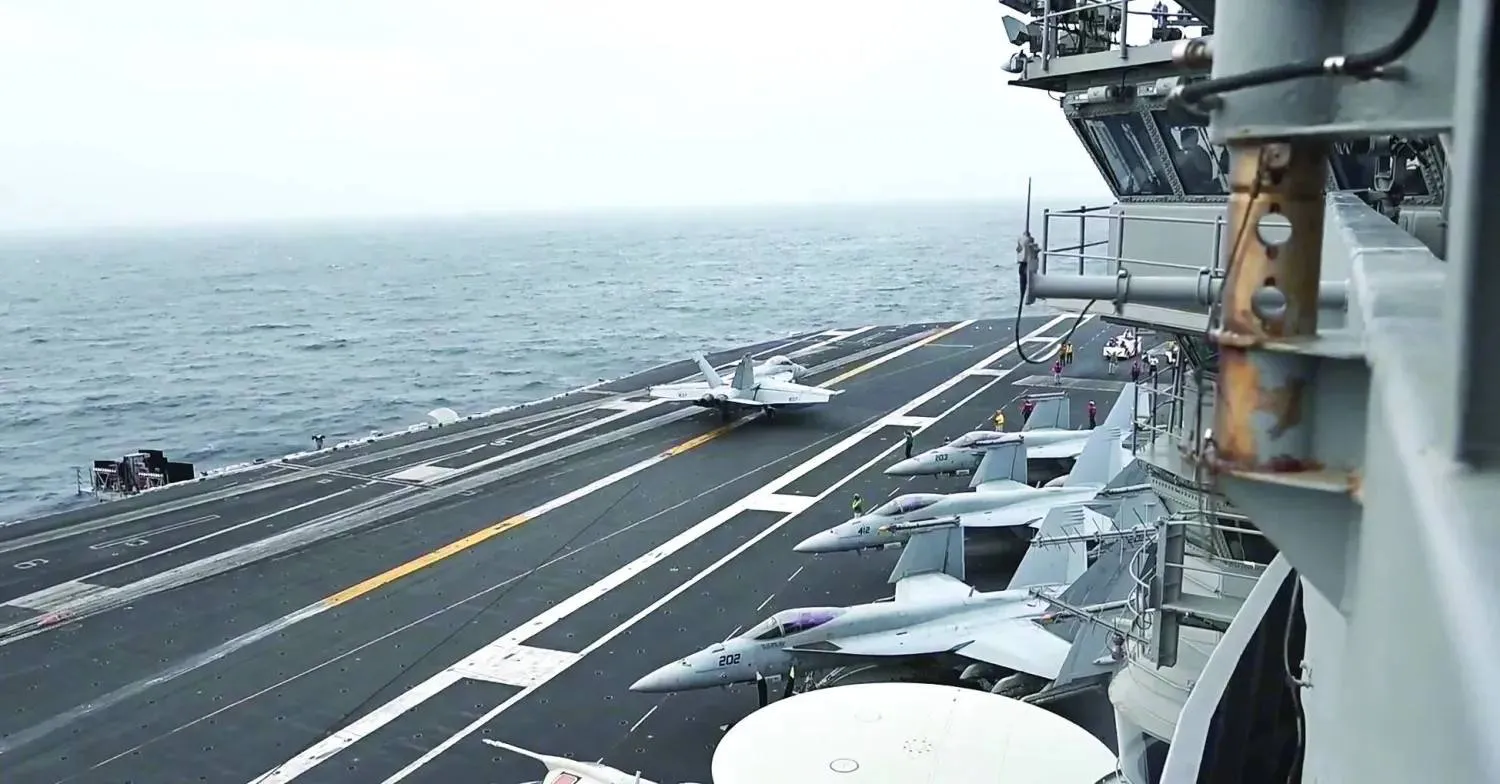



CENTCOM Tests Advanced Drone Capabilities in the Middle East

The aircraft carrier USS George Washington sails in Middle Eastern regional waters. (CENTCOM) 
TT

CENTCOM Tests Advanced Drone Capabilities in the Middle East

The aircraft carrier USS George Washington sails in Middle Eastern regional waters. (CENTCOM) 

The US Central Command (CENTCOM) said on Wednesday that Task Force 99, part of US Air Forces Central, introduced new drone and communication capabilities to warfighters in the Middle East.

“As a forward-deployed laboratory, the task force tests innovative concepts for enhancing combat effectiveness in the field,” the Command wrote in a post on X.

Late on Tuesday, CENTCOM had dismissed claims by Ali Azmayi, commander of Iran’s Revolutionary Guard Corps (IRGC) Navy, that Iran controls the Strait of Hormuz.

“[The] IRGC’s navy commander has no navy. American forces and regional partners clearly control the Strait of Hormuz,” the Command said, adding that US forces helped shipping partners move 19 million barrels of crude oil through the waterway.

Development of ‘Ballistic’

In Tehran, Iran’s defense minister nominee, Mehrdad Akhlaghi Ketabchi, outlined his plan for the ministry, prioritizing the upgrade of missile systems, expanding air defense production, and improving warhead effectiveness to meet current and future needs.

During a parliamentary session reviewing his plans for becoming defense minister, Akhlaghi Ketabchi said his priorities include “significantly and unexpectedly increasing the salaries of armed forces personnel.”

He also said: “We will work to accelerate the acquisition of technology for manufacturing heavy, multirole fighter jets, a project the ministry launched previously.”

Referring to ground combat, the nominee for the Defense post said that if he secures the confidence of deputies, his plan includes “developing the technology for designing and manufacturing artillery systems, missiles, and guided and smart mortar shells; modernizing production lines for advanced small arms; and developing and upgrading various anti-armor systems.”

Akhlaghi Ketabchi has been heavily involved in Iran's missiles programs and has previously served as head of the Aerospace Industries Organization, among other positions.

In 2007, he was designated by the UN Security Council in connection with his role as the head of the Shahid Bagheri Industrial Group (SBIG)—an entity subordinate to Iran's Aerospace Industries Organization (AIO), involved in the development and production of Iran's solid-propellant ballistic missiles.

His nomination depicts the pivotal role played by the Aerospace Industries Organization within Iran’s Defense Ministry.


US Military Weighs Use of ‘Mother of All Bombs’ in Potential Future Strikes on Iran

Iranians drive past an anti-US billboard in Vanak Square, Tehran, on October 14, 2026 (EPA).
TT

US Military Weighs Use of ‘Mother of All Bombs’ in Potential Future Strikes on Iran

Iranians drive past an anti-US billboard in Vanak Square, Tehran, on October 14, 2026 (EPA).

The US military has developed strike plans that could include using the GBU-43/B Massive Ordnance Air Blast Bomb, also known as the "mother of ‌all bombs", ‌against Iranian energy ‌infrastructure ⁠and nuclear sites ⁠if President Donald Trump orders renewed combat operations, CNN reported on Thursday citing ⁠US officials familiar ‌with ‌the matter.

The potential ‌deployment of the ‌largest non-nuclear bomb in the US arsenal would mark a significant ‌escalation in the conflict, although officials ⁠familiar ⁠with military planning discussions told CNN questions remain over its effectiveness in achieving Washington's strategic objectives.

Reuters could not immediately verify the report.


Russia’s Lavrov, China’s Wang Discuss Cooperation, Ukraine, Iran at Asia Security Meeting

In this handout photograph taken and released by the Russian Foreign Ministry on October 14, 2026, Russia's Foreign Minister Sergei Lavrov and China's Foreign Minister Wang Yi hold a meeting on the sidelines of the Seventh Summit of the Conference on Interaction and Confidence Building Measures in Asia (CICA) in Baku. (Handout /Russian Foreign Ministry / AFP)
TT

Russia’s Lavrov, China’s Wang Discuss Cooperation, Ukraine, Iran at Asia Security Meeting

In this handout photograph taken and released by the Russian Foreign Ministry on October 14, 2026, Russia's Foreign Minister Sergei Lavrov and China's Foreign Minister Wang Yi hold a meeting on the sidelines of the Seventh Summit of the Conference on Interaction and Confidence Building Measures in Asia (CICA) in Baku. (Handout /Russian Foreign Ministry / AFP)

The Russian ‌and Chinese foreign ministers discussed the state of bilateral cooperation as well as the crises in Ukraine and Iran during an Asia security meeting, the Russian Foreign Ministry said on Wednesday.

Russian President Vladimir Putin and his Chinese counterpart Xi Jinping reaffirmed ‌their strategic ‌alliance at a ‌regional summit ⁠last August and ⁠both praised prospects for closer cooperation.

The statement on Wednesday said Russian Foreign Minister Sergei Lavrov and his Chinese counterpart Wang Yi met in Azerbaijan at ⁠a meeting of the ‌Conference on ‌Interaction and Confidence Building Measures in Asia.

It ‌said the two ministers "praised the ‌development dynamics of comprehensive partnership and strategic cooperation" and "synchronized watches on bilateral political dialogue".

It said discussions ‌also focused on "relations with the United States and the situation ⁠around ⁠the Ukrainian and Iranian crises".

Both Russia and China have called for an end to the Iran conflict, saying it could expand and threaten stability throughout the region.

China has affirmed its "no limits" partnership with Russia throughout the 4-1/2-year-long war in Ukraine, while calling for diplomatic efforts to end the conflict.