

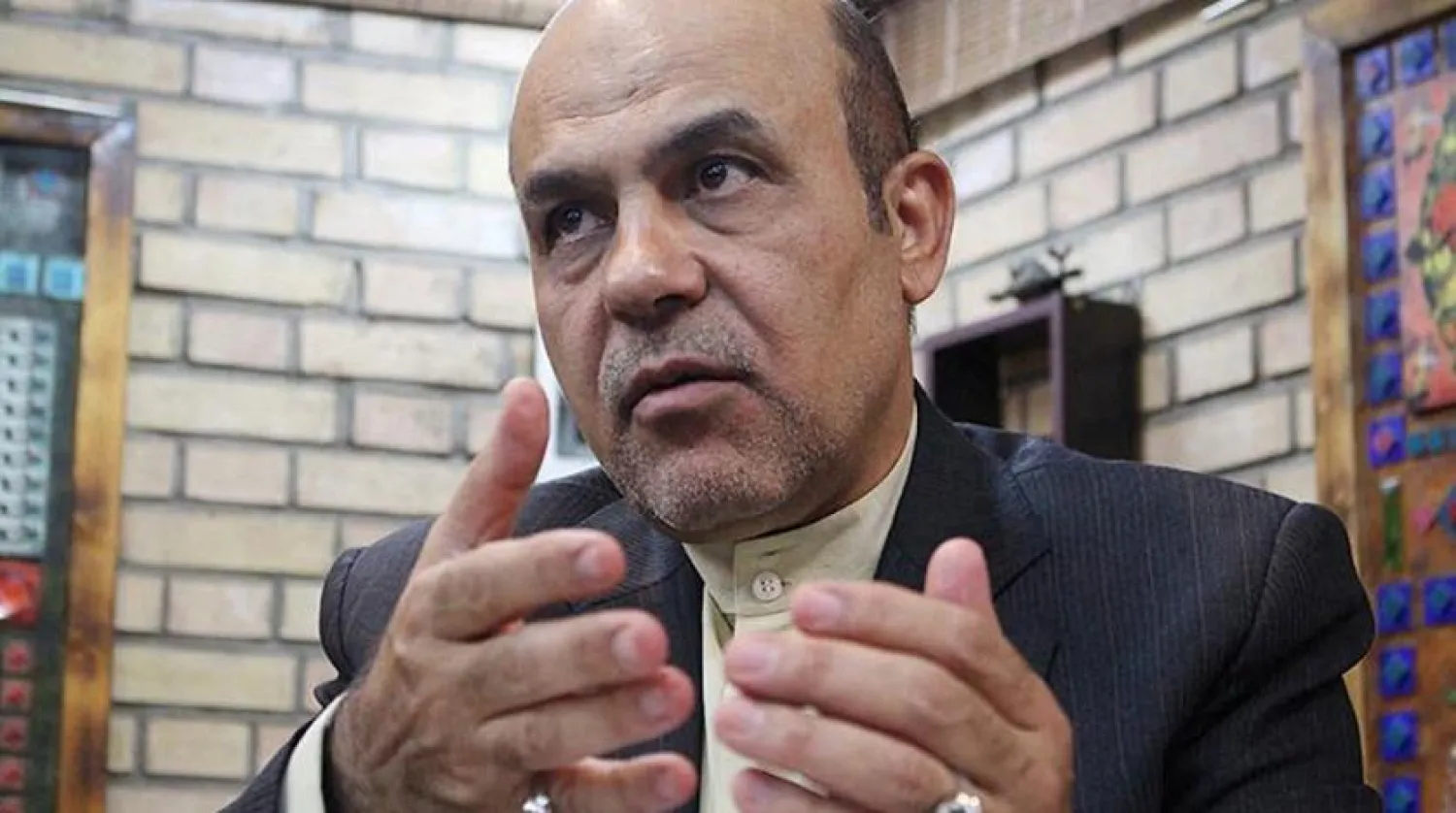

Iran Executes British-Iranian Accused of Spying, Prompts Western Condemnation 

Alireza Akbari, Iran's former deputy defense minister, speaks during an interview with Khabaronline in Tehran, Iran, in this undated picture obtained on January 12, 2023. Khabaronline/WANA (West Asia News Agency)/Handout via Reuters
TT

Iran Executes British-Iranian Accused of Spying, Prompts Western Condemnation 

Alireza Akbari, Iran's former deputy defense minister, speaks during an interview with Khabaronline in Tehran, Iran, in this undated picture obtained on January 12, 2023. Khabaronline/WANA (West Asia News Agency)/Handout via Reuters

Iran has executed a British-Iranian national who once served as its deputy defense minister, its judiciary said, defying calls from London and Washington for his release after he was handed the death sentence on charges of spying for Britain. 

Britain, which had declared the case against Alireza Akbari politically motivated, condemned the execution, with Prime Minister Rishi Sunak calling it "a callous and cowardly act carried out by a barbaric regime". 

Akbari, 61, was arrested in 2019. 

The Iranian judiciary's Mizan news agency reported the execution without saying when it had taken place. Late on Friday, British Foreign Secretary James Cleverly had said Iran must not follow through with the sentence. 

The execution looks set to further worsen Iran's long-strained relations with the West, which have deteriorated since talks to revive its 2015 nuclear deal hit deadlock and as Tehran unleashed a deadly crackdown on protesters last year. 

France and the United States both condemned the execution. 

In an audio recording purportedly from Akbari and broadcast by BBC Persian on Wednesday, he said he had confessed to crimes he had not committed after extensive torture. 

"Alireza Akbari, who was sentenced to death on charges of corruption on earth and extensive action against the country’s internal and external security through espionage for the British government's intelligence service ... was executed," Mizan said. 

The Mizan report accused Akbari of receiving payments of 1,805,000 euros ($1.95 million), 265,000 pounds ($323,989.00), and $50,000 for spying. 

Sunak said on Twitter he was "appalled by the execution", saying Tehran had "no respect for the human rights of their own people".  

Cleverly said in a statement it would "not stand unchallenged", later announcing Britain had imposed sanctions on Iran's prosecutor general. 

US Ambassador to London Jane Hartley called the execution "appalling and sickening". 

The US State Department on Saturday described the execution as being politically motivated and unjust, adding it was working with the UK and other allies to hold Iran accountable for alleged human rights abuses. 

British statements on the case have not addressed the Iranian charge that Akbari spied for Britain. 

Iran's foreign ministry summoned the British ambassador on Saturday over what it called London's "meddling in Iran's national security realm", the state news agency IRNA reported. 

Iranian state media, which have portrayed Akbari as a super spy, broadcast a video on Thursday, which they said showed that he played a role in the 2020 assassination of Iran's top nuclear scientist, Mohsen Fakhrizadeh, killed in an attack outside Tehran which authorities blamed at the time on Israel. 

In the video, Akbari did not confess to involvement in the assassination but said a British agent had asked for information about Fakhrizadeh. 

Iran’s state media often airs purported confessions by suspects in politically charged cases. 

Reuters could not establish the authenticity of the state media video and audio, or when or where they were recorded. 

Akbari was a close ally of Ali Shamkhani, now the secretary of Iran’s Supreme National Security Council, who was defense minister from 1997 to 2005, when Akbari was his deputy as part of the administration of reformist President Mohammad Khatami. 

He fought during the Iran-Iraq war in the 1980s as a member of the Revolutionary Guards. 

It marks a rare case of the Islamic Republic executing a serving or former senior official. One of the last occasions was in 1984, when Iranian navy commander Bahram Afzali was executed after being accused of spying for the Soviet Union. 

‘3,500 hours of torture’ 

French President Emmanuel Macron said the execution was a "despicable and barbaric act". "His name adds to too long a list of victims of repression and the death penalty in Iran," he wrote on Twitter. 

Iran's ties with the West have also been strained by its support for Russia in Ukraine, where Western states say Moscow has used Iranian drones during the invasion. 

Britain, which has a long history of fraught ties with Iran, and other Western states have been fiercely critical of Tehran's crackdown on anti-government protests, sparked by the death in custody of a young Iranian-Kurdish woman in September. 

Iran has issued dozens of death sentences as part of the crackdown, executing at least four people. 

In the audio recording broadcast by BBC Persian, Akbari said he had made false confessions as a result of torture. 

"With more than 3,500 hours of torture, psychedelic drugs, and physiological and psychological pressure methods, they took away my will. They drove me to the brink of madness... and forced me to make false confessions by force of arms and death threats," he said. 

Amnesty International said the execution displayed again Tehran's "abhorrent assault on the right to life". 

In Akbari's case "it is particularly horrific given the violations he revealed he was subjected to in prison," it said in a Tweet. 

The Iranian authorities have not responded to accusations that Akbari was tortured. 

An Iranian state TV report - details of which Reuters could not independently verify - said he was arrested on espionage charges in 2008 before he was freed on bail and left Iran. 

It 2009 he went to Austria under the pretext of medical treatment, then to Spain and eventually to England, the report said. 

In an interview with BBC Persian broadcast on Friday, Akbari's brother Mehdi said he had returned to Iran in 2019 based on an invitation from Shamkhani. 



Türkiye Says Greece-Chevron Activity off Crete Unlawful 

A Chevron gas station sign is pictured at one of their retain gas stations in Cardiff, California October 9, 2013. REUTERS/Mike Blake/File Photo
TT

Türkiye Says Greece-Chevron Activity off Crete Unlawful 

A Chevron gas station sign is pictured at one of their retain gas stations in Cardiff, California October 9, 2013. REUTERS/Mike Blake/File Photo

Türkiye said on Thursday it opposed Greece's "unilateral activities" in energy fields south of Crete with a consortium led by US major Chevron as a violation of international law and good neighbourly relations.

Athens responded that its policies abide international law.

The Chevron-led consortium signed exclusive lease agreements on Monday to look for natural gas off southern Greece, expanding US presence in the eastern Mediterranean.

"We oppose this unlawful activity, which is being attempted in violation of the 2019 Memorandum of Understanding on Maritime Jurisdiction between Libya and our country," the Turkish Defense Ministry said at a press briefing.

It said the activity, while not directly impacting Türkiye's continental shelf, also violated Libya's maritime jurisdiction that was declared to the United Nations in May last year.

"We continue to provide the necessary support to the Libyan authorities to take action against these unilateral and unlawful activities by Greece," the ministry said.

A 2019 agreement signed by Türkiye and Libya set out maritime boundaries in the Mediterranean Sea. It was rejected by Greece as it ignored the presence of the Greek island of Crete between the coasts of Türkiye and Libya. The Chevron deal doubles the amount of Greek maritime acreage available for exploration and is the second in months involving a US energy major, as the European Union seeks to phase out supplies from Russia and the US seeks to replace them.

Asked about the Turkish objections later on Thursday, Greek government spokesman Pavlos Marinakis told a press briefing that Athens followed an "active policy" and "exercises its rights in accordance with international law and respects international law steadfastly - and I think no one questions that, period."

There was no immediate comment from Chevron.

Neighbors and NATO members Türkiye and Greece have been at odds over a range of issues for decades, primarily maritime boundaries and rights in the Aegean, an area widely believed to hold energy resources and with key implications for airspace and military activity.

A 2023 declaration on friendly relations prompted a thaw between the sides and leaders have voiced a desire to address remaining issues.


Andrew Mountbatten-Windsor Arrested on Suspicion of Misconduct in Public Office

FILE - Britain’s Andrew Mountbatten-Windsor, formerly known as Prince Andrew, looks round as he leaves after attending the Easter Matins Service at St. George's Chapel, Windsor Castle, England, April 20, 2025. (AP Photo/Kirsty Wigglesworth, File)
TT

Andrew Mountbatten-Windsor Arrested on Suspicion of Misconduct in Public Office

FILE - Britain’s Andrew Mountbatten-Windsor, formerly known as Prince Andrew, looks round as he leaves after attending the Easter Matins Service at St. George's Chapel, Windsor Castle, England, April 20, 2025. (AP Photo/Kirsty Wigglesworth, File)

UK police arrested Andrew Mountbatten-Windsor on Thursday on suspicion of misconduct in public office.

The Thames Valley Police, an agency that covers areas west of London, including Mountbatten-Windsor’s former home, said it was “assessing” reports that the former Prince Andrew sent trade reports to convicted sex offender Jeffrey Epstein in 2010. The assessment followed the release of millions of pages of documents connected to a US investigation of Epstein.

The police force did not name Mountbatten-Windsor, as is normal under UK law. But when asked if he had been arrested, the force pointed to a statement saying that they had arrested a man in his 60s. Mountbatten-Windsor is 66.

“Following a thorough assessment, we have now opened an investigation into this allegation of misconduct in public office,’’ the statement said. “It is important that we protect the integrity and objectivity of our investigation as we work with our partners to investigate this alleged offence."

“We understand the significant public interest in this case, and we will provide updates at the appropriate time,” the statement added.

Pictures circulated online appearing to show unmarked police cars at Wood Farm on the Sandringham Estate in Norfolk, with plainclothes officers appearing to gather outside the home of Mountbatten-Windsor.


Georgia Arrests Two Foreigners Trying to Purchase Uranium

FILE PHOTO: A block with the symbol, atomic number and mass number of Uranium (U) element, in this illustration taken January 21, 2026. REUTERS/Dado Ruvic/Illustration/File Photo
TT

Georgia Arrests Two Foreigners Trying to Purchase Uranium

FILE PHOTO: A block with the symbol, atomic number and mass number of Uranium (U) element, in this illustration taken January 21, 2026. REUTERS/Dado Ruvic/Illustration/File Photo

Georgia has ‌detained two people who attempted to purchase $3 million worth of uranium and a cache of a radioactive isotope found in nuclear weapons testing programs, the national security service said on Thursday.

Two foreign nationals from unspecified countries were arrested in the city of Kutaisi, the State Security Service said in a statement.

"They were planning to ‌illegally purchase ‌nuclear material uranium and radioactive ‌substance ⁠Cesium 137 for $3 ⁠million and illegally transport it to the territory of another country," Reuters quoted it as saying.

It said other foreigners had been arriving in Georgia in recent weeks with the aim of purchasing and transporting the nuclear and ⁠radioactive materials, without elaborating further.

The ‌statement did ‌not specify the quantity of materials the individuals were ‌attempting to procure. There were ‌no details on the substances' origin or potential destination.

Cesium 137 is a radioactive isotope present primarily in the aftermath of nuclear weapons testing ‌and nuclear power plant accidents such as the Chernobyl disaster in ⁠then-Soviet ⁠Ukraine in 1986.

The security of nuclear materials was one of the biggest concerns after the 1991 fall of the Soviet Union, of which Georgia was part. There have been several serious incidents involving the illicit trade in nuclear materials in Georgia over recent decades.

Most recently, three Chinese citizens were arrested in the capital Tbilisi for attempting to purchase two kilograms of "nuclear material" uranium.
