


Pakistan Mosque Blast that Killed 95 Was ‘Revenge against Police’

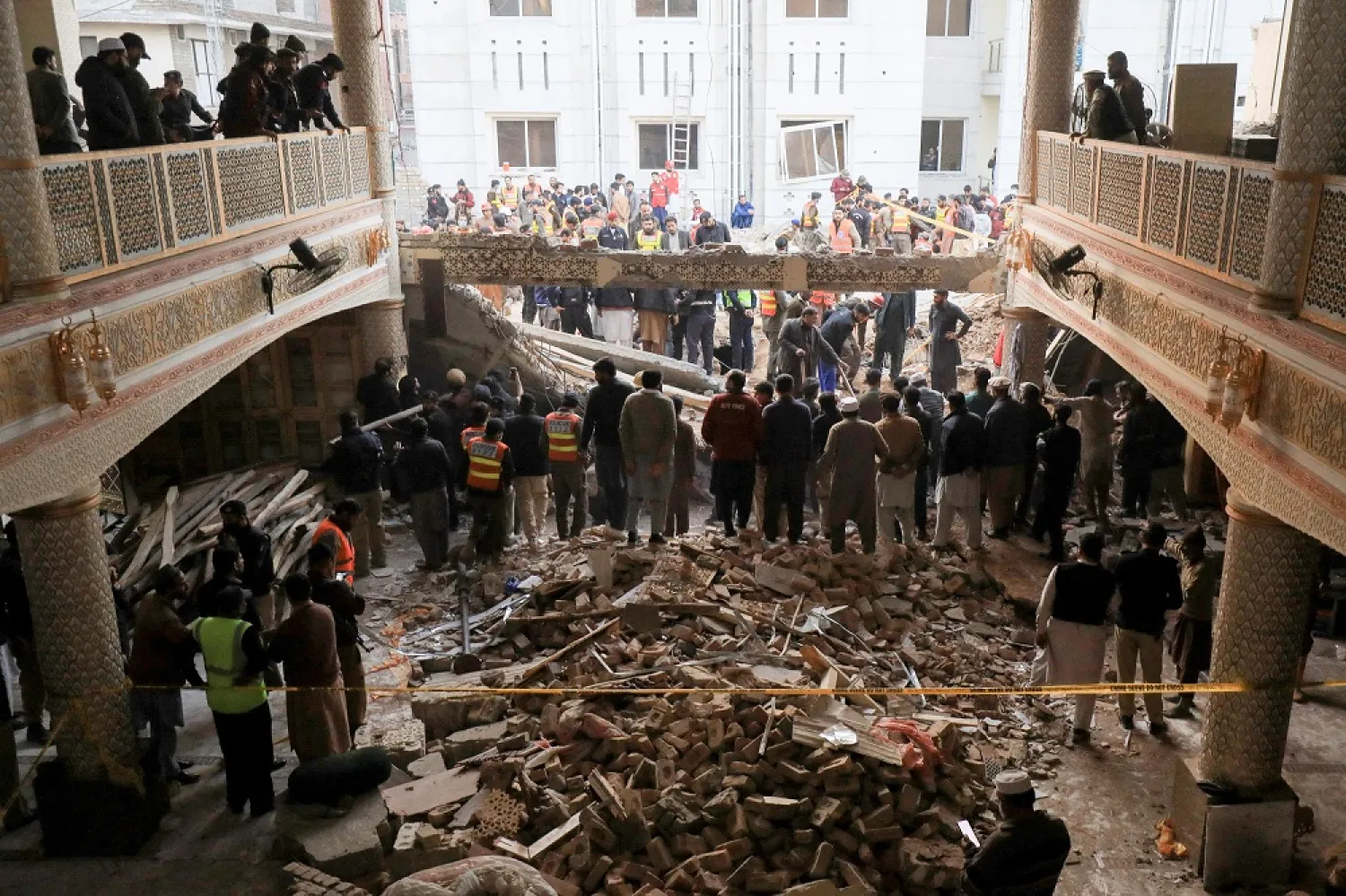
People and rescue workers gather to look for survivors under a collapsed roof, after a suicide blast in a mosque in Peshawar, Pakistan January 30, 2023. (Reuters)
TT

Pakistan Mosque Blast that Killed 95 Was ‘Revenge against Police’

People and rescue workers gather to look for survivors under a collapsed roof, after a suicide blast in a mosque in Peshawar, Pakistan January 30, 2023. (Reuters)

A suicide blast at a mosque inside a police headquarters in Pakistan that killed more than 90 people was a targeted revenge attack, a police chief said Tuesday.

Between 300 and 400 policemen had gathered for afternoon prayers at the compound's mosque on Monday in the provincial capital Peshawar when an entire wall and most of the roof were blown out, showering rubble on officers.

"We are on the frontline taking action against militants and that is why we were targeted," city police chief Muhammad Ijaz Khan told AFP.

"The purpose was to demoralize us as a force."

Low-level militancy, often targeting security checkpoints, has been steadily rising in the areas near Peshawar that border Afghanistan since the Taliban seized control of Kabul in August 2021.

The assaults are claimed mostly by the Pakistani Taliban, as well as the local chapter of ISIS, but mass casualty attacks remain rare.

The head of Khyber Pakhtunkhwa province police force, Moazzam Jah Ansari, told reporters that a suicide bomber had entered the mosque as a guest, carrying 10-12 kilograms (about 22-26 pounds) of "explosive material in bits and pieces".

He added that a militant group that was on-and-off affiliated with the Pakistani Taliban could be behind the attack.

Authorities are investigating how a major security breach could happen in one of the most tightly controlled areas of the city, housing intelligence and counter-terrorism bureaus, and next door to the regional secretariat.

The nation is already being hobbled by a massive economic downturn and political chaos, ahead of elections due by October.

Search for survivors

Provincial Chief Minister Muhammad Azam Khan confirmed it was a suicide blast, putting the latest death toll at 95, with more than 221 wounded.

Corpses were still being pulled from the wreckage of a collapsed wall and roof, with rescuers using listening devices to try and detect heartbeats beneath the rubble.

"I remained trapped under the rubble with a dead body over me for seven hours. I had lost all hope of survival," Wajahat Ali, a 23-year-old police constable whose feet were broken, told AFP from hospital on Tuesday.

Survivor Shahid Ali said the explosion took place seconds after the imam started prayers.

"I saw black smoke rising to the sky. I ran out to save my life," the 47-year-old police officers told AFP.

Dozens of slain police officers have already been buried in several mass prayer ceremonies, with coffins lined up in rows and draped in the Pakistani flag while a guard of honor was performed.

"Terrorists want to create fear by targeting those who perform the duty of defending Pakistan," Prime Minister Shehbaz Sharif said in a statement.

Rising militancy

In a statement, the Pakistani Taliban -- separate from the Afghan Taliban but with a similar extremist ideology -- denied it was responsible for the latest blast.

Known as the Tehreek-e-Taliban Pakistan, it carried out a years-long wave of horrific violence after emerging in 2007 but recently has attempted to rebrand itself as a less brutal outfit, claiming not to target places of worship.

But a security official in Peshawar, who asked not to be named, said Tuesday that authorities were considering all possibilities including the involvement of a TTP splinter faction, ISIS or a coordinated attack by several groups.

"Often in the past militant groups, including the TTP, that carry out attacks in mosques do not claim them" because a mosque is considered a sacred place, the official told AFP.

Pakistan was once plagued by almost daily bombings, but a major military clearance operation which started in 2014 largely restored order.

Analysts say militants in the former tribal areas adjacent to Peshawar and bordering Afghanistan have become emboldened since the return of the Afghan Taliban, with Islamabad accusing the new rulers of failing to secure their mountainous frontier.

But mass casualty attacks remain relatively rare, with ISIS claiming the most recent blast on a Shiite mosque in Peshawar last March that killed 64.

Provinces around the country announced they were on high alert after the blast, with checkpoints ramped up and extra security forces deployed, while in the capital Islamabad snipers were posted on buildings and at city entrance points.

Pakistan is also hosting an International Monetary Fund delegation from Tuesday as it works towards unlocking a vital bailout loan to prevent a looming default.

UN Secretary-General Antonio Guterres on Monday condemned the blast as "abhorrent", and US Secretary of State Antony Blinken extended his condolences for the "horrific attack".


Venezuela: Amnesty Law Excludes those who Promoted Military Action

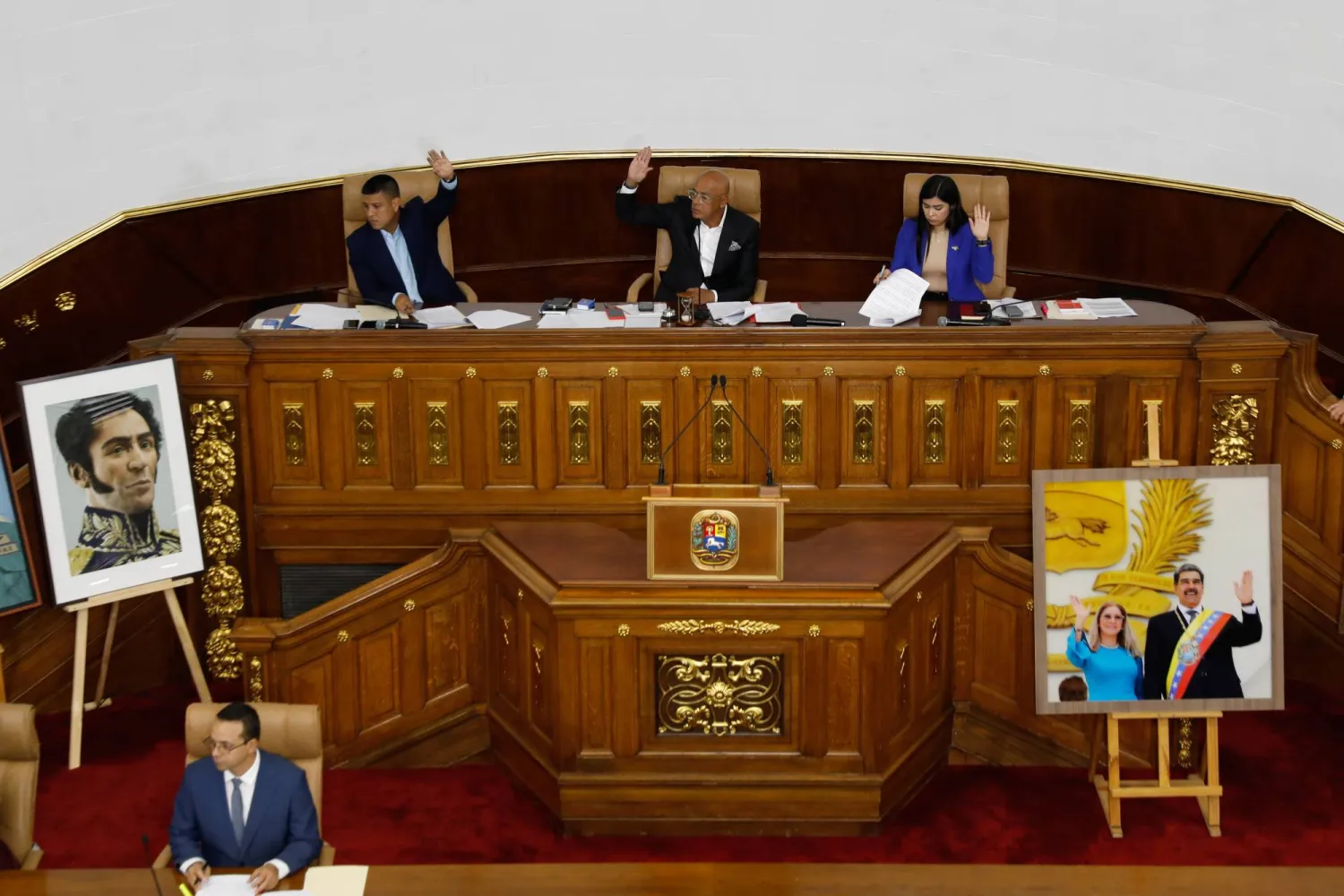
National Assembly President Jorge Rodriguez, center, presides over a session debating an amnesty bill in Caracas, Venezuela, Thursday, Feb. 19, 2026. (AP Photo/Crisitian Hernandez)
TT

Venezuela: Amnesty Law Excludes those who Promoted Military Action

National Assembly President Jorge Rodriguez, center, presides over a session debating an amnesty bill in Caracas, Venezuela, Thursday, Feb. 19, 2026. (AP Photo/Crisitian Hernandez)

Venezuela's parliament unanimously approved an amnesty law on Thursday that could free political prisoners, almost two months after President Nicolas Maduro was captured by US forces.

“The law on democratic coexistence has been approved. It has been forwarded to acting president Delcy Rodriguez for announcement,” said National Assembly President, Jorge Rodriguez, before parliament.

Acting president Delcy Rodriguez signed the legislation after it was handed to her by Jorge Rodrigez, her brother.

The passage of the law led to the end of a hunger strike by relatives of political prisoners.

Ten women have participated in a hunger strike outside the Zona 7 police facility in the capital Caracas last Saturday, setting up camps outside the prison and demanding the release of their relatives, according to AFP.

Because they experienced health problems, nine of them stopped the protest on Wednesday evening. Only one woman continued until Thursday, ending “136 hours,” or more than five days, of strike.

But the amnesty law excludes those who have been prosecuted or convicted of promoting military action against the country – which could include opposition leaders like Nobel Peace Prize winner Maria Corina Machado, who has been accused by the ruling party of calling for international intervention like the one that ousted Maduro.

Article 9 of the bill lists those excluded from amnesty as “persons who are being prosecuted or may be convicted for promoting, instigating, soliciting, invoking, favoring, facilitating, financing or participating in armed actions or the use of force against the people, sovereignty, and territorial integrity” of Venezuela “by foreign states, corporations or individuals.”


Türkiye’s Approval of Peace Roadmap is Important Step, PKK Source Says

A Turkish parliamentary commission’s approval of a report setting out a roadmap for legal reforms alongside the disbandment of the Kurdistan Workers Party (PKK) group is an important step and the beginning of a fundamental change in Turkish policy, a PKK source said Thursday. (AFP/File)
TT

Türkiye’s Approval of Peace Roadmap is Important Step, PKK Source Says

A Turkish parliamentary commission’s approval of a report setting out a roadmap for legal reforms alongside the disbandment of the Kurdistan Workers Party (PKK) group is an important step and the beginning of a fundamental change in Turkish policy, a PKK source said Thursday. (AFP/File)

A Turkish parliamentary commission's approval of a report setting out a roadmap for legal reforms alongside the disbandment of the Kurdistan Workers Party (PKK) group is an important step and the beginning of a fundamental change in Turkish policy, a PKK source told Reuters on Thursday.

The commission voted overwhelmingly on Wednesday to approve the report, advancing a peace process designed to end decades of conflict.

"The vote is considered an achievement and an important ‌step toward consolidating democracy ‌in Türkiye," said the PKK source.

The PKK - designated a ‌terrorist ⁠organization by Türkiye, ⁠the United States and the European Union - halted attacks last year and said in May it had decided to disband and end its armed struggle.

The parliamentary vote shifts the peace process to the legislative theatre, as President Tayyip Erdogan, Türkiye’s leader of more than two decades, bids to end a conflict focused in mainly Kurdish southeast Türkiye.

The insurgency began in 1984 and has killed more than 40,000 people, sowing deep discord at home and ⁠spreading violence across borders into Iraq and Syria.

IMPORTANT ISSUES OUTSTANDING

The PKK ‌source said there were foundations for resolving ‌the Kurdish issue, but there was a lack of clarity on the issue in the report.

"There also ‌remain other important issues, such as initiating constitutional amendments, especially in aspects related to ‌the Kurdish language as well as amendments to the anti-terrorism law," the source said.

Another issue was legislation concerning the return of PKK militants to Türkiye and their integration into society, the source said.

A key element of Wednesday's report recommended strengthening mechanisms to ensure compliance with decisions by the ‌European Court of Human Rights (ECHR) and the Constitutional Court.

Among key ECHR decisions related to Türkiye are rulings that the rights of ⁠jailed former pro-Kurdish ⁠party leader Selahattin Demirtas had been violated and that he should be released immediately.

Ankara's final appeal against that was rejected in November.

SIGN OF INTENT

Demirtas' lawyer Mahsuni Karaman told Reuters the report's comments on the ECHR were important as a sign of intent.

"We hope this will be reflected in judicial practice—that is our wish and expectation,” Karaman said.

Demirtas was detained in November 2016 on terrorism-related charges, which he denies. In May 2024, a court convicted him in connection with deadly 2014 protests and sentenced him to more than 40 years in prison.

Turkish nationalist leader Devlet Bahceli, a key Erdogan ally whose call in 2024 triggered the current PKK peace process, said in November that it "would be beneficial" to release Demirtas from prison.

The opposition pro-Kurdish DEM Party — the successor party of Demirtas' HDP — remains parliament's third-largest bloc and has cooperated closely with the parliamentary commission.


US Renews Threat to Leave IEA

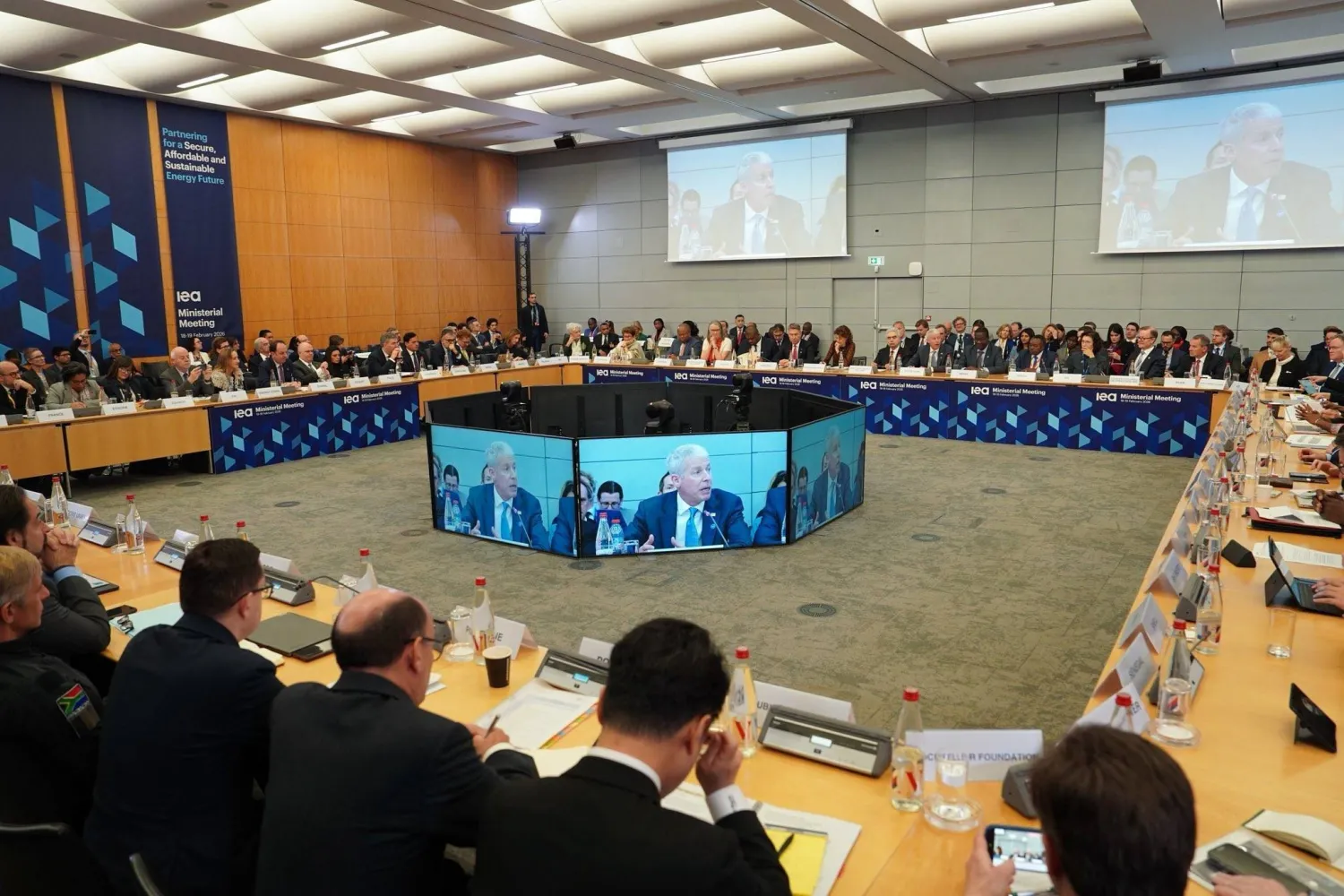
US Energy Secretary Chris Wright speaks at an IEA ministerial meeting in Paris (X)
TT

US Renews Threat to Leave IEA

US Energy Secretary Chris Wright speaks at an IEA ministerial meeting in Paris (X)

US Energy Secretary Chris Wright renewed his threat Thursday to pull out of the International Energy Agency, saying Washington would press the organization to abandon a net-zero agenda “in the next year or so.”

Speaking on the last day of an IEA ministerial meeting in Paris, Wright said the 52-year-old agency should return to its founding mission of ensuring energy security.

“The US will use all the pressure we have to get the IEA to eventually, in the next year or so, move away from this agenda,” Wright said in a news conference.

“But if the IEA is not able to bring itself back to focusing on the mission of energy honesty, energy access and energy security, then sadly we would become an ex-member of the IEA,” he added.

Meaning of Wright’s Warning

A US exit means a deep cut to IEA’s budget undermining the agency’s global influence.

Washington is not just a member of the agency but its largest funder. It alone contributes to 25% of the IEA core budget (equivalent to between $25 and $30 million annually) and therefore its exit would “dry up” a quarter of the agency’s financial resources.

Also, Washington is the world's largest oil and gas producer, meaning the US exit will affect the agency's reports and their credibility in markets.

The IEA was created to coordinate responses to major disruptions of supplies after the 1973 oil crisis. But in recent years, it became the main advocate of green transition policies, which the US considers as “politicized.”

The IEA produces monthly reports on oil demand and supply as well as annual world energy outlooks that include data on the growth of solar and wind energy, among other analyses.

Wright praised IEA Executive Director Fatih Birol for reinserting in November 2025’s annual outlook a Current Policies Scenario in which oil and gas demand would grow in the next decades. That scenario had been dropped for the past five years.

But the report still included a scenario where the world reaches net zero emissions by mid-century.

Birol’s current four-year term ends in 2027, but Wright demurred when asked who he would like to head the IEA, which has over 30 member nations.

“We remain today undecided or neutral on who the leadership is. We care about the mission much more than the individual leaders,” the US energy chief said.

If Birol can make the agency “get out the politics and get out the anti-energy part of it, that's great by us,” said Wright, who first warned last year that the US could leave the IEA if it did not reform.

For his part, Birol insisted that the Paris-based agency was “data-driven.” He said, “We are a non-political organization.”

The IEA was created “to focus on energy security,” Wright said on Wednesday at a ministerial meeting of the agency in Paris.

“That mission is beyond critical and I'm here to plead to all the members (of the IEA) that we need to keep the focus of the IEA on this absolutely life-changing, world-changing mission of energy security,” he said.

The Energy Secretary said he wanted to get support from “all the nations in this noble organization to work with us, to push the IEA to drop the climate. That's political stuff.”

His comments come just a day after he publicly threatened to quit the organization unless it abandoned its focus on the energy transition— a call that several countries rejected, including the UK, Austria and France.