


Saudi Arabia Increases Price for Arab Light Crude to Asia

A view shows branded oil tanks at the Saudi Aramco oil facility in Saudi Arabia (File photo: Reuters)
TT

Saudi Arabia Increases Price for Arab Light Crude to Asia

A view shows branded oil tanks at the Saudi Aramco oil facility in Saudi Arabia (File photo: Reuters)

Saudi Arabia, the world's top oil exporter, raised prices for its flagship crude for Asian buyers for the first time in six months amid an expectation of oil demand recovery, especially from China, according to Reuters.

Informed sources reported Monday that the official selling price (OSP) of Arab Light crude, March loading to Asia, rose 20 cents per barrel from February to $2 per barrel over the average of Oman and Dubai oil, contrary to previous market forecast to drop 30 cents.

"The OSP is quite unexpected. I think it indicates that Saudi is bullish on oil demand," a Singapore-based oil trader told Reuters.

The Executive Director of the International Energy Agency, Fatih Birol, expected that about half of the global oil demand growth, this year will come from China.

Analysts and traders have forecast China's oil demand to rebound from March alongside its economic recovery and the conclusion of a peak in COVID-19 infections in the country.

The OSP for Arab Extra Light was reduced by $1.30 to $2.25 a barrel over Oman/Dubai quotes, and for Arab Medium and Arab Heavy, they were both increased by 50 cents to $1.60 a barrel and minus $1.75 a barrel, respectively.

Oil prices rose on Monday, buoyed by supply concerns, but remained near three-week lows on fears that slower growth in major economies could curb demand.

Brent crude futures for April delivery fell 55 cents, or 0.07 percent, to $79.39 a barrel. West Texas Intermediate (WTI) crude futures lost 79 cents, or 1.1 percent, to record $72.60 a barrel.

The strong US jobs data raised concerns that the US Federal Reserve would keep raising interest rates, which could hurt economic growth and lead to a decline in fuel demand.

The dollar rose to its highest level in three weeks against the euro.

Meanwhile, JPMorgan said that Russian oil refining production could decline by about 300,000 barrels per day due to new sanctions on oil flows before recovery to pre-war levels by mid-2023.

Head of Asia energy and chemicals research at JPMorgan Chase Parsley Ong told Bloomberg TV that productivity might decline if Russia faces difficulties changing the path of 500,000 barrels of diesel per day through the last and first quarters.

Over time, there will be enough production ships to carry most of Russia's oil.

China's oil demand will grow in 2023 to 800,000 barrels per day annually, representing about half of the bank's forecast for global demand growth.

Ong recalled former predictions that the oil barrel will reach $90 in 2023, expecting most of the price increases to occur in the year's second half.



Oil Prices Fall after Trump Hails 'Good' Talks with Iran

FILE PHOTO: A small tanker sails near an oil refinery, in the Keihin Industrial Zone in Kawasaki, south of Tokyo, Japan March 17, 2026.  REUTERS/Issei Kato/File Photo
FILE PHOTO: A small tanker sails near an oil refinery, in the Keihin Industrial Zone in Kawasaki, south of Tokyo, Japan March 17, 2026. REUTERS/Issei Kato/File Photo
TT

Oil Prices Fall after Trump Hails 'Good' Talks with Iran

FILE PHOTO: A small tanker sails near an oil refinery, in the Keihin Industrial Zone in Kawasaki, south of Tokyo, Japan March 17, 2026.  REUTERS/Issei Kato/File Photo
FILE PHOTO: A small tanker sails near an oil refinery, in the Keihin Industrial Zone in Kawasaki, south of Tokyo, Japan March 17, 2026. REUTERS/Issei Kato/File Photo

Oil prices fell on Wednesday after President Donald Trump said US and Iranian representatives had met for "very good" talks at the United Nations.

The international benchmark, Brent crude, and main US contract, West Texas Intermediate, dipped to $98.91 and $89.93 per barrel respectively in early Asian trade -- well below the symbolic $100 mark they have smashed repeatedly since the Middle Eat war broke out in February, AFP reported.

The three-hour meeting was "very good", "very productive" and "they have another one scheduled in the very near future", Trump told reporters as he met Ukrainian President Volodymyr Zelensky.

Trump's announcement came just hours after he delivered a bellicose address to the UN in which he said he faced a "big decision" on whether to make a deal with Iran or "annihilate the Islamic Republic and do it quickly".

Nearly seven months after US-Israeli strikes on Tehran triggered the conflict, the foes remain at an impasse, with Iran keeping the Strait of Hormuz closed and the United States persisting with a counter-blockade of Iranian ports.

"The three-hour US-Iran meeting matters because it shifts the market from pure escalation pricing toward a genuine diplomatic process, even if a final deal still looks distant," said Stephen Innes at Quintex Intel.

Trump has pledged that oil would come down "as soon as" the United States wins the war.

The dip in oil prices came as the world's biggest crude exporter Saudi Arabia reportedly rebooted operations along its East-West Pipeline -- a crucial oil export route shut down by the conflict rocking the Middle East.

Riyadh said this month that drones launched from Iraq had forced the closure of the pipeline, which it had increasingly used to bypass the lockdown of the Strait of Hormuz by Iran.

The kingdom is aiming to resume exports later this week, Bloomberg quoted a source as saying.


Euro Zone Yields Fall after Iran Raises Prospect of Hormuz Reopening

Euro banknotes (Reuters)
TT

Euro Zone Yields Fall after Iran Raises Prospect of Hormuz Reopening

Euro banknotes (Reuters)

Euro zone bond yields fell for a second straight day on Tuesday, hitting their lowest in almost two weeks after Iran raised the prospect of reopening the Strait of Hormuz and Washington hinted it could restart talks with Tehran, pushing oil prices lower.

Germany's 10-year bond yield, the benchmark for the bloc, fell 1 basis point to 3.44% after rising as much as 4 bps earlier in the session. It fell 7 bps on Monday as energy prices retreated.

A senior Iranian official told Reuters that the strait, which carried about a fifth of global energy supplies before the war, could reopen within seven days if the US also lifts its blockade of Iranian ports.

The official added that Iran's delegation to a UN meeting in New York this week has full authority to revive diplomacy over the conflict.

US Secretary of State Marco Rubio told NBC's "Today" show that Washington was open to speaking with Tehran.

The dip in energy prices helped pull yields lower globally after a surge in recent weeks fuelled by expectations of further interest-rate hikes to combat energy-driven inflation. Traders are pricing in around 35 bps of additional European Central Bank tightening this year, down from 40 bps on Friday.

Germany's two-year bond yield, which is sensitive to interest-rate expectations, fell 1 bp to 3.19%, following a 6-bp drop on Monday.

Rabobank senior rates strategist Lyn Graham-Taylor said lower oil prices following the Iranian comments were weighing on bond yields.

Brent crude futures were last down 1% to $100 a barrel after earlier falling to $97.40, the lowest in two weeks.


Libya's NOC Says Sharara Crude Pipeline Closure Losses at 130,000 bpd

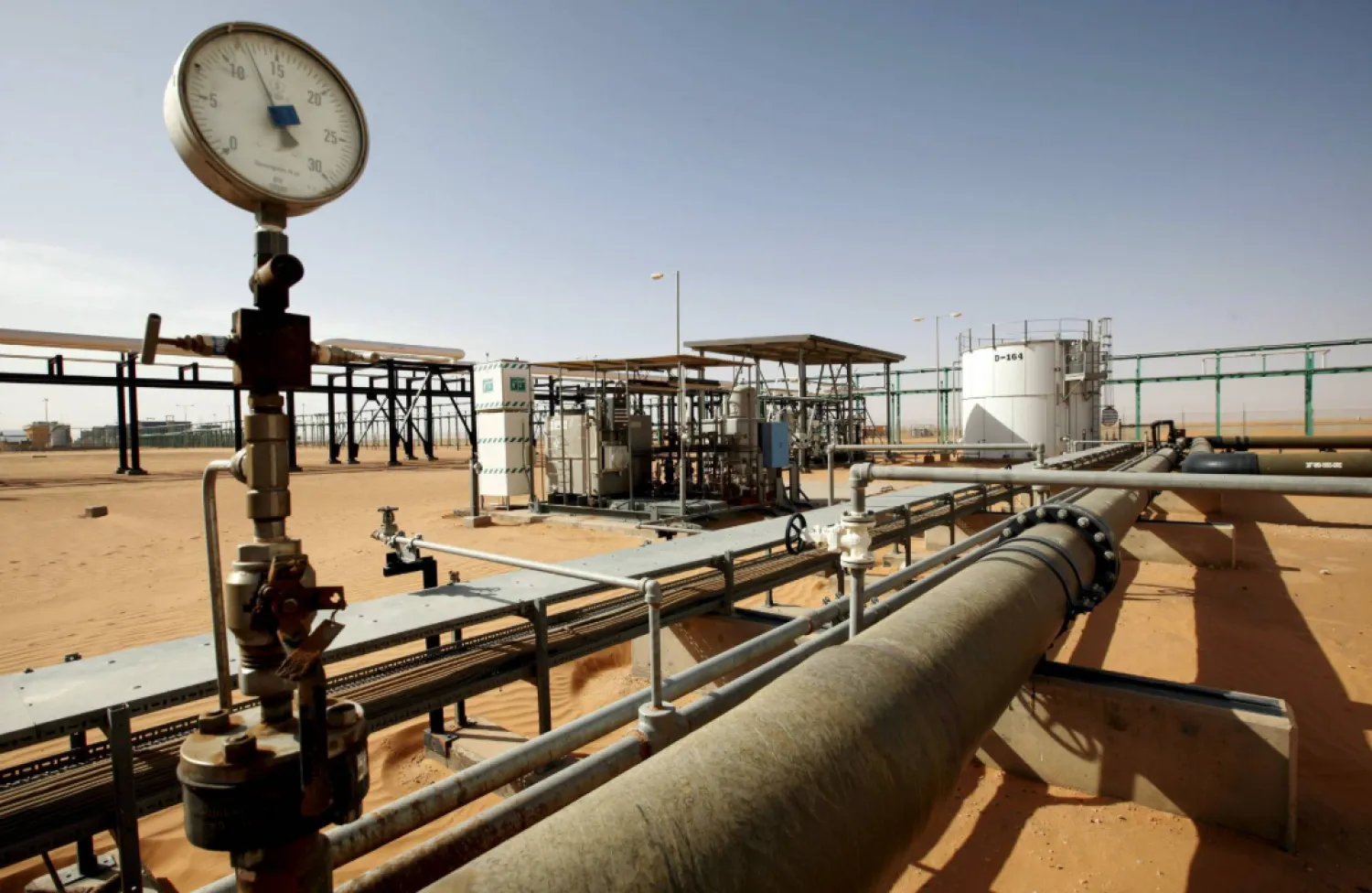
General view of the Sharara oil field in Libya (Reuters)
TT

Libya's NOC Says Sharara Crude Pipeline Closure Losses at 130,000 bpd

General view of the Sharara oil field in Libya (Reuters)

Libya's National Oil Corporation said on Tuesday that the Sharara-Zawiya crude loading pipeline closure has led to daily losses of about 130,000 barrels per day, Reuters reported.

An armed military group closed valve seven on the Sharara crude pipeline to Zawiya port on Monday, resulting in a significant decline in production at the Sharara oilfield, the National Oil Corporation said in a statement.