

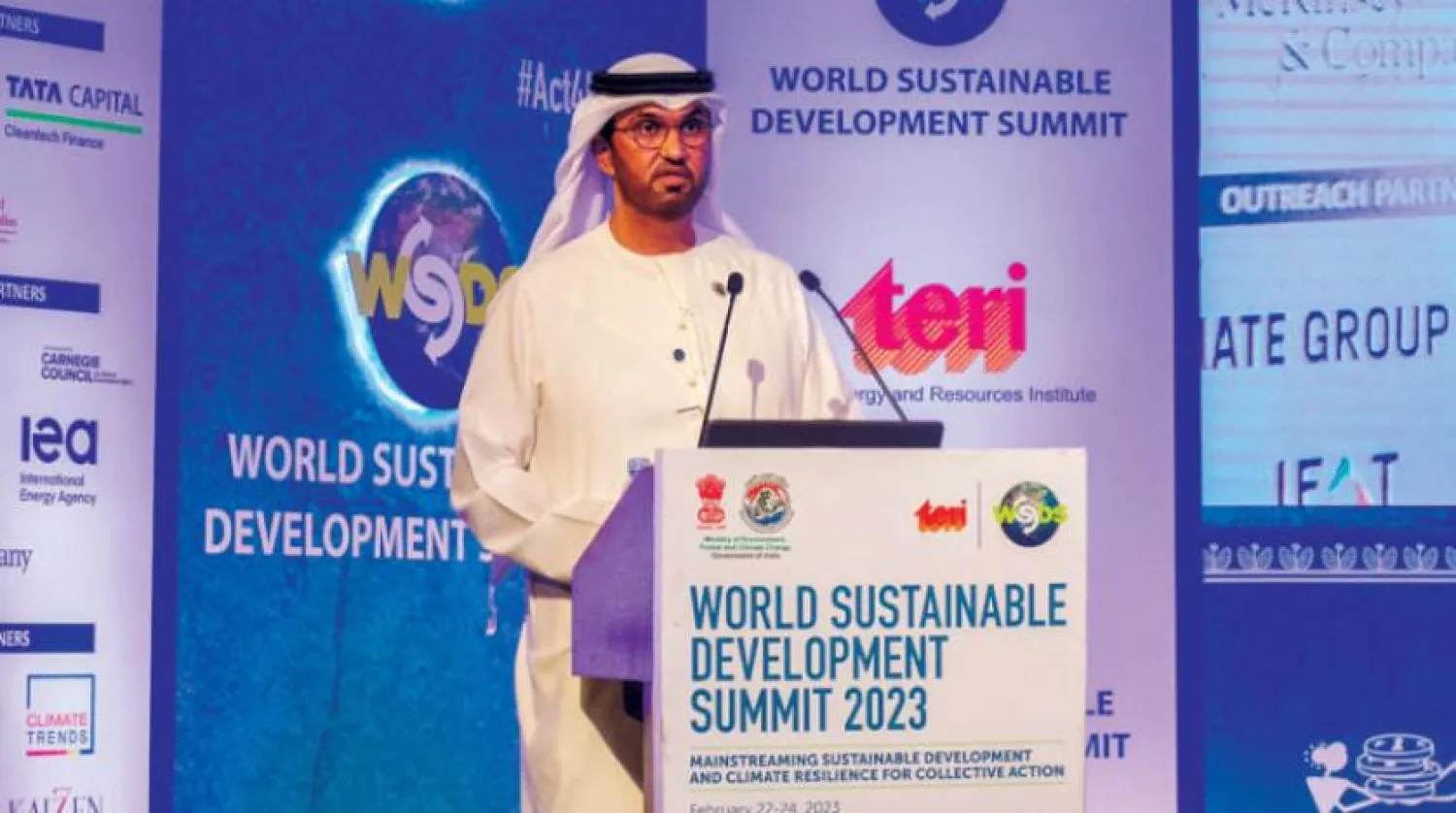

COP28 President-designate Says Paris Agreement Goal of 1.5°C Is ‘Non-negotiable'

Al Jaber speaking at the World Sustainable Development Summit in New Delhi. (WAM)
TT

COP28 President-designate Says Paris Agreement Goal of 1.5°C Is ‘Non-negotiable'

Al Jaber speaking at the World Sustainable Development Summit in New Delhi. (WAM)

Dr. Sultan Al Jaber, COP28 UAE President-Designate, emphasized the need to mobilize resources and partnerships toward a bold and transformative approach to climate action.

His remarks came during the World Sustainable Development Summit hosted by The Energy and Resources Institute (TERI) in New Delhi.

Al Jaber reaffirmed the UAE’s unwavering commitment to the Paris Agreement goal of limiting global temperature rise to 1.5 degrees Celsius but stressed that progress was far from what was needed.

“Let me make one thing absolutely clear: the goal of keeping 1.5 alive is non-negotiable. It is also clear that business as usual won’t get us there. We need a paradigm shift in our approach to mitigation, adaptation, finance, and loss and damage.”

Acknowledging the need to support those impacted by climate change, he also pointed to the need to boost support for adaptation, and to embrace nature-based solutions.

“On adaptation, COP28 must conclude the Global Goal on Adaptation, and finalize agreement around doubling adaptation finance. TERI has been at the forefront of pushing for this goal, which will help protect vulnerable communities across the Global South. Adaptation also means preserving ALL life on earth, protecting biodiversity, natural ecosystems, and endangered species. As a nation, and as the COP28 Presidency, we share India’s firm belief that safeguarding and respecting nature is a fundamental obligation. The UAE has always embedded environmental protection, respect for nature, and climate action into our development strategy,” state news agency WAM cited Al Jaber as saying.

The COP28 President-Designate emphasised that the step change in the climate progress needed cannot happen without accessible and affordable capital, noting that trillions, not billions, are required.

“A key enabler will be the reform of the International Financial Institutions and Multilateral Development Banks. We must mobilise much more concessional finance to unlock more private sector capital and target investments where they are needed most. As such, scaling and accelerating climate finance will be one of the key goals of the COP28 Presidency, and we will rally all relevant parties in an effort to get it done.”

Dr. Al Jaber expressed that progressive climate action represents an immense opportunity for the world: “An opportunity to create millions of jobs and invent new sectors, businesses, and industries. In fact, it will create the greatest leap in human development and prosperity since the first industrial revolution.”

“Let’s ensure that progress is truly inclusive… that no-one is left behind. Let’s keep 1.5 alive, while putting an end to energy and water poverty. Let’s unite around climate action that carries humanity forward. And let’s prove that you can be pro-climate and pro-growth at the same time.

“In the months to come, myself and the COP28 team, will continue to listen, consult, and engage with everyone. Everyone from civil society, Indigenous peoples, the private sector, governments, women, and youth," he added.

“Let’s unite everyone around a COP of action and a COP for all. Let’s remember that the world makes progress through partnership, not polarization."

“And let’s follow TERI’s motto: ‘the best way to predict the future is to create it.’ So, let’s get to work and create a sustainable future together.”



Euro Zone Yields Fall after Iran Raises Prospect of Hormuz Reopening

Euro banknotes (Reuters)
TT

Euro Zone Yields Fall after Iran Raises Prospect of Hormuz Reopening

Euro banknotes (Reuters)

Euro zone bond yields fell for a second straight day on Tuesday, hitting their lowest in almost two weeks after Iran raised the prospect of reopening the Strait of Hormuz and Washington hinted it could restart talks with Tehran, pushing oil prices lower.

Germany's 10-year bond yield, the benchmark for the bloc, fell 1 basis point to 3.44% after rising as much as 4 bps earlier in the session. It fell 7 bps on Monday as energy prices retreated.

A senior Iranian official told Reuters that the strait, which carried about a fifth of global energy supplies before the war, could reopen within seven days if the US also lifts its blockade of Iranian ports.

The official added that Iran's delegation to a UN meeting in New York this week has full authority to revive diplomacy over the conflict.

US Secretary of State Marco Rubio told NBC's "Today" show that Washington was open to speaking with Tehran.

The dip in energy prices helped pull yields lower globally after a surge in recent weeks fuelled by expectations of further interest-rate hikes to combat energy-driven inflation. Traders are pricing in around 35 bps of additional European Central Bank tightening this year, down from 40 bps on Friday.

Germany's two-year bond yield, which is sensitive to interest-rate expectations, fell 1 bp to 3.19%, following a 6-bp drop on Monday.

Rabobank senior rates strategist Lyn Graham-Taylor said lower oil prices following the Iranian comments were weighing on bond yields.

Brent crude futures were last down 1% to $100 a barrel after earlier falling to $97.40, the lowest in two weeks.


Libya's NOC Says Sharara Crude Pipeline Closure Losses at 130,000 bpd

General view of the Sharara oil field in Libya (Reuters)
TT

Libya's NOC Says Sharara Crude Pipeline Closure Losses at 130,000 bpd

General view of the Sharara oil field in Libya (Reuters)

Libya's National Oil Corporation said on Tuesday that the Sharara-Zawiya crude loading pipeline closure has led to daily losses of about 130,000 barrels per day, Reuters reported.

An armed military group closed valve seven on the Sharara crude pipeline to Zawiya port on Monday, resulting in a significant decline in production at the Sharara oilfield, the National Oil Corporation said in a statement.


Sources: Saudi Arabia Restarts East-West Oil Pipeline

FILE PHOTO: A model of an oil pump is seen in front of a Saudi Arabian flag in this illustration taken January 9, 2026. REUTERS/Dado Ruvic/Illustration/File Photo
TT

Sources: Saudi Arabia Restarts East-West Oil Pipeline

FILE PHOTO: A model of an oil pump is seen in front of a Saudi Arabian flag in this illustration taken January 9, 2026. REUTERS/Dado Ruvic/Illustration/File Photo

Saudi Arabia has restarted operations at its East-West Pipeline and could resume exports from the Red Sea port of Yanbu later on Tuesday, three sources briefed on the matter said.

Drone attacks forced Saudi Arabia to shut its East-West Pipeline on September 13, halting crude loadings at the kingdom's Yanbu port.

The resumption of supplies on Tuesday helped to drive selling on global oil markets, traders said. Brent crude futures fell by more than $2 a barrel to its lowest since September 8.

Two trading sources said traders were getting ready for Saudi oil loadings by moving tankers to Egypt's Mediterranean Port Said for ship-to-ship transfers and also to Sidi Kerir.