First UK Polar Bear in 25 Years Born at Scottish Zoo

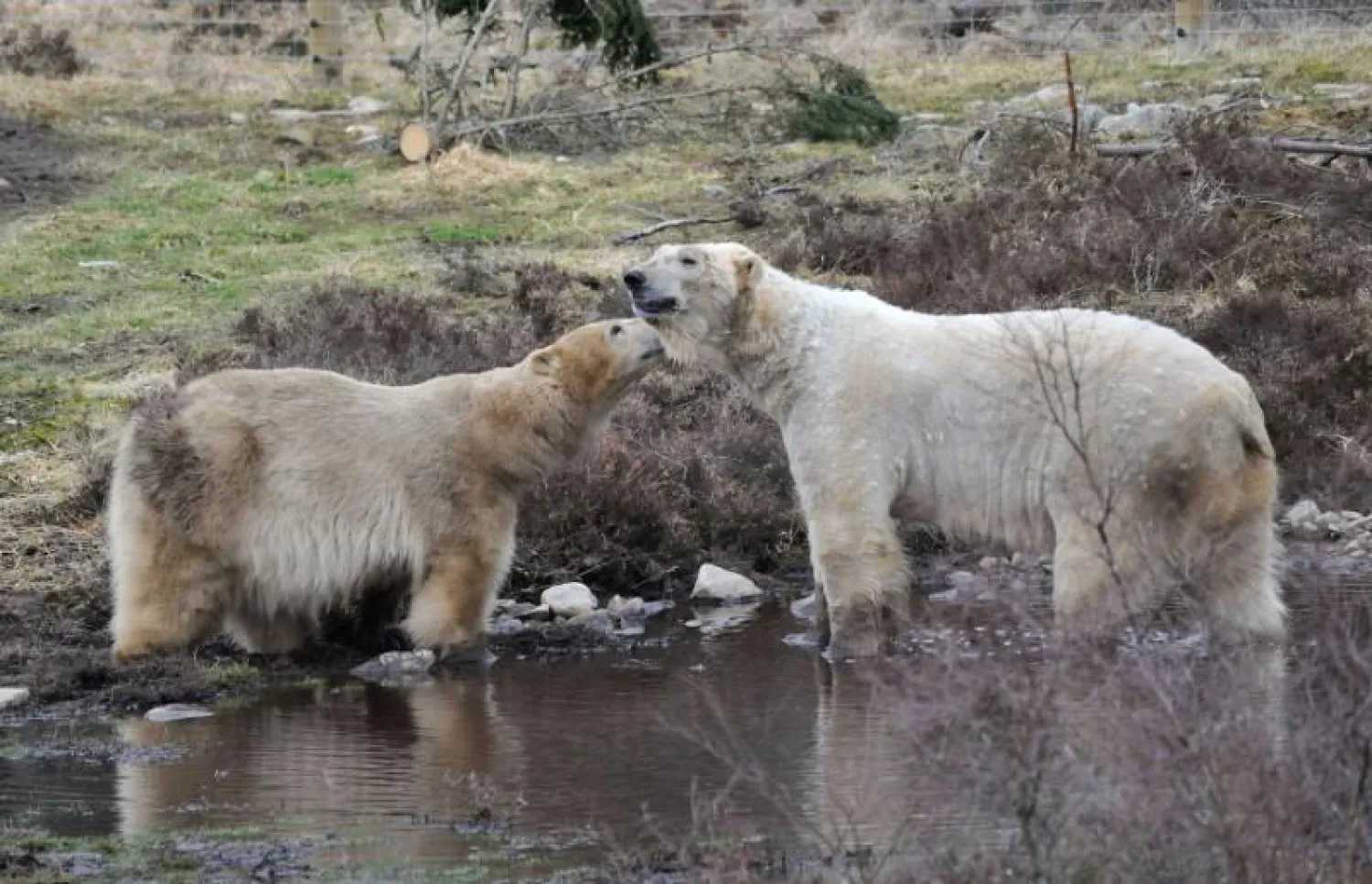
Polar bears Victoria and Arktos interact in Highland Wildlife Park in Kincraig, Kingussie, Scotland in this undated photo obtained from social media. COURTESY of RZSS Highland Wildlife Park polar bear breeding /via REUTERS
TT

First UK Polar Bear in 25 Years Born at Scottish Zoo

Polar bears Victoria and Arktos interact in Highland Wildlife Park in Kincraig, Kingussie, Scotland in this undated photo obtained from social media. COURTESY of RZSS Highland Wildlife Park polar bear breeding /via REUTERS

A polar bear cub has been born in Britain for the first time in 25 years, the Royal Zoological Society of Scotland said on Wednesday.

Mother polar bear Victoria is believed to have given birth at the Highland Wildlife Park in northeastern Scotland after staff heard high pitched cries in late December.

“We first heard promising noises in the week before Christmas and these have now continued into the new year,” said Una Richardson, the park’s head keeper.

“Because we don’t have sight inside her cubbing box we can’t be sure if Victoria has had more than one cub but we can confirm the birth,” she added.

Polar bears are known for their need for privacy and newborns are extremely delicate, so the maternity den is closed to visitors at the zoo. The survival of the cub or cubs will not be fully confirmed until March, when bears emerge after winter.

“While we are absolutely thrilled, we are not celebrating prematurely as polar bear cubs have a high mortality rate in the first weeks of life due to their undeveloped immune system and the mother’s exaggerated need for privacy, with any disturbance risking the cub being killed or abandoned,” Richardson said.

Polar bears are born about 30 cm long and weigh roughly the same as a guinea pig. They emerge blind and do not open their eyes until they are about a month old, depending entirely on their mother’s milk.

The last polar bear cubs born in the UK were twins at Flamingo Land in Yorkshire on 8 December 1992.


January Was Fifth Hottest on Record despite Cold Snap

This handout photo taken on February 7, 2026 and received on February 10 from Japan's Ministry of Defense shows members of the Japan Ground Self-Defense Force's 5th Infantry Regiment, stationed in Aomori Prefecture, carrying out snow removal work in a town within Aomori Prefecture. (Photo by Handout / Japan's Ministry of Defense / AFP)
TT

January Was Fifth Hottest on Record despite Cold Snap

This handout photo taken on February 7, 2026 and received on February 10 from Japan's Ministry of Defense shows members of the Japan Ground Self-Defense Force's 5th Infantry Regiment, stationed in Aomori Prefecture, carrying out snow removal work in a town within Aomori Prefecture. (Photo by Handout / Japan's Ministry of Defense / AFP)

The planet experienced its fifth-hottest January on record despite a cold snap that swept across the United States and Europe, the EU's climate monitor said Tuesday.

The Northern Hemisphere was hit by severe cold waves in the final weeks of January as a polar jet stream blew icy air into Europe and North America, according to the Copernicus Climate Change Service.

But monthly temperatures were above average over much of the globe, including in large parts of the Arctic and western North America, according to Copernicus.

"January 2026 delivered a stark reminder that the climate system can sometimes simultaneously deliver very cold weather in one region, and extreme heat in another," said Samantha Burgess, strategic lead for climate at the European Centre for Medium-Range Weather Forecasts (ECMWF).

The average global temperature in January was 1.47C above preindustrial times.

Europe endured its coldest January since 2010, with an average temperature of 2.34C, the service said.

The United States, meanwhile, was hit by a monster winter storm that dumped snow and crippling ice from New Mexico to Maine. It was linked to more than 100 deaths.

The planet remains in an extended run of human-driven warming, with 2024 setting a record high, 2023 ranking second 2025 now third warmest.


Beirut's 'Mother of Cats' Who Rescues Felines

Diana Abadi, known as "the mother of cats," sits with felines waiting for adoption at her small pet food and plant shop in Hadath, in Beirut's southern suburbs known as Dahiyeh, in Lebanon, Saturday, Feb. 7, 2026. (AP Photo/Bilal Hussein)
TT

Beirut's 'Mother of Cats' Who Rescues Felines

Diana Abadi, known as "the mother of cats," sits with felines waiting for adoption at her small pet food and plant shop in Hadath, in Beirut's southern suburbs known as Dahiyeh, in Lebanon, Saturday, Feb. 7, 2026. (AP Photo/Bilal Hussein)

Diana Abadi is known in the southern suburbs of Beirut as the “Mother of Cats.”

For the past 12 years, she has turned her home and shop into a refuge for abandoned felines who now number between 50 and 70, and she often sleeps beside the cats as she cares for them full time.

Abadi began by taking in a single kitten.

Word spread, and residents started bringing her injured and unwanted animals, especially during periods of crisis. At its peak, the shelter housed more than 150 cats, especially during the COVID-19 pandemic and the recent Israel-Hezbollah war, when fear and displacement led many people to abandon their pets.

Her plant and pet food shop in the southern suburbs known as Dahiyeh serves as both her livelihood and the cats’ shelter. Among those currently in her care are Joujou, 13, the oldest, as well as cats named Loulou, Fluffy, Emma and Panda.

One of the most challenging cases involves a cat that was completely blind when abandoned. A woman offered to cover the animal’s expenses if Abadi would take him in. After months of treatment, the cat has partially regained vision in one eye.

Social media has recently helped improve adoption rates, reducing the number of cats under Abadi's care. Rising costs, however, threaten the shelter’s future. Monthly rent has climbed to $800, up from $250 before the war, forcing Abadi to cover most expenses herself.

“These are living beings,” she said. “I don’t take holidays or Sundays off.”


Face of 400-Year-Old 'Vampire' Recreated

Scientists have given a face to a decapitated skull which was uncovered in Croatia. (Croatia’s excavation team)
TT

Face of 400-Year-Old 'Vampire' Recreated

Scientists have given a face to a decapitated skull which was uncovered in Croatia. (Croatia’s excavation team)

The face of a "vampire", whose remains were posthumously mutilated to prevent them from rising from the dead, can be seen for the first time in more than 400 years, reported Sky News.

Discovered in a grave at Racesa, a fortress in eastern Croatia, the body had been exhumed, beheaded and reburied face down beneath heavy stones.

And since the desecration cannot be explained by environmental factors, experts believe it was done to stop the dead man returning as a vampire.

Now the face of the deceased can be seen for the first time in centuries, after scientists rebuilt his likeness from his skull.

Archaeologist Natasa Sarkic, part of the excavation team, said the fear inspired by the man in death may stem from the fear he inspired in life.

She said: “Bioarchaeological analysis showed that this man often participated in violent conflicts, and died a violent death. He experienced at least three episodes of serious interpersonal violence during his lifetime.”

“One of those attacks left his face disfigured, which could cause fear and repulsion, leading to social exclusion. Before even recovering from the penultimate trauma, he sustained a final fatal attack,” she revealed.

“Individuals who died violently, behaved violently in life, or were considered sinful or socially deviant, were believed to be at risk of becoming vampires,” she continued.

“He may have been regarded as a 'vampire', or a supernatural threat due to his facial disfigurement and his marginal lifestyle, characterized by repeated interpersonal violence,” Sarkic explained.

She said such beings were thought to be restless, vengeful, and capable of harming the living, spreading disease and killing people or livestock.

Sarkic said that, in the Slavic tradition, the soul remains attached to the body for about 40 days after death.