US Angered by Failed Mossad Operation in Arab Country

The Pentagon in Washington, US, is seen from aboard Air Force One, March 29, 2018. (Reuters)
TT

US Angered by Failed Mossad Operation in Arab Country

The Pentagon in Washington, US, is seen from aboard Air Force One, March 29, 2018. (Reuters)

The US Army was angered with the Israeli intelligence agency, the Mossad, for a failed operation it had carried out in a Middle Eastern country and which undermined both parties, revealed political sources in Tel Aviv.

The Mossad failed because it did not coordinate the operation with US forces deployed in that country, reported a high-ranking official in the Israeli army.

According to a report published on Tuesday by Amir Oren, a writer for Walla News, the Israeli army fears a setback in the close relations with its American counterpart and the Pentagon.

Some of the first signs of this setback emerged recently and impacted ties between the Israeli military and Mossad director Yossi Cohen due to the latter’s actions.

An official in the army accused the Mossad of having a flaw in its performance that is jeopardizing the delicate ties with the National Security Agency (NSA) in Washington and the region.

Oren spoke of a “hidden” tensions between the Israeli army and Mossad on leading contacts with the American security agencies and the recent dispute with the US aggravated them.

Daily contacts are made via the Israeli army, namely the department of operations and planning and the military attache in Washington. While the Mossad carries on its communication through its director with the CIA envoy in Tel Aviv, and also through head of the Mossad Mission at the Israeli Embassy in Washington with the Coordinator of Government Activities in the Territories (COGAT) at the CIA’s headquarters. Occasionally, direct contact is made between Cohen and CIA Director Gina Haspel.

Oren added that the issue of Israeli-American coordination was brought up after the Israeli army carried out an operation in a region of operation of the US Central Command.

This could be understood as a hint of Israeli involvement in the recent blasts that took place in Iraq and that targeted Popular Mobilization Forces positions.

The Central Command is critical about violating the sovereignty of countries in its area of operations, which does not border Israel.

The Israeli operation, therefore, angered the Pentagon and it has rejected all excuses and apologies.

This tension coincides with another debate between Tel Aviv and Washington on American-Iranian ties.

Israeli Prime Minister Benjamin Netanyahu has been very concerned with signs that US President Donald Trump was ready to open a new chapter in relations with Iran and abandoning the hardline policy adopted by the premier, revealed the sources.

These concerns increased on Monday when French President Emmanuel Macron announced a plan to hold a summit between Trump and his Iranian counterpart Hassan Rouhani.


Lebanon, Jordan Seek Solutions After Damascus Bans Non-Syrian Trucks

Lebanese truck drivers block the road on the Lebanese side of the Masnaa border crossing in protest against Syria's decision to ban non-Syrian trucks from entering its territory, on February 10, 2025. (AFP)
TT

Lebanon, Jordan Seek Solutions After Damascus Bans Non-Syrian Trucks

Lebanese truck drivers block the road on the Lebanese side of the Masnaa border crossing in protest against Syria's decision to ban non-Syrian trucks from entering its territory, on February 10, 2025. (AFP)

Lebanon and Jordan are seeking a solution with Syria after the latter barred foreign trucks from entering its territory, officials from both countries told AFP on Tuesday.

Damascus had issued a decision on Saturday stipulating that "non-Syrian trucks will not be allowed to enter" the country, and that goods being imported by road must be unloaded at specific points at border crossings.

The decision exempts trucks that are only passing through Syria to other countries.

Dozens of trucks unable to enter the country were lined up on the Lebanese side of the Masnaa border crossing on Tuesday, an AFP photographer saw.

Ahmad Tamer, head of land and maritime transportation at the Lebanese transport ministry told AFP that discussions were underway with Damascus over the decision.

He said the issue was not specifically targeting Lebanon -- which is trying to reset ties with Damascus after the fall of Bashar al-Assad -- adding that he hoped to hold a meeting with the Syrian side soon.

Lebanon sends around 500 trucks to Syria per day, according to Tamer.

In Jordan, also affected by the decision, transport ministry spokesperson Mohammed al-Dweiri told AFP that "discussions are currently underway, and we are awaiting a response from the Syrian side regarding allowing foreign trucks to enter and cross".

Dweiri said that Jordanian trucks were continuing to unload their cargo at the free zone at the Nassib border crossing with Syria despite some "confusion".

Around 250 Jordanian trucks travel to Syria daily, according to him.

A source in the Syrian General Authority for Ports and Customs told AFP that the decision aimed to "regulate the movement of cargo through the ports".

Representatives of unions and associations in Lebanon's transport sector denounced the decision on Tuesday and warning of "negative repercussions", according to the state-run National News Agency.

Syria is the only land route Lebanon can use to export merchandise to wealthy Gulf markets.

As part of continued attempts to rekindle ties, the two countries signed an agreement on Friday to hand around 300 Syrian convicts over to Damascus.


Israeli Drone Strike Kills 2 Cyclists in Gaza as Death Toll Mounts Despite Ceasefire

 Smoke rises following an explosion, within the "yellow line" zone, which is controlled by Israel, in Khan Younis in the southern Gaza Strip, February 10, 2026. (Reuters)
Smoke rises following an explosion, within the "yellow line" zone, which is controlled by Israel, in Khan Younis in the southern Gaza Strip, February 10, 2026. (Reuters)
TT

Israeli Drone Strike Kills 2 Cyclists in Gaza as Death Toll Mounts Despite Ceasefire

 Smoke rises following an explosion, within the "yellow line" zone, which is controlled by Israel, in Khan Younis in the southern Gaza Strip, February 10, 2026. (Reuters)
Smoke rises following an explosion, within the "yellow line" zone, which is controlled by Israel, in Khan Younis in the southern Gaza Strip, February 10, 2026. (Reuters)

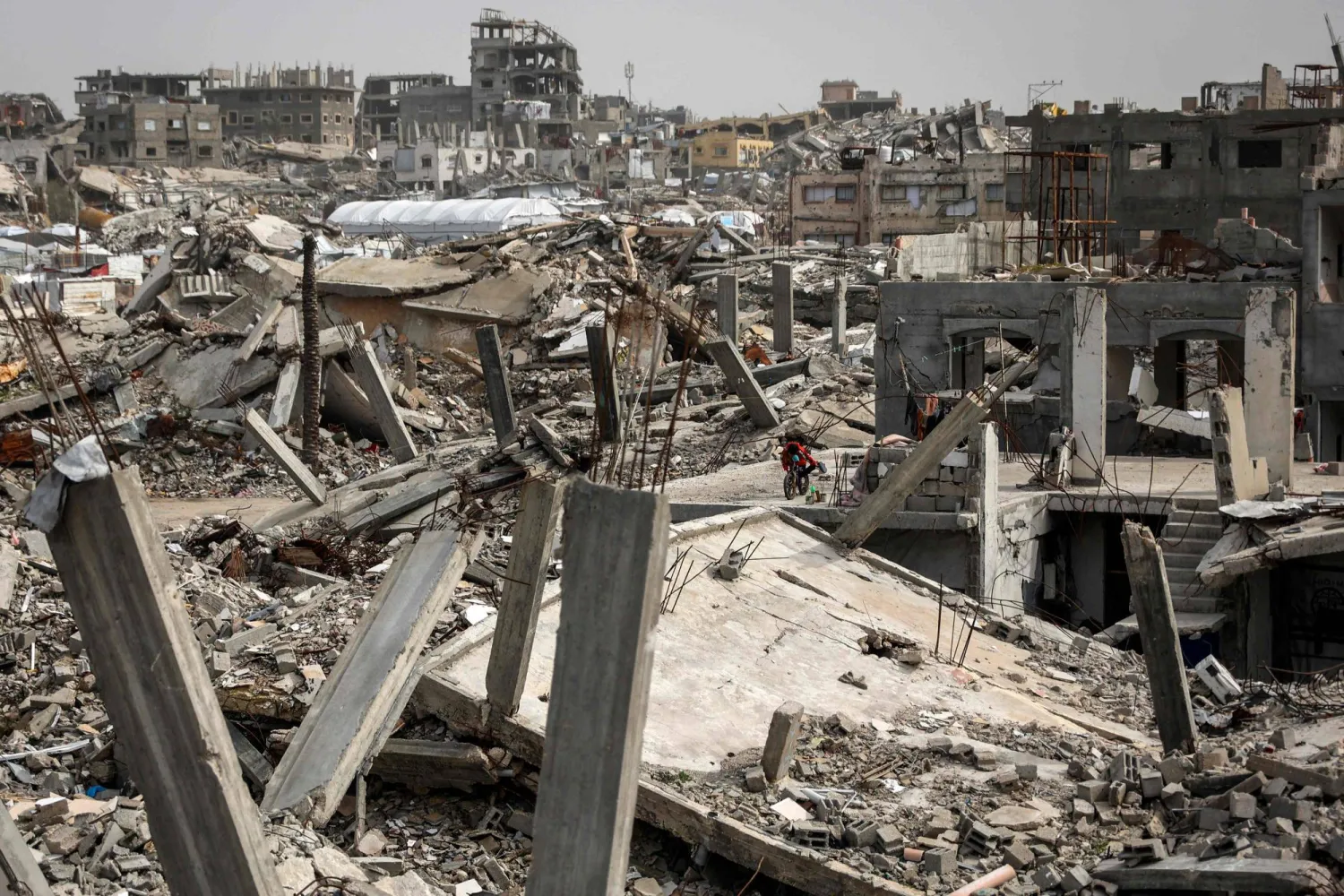
An Israeli drone strike killed two Palestinians on bicycles Tuesday, hospital officials said, marking the latest deaths since an October ceasefire that hasn't halted deadly attacks in the Gaza Strip.

Al-Aqsa Martyrs Hospital said the two men were hit near the ceasefire line that divides Gaza, with one half under Israeli military control. They were hit in eastern Deir al-Balah, the hospital said, adding that it also received the body of a woman who was killed by Israeli gunfire in central Maghazi refugee camp.

Israel's military did not immediately respond to questions about either strike. It has previously said its forces respond to ceasefire violations or attacks on its soldiers.

Gaza's Health Ministry on Tuesday said reported 586 Palestinians had been killed since the start of the ceasefire, bringing the cumulative toll to 72,037 killed since the start of Israel's offensive. The ministry, which is part of the Hamas-led government, maintains detailed casualty records that are seen as generally reliable by UN agencies and independent experts.

Deadly Israeli strikes have repeatedly disrupted the truce since it took effect on Oct. 10. The escalating Palestinian toll has prompted many in Gaza to say it feels like the war has continued unabated.

Yet parts of the agreement outlined in last year’s ceasefire are moving forward. After a chaotic first week, officials say more Palestinians are entering and leaving Gaza for Egypt via the reopened Rafah crossing. Plans for an international peacekeeping force meant to provide security in Gaza are also beginning to take shape.

Indonesia — the world's most populous Muslim-majority country — said Tuesday that its military had begun training personnel to serve in Gaza, specifically for reconstruction and humanitarian response. Its army chief of staff said between 5,000 and 8,000 troops were preparing to deploy.

Vahd Nabyl Achmad Mulachela, a spokesperson for Indonesia’s Foreign Affairs Ministry, said Indonesian troops would not take part in disarmament — one of the most contentious and unresolved elements of the peace plan.

Indonesia’s President Prabowo Subianto told the UN General Assembly in October that his country planned to contribute troops, even as details about the force’s role and mandate was unclear. The commitment came as Prabowo sought closer ties with US President Donald Trump.

Israel and Hamas remain divided over the timeline and scope of Israel’s withdrawal and the demilitarization of the enclave after nearly two decades of Hamas rule.

The temporary International Stabilization Force outlined last year in Trump’s 20-point peace plan — among the key components of the demilitarization effort— is envisioned as a later phase of the plan.

The war began when Hamas-led fighters stormed into southern Israel and killed around 1,200 people, mostly civilians, on Oct. 7, 2023. The 251 hostages taken in the attack were returned to Israel in various ceasefire agreements, with the remains of Israeli police officer Ran Gvili — the final body in Gaza — were found and returned in January, paving the way for the advance of the ceasefire agreement. The war has sparked worldwide protests and brought allegations of genocide that Israel denies.


Syria Joining Anti-ISIS Coalition 'Marks New Chapter' in Global Security, US Envoy Says

A large Syrian flag flutters above Tishreen Park in Damascus, June 4, 2025. (AFP)
TT

Syria Joining Anti-ISIS Coalition 'Marks New Chapter' in Global Security, US Envoy Says

A large Syrian flag flutters above Tishreen Park in Damascus, June 4, 2025. (AFP)

The US-led international coalition to fight the ISIS has welcomed Syria in the fight against the extremists, saying that the priorities include the swift transfer of ISIS detainees to Iraq and third-country repatriation of families linked to ISIS held in two camps in Syria.

The State Department also welcomed a recent ceasefire that ended fighting between Syrian government forces and the US-backed and Kurdish-led Syrian Democratic Forces that were a main force in the fight against ISIS in Syria, The AP news reported.

Representatives from Syria — which officially joined the global coalition against ISIS in November during a historic visit by Syria’s President Ahmad al-Sharaa’s to Washington — attended a meeting on Monday of some officials from the 90-member coalition in Saudi Arabia.

“Regional solutions, shared responsibility. Syria’s participation in the D-ISIS Coalition meeting in Riyadh marks a new chapter in collective security,” Tom Barrack, the US envoy to Syria, said in comments posted on X on Tuesday.

The US military began transferring some of the about 9,000 ISIS detainees held in northeastern Syria last month to secure facilities in Iraq, following clashes between government forces and the SDF.

Monday's State Department statement said coalition members “underscored their readiness to work closely with the Syrian government” and encouraged members to provide direct support to Syrian and Iraqi efforts.

It said that in addition to the transfer of detainees to Iraq, the participants reaffirmed their priorities that include “dignified reintegration” of families from the al-Hol and Roj camps, in northeast Syria, to their communities of origin. Syria's government took over al-Hol in late January.

The camps house more than 25,000 mostly women and children linked to ISIS militants, the vast majority of them from Syria and Iraq. The State Department called on dozens of countries other than Syria and Iraq to repatriate their citizens from al-Hol and Roj camps.

“Officials commended Iraq’s efforts to securely detain ISIS militants” the statement said, adding that they also welcomed Syria’s assumption of responsibility for detention facilities and displacement camps housing ISIS militants and their family members.

The SDF, which controls much of the detention facilities in northeast Syria, will merge into the national army as part of a deal reached with the central government last month.

Part of the deal reached last month, government delegations visited over the past days the Qamishli International Airport in the predominantly Kurdish city of Qamishli as well as some oil fields and the headquarters of a national oil company as SDF members withdraw from some of their positions.

Government forces also entered parts of the northeastern city of al-Hassakeh. In the near future, Syria’s central authorities are supposed to take over border crossings with neighboring Iraq and Türkiye.