Iraq: Election of Ex-military Commander as Governor Stirs Debatehttps://english.aawsat.com/home/article/2007321/iraq-election-ex-military-commander-governor-stirs-debate
Iraq: Election of Ex-military Commander as Governor Stirs Debate
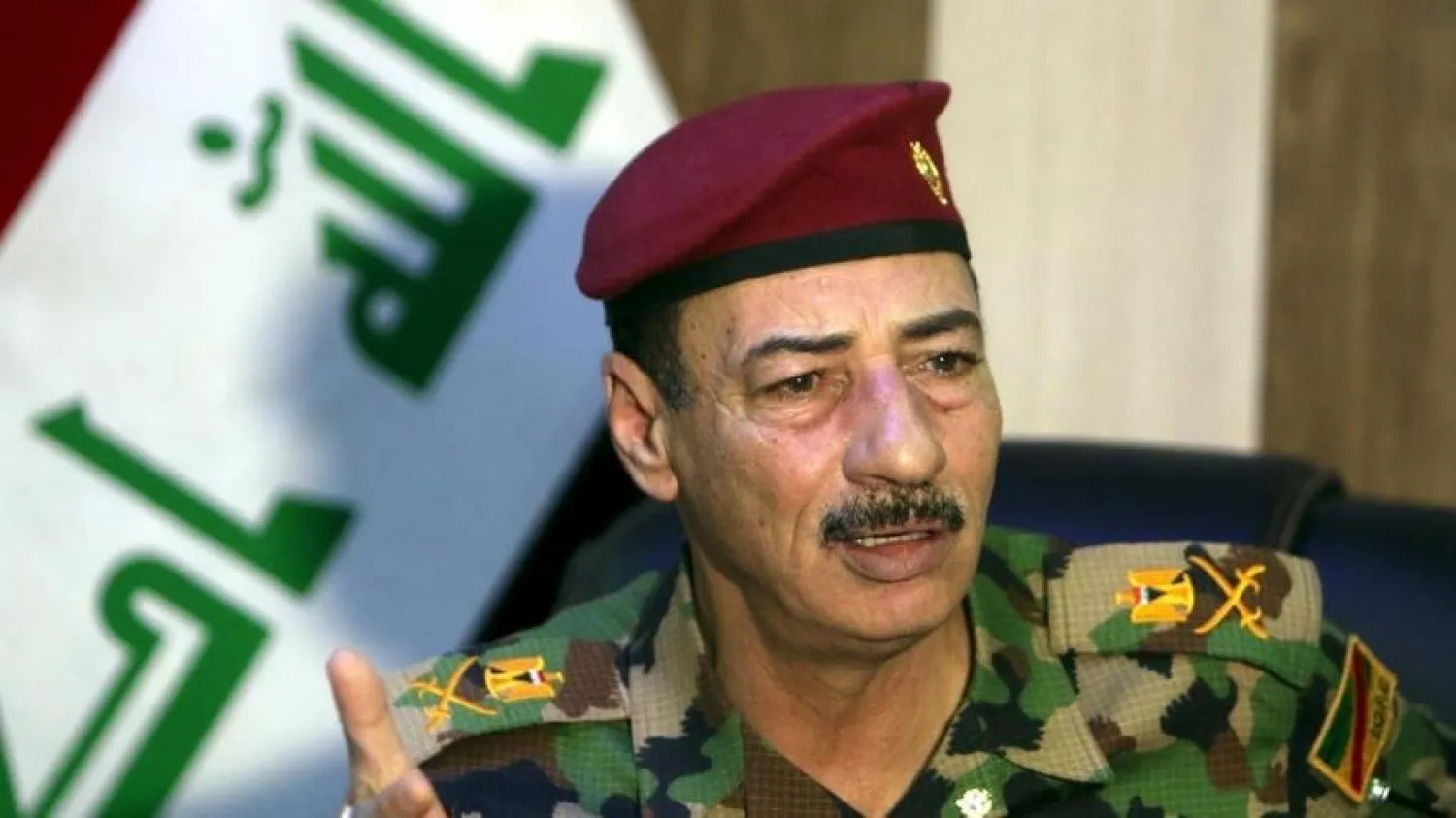
Newly elected Nineveh Governor Lt. Gen. Najm al-Jubouri (nina news agency)
The Nineveh provincial council’s election of Lt. Gen. Najm al-Jubouri as governor to replace Mansour al-Mareed stirred a political and legal dispute in Iraq on Sunday.
“The dismissal of the former governor and the election of a new one are considered two unconstitutional and illegitimate moves,” legal expert Ahmad al-Abadi told Asharq Al-Awsat.
He said that based on Article 7 of the provincial councils law No. 21 of 2008, the election of a new governor is not valid if all legal measures are not completed, including an appeal against decisions issued by the provincial councils before the Cassation Chamber within 30 days.
In light of this law, the dismissed or resigned governor stays in office until a decision is issued by the administrative judiciary, in addition to a presidential decree on his dismissal and the appointment of a new governor, the expert said.
“Therefore, the election of a new governor is considered invalid because the mandate of the current provincial council has expired,” Abadi said.
However, MP Mohammed al-Karbouli defended the election and said it was consistent with the laws of provincial councils valid until March 2020.
“We support the election of Jubouri and we wish him luck in managing the governorate, which needs a lot of work to return to normalcy,” the deputy said.
On Sunday, Jubouri was elected by 22 out of 39 council member votes.
The new governor was a former major general in the Iraqi security forces and a former commander of the Nineveh Operations in the past few years.
Following his election, Mareed rejected the decision of the provincial council, describing it as illegitimate. "I will continue to carry out my duties as governor," he affirmed.
Syria's interim president Ahmad al-Sharaa attends a meeting with his foreign minister and the leader of the Kurdish-led Syrian Democratic Forces (SDF), at the People's Palace in Damascus on August 25, 2026. (AFP)
TT
TT
Russia’s Putin and Syria’s Sharaa Discussed Deepening Ties, Kremlin Says
Syria's interim president Ahmad al-Sharaa attends a meeting with his foreign minister and the leader of the Kurdish-led Syrian Democratic Forces (SDF), at the People's Palace in Damascus on August 25, 2026. (AFP)
Russian President Vladimir Putin and Syrian President Ahmad al- Sharaa on Wednesday spoke by phone and discussed deepening political dialogue and cooperation in trade and other areas, the Kremlin said.
It said in a statement that the two leaders had noted the importance of an August 9 memorandum of understanding to settle the future of Russia's bases at Tartous and Hmeimim after 18 months of negotiations.
Khaddam: Syria’s $12 Billion Reserve Was Registered Under Hafez Al-Assad's Namehttps://english.aawsat.com/arab-world/5311252-khaddam-syria%E2%80%99s-12-billion-reserve-was-registered-under-hafez-al-assads-name
Khaddam: Syria’s $12 Billion Reserve Was Registered Under Hafez Al-Assad's Name
Late Syrian President Hafez al-Assad during a visit to Moscow in 1999. (AFP)
Former Syrian Vice President Abdul Halim Khaddam’s recent memoirs revealed sensitive information about wealth and power in the country, notably that the Syrian state reserve, which according to the late official amounted to twelve billion dollars at the time, was registered under the name of late President Hafez al-Assad, rather than state institutions.
The memoirs, edited and introduced by Ibrahim Hamidi, are due to be published in early September by Raff Publishing, a subsidiary of the Saudi Research and Media Group (SRMG).
"No one imagined that an amount of this magnitude would be placed under the personal name of the head of state, given that it belongs to the Syrian state, not him," Khaddam wrote.
The memoirs are due to be published in early September by Raff Publishing, a subsidiary of the Saudi Research and Media Group (SRMG).
According to Khaddam, the issue did not remain a mere formality, but turned into an internal crisis when the president received a document indicating that a sum of money had been withdrawn from the account registered in his name abroad.
Assad found the issue strange and requested the transfer document from the bank. Days later, a copy of the request arrived, and upon reviewing the signature, it turned out to be forged.
When the bank was questioned about the recipient of the transferred amount, $65 million, it was revealed to belong to Prime Minister Mahmoud Al-Zoubi.
Khaddam recalled that Assad was infuriated and ordered a security chief to summon Al-Zoubi, warning him to return the money or face execution. The funds were returned to the bank.
Al-Zoubi remained prime minister from November 1987 until March 2000, marking the longest premiership since the Syrian state’s establishment in 1918.
Khaddam painted a harsh picture of the man who "not only into facilitated corruption, but also practiced it."
Hafez al-Assad and late Prime Minister Mahmoud Al-Zoubi. (AFP)
He recounted how he built his network of trust upward toward the office of Bassel al-Assad and Mohammad Makhlouf, while Khaddam himself had been overseeing the corruption file with Hafez al-Assad since 1989.
Khaddam recalled how Al-Zoubi's political career came to an end. In mid-May 2000, Assad, who was showing "signs of death," invited a number of members of the ruling Baath Party leadership to his home and told them: "Mahmoud Al-Zoubi has betrayed me. Investigate him and hold him accountable." Assad did not disclose more details.
Al-Zoubi was expelled from the party and a decision was made to refer him for investigation. Upon being informed of the decision, he repeatedly asked: "What did I do?"
He warned Khaddam: "If they call me for investigation, I will commit suicide."
On May 24, 2000, when the Damascus police chief and two officers arrived to escort him to interrogation, Al-Zoubi went up to the second floor of his house and shot himself in the head.
Khaddam wrote that he learned about the forgery incident and the reserve "shortly after" the suicide.
Hafez al-Assad with Vice President Abdul Halim Khaddam to his left in 1999. (Getty)
The memoirs include other incidents related to Al-Zoubi's tenure, most notably a contract to purchase Airbus aircraft in the early 1990s: a committee headed by the PM, a transport minister who was excluded from the deal after contacting the French company "to obtain a commission," and a contract approved by the government despite objections "after Al-Zoubi insinuated that the President had approved it."
Khaddam noted that a few days after Al-Zoubi's suicide, Deputy Prime Minister Salim Yasin and Minister of Transport Mufid Abdel Karim, both of whom had objected to the contract, were "unjustly" arrested and sentenced to 15 years in prison alongside a fine exceeding the total value of the aircraft.
He also recalled that an economic reform study prepared by experts commissioned by late Lebanese Prime Minister Rafik al-Hariri, with Assad’s approval, and costing three million dollars, "was read by no one other than myself among the members of the government and leadership."
Independent verification of the referenced banking documents was not possible and the account remains the sole responsibility of its author. The details of the incident and corruption files appear in the book's chapter titled "The Suicide of Mahmoud Al-Zoubi."
Israeli Officials Fuel Tensions in West Bank ahead of October Electionshttps://english.aawsat.com/arab-world/5311232-israeli-officials-fuel-tensions-west-bank-ahead-october-elections
Israeli forces detain a Palestinian man during a raid on the UNRWA Vocational Training Center, located between the Kafr Aqab neighborhood and the Qalandiya refugee camp, south of the West Bank city of Ramallah, on August 25, 2026. (AFP)
Israeli Officials Fuel Tensions in West Bank ahead of October Elections
Israeli forces detain a Palestinian man during a raid on the UNRWA Vocational Training Center, located between the Kafr Aqab neighborhood and the Qalandiya refugee camp, south of the West Bank city of Ramallah, on August 25, 2026. (AFP)
Israeli politicians are increasingly turning to the West Bank as a stage for electoral maneuvering amid fierce competition two months before elections scheduled for October.
As the campaign heats up and the government loses ground in opinion polls, far-right National Security Minister Itamar Ben-Gvir entered a UN Relief and Works Agency for Palestine Refugees (UNRWA) compound in Qalandiya, between Jerusalem and Ramallah, accompanied by Israeli forces and media, and declared that Israel had “taken control” of the site.
At the same time, Religious Zionism lawmaker Zvi Sukkot entered the village of Madama near Nablus under military protection and began demolishing a memorial to Palestinian fighters.
Ben-Gvir arrived at the UNRWA compound with Israeli police and coverage from the right-wing Channel 14, declaring that he was “making history.”
He later posted a photograph of an Israeli flag raised over the site with the caption, “UNRWA is in our hands.”
UNRWA condemned the “unauthorized and deeply disturbing incursion” into its Qalandiya Training Center.
The Palestinian Authority, Palestinian factions and institutions also denounced the raid, while the Palestinian presidency called on the UN Security Council to convene urgently and take binding measures to halt Israeli actions against UN facilities in Jerusalem and Qalandiya.
Israel closed UNRWA’s headquarters in East Jerusalem’s Sheikh Jarrah neighborhood in early 2025 over its alleged ties to Hamas and later announced its seizure after the Knesset voted to ban the agency from operating in Israel.
The Qalandiya center, whose employees were expelled before the takeover, provides free vocational training in 16 fields to Palestinian refugee students. The 80-dunam site was provided to the UN by Jordan in 1952.
In Madama, Sukkot said he had personally come to demolish the memorial after the Israeli military failed to act on his request to remove such monuments across the West Bank.
Video showing Sukkot tearing down the structure as Israeli soldiers looked on sparked an uproar and sharp criticism of both the lawmaker and the military.
The Israeli military accused Sukkot of “manipulation and deception,” acting without authority and violating agreed arrangements. It said troops eventually halted the demolition.
Prime Minister Benjamin Netanyahu backed Ben-Gvir, saying the minister had acted on his instructions and that further measures would be taken against UNRWA. He did not, however, endorse Sukkot’s actions.
“The army is the sovereign authority in Judea and Samaria,” Netanyahu said, using Israel’s term for the West Bank. “Taking the law into one’s own hands, particularly by public figures, is unacceptable.”
Foreign Minister Gideon Saar similarly stressed that Sukkot “is not the sovereign” in the West Bank.
Opposition leaders sharply condemned the incident. Democrats leader Yair Golan accused Sukkot of trying to ignite another war, while Naftali Bennett, leader of the Together party, accused the government of damaging Israel’s security and international standing “for TikTok views.” Yashar party leader Gadi Eisenkot called Sukkot’s conduct “disgraceful.”
Senior military officials told Maariv that Ben-Gvir and Sukkot were seeking to inflame tensions and trigger a third intifada ahead of the elections.
Security officials issued a similar warning Tuesday, telling Israel’s Kan public broadcaster that the West Bank was close to erupting, accusing political figures of deliberately aggravating tensions.
“It is an arena that could explode at any moment,” a security source said. “Instead of calming it, ministers and Knesset members are making matters worse.”
لم تشترك بعد
انشئ حساباً خاصاً بك لتحصل على أخبار مخصصة لك ولتتمتع بخاصية حفظ المقالات وتتلقى نشراتنا البريدية المتنوعة