


UN Council Tries to Agree on COVID-19 Truce Amid New Resolution

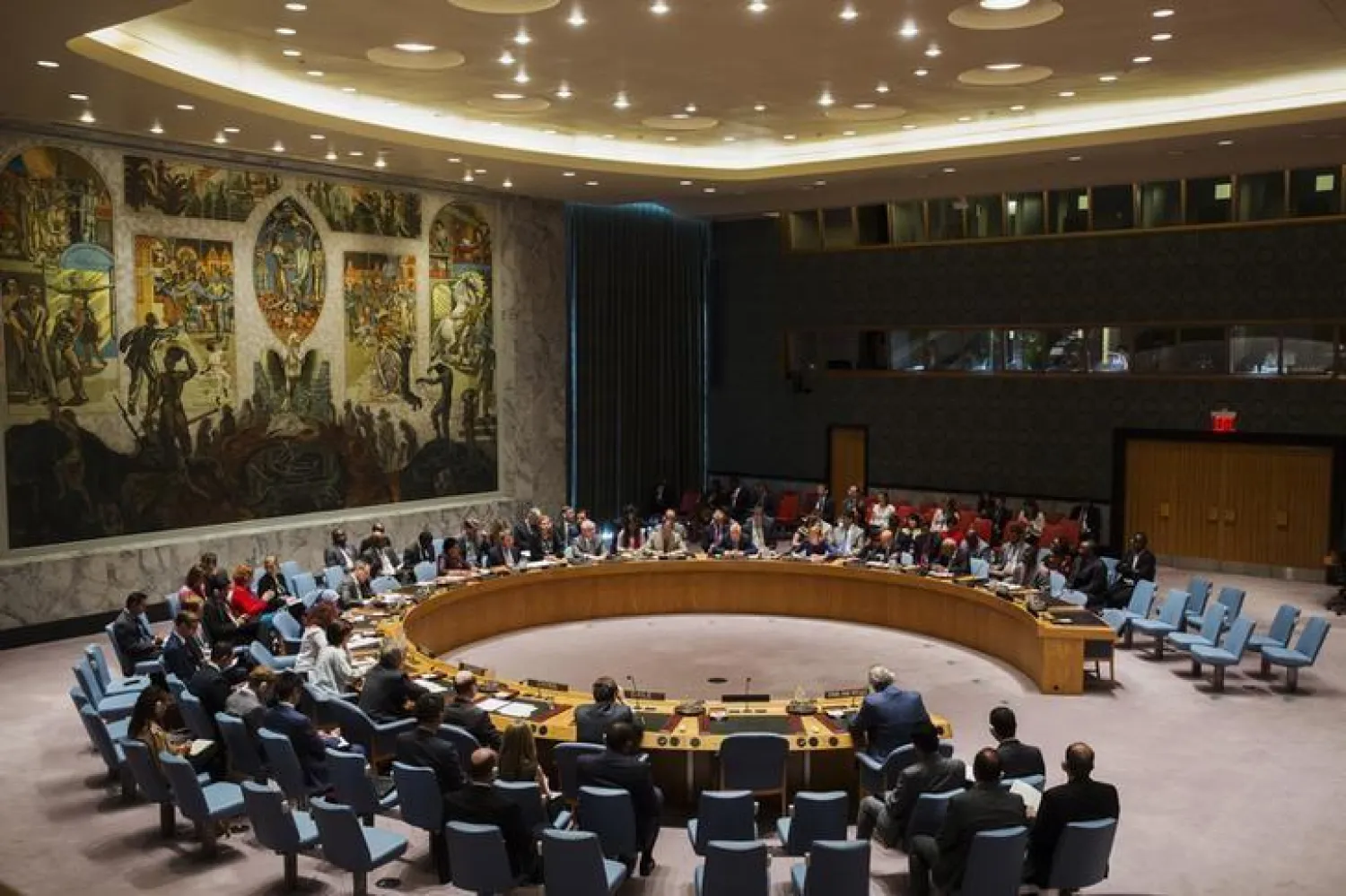
Members of the United Nations Security Council address a resolution to investigate the use of chemical weapons in Syria during a meeting at the UN headquarters in New York August 7, 2015. REUTERS/Lucas Jackson
TT

UN Council Tries to Agree on COVID-19 Truce Amid New Resolution

Members of the United Nations Security Council address a resolution to investigate the use of chemical weapons in Syria during a meeting at the UN headquarters in New York August 7, 2015. REUTERS/Lucas Jackson

A new resolution has been submitted to the UN Security Council on a ceasefire in various conflicts around the world during the coronavirus pandemic, to replace one drafted by France and Tunisia that the United States has blocked.

Encompassing five major points -- compared to the previous draft's nine -- the proposal by the two non-permanent members of the Security Council and seen by AFP "demands a general and immediate cessation of hostilities in all situations on its agenda."

Such a move is intended to help some 20 countries in crisis or at war - from Syria and Yemen to Libya, South Sudan and Congo - battle the coronavirus, but it is unclear if concrete steps on the ground have been taking.

The resolution submitted by Germany and Estonia on Tuesday borrows from the French-Tunisian proposal, using language agreed upon by the 15 Council members during negotiations that have been ongoing since March or that had been used in previous resolutions, such as making ceasefire exceptions to battle militant groups.

As in the French-Tunisian resolution, the new proposal calls for a "humanitarian pause for at least 90 consecutive days" in order to allow for the delivery of aid to the hardest-hit communities.

A date has not yet been set for the vote, but it could happen quickly if none of the five permanent Council members threatens to use its veto, as when Washington criticized the mention of the World Health Organization (WHO) in the French-Tunisian resolution.

The German-Estonian text makes no mention of the WHO, so the uncertainty resides with China, which until the last minute insisted on a reference to the UN health group, even an implicit one.

The new resolution was proposed Tuesday during a teleconference held behind closed doors and organized by Estonia, which holds the rotating presidency of the Security Council.

One of the diplomats, speaking on condition of anonymity, said China declared in the meeting that it backed swift action in the Council.

But the Council is trying again to reach agreement on the first resolution.

The 15 Council ambassadors discussed how to proceed in closed consultations and afterward Russia’s UN Ambassador Vassily Nebenzia said “all Council members are willing to come to a final agreement.”

“I would assure you that the willingness to mend bridges is there, and we will attempt it in the nearest times,” he told a video news conference. “We have to respect the differences that we nearly managed to bridge, but still have not arrived there yet.”

Nebenzia said there was agreement on almost all the rest of the resolution.

Tunisia’s UN Ambassador Kais Kabtani said after the meeting that “Tunisian authorities are conducting at this moment intensive consultations at the highest political level” to resolve the differences.

He said new compromises with be presented by Tunisia and France “very soon” in hopes of reaching consensus.



Top Trump Iran Negotiator Says Visits US Aircraft Carrier in Middle East

US Special Envoy Steve Witkoff delivers a press conference upon the signing of the declaration on deploying post-ceasefire force in Ukraine, during the so-called "Coalition of the Willing" summit, at the Elysee Palace in Paris, France, January 6, 2026. (Reuters)
TT

Top Trump Iran Negotiator Says Visits US Aircraft Carrier in Middle East

US Special Envoy Steve Witkoff delivers a press conference upon the signing of the declaration on deploying post-ceasefire force in Ukraine, during the so-called "Coalition of the Willing" summit, at the Elysee Palace in Paris, France, January 6, 2026. (Reuters)

US President Donald Trump's lead Iran negotiator Steve Witkoff on Saturday said he visited the USS Abraham Lincoln aircraft carrier currently in the Arabian Sea, with Washington and Tehran due to hold further talks soon.

"Today, Adm. Brad Cooper, Commander of US Naval Forces Central Command, Jared Kushner, and I met with the brave sailors and Marines aboard the USS Abraham Lincoln, her strike group, and Carrier Air Wing 9 who are keeping us safe and upholding President Trump's message of peace through strength," said Witkoff in a social media post.

Iranian Foreign Minister Abbas Araghchi said on Saturday he hoped talks with the United States would resume soon, while reiterating Tehran's red lines and warning against any American attack.


Israel’s Netanyahu Expected to Meet Trump in US on Wednesday and Discuss Iran

Israeli Prime Minister Benjamin Netanyahu delivers a speech during a special session to mark the 77th anniversary of the Knesset's establishment and the 60th anniversary of the dedication of the current building at the Knesset, the Israeli parliament, in Jerusalem, 02 February 2026. (EPA)
TT

Israel’s Netanyahu Expected to Meet Trump in US on Wednesday and Discuss Iran

Israeli Prime Minister Benjamin Netanyahu delivers a speech during a special session to mark the 77th anniversary of the Knesset's establishment and the 60th anniversary of the dedication of the current building at the Knesset, the Israeli parliament, in Jerusalem, 02 February 2026. (EPA)

Israeli Prime Minister Benjamin Netanyahu is expected to meet US President Donald Trump on Wednesday in Washington, where they will discuss negotiations with Iran, Netanyahu's office said on Saturday.

Iranian and US officials held indirect nuclear ‌talks in the ‌Omani capital ‌Muscat ⁠on Friday. ‌Both sides said more talks were expected to be held again soon.

A regional diplomat briefed by Tehran on the talks told Reuters Iran insisted ⁠on its "right to enrich uranium" ‌during the negotiations with ‍the US, ‍and that Tehran's missile capabilities ‍were not raised in the discussions.

Iranian officials have ruled out putting Iran's missiles - one of the largest such arsenals in the region - up ⁠for discussion, and have said Tehran wants recognition of its right to enrich uranium.

"The Prime Minister believes that any negotiations must include limiting ballistic missiles and halting support for the Iranian axis," Netanyahu's office said in a ‌statement.


Italy FM Rules Out Joining Trump’s ‘Board of Peace’

Italy's Minister for Foreign Affairs Antonio Tajani speaks to the press during the EPP Leaders’ meeting, in Zagreb, Croatia, 30 January 2026. (EPA)
TT

Italy FM Rules Out Joining Trump’s ‘Board of Peace’

Italy's Minister for Foreign Affairs Antonio Tajani speaks to the press during the EPP Leaders’ meeting, in Zagreb, Croatia, 30 January 2026. (EPA)

Italy will not take part in US President Donald Trump's "Board of Peace", Italian Foreign Minister Antonio Tajani said Saturday, citing "insurmountable" constitutional issues.

Trump launched his "Board of Peace" at the World Economic Forum in Davos in January and some 19 countries have signed its founding charter.

But Italy's constitution bars the country from joining an organization led by a single foreign leader.

Prime Minister Giorgia Meloni, a Trump ally, last month noted "constitutional problems" with joining, but suggested Trump could perhaps reopen the framework "to meet the needs not only of Italy, but also of other European countries".

Tajani appeared Saturday to rule that out.

"We cannot participate in the Board of Peace because there is a constitutional limit," he told the ANSA news agency.

"This is insurmountable from a legal standpoint," he said, the day after meeting US Secretary of State Marco Rubio and US Vice President JD Vance at the Olympics in Milan.

Although originally meant to oversee Gaza's rebuilding, the board's charter does not limit its role to the Palestinian territory and appears to want to rival the United Nations.