


Plan to Bring back Suez Canal Statue Stirs Debate in Egypt

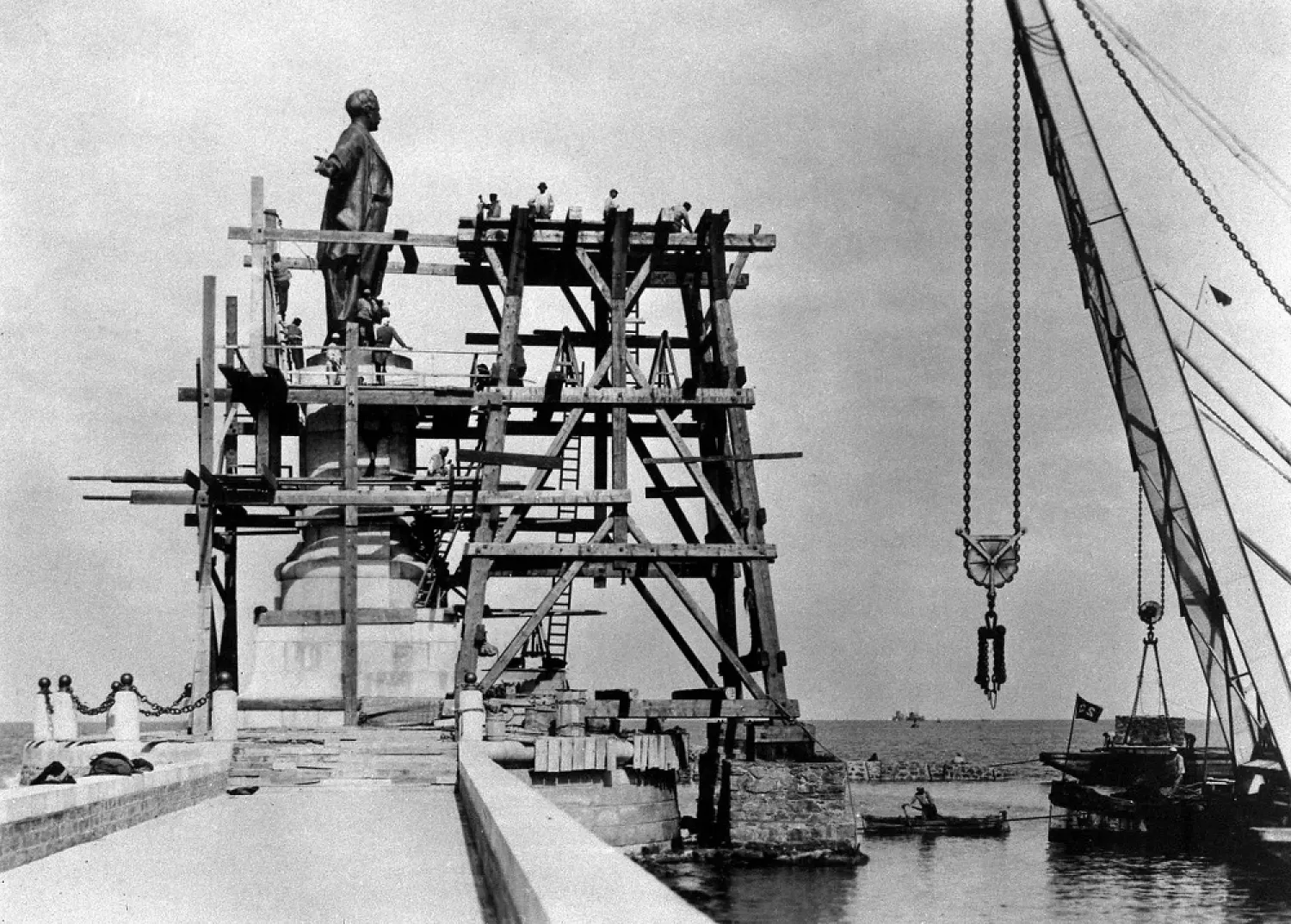
The statue of Ferdinand de Lesseps seen at the entrance of the Suez Canal in 1899. (AFP)
TT

Plan to Bring back Suez Canal Statue Stirs Debate in Egypt

The statue of Ferdinand de Lesseps seen at the entrance of the Suez Canal in 1899. (AFP)

A proposal to bring back the statue of a French diplomat behind the idea to build the Suez Canal has stirred controversy in Egypt, with many saying it would be a salute to colonial times and a “humiliation” to the memory of tens of thousands of Egyptian laborers who died building the waterway in the 1860s.

The debate started when the daily el-Shorouk reported last month that local authorities in the Mediterranean province of Port Said were thinking of returning the statue of Ferdinand de Lesseps to where it once stood, at the northern entrance of the canal.

De Lesseps, who came to Cairo in 1833 as a consul and was later posted to Alexandria, had been inspired by the idea of joining the Red Sea and the Mediterranean. He persuaded the Ottoman governor of Egypt to build the canal and in 1859, he symbolically swung a pickax to launch the construction, which took 10 years. The canal was officially opened on Nov. 17, 1869.

A 33-foot bronze statue of de Lesseps by French sculptor Emmanuel Frémiet, was erected in Nov. 1899 at Port Said, showing the diplomat with his right hand extended to welcome visitors entering the Suez Canal, his left holding a map of the canal.

The statue was destroyed by Egyptian fighters amid the 1956 Middle East War, when Israeli forces pushed into Egypt toward the Suez Canal after Egyptian President Gamal Abdel Nasser nationalized the canal. It was later restored by the Paris-based Association des Amis du Canal de Suez, and is now housed in a shipyard in Port Fouad. The Egyptian government registered the statue as an artifact in 2019.

The el-Shorouk report said that along with the return of the de Lesseps statue, another statue would be erected next to it, showing an Egyptian farmer, symbolizing the workers who had dug the canal.

A local official in Port Said, speaking on condition of anonymity because he was not authorized to talk to reporters, told The Associated Press that no decision has yet been made and that more “public debate" is needed before the statue can be returned.

Lawmaker Mustafa Bakry on Monday condemned the proposal. Abdallah el-Senawy, a columnist for el-Shorouk, said the deaths of forced laborers during the canal's construction was a “racist crime that requires accountability, condemnation, and an apology."

Hundreds of thousands of Egyptian peasants were drafted into low-wage digging work with hand tools and tens of thousands died before the practice was banned and steam-powered excavators took their place.

In 1956, Nasser nationalized the canal from the British and French companies that owned it, a moment cherished by Egyptians as a defiant break from imperialist control. Britain, France and Israel invaded in response, but were ordered to withdraw by the United States and the Soviet Union, in what was seen across the Arab world as a defining victory for Nasser and Arab nationalism.

Around 10% of the world’s trade flows through the waterway, which is one of Egypt’s top foreign currency earners. In 2015, the government of President Abdel Fattah al-Sisi completed a major expansion of the canal, allowing it to accommodate the world’s largest vessels.



Benefit of Taking Magnesium Does Not Get Enough Attention

Nutrition experts recommended trying to get more of magnesium in our diet from food first (Harvard University)
TT

Benefit of Taking Magnesium Does Not Get Enough Attention

Nutrition experts recommended trying to get more of magnesium in our diet from food first (Harvard University)

Nutrition experts revealed that magnesium is often not given the same attention as other vitamins and minerals, although it plays a pivotal role in supporting the overall health of our body, especially improving blood sugar management and supporting neuro-psychological balance.

According to the US National Institutes of Health (NIH), magnesium is an abundant mineral in our body and it’s naturally present in many foods.

The mineral is required in more than 300 different reactions in our body, including those that regulate muscle and nerve function, blood sugar levels, and blood pressure.

“Magnesium plays a role in how our body handles sugar,” Scott Keatley, RD, co-owner of Keatley Medical Nutrition Therapy told Prevention magazine.

“It helps with the action of insulin, the hormone that controls blood sugar levels.” When you have enough magnesium in your body, insulin can work better and your body can manage blood sugar more effectively, Keatley said.

Also, stress can cause our body to use more magnesium than usual, which can limit our body’s ability to do other tasks with the nutrient, Keatley said.

“In addition, magnesium can help reduce the release of stress hormones like cortisol,” he said. “It’s like a natural chill pill that can help keep our body’s stress response in check.”

Magnesium helps regulate brain function and mood. It plays a role in releasing and using neurotransmitters, which are chemicals in our brain that affect our mood and emotions.

The mineral may help improve bone density and decrease fracture risk.
“Magnesium is stored in bones and is an important part of bone health,” said Deborah Cohen, DCN, an associate professor in the department of clinical and preventive nutrition sciences at Rutgers University School of Health Professions.

At baseline, magnesium can help to relax and widen your blood vessels, Keatley said. “This makes it easier for blood to flow and can help lower blood pressure,” he added. “It’s like making the highways wider so that traffic can move more smoothly.”

A 2025 review in hypertension found that magnesium seems to be beneficial for lowering blood pressure in people with high blood pressure and magnesium deficiency, but larger studies are needed.

There are a lot of foods that are high in magnesium. Nutrition experts recommended trying to get more of the nutrient in our diet from food first.

These are the most magnesium-rich foods, according to the NIH are: Pumpkin seeds, Chia seeds, almonds, spinach, cashews, peanuts, shredded wheat, soymilk, black beans, edamame, peanut butter, potato with skin, brown rice and plain yogurt.


SpaceX Prioritizes Lunar 'Self-growing City' over Mars Project

FILE - A SpaceX logo is displayed on a building, May 26, 2020, at the Kennedy Space Center in Cape Canaveral, Fla. (AP Photo/David J. Phillip, File)
TT

SpaceX Prioritizes Lunar 'Self-growing City' over Mars Project

FILE - A SpaceX logo is displayed on a building, May 26, 2020, at the Kennedy Space Center in Cape Canaveral, Fla. (AP Photo/David J. Phillip, File)

Elon Musk said on Sunday that SpaceX has shifted its focus to building a "self-growing city" on the moon, which could be achieved in less than 10 years.

SpaceX still intends to start on Musk's long-held ambition of a city on Mars within five to seven years, he wrote on his X social media platform, "but the overriding priority is securing the future of civilization and the Moon is faster."

Musk's comments echo a Wall Street Journal report on Friday, stating that SpaceX has told investors it would prioritize going to the moon and attempt a trip to Mars ⁠at a later time, targeting March 2027 for an uncrewed lunar landing.

As recently as last year, Musk said that he aimed to send an uncrewed mission to Mars by the end of 2026.

The US faces intense competition from China in the race to return humans to the moon this decade. Humans have not visited the lunar surface since the Apollo 17 mission in 1972. Less than a week ago, Musk announced that SpaceX ⁠acquired the artificial intelligence company he also leads, xAI, in a deal that values the rocket and satellite company at $1 trillion and the artificial intelligence outfit at $250 billion.

Proponents of the move view it as a way for SpaceX to bolster its plans for space-based data centers, which Musk sees as more energy efficient than terrestrial facilities as the demand for compute power soars with AI development.

SpaceX is hoping a public offering later this year could raise as much as $50 billion, which could make it the largest public offering in history.

On Monday, Musk said in response to a user on X that NASA will constitute less than 5% of SpaceX's revenue this year. SpaceX is ⁠a core contractor in NASA's Artemis moon program with a $4 billion contract to land astronauts on the lunar surface using Starship.

"Vast majority of SpaceX revenue is the commercial Starlink system," Musk added.

Earlier on Sunday, Musk shared the company's first Super Bowl ad, promoting its Starlink Wi-Fi service.

Even as Musk reorients SpaceX, he is also pushing his publicly traded company, Tesla, in a new direction.

After virtually building the global electric vehicles market, Tesla is now planning to spend $20 billion this year as part of an effort to pivot to autonomous driving and robots.

To speed up the shift, Musk said last month Tesla is ending production of two car models at its California factory to make room for manufacturing its Optimus humanoid robots.


Saudi Arabia Participates in Drafting the International AI Safety Report 2026

General view of Riyadh, Saudi Arabia. (SPA)
TT

Saudi Arabia Participates in Drafting the International AI Safety Report 2026

General view of Riyadh, Saudi Arabia. (SPA)

The Kingdom of Saudi Arabia, represented by the Saudi Data and Artificial Intelligence Authority (SDAIA), participated for the second consecutive year in the preparation of the International AI Safety Report 2026, reinforcing its international efforts to advance AI safety and support responsible innovation worldwide, the Saudi Press Agency said on Monday.

The report, emerging from the 2023 AI Safety Summit at Bletchley Park, provides a scientific assessment of advances in advanced AI systems, examines associated risks, and outlines practical approaches to strengthening safety standards and global governance, serving as a key reference for policymakers, regulators, and researchers.

The report is a comprehensive global document assessing AI risks and related challenges and serves as a trusted scientific reference to support regulatory policies and the development of governance frameworks for the safe and responsible use of advanced technologies.

The report was developed by a distinguished group of international scientists and experts in AI safety and technology governance, featuring specialists from prestigious universities and research centers, as well as representatives from over 30 countries and major international organizations, including the United Nations, the Organization for Economic Co-operation and Development, and the European Union.

The report highlights several key messages, notably the importance of keeping pace with the rapidly growing capabilities of AI through advanced regulatory and scientific frameworks, the need to invest in safety and technical compliance research to ensure systems remain under effective human oversight, and the promotion of international coordination to establish common standards supporting the safe and responsible use of advanced technologies.

It also emphasizes the need to consider economic and social dimensions to ensure the fair distribution of AI benefits and reduce inequality gaps.

Saudi Arabia’s participation in this international effort aligns with the objectives of Saudi Vision 2030, which aims to establish the Kingdom as a global hub for technological innovation while upholding the highest standards of responsibility and technical security.

It reflects the Kingdom’s commitment to actively shaping the global future of AI, promoting sustainable development, safeguarding community security, and enhancing international cooperation toward a safer, more stable technological future.