


Financier Joseph Safra, Brazil's Richest Man, Dies at 82

Lebanese-Brazilian financier Joseph Safra. (AP)
TT

Financier Joseph Safra, Brazil's Richest Man, Dies at 82

Lebanese-Brazilian financier Joseph Safra. (AP)

Lebanese-Brazilian financier Joseph Safra, who built a banking empire spanning from Brazil to Switzerland and a fortune that made him the world’s wealthiest banker, has died at the age of 82, Banco Safra said.

Safra helped run and expand his family’s commercial and private-banking realm, catering to an affluent clientele from São Paulo to New York and Monte Carlo. He died of natural causes, according to a statement issued by the bank.

Safra was credited with making Banco Safra Brazil’s eighth largest bank by assets. The Swiss private banking arm of his group acquired Switzerland’s Bank Sarasin & Co in 2011, later rebaptized J. Safra Sarasin.

The Safras stood out among a number of Brazilian families whose businesses grew transnational, yet remained loyal to their ethnic roots. While banking was the axis of his activities, Safra also sought to diversify his wealth by investing in paper and pulp, global real estate, telecoms and cattle ranching.

The Safra Group also has a stake in banana producer Chiquita Brands International and real estate assets such as London’s 30 St. Mary Axe, often known as “The Gherkin.”

Safra, who arrived in Brazil as a teenager nearly 70 years ago from Beirut with his father Jacob and brothers Edmond and Moise to set up a trade financing shop, ranks as the world’s wealthiest banker, with an estimated fortune of $19.9 billion, according to Forbes Magazine.

His family’s roots in banking date back five generations. Joseph Safra’s predecessors banked the Ottoman Empire’s caravan trade between the Syrian city of Aleppo, Alexandria in Egypt and Constantinople in Turkey.

Privacy
Safra seldom granted interviews, saying he avoided speaking Portuguese in public for fear of “being misunderstood.” However, his efforts to keep a low profile were punctuated by ruthless boardroom battles, even with members of his own family.

A fluent speaker of Arabic, English and four other languages, he reportedly paid $2.5 billion for Moise’s 50% stake in Banco Safra in 2006, putting an end to years of disputes over the direction of the bank.

The Safras were also known in Brazil for their obsession with personal security. Edmond, Joseph’s older brother and one of the most prominent private bankers of the past century, died in 1999 in an arson attack on his Monte Carlo penthouse that shocked the banking world.

Joseph and Moise jointly funded the construction of the largest synagogue in Brazil, an ornate structure serving Sao Paulo’s Sephardic Jews, and the restoration of the country’s first synagogue, in the northeastern city of Recife.

Joseph Safra is survived by his wife Vicky and his four children.

One of his sons, Alberto, left Banco Safra about a year ago to found his own bank after a disagreement with his brother David about who would oversee a digital bank that would mark Safra’s debut in mass retail banking. That left David Safra in charge.

Earlier this year, Alberto launched ASA Bank, mainly focused on asset management.

Joseph’s son Jacob oversees the Safra units outside Brazil, including J. Safra Sarasin. Safra also has a daughter, Esther, who is not involved in the family’s businesses.



Iran Reviewing US Proposal as Trump Pressures Tehran for Agreement on Deal to End War

US and Iran flags are seen in this illustration taken June 18, 2025. REUTERS/Dado Ruvic/Illustration/File Photo
TT

Iran Reviewing US Proposal as Trump Pressures Tehran for Agreement on Deal to End War

US and Iran flags are seen in this illustration taken June 18, 2025. REUTERS/Dado Ruvic/Illustration/File Photo

Iran said it was reviewing the latest American proposals to end the war after US President Donald Trump threatened the country with a new wave of bombing unless a deal is reached that includes reopening the crucial Strait of Hormuz to international shipping.

Hope that the two-month conflict could soon be over buoyed international markets Thursday, a day after the US military fired on an Iranian oil tanker attempting to breach the American blockade of Iran’s ports. The developments followed days of mixed messages from the Trump administration over its strategy to end the war, according to The AP news.

Meanwhile, US Secretary of State Marco Rubio discussed peace efforts in the Middle East at the Vatican. Rubio met with Pope Leo XIV, whose opposition to the Iran war has led to open sparring with Trump.

Trump posted on social media Wednesday that ending the war and resuming oil and natural gas shipments disrupted by the conflict depends on Iran accepting an agreement, which he did not detail.

“If they don’t agree, the bombing starts,” Trump wrote.

A fragile ceasefire between the US and Iran has largely held since April 8. But in-person talks between the two countries hosted by Pakistan last month failed to reach an agreement. The war began Feb. 28, when the US and Israel launched strikes against Iran.

Pakistan says it expects a deal soon “We expect an agreement sooner rather than later,” Pakistani Foreign Ministry spokesperson Tahir Andrabi said Thursday.

“We hope the parties will reach a peaceful and sustainable solution that will contribute not only to peace in our region but to international peace as well.” But he declined to give a timeline, saying Pakistan would not disclose details of the ongoing diplomatic efforts.

Asked whether Pakistan was expecting any response from Iran later Thursday, Andrabi said: “I will not comment on specifics or the movement of the messages.”

Pakistani Prime Minister Shehbaz Sharif, speaking in televised remarks, said Islamabad remained in “continuous contact with Iran and the United States, day and night, to stop the war and extend the ceasefire.”


Pakistan Warns of Strong Response to Any Attack on Anniversary of Clash with India

The Pakistani flag is seen in Islamabad. AP file photo
TT

Pakistan Warns of Strong Response to Any Attack on Anniversary of Clash with India

The Pakistani flag is seen in Islamabad. AP file photo

Pakistan’s military warned Thursday it would respond strongly against any attack as it marked the anniversary of last year’s four-day conflict with neighboring India that brought the nuclear-armed rivals to the brink of war before a US-brokered ceasefire halted the fighting.

The military said that any “hostile design” against Pakistan would be countered with “greater strength, precision and resolve” than what India witnessed during the May 2025 conflict, which Islamabad named “Marka-e-Haq,” or “Battle of Truth.”

Pakistan and India had exchanged tit-for-tat strikes following an attack by gunmen in the Indian-controlled part of the disputed Himalayan region of Kashmir that killed 26 people, most of them Hindu tourists. India blamed Pakistan-backed militants for the massacre in the town of Pahalgam, an allegation Islamabad denied while calling for an independent investigation, The AP news reported.

India launched strikes inside Pakistan on May 7, triggering retaliatory attacks by Pakistan that included drone incursions, missile strikes and artillery fire. Dozens of people were killed on both sides before a ceasefire was reached on May 10 following US mediation.

Pakistan at the time claimed it shot down at least seven Indian military aircraft, including a French-made Rafale fighter jet. India acknowledged suffering some losses but did not provide details.

US President Donald Trump has repeatedly taken the credit for helping avert a wider war.

Speaking at a televised news conference, army spokesperson Lt. Gen. Ahmad Sharif Chaudhry said India had blamed Pakistan for the attack on tourists in Kashmir within minutes of the shooting without presenting evidence.

“It has been one year since the Pahalgam incident, yet the questions Pakistan raised remain unanswered,” he said. Chaudhry said Pakistan did not underestimate India’s military capability but was fully prepared to respond to any “misadventure.”

“We are prepared; if anyone wishes to test us, they are more than welcome,” he said alongside Deputy Chief of Naval Staff Rear Adm. Shifaat Ali and Deputy Chief of Air Staff (Projects) Air Vice Marshal Tariq Ghazi. However, Chaudhry added: “We are not seeking conflict, we are not seeking war. But we know how to defend ourselves with honor and dignity.”

Ali said the Indian navy had attempted to deploy vessels in the northern Arabian Sea during the fighting in an effort to target Pakistan’s naval assets and disrupt maritime trade routes. “But due to the effective strategy of the Pakistan Navy, maritime traffic in all our waterways remained uninterrupted,” he said.

At Thursday’s briefing, Ghazi said Pakistan had downed eight Indian fighter jets during the conflict. He added that Pakistan had exercised restraint and that its air force had the capability to inflict greater damage on the enemy.

Pakistan and India have long had strained relations and have fought two of their three wars over Kashmir, which is claimed by both in its entirety.


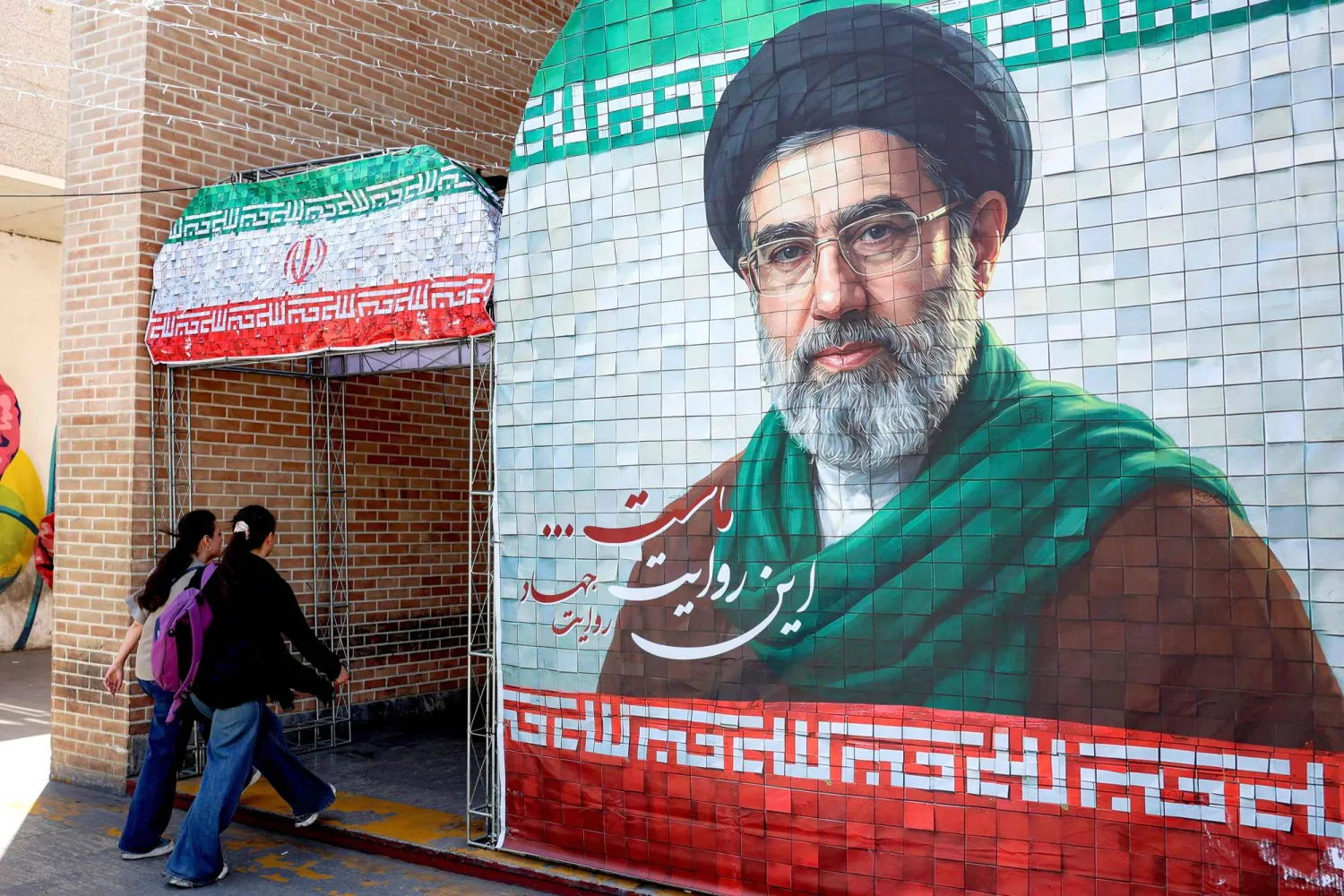
Pezeshkian Says he Recently Met with the Supreme Leader

Women walk past a banner depicting Iran's current supreme leader Mojtaba Khamenei along a street Tehran on May 6, 2026. (Photo by AFP)
TT

Pezeshkian Says he Recently Met with the Supreme Leader

Women walk past a banner depicting Iran's current supreme leader Mojtaba Khamenei along a street Tehran on May 6, 2026. (Photo by AFP)

Iran’s President Masoud Pezeshkian said he met recently with Supreme Leader Mojtaba Khamenei, state media reported ⁠on Thursday, offering ⁠a first public account of him ⁠meeting Khamenei after the latter suffered severe wounds at the start of the US-Israeli war on Iran.

The ⁠meeting ⁠was marked by a "humble and deeply cordial" atmosphere, Pezeshkian was reported as saying.

Khamenei, reportedly wounded in strikes on the first day of the Middle East war that claimed the life of his father and predecessor Ali Khamenei, has released only written statements since his appointment.

"What struck me most during this meeting was the vision and the humble and sincere approach of the supreme leader of the Islamic revolution," Pezeshkian said in a video broadcast by state television.