


World Health Body Plans to Vaccinate 20% of Syrians in 2021

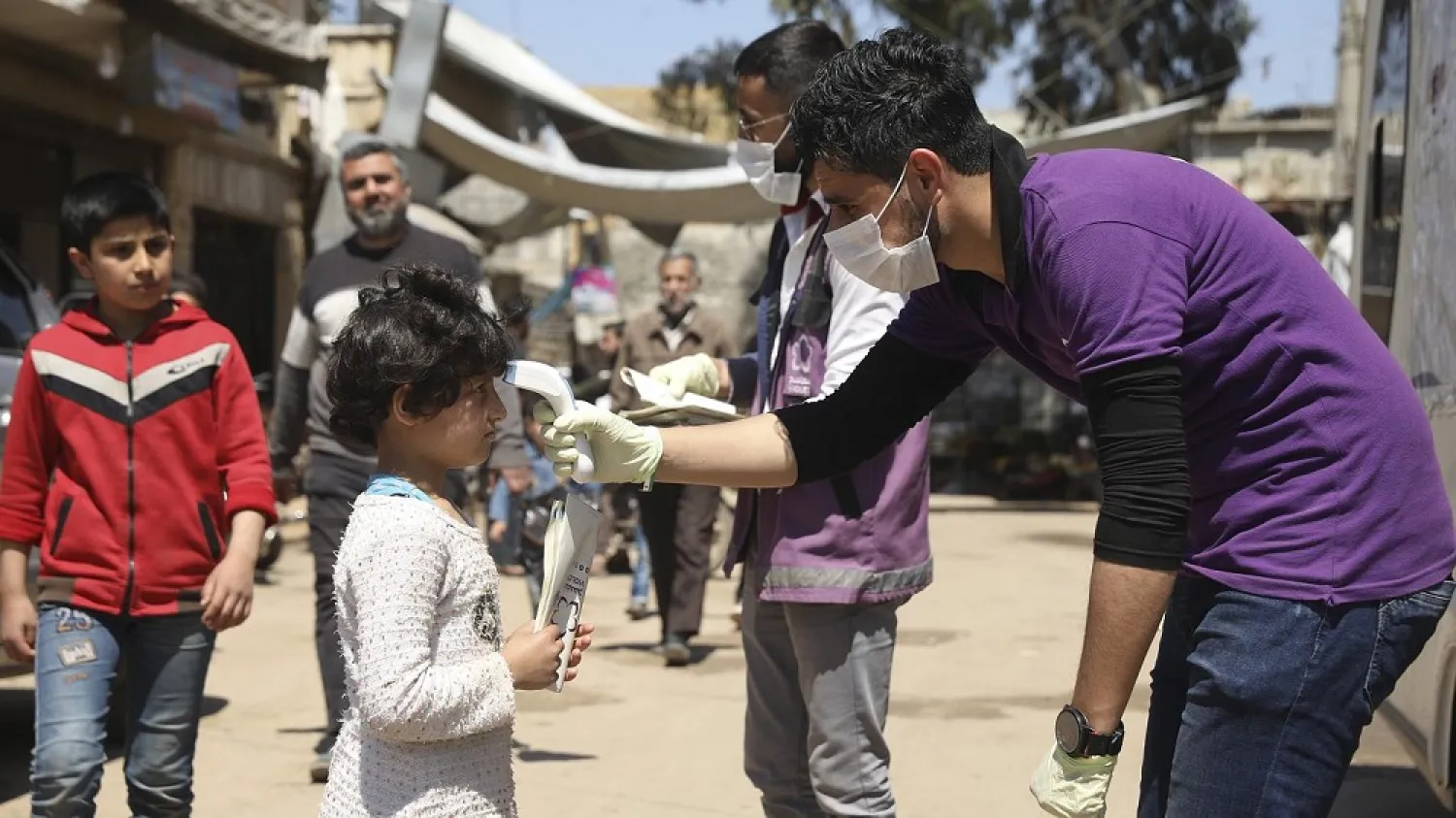
A member of a non-governmental aid organization measures temperature as a preventive measure for coronavirus in the town of Kafr Takharim, Idlib province, Syria, April 14, 2020. (AP)
TT

World Health Body Plans to Vaccinate 20% of Syrians in 2021

A member of a non-governmental aid organization measures temperature as a preventive measure for coronavirus in the town of Kafr Takharim, Idlib province, Syria, April 14, 2020. (AP)

The World Health Organization will oversee a coronavirus vaccination campaign in war-torn Syria that is expected to start in April with the aim of inoculating 20% of the population by the end of 2021, it said Tuesday.

The announcement came amid a sharp increase in cases in government-held parts of the country. State media has reported that intensive care units in state hospitals in the capital Damascus are full and medical staff have been called to stay on alert to deal with coronavirus patients.

Among those infected earlier this month were President Bashar Assad and his wife Asma who are now both in a “state of recovery,” according to the presidency.

WHO said it doesn’t know what variant or variants are spreading in Syria because the country's laboratory capacity is weak and it has sent samples to labs outside of Syria for more information. Neighboring countries have seen both the United Kingdom and South African variants.

The country that had a pre-war population of 23 million people has registered nearly 50,000 coronavirus cases, of which 40% are in the last opposition stronghold in the Syria's northwest along the border with Turkey, according to Akjemal Magtymova, WHO representative and head of mission in Syria.

Magtymova said more than 17,000 cases have been registered in government-held parts of Syria, while in areas controlled by Kurdish-led US-backed fighters there have been more than 9,000 cases.

“I do believe that the real numbers are much higher. The virus is not behaving differently in Syria,” said Magtymova about government-controlled areas. She spoke from the northern city of Aleppo during a virtual news conference.

Syria’s Health Ministry has registered nearly 17,600 cases, including 1,175 deaths, since the first case was registered in March last year.

Magtymova said the fatality ratio is highest in government areas, where out of every 100 people, 6.7 or 7 are likely to die. She added that the overall case fatality is 4.5 while in the northwest it is 3 and the northeast is 3.9.

Mahmoud Daher, the WHO representative responsible for northwest Syria, said there have been 411 deaths in the region, adding that there was a rise in cases between August and December.

Daher said the “curve has gone sharply down” recently but warned that the region will probably see an impact of the third wave that is happening in other territories, as well as across the border from Turkey.

Magtymova, the WHO mission head, said there will be two routes through which vaccines will flow to Syria. The first, from Damascus, will cover government-held areas and those held by Kurdish fighters, while opposition-held areas will be supplied through the border with Turkey.

Magtymova said the northwest will receive 224,000 doses of the AstraZeneca vaccine from India within a few weeks to cover 3% of the population, mainly health care workers.

She said another 912,000 doses for the rest of Syria will arrive through Damascus and will be mainly for health care workers and the elderly.

The first phase is expected to end in June and after that another batch of vaccines should arrive and “we are hoping by the end of December 2021 we cover 20% of the population across Syria.”

Syria announced earlier this month it began a vaccination campaign without giving any details. The health minister said the government procured the vaccines from a friendly country, which he declined to name.

Magtymova said WHO will need $38 million in donations to vaccinate 20% of Syrians to cover operation cost, mobile clinics, services, training, provision and administration of vaccines as well as surveillance and dealing with side effects.

Syria’s 10-year conflict that has killed more than half a million people and displaced half the country’s population has damaged hundreds of hospitals and clinics around the country. The war and a severe economic and financial crisis has left more than 80% of Syrians living under poverty levels and unable to afford PCR tests.



Diplomats Sought Guarantees from Hezbollah That It Will Hold Fire if Iran Is Attacked, Source Says

Mourners hold anti-US and anti-Israeli placards during a funeral ceremony for security personnel killed during anti-government protests, in Tehran, Iran, 14 January 2026. (EPA)
TT

Diplomats Sought Guarantees from Hezbollah That It Will Hold Fire if Iran Is Attacked, Source Says

Mourners hold anti-US and anti-Israeli placards during a funeral ceremony for security personnel killed during anti-government protests, in Tehran, Iran, 14 January 2026. (EPA)

Diplomats have sought guarantees from Lebanese armed group Hezbollah that it would not take military action if the United ‌States ‌or ‌Israel ⁠carried out on ‌an attack on Iran, a Lebanese source familiar with the group's thinking told ⁠Reuters on Wednesday.

The ‌source said ‍the ‍Iran-backed group was ‍approached through diplomatic channels last week.

Hezbollah did not offer explicit guarantees but has no ⁠plans to act if the strike on Iran is not "existential" for Iran's leadership, the source added.


Palestinian Factions Offer Support for Gaza Technocratic Committee

A handout photo made available by Egyptian State Press Office shows Egyptian authorities holding talks with a Hamas delegation and representatives of various Palestinian factions, in Cairo, Egypt, 14 January 2026, to select a technical committee for Gaza. (EPA/Egyptian State Press Office)
TT

Palestinian Factions Offer Support for Gaza Technocratic Committee

A handout photo made available by Egyptian State Press Office shows Egyptian authorities holding talks with a Hamas delegation and representatives of various Palestinian factions, in Cairo, Egypt, 14 January 2026, to select a technical committee for Gaza. (EPA/Egyptian State Press Office)

The majority of Palestinian factions and the presidency offered their support for the Palestinian technocratic committee meant to govern Gaza, after mediator Egypt announced on Wednesday that all parties had agreed on its members.

In a statement, Palestinian factions including Hamas and Islamic Jihad said they had agreed "to support the mediators' efforts in forming the Palestinian National Transitional Committee to administer the Gaza Strip, while providing the appropriate environment" for it to begin its work.

The Ramallah-based Palestinian presidency also announced its support in official media, with a source from the office telling AFP the statement "reflects the position of the Fatah movement because President (Mahmoud) Abbas is also the head of Fatah".


Syria Moves Military Reinforcements East of Aleppo After Telling Kurds to Withdraw

Military vehicles drive along a road as the last Kurdish-led Syrian Democratic Forces (SDF) fighters left the Syrian city of Aleppo on Sunday, state-run Ekhbariya TV said, following a ceasefire deal that allowed evacuations after days of deadly clashes, in Latakia, Syria, January 14, 2026. (Reuters)
TT

Syria Moves Military Reinforcements East of Aleppo After Telling Kurds to Withdraw

Military vehicles drive along a road as the last Kurdish-led Syrian Democratic Forces (SDF) fighters left the Syrian city of Aleppo on Sunday, state-run Ekhbariya TV said, following a ceasefire deal that allowed evacuations after days of deadly clashes, in Latakia, Syria, January 14, 2026. (Reuters)

Syria's army was moving reinforcements east of Aleppo city on Wednesday, a day after it told Kurdish forces to withdraw from the area following deadly clashes last week.

The deployment comes as Syria's government seeks to extend its authority across the country, but progress has stalled on integrating the Kurds' de facto autonomous administration and forces into the central government under a deal reached in March.

The United States, which for years has supported Kurdish fighters but also backs Syria's new authorities, urged all parties to "avoid actions that could further escalate tensions" in a statement by the US military's Central Command chief Admiral Brad Cooper.

On Tuesday, Syrian state television published an army statement with a map declaring a large area east of Aleppo city a "closed military zone" and said "all armed groups in this area must withdraw to east of the Euphrates" River.

The area, controlled by Kurdish forces, extends from near Deir Hafer, around 50 kilometers (30 miles) from Aleppo, to the Euphrates about 30 kilometers further east, as well as towards the south.

State news agency SANA published images on Wednesday showing military reinforcements en route from the coastal province of Latakia, while a military source on the ground, requesting anonymity, said reinforcements were arriving from both Latakia and the Damascus region.

Both sides reported limited skirmishes overnight.

An AFP correspondent on the outskirts of Deir Hafer reported hearing intermittent artillery shelling on Wednesday, which the military source said was due to government targeting of positions belonging to the US-backed, Kurdish-led Syrian Democratic Forces.

- 'Declaration of war' -

The SDF controls swathes of the country's oil-rich north and northeast, much of which it captured during Syria's civil war and the fight against the ISIS group.

On Monday, Syria accused the SDF of sending reinforcements to Deir Hafer and said it would send its own personnel there in response.

Kurdish forces on Tuesday denied any build-up of their personnel and accused the government of attacking the town, while state television said SDF sniper fire there killed one person.

Cooper urged "a durable diplomatic resolution through dialogue".

Elham Ahmad, a senior official in the Kurdish administration, said that government forces were "preparing themselves for another attack".

"The real intention is a full-scale attack" against Kurdish-held areas, she told an online press conference, accusing the government of having made a "declaration of war" and breaking the March agreement on integrating Kurdish forces.

Syria's government took full control of Aleppo city over the weekend after capturing its Kurdish-majority Sheikh Maqsud and Achrafieh neighborhoods and evacuating fighters there to Kurdish-controlled areas in the northeast.

Both sides traded blame over who started the violence last week that killed dozens of people and displaced tens of thousands.

- PKK, Türkiye -

On Tuesday in Qamishli, the main Kurdish city in the country's northeast, thousands of people demonstrated against the Aleppo violence, while shops were shut in a general strike.

Some protesters carried Kurdish flags and banners in support of the SDF.

"This government has not honored its commitments towards any Syrians," said cafe owner Joudi Ali.

Other protesters burned portraits of Turkish Foreign Minister Hakan Fidan, whose country has lauded the Syrian government's Aleppo operation "against terrorist organizations".

Türkiye has long been hostile to the SDF, seeing it as an extension of the Kurdistan Workers' Party (PKK) and a major threat along its southern border.

Last year, the PKK announced an end to its long-running armed struggle against the Turkish state and began destroying its weapons, but Ankara has insisted that the move include armed Kurdish groups in Syria.

On Tuesday, the PKK called the "attack on the Kurdish neighborhoods in Aleppo" an attempt to sabotage peace efforts between it and Ankara.

A day earlier, Ankara's ruling party levelled the same accusation against Kurdish fighters.

The Britain-based Syrian Observatory for Human Rights reported 45 civilians and 60 soldiers and fighters from both sides killed in the Aleppo violence.