Lebanese President Aoun Fears Chaos as Crisis Bites

Lebanon's President Michel Aoun speaks during a news conference at the presidential palace in Baabda, Lebanon October 21, 2020. (Dalati & Nohra)
TT

Lebanese President Aoun Fears Chaos as Crisis Bites

Lebanon's President Michel Aoun speaks during a news conference at the presidential palace in Baabda, Lebanon October 21, 2020. (Dalati & Nohra)

Lebanon’s President Michel Aoun said on Wednesday the country could face chaos before it can recover from a financial meltdown.

Crushed under a mountain of debt and decades of graft, Lebanon has plunged into its worst crisis since the 1975-1990 civil war.

Aoun, a former army commander, and Saad al-Hariri, a three-time premier who was designated prime minister in October, have been locked in a standoff over the makeup of a new cabinet as the crisis worsens.

Scenes of shoppers brawling over goods, protesters blocking roads, and shuttered businesses are now commonplace.

“I will hand over the country better than when it was handed to me ... but I fear the cost will be very high, ‮)‬there‮(‬ may be chaos before that,” Aoun said in comments published by Lebanese television channel al-Jadeed. Aoun’s term expires in 2022.

The president, whose party run by his son-in-law Gebran Bassil leads the biggest bloc in parliament, told a reporter at al-Jadeed he feared the dangers looming over Lebanon threatened its very existence.

The currency has lost most of its value, making more than half the population poor. Last August’s port blast, which devastated parts of Beirut and killed 200 people, deepened the country’s misery.

The deadlock has persisted since Aoun warned in September that the country was going “to hell” without a new government.

Foreign donors have made clear they will not bail out Lebanon before its leaders agree a new cabinet that must launch reforms.

“I wish I inherited my grandfather’s orchard and didn’t take up the presidency,” Jadeed cited Aoun as saying on Wednesday.


Is Egypt Rethinking its Strategy in Libya?

Egyptian President Abdel Fattah el-Sisi welcomes Libya’s Government of National Unity Prime Minister Abdul Hamid Dbeibeh in Cairo on Thursday (Egyptian Presidency)
TT

Is Egypt Rethinking its Strategy in Libya?

Egyptian President Abdel Fattah el-Sisi welcomes Libya’s Government of National Unity Prime Minister Abdul Hamid Dbeibeh in Cairo on Thursday (Egyptian Presidency)

Egypt’s growing rapprochement with Libya’s interim Government of National Unity (GNU), led by Abdul Hamid Dbeibeh, has raised questions about whether Cairo is reassessing its longstanding priorities in a country divided by years of institutional rivalry.

After years of closer ties with the eastern-based Libyan National Army (LNA), commanded by Field Marshal Khalifa Haftar, Egypt has intensified contacts with Tripoli. The outreach culminated in President Abdel Fattah el-Sisi’s talks with Dbeibeh, their second meeting in recent months.

Thursday’s meeting followed separate visits to Tripoli by Egyptian Foreign Minister Badr Abdelatty and intelligence chief Hassan Rashad, at a time when political, security and economic challenges remain intertwined and disputes over institutional legitimacy continue to obstruct efforts to establish a unified government.

Yet Egyptian and Libyan diplomats interviewed by Asharq Al-Awsat cautioned against interpreting Cairo’s outreach as a shift from one camp to another.

Egypt has not abandoned its close ties with eastern Libya, they argued, while the security and geographic interests underpinning its relationship with the LNA leadership remain unchanged by renewed engagement with Tripoli.

Parallel Channels of Communication

Former Egyptian Assistant Foreign Minister Ezzat Saad traced Cairo’s approach to a broader policy that took shape in 2020, when Egypt adopted the Berlin Declaration as a comprehensive international framework for addressing the Libyan crisis.

The declaration encompasses political, military, security and economic tracks, as well as the arms embargo, human rights and international humanitarian law.

Saad explained that the framework, whose outcomes were endorsed by the UN Security Council, brings the various dimensions of Libya’s crisis under a single approach aimed at achieving a comprehensive settlement and unifying state institutions.

Egypt has maintained coordination with Libyan parties in recent years without developing formal alliances, he added, while keeping communication channels open with both eastern and western Libya.

Analysts therefore view Cairo’s continued engagement across the political divide less as a retreat from previous understandings than as an effort to preserve parallel channels of communication and avoid concentrating Egyptian influence within a single Libyan camp.

Eastern Libya’s Strategic Importance

Cairo’s rapprochement with the GNU has nevertheless prompted concern among politicians and activists in eastern Libya, particularly amid disagreements over a maritime boundary agreement with Türkiye.

Libya’s House of Representatives approved the agreement in October, but Egypt has rejected it.

Former Libyan diplomat Mohamed al-Jazwi, who previously served as consul in Cyprus, dismissed the prospect of a fundamental shift in Cairo’s priorities.

“Eastern Libya represents strategic depth for Egyptian national security,” he told Asharq Al-Awsat, arguing that relations with the LNA rest on considerations extending beyond current political disagreements, which he described as a passing cloud.

Those considerations date back to battles against extremist organizations in Benghazi and Derna, when developments in eastern Libya’s counterterrorism campaign were closely linked to security along Egypt’s western border.

From this perspective, the LNA’s role in combating terrorism carries regional significance beyond eastern Libya itself.

Al-Jazwi pointed to Rashad’s November 13 meeting in Cairo with Saddam Haftar, the LNA’s deputy commander-in-chief, as further evidence of continued cooperation.

The discussions addressed unifying political authority, advancing joint projects and holding permanent elections. The LNA portrayed the meeting as part of efforts to establish a unified, stable state and strengthen political and security stability.

A Broader Partnership

Former Libyan ambassador to Ukraine Adel Issa offered a different perspective, viewing Egypt’s outreach as an opportunity to reshape its role through closer engagement with all components of the Libyan state.

Rather than aligning itself with one faction or treating Libya’s internal divisions as permanent political calculations, Cairo could pursue a broader partnership, he argued.

Under this approach, Egypt’s interests would be better served by treating Libya as a single entity, helping bridge differences and overcome divisions while preserving institutional unity and promoting stability in both countries.

Libya remains divided politically and militarily between rival administrations: Dbeibeh’s GNU in the west and a parliament-appointed government led by Osama Hammad in the east, which is backed by the LNA.

Analysts believe the agenda of Thursday’s Sisi-Dbeibeh meeting offered practical indications of the broader engagement advocated by Issa.

Beyond reaffirming Libya’s security, unity and territorial integrity, the talks focused on expanding trade and investment, particularly in energy, natural gas, oil and reconstruction.


Israel Says Struck Hezbollah Weapons Site in East Lebanon

Smoke rises following an Israeli strike in the southern village of Kfar Tebnit, Lebanon, Thursday, Nov. 19, 2026. (AP)
TT

Israel Says Struck Hezbollah Weapons Site in East Lebanon

Smoke rises following an Israeli strike in the southern village of Kfar Tebnit, Lebanon, Thursday, Nov. 19, 2026. (AP)

The Israeli military said it struck a previous Hezbollah missile production and storage site in eastern Lebanon on Thursday, marking the second attack in the region this week.

"A short while ago, the Israeli Air Force conducted a strike, guided by precise intelligence, in the Janta area in the Bekaa region of Lebanon, targeting a site that was previously used by the Hezbollah terrorist organization for missile production and the storage of weapons," the military said in a statement.

"The site was struck by the army several times during the war. The army identified that Hezbollah terrorists had arrived at the site recently and struck the site's entrances in order to prevent its restoration," it added.

Lebanon's official National News Agency reported that "enemy aircraft launched five airstrikes" in eastern Lebanon.

On Monday, the Israeli military had carried out a bombing in the same region, saying it "struck a weapons shipment transferred from Syria to Lebanon, intended for the Hezbollah terrorist organization".

"The military will not allow the Hezbollah terrorist organization to restore its capabilities and harm Israeli civilians and soldiers," the army said Thursday.

Hezbollah has been weakened by two successive wars with Israel since 2023, most recently after it drew Lebanon into the Middle East conflict in March this year with rocket fire at Israel, which responded with airstrikes and a ground invasion.

Hezbollah lawmakers have nonetheless maintained that the group is rebuilding its military capacities.

Hostilities in Lebanon have declined since June after a US-Iran understanding over the broader regional war, and a US-sponsored Israel-Lebanon framework agreement.

The framework involves the disarmament of Hezbollah, a gradual Israeli troop withdrawal from south Lebanon, and the deployment of the Lebanese army to the area.

But implementation has stalled and Hezbollah has refused to surrender its weapons.

Israel's army still carries out strikes in south Lebanon, where its forces are operating in a self-declared occupied "security zone" running around 10 kilometers (six miles) deep along the border.


Cairo, Tripoli Deepen Ties Despite Maritime Dispute

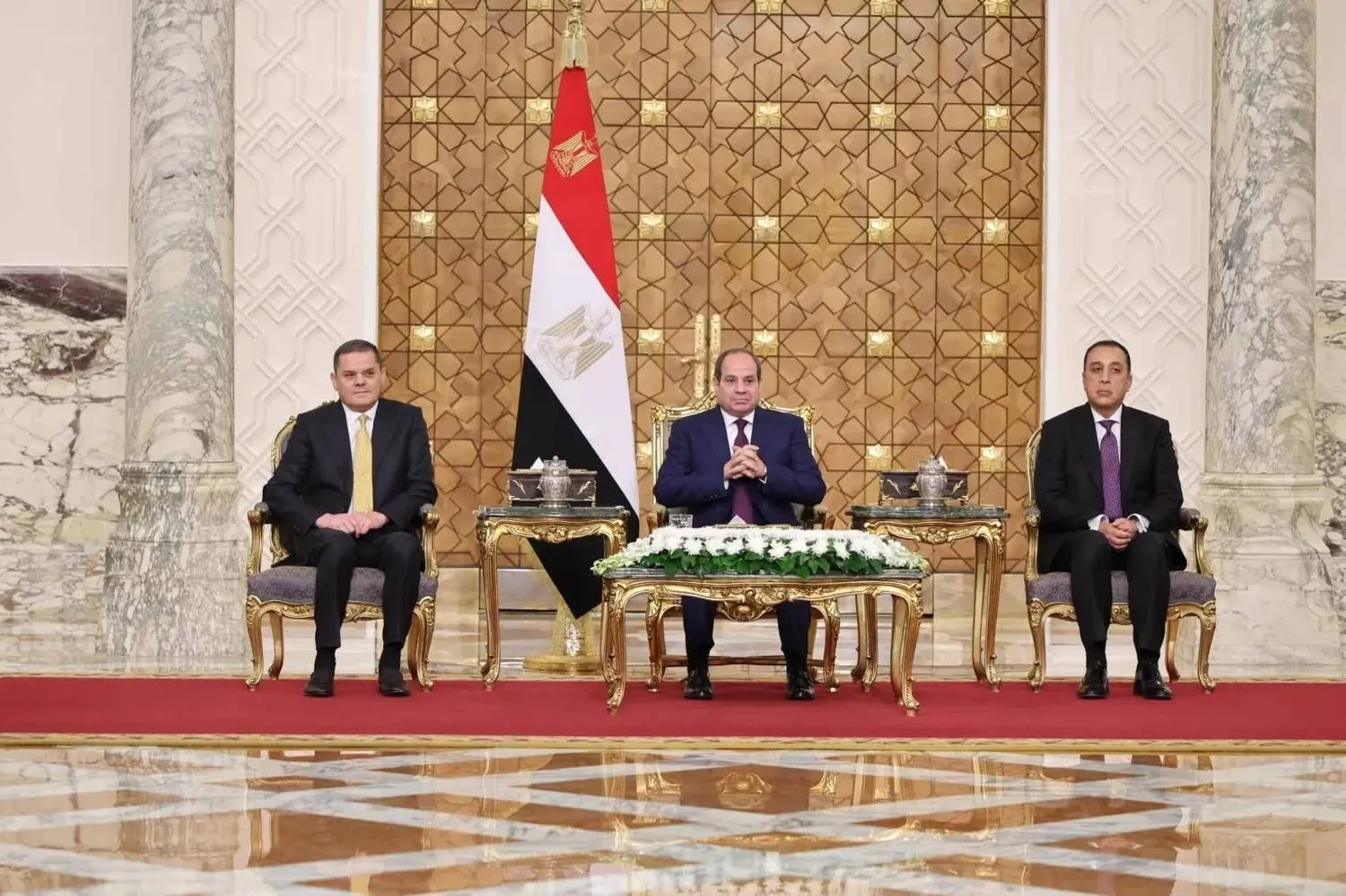
(From left to right) Libya’s interim Prime Minister Abdul Hamid al-Dbeibeh, Egyptian President Abdel Fattah al-Sisi and Egyptian Prime Minister Mostafa Madbouly in Cairo on Thursday. (Egyptian Presidency)
TT

Cairo, Tripoli Deepen Ties Despite Maritime Dispute

(From left to right) Libya’s interim Prime Minister Abdul Hamid al-Dbeibeh, Egyptian President Abdel Fattah al-Sisi and Egyptian Prime Minister Mostafa Madbouly in Cairo on Thursday. (Egyptian Presidency)

Egyptian President Abdel Fattah al-Sisi met Libya’s interim Prime Minister Abdul Hamid al-Dbeibeh in Cairo on Thursday, strengthening political and economic ties with western Libya despite a dispute over a maritime agreement between Libya and Türkiye.

The meeting marked Dbeibeh’s fourth visit to Egypt and his first since Cairo rejected the agreement approved by Libya’s House of Representatives on October 20.

Dbeibeh arrived Wednesday evening with a high-level ministerial delegation and was received by Egyptian Prime Minister Mostafa Madbouly.

The talks, seen as a sign of unprecedented rapprochement, covered bilateral relations, Libya’s political developments, regional security and cooperation in trade, investment, energy and reconstruction.

Egypt presidential spokesman Mohamed el-Shennawy said Sisi stressed the importance of strengthening the two countries’ historic ties and expanding cooperation in priority sectors.

Sisi also reaffirmed Egypt’s commitment to Libya’s security, stability, unity and territorial integrity.

Dbeibeh expressed his government’s determination to strengthen bilateral relations and praised Cairo’s efforts to preserve stability in Libya, said the Egyptian presidency.

Diplomatic engagement intensifies

Dbeibeh’s visit followed two trips to Tripoli by senior Egyptian officials this month.

Foreign Minister Badr Abdelatty reopened Egypt’s embassy in the Libyan capital during a November 7 visit, while intelligence chief Hassan Rashad traveled there on November 16.

Cairo’s intensified engagement with western Libya comes amid disagreements with eastern Libyan authorities over the maritime agreement, which Egypt continues to reject.

Analysts have linked the diplomatic shift to those differences, although Cairo has maintained contacts with both sides of Libya’s political divide.

Dbeibeh signaled flexibility during an October 24 telephone conversation with Rashad, expressing a willingness to address Egyptian concerns through dialogue and coordination while protecting both countries’ legitimate maritime rights and interests.

Egypt considers the agreement null and void, without legal effect, and maintains that its ratification by Libya’s House of Representatives creates no legal obligations for Cairo.

The Egyptian Foreign Ministry previously announced that Abdelatty had conveyed Cairo’s categorical rejection of the ratification to Turkish Foreign Minister Hakan Fidan during talks in Istanbul.

Economic agreements

Sisi and Dbeibeh witnessed the signing of several agreements and memoranda of understanding covering infrastructure development, natural gas, petroleum refining, natural resources, scientific research and labor.

Other agreements addressed training, capacity-building, technical support, professional development, leadership training, small and medium-sized enterprises, media cooperation, government communications and institutional coordination, as well as fisheries and lake development.

The latest agreements build on earlier economic cooperation between Egypt and western Libyan authorities.

In September 2021, the two sides signed 13 agreements during a meeting of their joint higher committee attended by Dbeibeh and Madbouly.

Those agreements covered transportation, electricity, petroleum, infrastructure, youth and sports, and social insurance. The committee had not met since 2009.

Egyptian companies are also involved in major reconstruction projects in Libya.