Morocco: More Than 12,000 Illegal Migrants Held in 2021

A Spanish soldier helps a migrant after his arrival at a beach in the Ceuta enclave, in the north of Morocco, on Sunday (EPA)
TT

Morocco: More Than 12,000 Illegal Migrants Held in 2021

A Spanish soldier helps a migrant after his arrival at a beach in the Ceuta enclave, in the north of Morocco, on Sunday (EPA)

Moroccan police said Monday they had arrested more than 12,000 people trying to leave the country illegally since the start of the year and had also dismantled 150 smuggling networks.

In a statement carried by the official MAP agency, the Directorate General of National Security said it had detained "415 organizers and mediators and 12,231 candidates for illegal immigration" and dismantled "150 criminal networks active in organizing illegal immigration".

Mainland Spain is only about 20 kilometers from Morocco, making it a target for those fleeing poverty or conflicts elsewhere in Africa or even further afield.

Officers also seized "752 forged travel documents, 67 inflatable boats and 47 engines, and 65 vehicles", AFP quoted MAP as saying.

The year's figures relate only to police operations, and do not include naval interceptions of migrants headed to Spain.

A military source said the Moroccan coastguard aided around 330 migrants between November 12 and 15 in both the Atlantic and the Mediterranean.

At the end of September, the UN's International Organization for Migration said 2021 had been "the deadliest year on the migratory route to Spain", with more than 1,000 fatalities.

Other North African countries, Tunisia and Libya, are also major migrant departure points to Europe.


Morocco’s King Calls for Youth Issues to Top Public Policy Agenda

Morocco’s king called for the new parliamentary and government term to mark a turning point in advancing the country’s ambition as a rising economic power (MAP)
TT

Morocco’s King Calls for Youth Issues to Top Public Policy Agenda

Morocco’s king called for the new parliamentary and government term to mark a turning point in advancing the country’s ambition as a rising economic power (MAP)

Morocco’s King Mohammed VI called for the new parliamentary and government term to mark a genuine turning point in advancing Morocco’s ambition as a rising, trusted economic power, balancing economic growth with greater social and regional equity. He stressed that youth issues must be a public policy priority.

Speaking in Rabat on Friday at the opening of the first session of the first legislative year of the 12th parliamentary term, the king said the term came at an exceptional moment, with opportunities that might not recur to build on achievements across various fields. He congratulated members of the House of Representatives on winning voters’ confidence.

King Mohammed VI urged governance bodies to put youth issues first through an integrated approach that ensures equal opportunities and covers education, training and economic inclusion.

The royal address linked this approach to strengthening young people’s confidence in their prospects for upward social mobility, in their country’s institutions and in the opportunities it offers to build a better future in freedom, dignity and stability.

On territorial governance, the king said the central challenge in the coming period was to work on the ground, identify each area’s actual problems and find realistic solutions.

He said integrated development, better public services and productive investment were closely tied to advanced regionalization and the implementation of administrative decentralization.

He warned that delays and shortcomings hampering decentralization undermined economic and social development programs and hindered responses to citizens’ actual concerns.

“Any delay or procrastination in fully implementing the Decentralization Charter is no longer acceptable,” King Mohammed VI said. This requires transferring powers and the necessary human and financial resources from the central administration to provinces and regions.

He also called for removing obstacles to regional institutions’ work by defining their powers more clearly, increasing their human and material resources, organizing relations between the state and the regions, and establishing coordination and contractual mechanisms that enable regions to make decisions and carry out projects.

On the economy, the king called for accelerating planned infrastructure projects and launching a new generation of major strategies, particularly in water, energy and food security, industrial development, the digital economy and artificial intelligence.

He also urged more efficient management and stronger national capacity in strategic reserves, along with secure supplies of essential goods.

He called on the domestic private sector to become a strategic actor in the country’s development transformation, with greater initiative, innovation and capacity to create jobs, invest and export.

On migration and the crisis that erupted with Spain, King Mohammed VI said Morocco’s balanced approach to managing migration had delivered tangible results. But recurring crises showed that the current cooperation model had become outdated.

He said the partnership with Spain had made significant progress across various fields, including efforts to combat irregular migration. It now faced major challenges, however, from certain outdated legal provisions and court rulings detached from reality.

He said these provisions and rulings regrettably prevented the repatriation of minors and people falsely claiming asylum status, while encouraging criminal networks’ ambitions.

Addressing irresponsible statements from some political and media circles, King Mohammed VI stressed that the partnership was a political choice and a voluntary commitment, and would never be subject to pressure, threats or blackmail.

He said Morocco would present its partners with a clear, practical strategic document laying the foundations for a new form of partnership to strengthen shared development and economic competitiveness.

In a message to lawmakers, King Mohammed VI said a parliamentary mandate was “a position of trust, a political commitment and a moral contract” binding them to citizens.

He urged members of parliament to fulfill their national responsibility.

“Be equal, may God protect you, to this national responsibility that you bear before God, before the citizens and before history,” he said.

King Mohammed VI was accompanied by Crown Prince Moulay Hassan, Prince Moulay Rachid and Prince Moulay Ahmed.


Mass Protests in Hasakah Under ‘Friday of the Syrian Flag’ Banner

The Syrian flag at a protest in Hasakah (Social media)
TT

Mass Protests in Hasakah Under ‘Friday of the Syrian Flag’ Banner

The Syrian flag at a protest in Hasakah (Social media)

Thousands of residents of Syria’s Hasakah province rallied after Friday prayers to demand state authority across the province and the release of detainees and people forcibly disappeared in prisons run by the dissolved Syrian Democratic Forces (SDF).

In scenes described as the “greatest celebration” and the “Hasakah flood,” protesters gathered in Freedom Square in the city center under the slogan “Friday of the Syrian Flag.”

They called for state sovereignty and a stronger presence for its institutions, a day after the national flag was raised on the square’s tallest flagpole before a large gathering of residents and officials.

The protests capped a week of rapid developments in Hasakah over the implementation of a Jan. 29, 2026, agreement between the Syrian government and the SDF.

The deal called for the former Kurdish Autonomous Administration’s civilian, security and military institutions to be integrated into state structures.

Arabs, who make up the province’s population majority, have complained that the SDF remains dominant despite its announced dissolution in late August.

Residents began arriving early in the morning from Hasakah’s al-Aziziya, al-Kallasa and al-Nashwa neighborhoods and from other towns, including al-Shaddadi, Markada, al-Hol and al-Arisha.

They gathered outside Abu Bakr al-Siddiq Mosque in Ghweiran before marching after Friday prayers to the city’s main square, known as Liberation Square, carrying Syrian national flags.

Government internal security forces reinforced their presence across the city from midnight Thursday to protect protesters, residents and public and private property. The deployment followed indiscriminate gunfire by “outlaw” gunmen in several neighborhoods.

Activists accused a Kurdish group referred to as “Revolutionary Popular” of stirring tensions to impose a curfew and block the demonstrations. Internal security forces restored calm that night, Syria’s Al-Ikhbariya television channel reported.

Protesters carried national flags, photographs of SDF detainees and pictures of “martyrs of the Syrian revolution.”

They chanted, “One, one ... the Syrian people are one,” seeking to reassure the province’s Arab, Kurdish and Christian communities that all were subject to the law and equal in rights and duties.

Their demands included extending state sovereignty and authority across Hasakah, restoring state institutions and making them operational, releasing detainees forcibly disappeared in SDF prisons, and allowing their sons to join the internal security forces. They also called for an end to the province’s dual authorities and the presence of Revolutionary Youth.

Videos posted on social media showed protesters removing Kurdistan Workers’ Party (PKK) and SDF flags and banners from streets and buildings.

Sohaib al-Yaarubi, an activist from the province’s Arab tribes and one of those who called for the protests, said the message was clear: the overwhelming majority in Hasakah supported the Syrian state, wanted its sovereignty extended across the province and wanted only the flag of the Syrian Arab Republic flown there.

Yaarubi told Asharq Al-Awsat the demonstrations were “successful” and the demands “patriotic and legitimate.” He said there were no tensions or provocations apart from one incident involving Revolutionary Youth members, which protesters defused.

Ibrahim al-Halabi, another activist from the province’s Arab tribes, described the crowds in Liberation Square as “awe-inspiring, beautiful and truly wonderful.” The peaceful demonstrations lasted about two hours.

He said the raising of the national flag brought overwhelming joy, stirring emotions that recalled the early days of the Syrian revolution against the former government in 2011.

“Some described the demonstrations and the crowds in Liberation Square as the greatest celebration in Hasakah, a city denied the chance to celebrate the victory achieved when the ousted government fell nearly two years ago,” Halabi said.

Delegations from other provinces, including Deir Ezzor, joined the Hasakah protests.

Similar demonstrations took place in several provinces in support of its residents’ demands.

The Friday rallies followed Thursday’s raising of the national flag on the tallest flagpole in central Hasakah before a large gathering of residents and officials. Government officials also inspected the courthouse to “create suitable conditions for making the judicial system operational.”

Internal security forces had deployed around the courthouse after members of the dissolved SDF vacated their positions there, while the government strengthened its security presence across the city.

On Tuesday, the SDF’s counterterrorism forces had handed over their positions to internal security forces.

Maj. Gen. Abdul Qader Tahhan, head of Syria’s General Intelligence Service, and Brig. Gen. Abdul Rahman al-Dabbagh, head of foreign intelligence, subsequently arrived in Hasakah with a large security delegation.

The developments followed mass peaceful protests after prayers the previous Friday in several towns and cities across Hasakah province, demanding state authority and a stronger presence for its institutions throughout the province.



EU Lays Groundwork to Keep its Forces in Lebanon after UNIFIL Term Ends

A UNIFIL patrol in southern Lebanon. (UNIFIL)
TT

EU Lays Groundwork to Keep its Forces in Lebanon after UNIFIL Term Ends

A UNIFIL patrol in southern Lebanon. (UNIFIL)

The European Union is continuing to fulfill its commitments to support Lebanon’s military and security institutions after the end of UNIFIL’s mandate by establishing a new mission to provide training and advice to the Lebanese army and Internal Security Forces.

The mission will not replace the UN Interim Force in Lebanon (UNIFIL), but will help “strengthen state sovereignty and extend its authority” across Lebanese territory.

Speaking in Beirut on Thursday, Kaja Kallas, the EU’s high representative for foreign affairs and security policy and vice president of the European Commission, announced plans for a new EU mission to provide training and advice to the Lebanese army.

She said she expects EU foreign ministers on Monday to formally establish the mission, which will make a key contribution to Lebanon’s security.

The mission will provide advice and assistance to the Lebanese army and Internal Security Forces to strengthen their authority across Lebanon, secure its borders and bolster internal security.

All of this will be in line with UN Security Council Resolution 1701, Kallas said, adding that the mission will not replace UNIFIL and will not focus exclusively on southern Lebanon.

UNIFIL’s mandate is nearing its end. European countries are among its leading supporters and troop contributors, notably France, Italy, Spain, Germany and Ireland.

As the mandate’s expiration approaches, a proposal to establish a European replacement force with the same responsibilities has faced US and Israeli opposition, stalling the initiative.

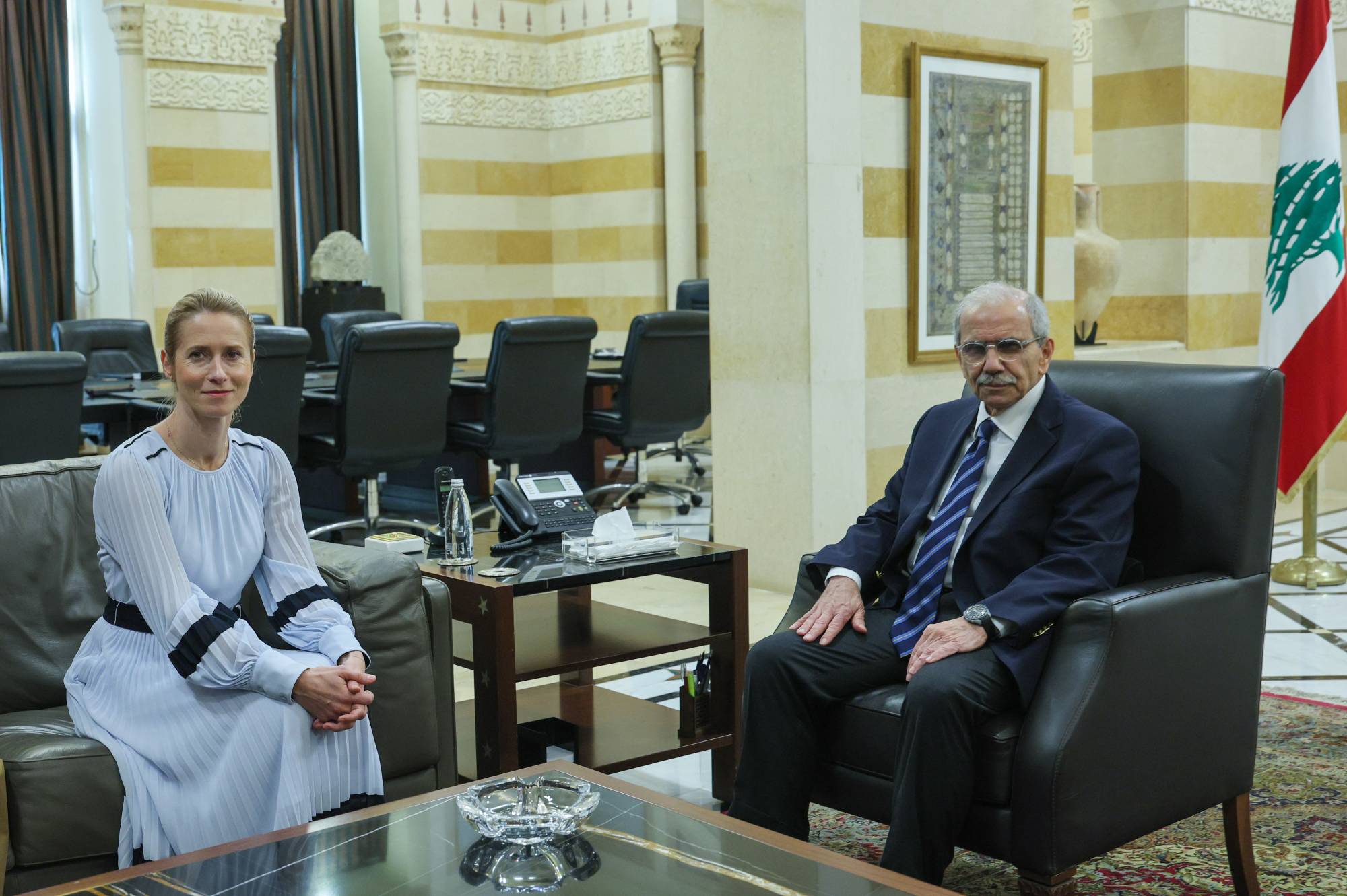
Lebanese Prime Minister Nawaf Salam (R) meets with Kaja Kallas (L), the European Union's high representative for foreign affairs and security policy, at the Government Palace in Beirut, Lebanon, 08 October 2026. (EPA)

Multiple roles

Through the new mission, the EU is continuing its commitment to support Lebanon’s armed forces and enable the Lebanese state to fulfill its pledges, particularly maintaining internal stability and implementing its decisions to establish a state monopoly on weapons and extend control across its territory exclusively through its legitimate forces.

A Lebanese ministerial source told Asharq Al-Awsat that the mission “is not linked to UNIFIL or any other mission.”

“Its role is not military, and it will not take over UNIFIL’s responsibilities. Its role will be logistical and will include training Lebanese military forces, alongside social, health and education activities, meaning it will have more than one role,” the source said.

It added that the European mission’s task would be to “strengthen state sovereignty, extend its authority and enable Lebanese security agencies to deploy and carry out their duties.” That role can be inferred from Kallas’s statement that the mission would align with Security Council Resolution 1701, which provides its political framework.

The EU has allocated 505 million euros to Lebanon for 2026 and 2027, the second part of a 1-billion-euro package announced in 2024, to support economic recovery, reforms, security and essential services.

European assistance to the army through the European Peace Facility has totaled 182 million euros since 2022.

The EU has expressed its readiness to provide Lebanon with the assistance it needs, particularly for the army, Internal Security Forces, and social and humanitarian institutions. It also supports the Lebanese state’s decisions to establish full control over its territory and move ahead with disarming Hezbollah.

Alongside this role, the EU is pushing to extend UNIFIL’s mandate to avoid a security vacuum after the international mission leaves.

UNIFIL has played an important role for almost 50 years. A continued UN presence in Southern Lebanon is under discussion, and the EU remain ready to work with Lebanon, the UN, and the Security Council members on what comes next, Kallas said in Beirut.