Sadr: No Room for Militias in Iraq Anymore

Iraqi cleric Moqtada al-Sadr attends a news conference in Najaf, Iraq, November 18, 2021. (Reuters)
TT

Sadr: No Room for Militias in Iraq Anymore

Iraqi cleric Moqtada al-Sadr attends a news conference in Najaf, Iraq, November 18, 2021. (Reuters)

On the eve of the new Iraqi parliament holding its inaugural meeting, head of the Sadrist movement, cleric Moqtada al-Sadr slammed pro-Iran militias, saying there was no room left for them in the country.

In a tweet, he said: "There is no room for sectarianism or racism. There is only room for a national majoritarian government in which the Shiite will defend the rights of the minority Sunnis and Kurds."

"The Kurd will defend the rights of the minority Sunnis and Shiites and the Sunni will defend the rights of the minority Shiites and Kurds," he stressed.

Moreover, he revealed that his movement has reached an agreement with the Sunni and Kurdish forces to form the largest bloc in parliament that will allow it to form a new government at the expense of his rival fellow Shiite forces in the "Coordination Framework."

"There is no room anymore for militias, as everyone will support the army, police and security forces," Sadr announced.

"Along with the people, today we declare that we say no to subjugation," he stated. "Our decision is Iraqi, Shiite, Sunni, Kurdish, Turkmen, Christian, Feyli, Shabak, Yazidi and Sabian: This is an Iraqi mosaic that is neither eastern, nor western."

On Friday, Sadr had declared that he will go ahead to form a national majoritarian government that includes representatives of Sunni Arabs - from the Taqadum party and Azm alliance - and Kurds, represented by the Kurdistan Democratic Party, headed by Masoud Barzani.


PMF-Led Government Committee Enters Iraq’s Jurf al-Sakhar

Members of the committee in Jurf al-Sakhar on Friday in this photo released by platforms close to the PMF.
TT

PMF-Led Government Committee Enters Iraq’s Jurf al-Sakhar

Members of the committee in Jurf al-Sakhar on Friday in this photo released by platforms close to the PMF.

An Iraqi security committee began investigating suspected fuel smuggling in Jurf al-Sakhar, north of the Babil province, on Friday, amid mounting tensions between the government and Kataib Hezbollah over the area and efforts to bring weapons under state control.

Troops deployed around the area to secure the committee’s entry, but political mediation reportedly halted their advance amid disagreements over how the investigation would proceed.

Footage showed a large military deployment before committee members met commanders believed to be from the pro-Iran Kataib Hezbollah. Sabereen News, an outlet close to armed factions, broadcast a Kataib Hezbollah commander addressing Interior Ministry officers.

Security Media Cell chief Saad Maan denied that political groups or armed factions were represented on the committee, saying it had begun fieldwork early Friday.

A security source told Shafaq News that the committee conducted an initial inspection after agreeing with faction representatives on investigative procedures and field visits.

Prime Minister Ali al-Zaidi formed the committee Thursday, placing it under the Popular Mobilization Forces (PMF). Its members represent the prime minister’s office, intelligence and anti-corruption bodies, the Oil Ministry, security agencies, forensic authorities and the Energy Police.

The November 12 order was signed by Lt. Gen. Abdul Amir al-Shammari, director of the commander-in-chief’s office.

The decision followed a three-hour meeting between al-Zaidi, Badr Organization leader Hadi al-Amiri, PMF chairman Falih al-Fayyadh and chief of staff Abdul Aziz al-Muhammadawi, known as Abu Fadak.

According to Shafaq News, al-Zaidi demanded enforcement of Iraqi law against offenders, while al-Amiri and al-Fayyadh proposed giving the parties concerned time to reorganize and resume dialogue over weapons.

The proposal included continuing negotiations through a four-member committee seeking to resolve disputes and preserve stability.

A government adviser told Asharq Al-Awsat that Baghdad’s changing approach reflected the armed groups’ growing political influence.

“The state is not merely confronting forces that possess weapons; these forces have also become capable of influencing political decision-making,” the adviser said.

The government prioritizes restoring sovereignty without confronting society or its communities, he stressed.

Disputes over Kataib Hezbollah had already disrupted a planned Monday meeting between al-Zaidi and Coordination Framework leaders, while negotiations over bringing weapons under state control had produced no progress.

Separately, Babil Governor Ali Turki, affiliated with Asaib Ahl al-Haq, resigned after publicly denying oil smuggling in Jurf al-Sakhar.

Informed sources said his remarks were made without the federal government’s knowledge or coordination with Asaib’s leadership, prompting movement chief Qais al-Khazali to order his resignation.

Jurf al-Sakhar has been a major armed-faction stronghold since 2014. It is believed to contain military camps, prisons, weapons depots and rocket and drone manufacturing facilities.

Many also believe the area serves as an operations center for Iran’s Revolutionary Guard Corps, an allegation denied by faction representatives and parties in Iraq’s governing coalition.


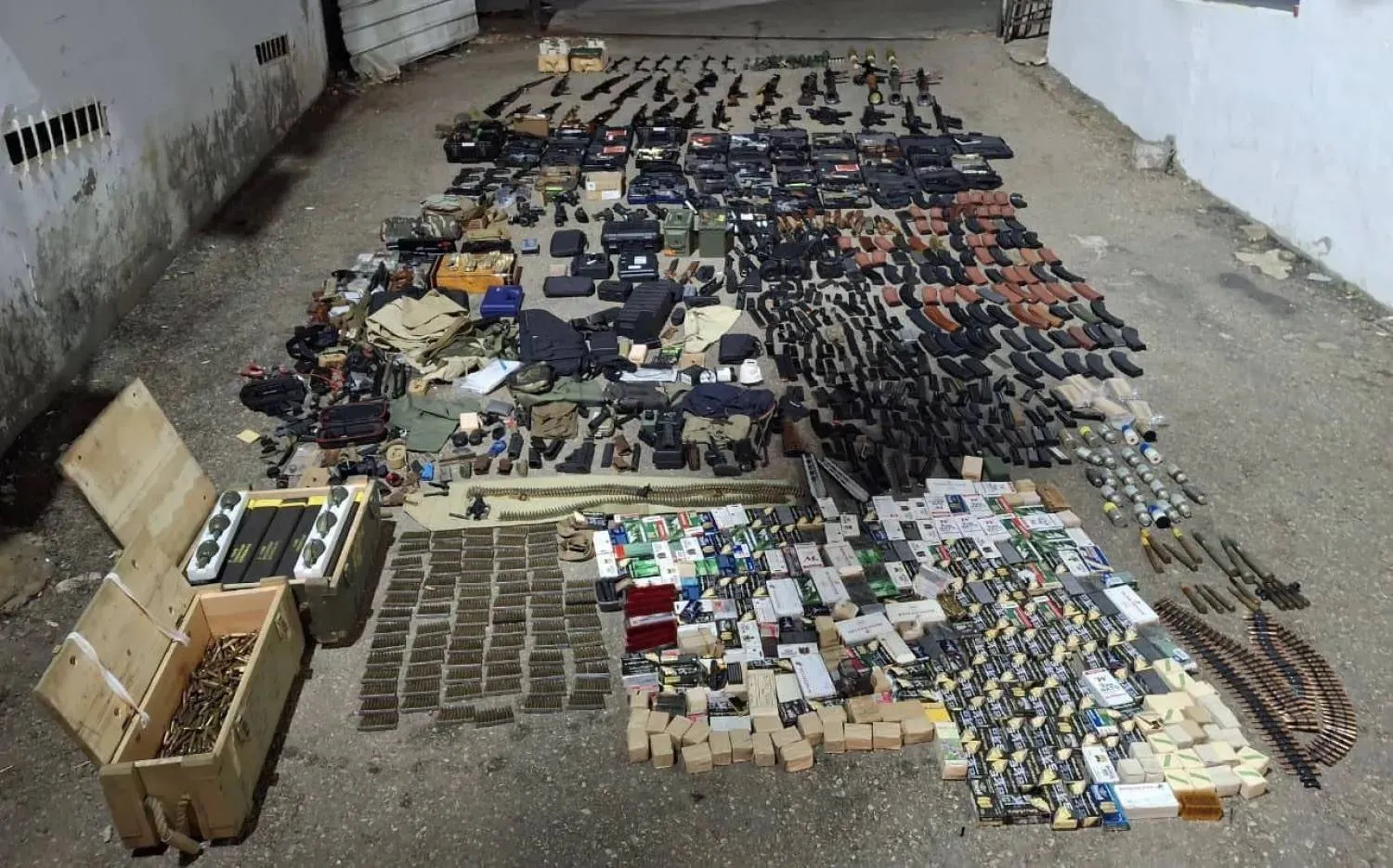
Lebanese Army Seizes Weapons Cache in Beirut’s Southern Suburbs, Raising Questions about Their Origins

The seized weapons in this photo released by the Lebanese Army.
TT

Lebanese Army Seizes Weapons Cache in Beirut’s Southern Suburbs, Raising Questions about Their Origins

The seized weapons in this photo released by the Lebanese Army.

The Lebanese Army seized a large cache of weapons and ammunition during a raid on a warehouse in Musharrafieh, in Beirut’s southern suburbs.

Although the warehouse does not appear to belong to Hezbollah, the operation drew attention because it took place in the group’s stronghold, reviving debate over the state’s efforts to impose monopoly on arms.

The army said the raid followed “surveillance and monitoring of activities linked to weapons transportation and trafficking.” The seized weapons and ammunition were handed over, and an investigation into a detained suspect was launched under judicial supervision.

The army arrested a Lebanese citizen identified by the initials “A.A.” Its statement did not identify the warehouse’s owner or indicate any organizational affiliation.

According to information obtained by Asharq Al-Awsat, the owner belongs to a family from the Chiyah area and went into hiding immediately after the raid.

Retired Brig. Gen. Fadi Daoud told Asharq Al-Awsat that the raid was a preemptive security operation based on surveillance rather than a reaction to an immediate incident.

He noted that the army’s statement referred to weapons trafficking and transportation without attributing the warehouse to any particular organization.

“We therefore cannot hold any specific party responsible before the investigation is completed,” he said.

Daoud also warned that storing ammunition in the densely populated southern suburbs posed a direct threat to residents.

“This raid carries a dual message: domestically, that weapons fall exclusively under state authority, and internationally, that the army is serious and capable,” he said.

He described the raid as part of a broader process that began with the government’s decision to establish a state monopoly on arms, stressing the importance of awaiting the investigation’s findings and applying the same standards across all regions.

“The army has once again demonstrated its capabilities and will continue this approach consistently and transparently,” he added.

Possible sources

Military affairs observer Mustafa al-Asaad examined photographs of the seized weapons and suggested that the collection was more consistent with the activities of an experienced arms dealer than with preparations for direct military confrontation.

Speaking to Asharq Al-Awsat, he considered it unlikely that the weapons formed part of military shipments sent from Iran to Lebanon.

“The variety of the weapons on display and their different origins indicate that the dealer does not rely on a single source but has an extensive network of contacts allowing him to obtain various types of firearms,” he said.

Al-Asaad noted that some of the pistols visible in the photographs are legally imported into Lebanon through established channels, while others appeared to have been smuggled or stolen from Iraq.

He pointed in particular to several Glock pistols, especially beige-colored models, resembling firearms used by Iraqi military and security agencies, including the police, army and special forces.

They may have reached Lebanon through a smuggling route from Iraq via Syria, although he cautioned that their origins could not be established without examining their serial numbers and identifying marks.

Al-Asaad also drew attention to a gold-plated Kalashnikov rifle, suggesting that some of the dealer’s customers might be collectors seeking distinctive firearms rather than weapons for combat.

He said the variety and quantity of weapons indicated considerable experience and connections within Lebanon’s arms trade, which has operated through established networks for decades.

Grenades and night-vision equipment

Al-Asaad also identified hand grenades and materials that could be used to manufacture explosives, although the quantities visible did not suggest an unusually large stockpile.

The collection included scopes and night-vision equipment used for military purposes but also available on the arms market.

He pointed to small automatic firearms resembling pistols, including models from the Skorpion family, which have historically been used in assassinations, including during the 1980s.

However, he stressed that their presence did not indicate preparations for assassinations, as such weapons could also appeal to collectors.

Al-Asaad compared the cache with arms seized by the Lebanese Army during previous raids in the Bekaa Valley, including rocket launchers and anti-armor weapons more clearly associated with direct military use.

He said that the latest photographs did not show any particularly unusual weapons that would be difficult to obtain on the Lebanese market.


Israeli Political Shake-Up Clouds Lebanon Talks, Eisenkot May Take Tougher Line

US State Department Chief of Staff Daniel Holler speaks as Israeli Ambassador to the US Yechiel Leiter and Lebanese Ambassador to the US Nada Hamadeh, accompanied by US Ambassador to Lebanon Michel Issa, attend a meeting between Israeli and Lebanese delegations hosted by the United States, after the Trump administration said Israel and Lebanon agreed to implement a ceasefire to end hostilities, at the State Department in Washington, DC, US, June 3, 2026. (Reuters)
TT

Israeli Political Shake-Up Clouds Lebanon Talks, Eisenkot May Take Tougher Line

US State Department Chief of Staff Daniel Holler speaks as Israeli Ambassador to the US Yechiel Leiter and Lebanese Ambassador to the US Nada Hamadeh, accompanied by US Ambassador to Lebanon Michel Issa, attend a meeting between Israeli and Lebanese delegations hosted by the United States, after the Trump administration said Israel and Lebanon agreed to implement a ceasefire to end hostilities, at the State Department in Washington, DC, US, June 3, 2026. (Reuters)

Political upheaval in Israel has cast fresh uncertainty over negotiations with Lebanon, raising questions about whether Prime Minister-designate Gadi Eisenkot will change Israel's approach or commit to the security conditions set by Benjamin Netanyahu.

Lebanon is waiting for Israel's next government to take shape before setting a date to resume talks. But political assessments suggest a change in leadership is unlikely to soften Israel's stance and could see Eisenkot take an even tougher line.

The uncertainty highlights a divide between diplomatic calculations over when talks might resume and political assessments of where they are headed.

The last round of negotiations in Tampa, Florida, ended without a date for further talks, while disputes persist over implementing the trilateral framework agreement, Israel's withdrawal from Lebanese territory and Hezbollah's disarmament.

Lebanon awaits Israeli govt

A Lebanese ministerial source told Asharq Al-Awsat that talks with Israel remain on hold pending clarity over the country's next government, despite continued contacts with Washington.

"The Americans were the ones who called for negotiations," the source said, referring to the last meeting in Tampa.

The source said all sides recognized that elections in Israel and the United States could divert attention from the talks or shift political priorities. Lebanon is now watching whether Eisenkot can form a government, with his position on negotiations still unclear.

If Eisenkot fails to form a coalition, Lebanon could find itself negotiating again with Netanyahu, whose government would remain in a caretaker capacity, adding further political complications.

Asked about contacts with Washington, the source said: "There is always communication, but there has been no answer on this issue."

The uncertainty follows Israeli President Isaac Herzog's decision on Nov. 8 to task Eisenkot, leader of the Yashar party, with forming a government after he secured recommendations from 67 Knesset members, against 46 for Netanyahu.

Despite securing the most endorsements, Eisenkot faces divisions among his backers over the makeup of a governing coalition, particularly the participation of Arab parties and potential arrangements with religious parties.

He has 28 days to form a government, with a possible 14-day extension. Netanyahu and his cabinet retain their powers until a transfer of authority.

Talks will continue

Former Lebanese lawmaker Fares Souaid offered a different assessment, saying Israel's change in leadership would neither alter its strategic course nor halt negotiations with Lebanon.

He said the talks would continue and inevitably lead to new arrangements between the two countries, though not necessarily a peace agreement.

Souaid told Asharq Al-Awsat that the regional "earthquake" had shifted Israel from watching and waiting to seeking "a long-term insurance policy from neighboring countries."

"This will not change from one government to another or from one prime minister to another," he said.

But peace would require a major Arab initiative, he added

Souaid linked the future of Lebanese-Israeli relations to broader regional shifts, saying discussions over a new regional order could pave the way for comprehensive settlements benefiting countries that have paid a heavy price for decades of Arab-Israeli conflict.

"Everyone is talking about a new Middle East," he said.

Souaid said confrontations stretching from the Strait of Hormuz and Bab al-Mandeb to the Ali al-Taher ridge in southern Lebanon were part of a single conflict unlikely to end through separate or phased settlements.

"This is one battle," he said, predicting it would end not in stages but through a broad regional conference in which all sides would find their place in the new regional order.

Souaid also dismissed the prospect of a fundamental shift in Israel's negotiating approach under Eisenkot, saying his military background could make him at least as uncompromising as Netanyahu.

"He is no less hard-line than Netanyahu," Souaid said.

Eisenkot could adopt an even tougher negotiating stance, driven by security and military considerations, as well as domestic political pressures, he added.