Qaani's Efforts to Reach Political Understandings in Iraq Stumble at Barzani, Sadr's Demands

A picture hows few Iraqi lawmakers attending a scheduled parliament session in Baghdad, with most major political blocs boycotting it. (AFP)
TT

Qaani's Efforts to Reach Political Understandings in Iraq Stumble at Barzani, Sadr's Demands

A picture hows few Iraqi lawmakers attending a scheduled parliament session in Baghdad, with most major political blocs boycotting it. (AFP)

The Iraqi parliament announced on Monday that the postponement of the presidential elections will not impact the work of the legislature.

The parliament had on Monday cancelled the polls as it lacked the quorum to hold a session.

Only 58 members out of 329 were present, which is less than the necessary two-thirds quorum needed to choose a new president for the mostly ceremonial post.

On Sunday many lawmakers said they would boycott the proceedings after the Supreme Court suspended a former foreign minister's presidential bid over graft allegations.

The court said on Sunday that the candidacy of Hoshyar Zebari, a veteran Iraqi Kurdish statesman, could not proceed until corruption charges from a separate 2016 stint as finance minister were dealt with.

The elections have been postponed indefinitely until political parties can resolve their differences.

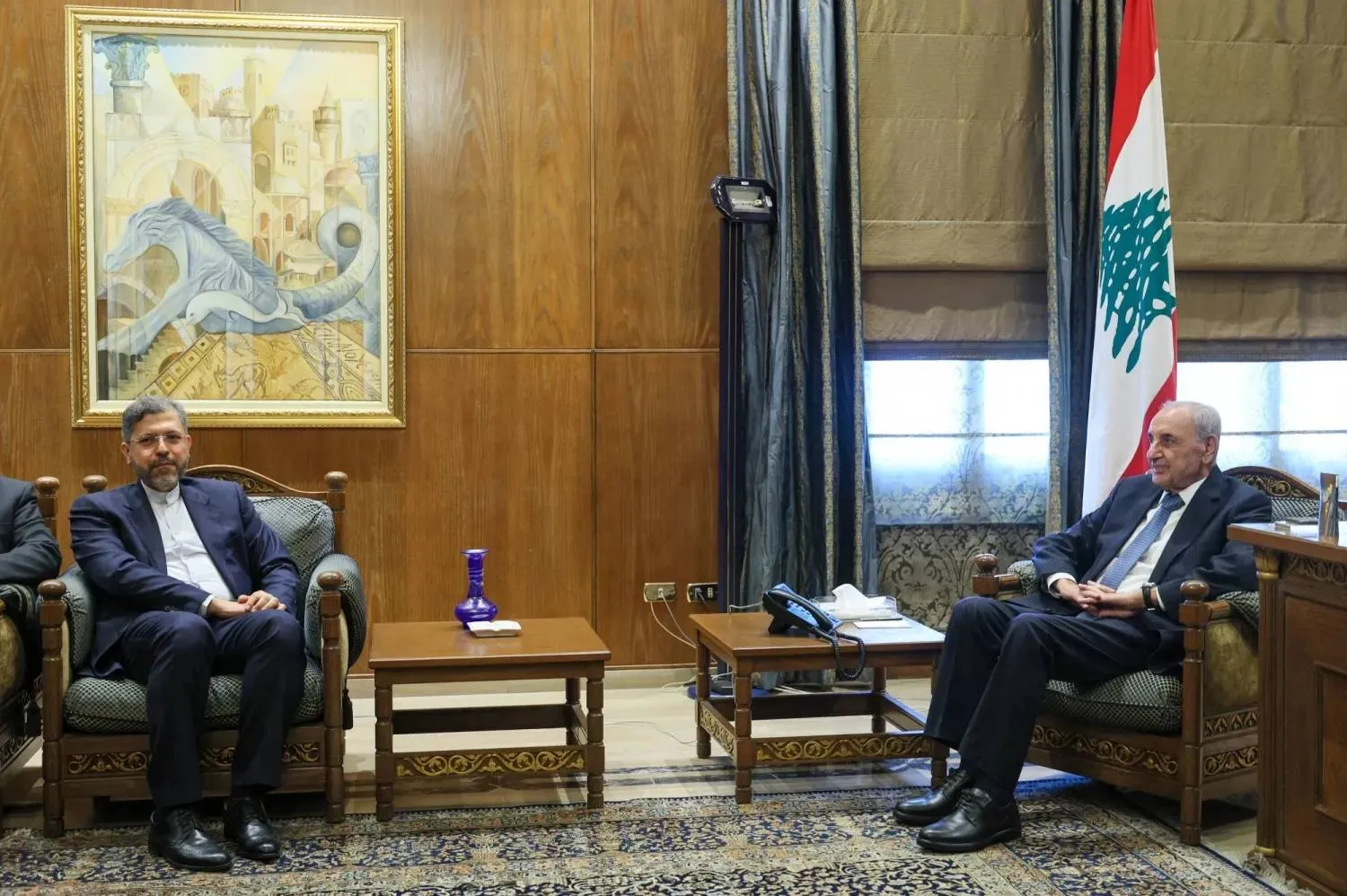
Political sources said commander of Iran's Quds Forces, Esmail Qaani, has become involved in efforts to reached political understandings to resolve the presidential elections and form a new government.

He has held several meetings with officials in Baghdad, Erbil and Najaf to reach agreements with officials.

His efforts have, however, stumbled at Kurdistan Democratic Party (KDP) leader Masoud Barzani's insistence on Zebari's nomination. The Patriotic Union of Kurdistan is meanwhile insisting on the reelection of President Barham Salih.

Qaani has also stumbled at Sadrist movement leader cleric Moqtada al-Sadr's insistence on the formation of national majority government that excludes the rival Shiite pro-Iran Coordination Framework. He is also adamant on the exclusion of the State of Law coalition, specifically its leader former Prime Minister Nouri al-Maliki.

Sadr emerged as the winner in the October parliamentary elections, giving him control over the formation of the government.


UN's Sudan Probe Says Foreign Fighters Fueling Conflict

 Women walk through a war-torn neighborhood in Sudan's Omdurman on November 2, 2024. (AFP)
Women walk through a war-torn neighborhood in Sudan's Omdurman on November 2, 2024. (AFP)
TT

UN's Sudan Probe Says Foreign Fighters Fueling Conflict

 Women walk through a war-torn neighborhood in Sudan's Omdurman on November 2, 2024. (AFP)
Women walk through a war-torn neighborhood in Sudan's Omdurman on November 2, 2024. (AFP)

Foreign fighters and support networks are fueling the conflict in Sudan and worsening violence against civilians, a UN-backed investigation warned Thursday.

The United Nations' independent fact-finding mission on Sudan said foreign involvement was strengthening the military capabilities of the country's warring parties, enabling increasingly sophisticated military operations, with devastating consequences for ordinary people.

Since April 2023, the conflict between Sudan's army and the paramilitary Rapid Support Forces has killed tens of thousands and forced millions to flee their homes.

In a report, the probe documented the recruitment, training and deployment of foreign personnel to support the RSF, with transnational entities also facilitating the transfer of weapons, ammunition, military technology and logistical support.

It also said there were reasonable grounds to believe that the regular army used foreign-supplied drones in its operations that harmed civilians and civilian infrastructure.

"This external support has not brought greater protection for civilians," said the fact-finding mission's chairman Mohamad Chande Othman.

"Instead, civilians are paying the price through attacks on homes, hospitals, schools, markets and places of refuge."

The UN Human Rights Council established the probe in October 2023, to begin gathering evidence of violations in Sudan.

The independent investigative team does not speak on behalf of the United Nations.

- Colombian contingent -

The investigation documented the deployment of up to 2,000 ex-military Colombian contractors who directly operated combat drones, artillery and advanced weapons alongside RSF units.

Witnesses also reported fighters from South Sudan, Chad and Ethiopia, "including women, serving primarily in frontline, rather than technical roles", identified by language, accent "and, in some cases uniforms", the report said.

Private entities, intermediaries and recruiters operating from countries including Colombia used transit locations in Chad, Libya and Somalia to facilitate the delivery of personnel, training, weapons and logistics to the RSF in Sudan, the report said.

It found that foreign suppliers had boosted the RSF and the army's drone capabilities, allowing them to strike far beyond the front lines.

The mission found reasonable grounds to believe that the army and RSF attacks it documented may amount to war crimes.

The United States last month urged the UN Security Council to expand an arms embargo on the Darfur region to cover all of Sudan -- a call echoed by the fact-finding mission.

"Protecting Sudan's civilians requires action not only against those fighting the war, but also against the individuals, entities and networks that enable it to continue," said Chande Othman.


‘Race Against Time’: Hamas Moves to Protect Networks Linked to Al-Arabeed

Israeli Prime Minister Benjamin Netanyahu in an area occupied by Israeli forces in Gaza on Wednesday (Netanyahu’s X account) 
TT

‘Race Against Time’: Hamas Moves to Protect Networks Linked to Al-Arabeed

Israeli Prime Minister Benjamin Netanyahu in an area occupied by Israeli forces in Gaza on Wednesday (Netanyahu’s X account) 

Hamas has entered a “race against time” to protect networks linked to senior security officer Moin Al-Arabeed after an Israeli force captured him Tuesday in a rare operation deep inside Hamas-controlled Gaza City.

Three Hamas sources told Asharq Al-Awsat that the group imposed emergency security measures following al-Arabeed's capture, moving quickly to prevent Israel from obtaining information that “could be extremely important,” according to one source.

Speaking separately, the sources said the measures were intended to head off potential surprise Israeli attacks, including assassinations of leaders, security officials and other figures who had been in direct contact with al-Arabeed.

“Hamas is in a race against time,” one source said. “Some officials who had been in contact with al-Arabeed were moved to safe locations, while documents were removed from places he frequented and from other locations he knew about.”

Two sources said Hamas security services had also scrapped some procedures used to relay messages through intermediaries and replaced the people involved. The sources agreed that Hamas was moving swiftly to “reduce the risk” after confirming that al-Arabeed had been captured alive.

A New Target Bank

One source assessed that a key Israeli objective was to “gather new security intelligence about Hamas’ structure in Gaza, after the previously known security picture changed as a result of intensive assassinations, determine who is now running the organization, and compile a new target bank.”

According to the sources, information gathered by Hamas security services over the past two days indicated that the Israeli force received “partial and limited” assistance from Israeli-backed armed Palestinian groups that had been operating in the area for some time, including through surveillance, movement around the site of the operation and monitoring nearby locations.

Some Israeli media cited Palestinian sources as confirming the armed groups’ involvement. However, military correspondents for Israeli television channels quickly relayed denials from Shin Bet security sources, saying the agency had “fully supervised the operation and carried it out highly professionally,” according to Channel 12.

Israeli Forces on Alert

Israeli forces, meanwhile, raised their alert level along the Gaza border over what Israel claimed was the possibility of Hamas attacks in retaliation for al-Arabeed’s capture.

Israel’s Channel 14 reported a “maximum security alert” after what it described as precise intelligence indicating Hamas intended to attack forces deployed in the area.

The Israeli military prepared its troops to thwart any such attack, but none occurred over the following two days. The channel said the intelligence nevertheless indicated Hamas’ growing motivation to target forces deployed near the so-called Yellow Line separating Israeli-held areas from those controlled by Palestinian factions.

Israel Hayom, however, reported that the heightened alert coincided with and followed Prime Minister Benjamin Netanyahu’s visit to the Yellow Line opposite Jabalia in northern Gaza, a day after al-Arabeed’s capture.

During the visit, Netanyahu hailed the operation to seize the Hamas internal security official and said Israeli forces would continue their missions and would not withdraw from Gaza until Hamas and the territory were fully disarmed.

Israeli military operations in Gaza intensified Thursday. Two people, including a child, were killed by Israeli fire near the Yellow Line in Beit Lahia in northern Gaza. Israeli forces also carried out a limited ground incursion near Kamal Adwan Hospital, temporarily forcing it to suspend operations after gunfire reached the facility.

Four Palestinians were wounded in similar shooting incidents near the Yellow Line in several areas of Khan Younis in southern Gaza and east of Deir al-Balah in central Gaza.


Israeli Military Says It Has Control of Lebanon’s Strategic Ali Al-Taher Area

A satellite image shows damage at the Ali al-Taher ridge near Nabatiah, Lebanon, March 8, 2026. 2026 (Planet Labs PBC/Handout via Reuters)
TT

Israeli Military Says It Has Control of Lebanon’s Strategic Ali Al-Taher Area

A satellite image shows damage at the Ali al-Taher ridge near Nabatiah, Lebanon, March 8, 2026. 2026 (Planet Labs PBC/Handout via Reuters)

Israel's military said on Thursday it had taken “operational control” of the strategic Ali al-Taher ridge area in southern Lebanon, the site of sporadic clashes between Israeli forces and Hezbollah in recent weeks. It is where Hezbollah is believed to have an extensive underground military facility.

The military said troops had cleared Hezbollah fighters from two underground routes, killing some while others fled. It said operations were ongoing.

Operations aimed at neutralizing underground infrastructure, after clearing them of Hezbollah operatives, are ongoing, with the military set to redeploy defensively following the completion of the activity, based on a situational assessment, it added.

The military accused the fighters inside the facilities of working to carry out plots against Israel and army forces. It noted that operations in the area in recent weeks have neutralized the capability to launch attacks against Israelis and army forces from it.

The Israeli army stated that inside the underground infrastructure, it discovered operations rooms, rooms designated for combat gear, and others for generators and accommodation, in addition to showering facilities and a kitchen, allowing Hezbollah fighters to manage combat and remain inside for extended periods.

It described these facilities as “strategic infrastructure” built over two decades, saying they were planned and funded by the Iranian regime.

There was no immediate comment from Hezbollah.

The Israeli army said its forces will continue to clear the occupied so-called “security zone” in southern Lebanon of Hezbollah, saying it will not allow the party to carry out plots against it,

Any attempt by Hezbollah to launch attacks against the army “will be met with force,” warned Israel, while saying it was committed to the ceasefire agreement in Lebanon.

The Ali al-Taher hill overlooks several villages as well as main roads leading to the city of Nabatieh. Losing control of it would disrupt Hezbollah’s presence and supply lines in the area.