


Bloody Fighting between Opposition Factions in N.Syria in Struggle for Power, Influence

Disputes have erupted between rival factions over a struggle for power and influence. (Asharq Al-Awsat)
TT

Bloody Fighting between Opposition Factions in N.Syria in Struggle for Power, Influence

Disputes have erupted between rival factions over a struggle for power and influence. (Asharq Al-Awsat)

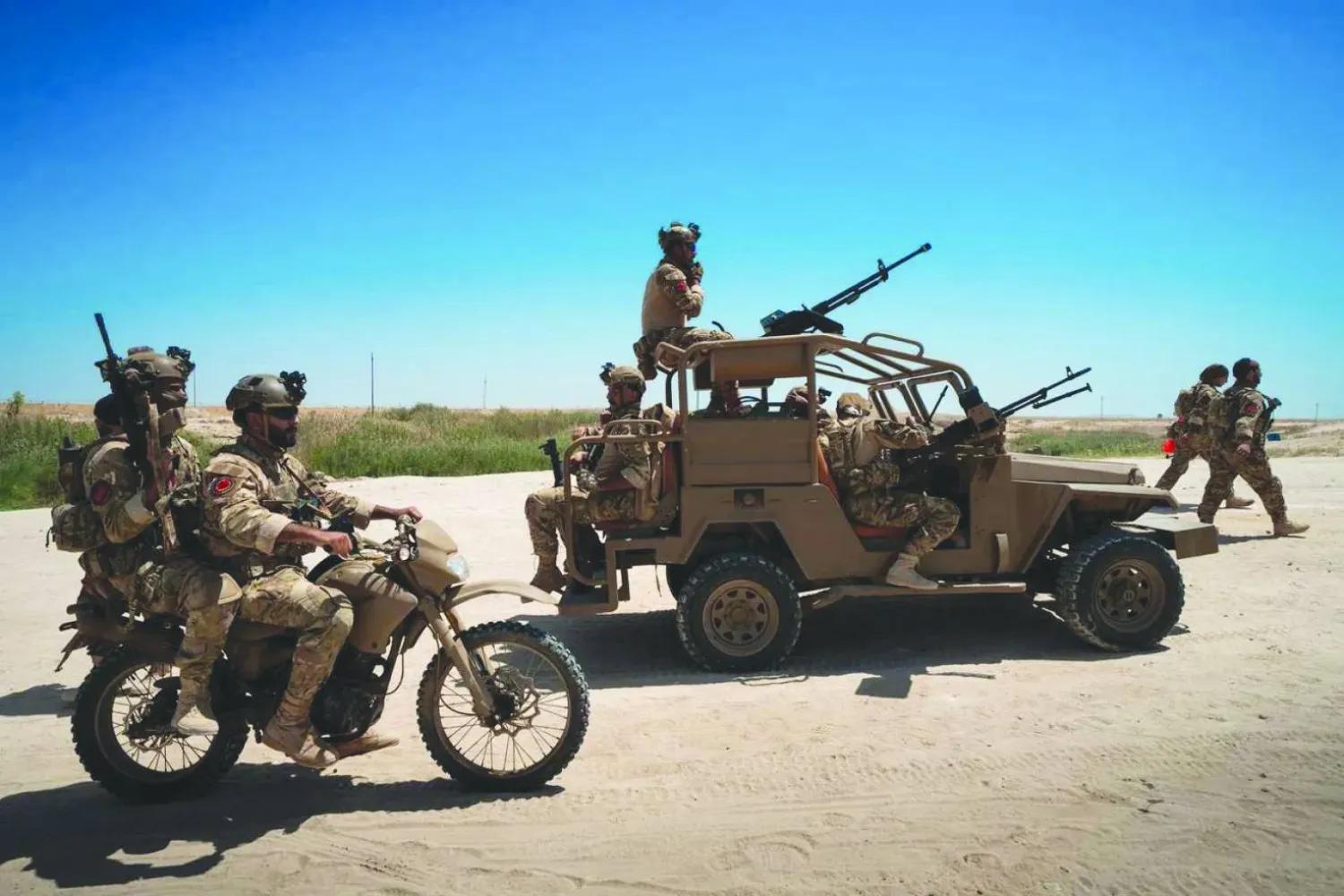
Internal fighting continued between different factions of the Syrian National Army, supported by Ankara, in the areas of Turkish military operations in northern Syria.

Disputes have erupted over a struggle for power and influence, and for material gains that are reaped from ports and smuggling crossings.

Activists in the countryside of Aleppo said a member was killed on Thursday in an armed clash between two groups of the Sultan Suleiman Shah Division, affiliated with the Syrian National Army, in the city center of Jindires in the countryside of Afrin, northern Aleppo. The dispute resulted in the serious injury of other militants.

On April 18, the Syrian Observatory for Human Rights said violent clashes, using with medium and light machine guns, erupted between two groups of the Syrian Front faction, which is affiliated with the Syrian National Army, near Al-Qabban roundabout in the center of Afrin city.

The dispute developed into violent clashes between the two parties, without reports on human casualties.

Husam al-Shihabi, a resident of the city of al-Bab in the countryside of Aleppo, said violent clashes erupted on April 2, between the Ahrar al-Sham and Al-Jabha al-Shamiya factions, near the city, located within the Euphrates Shield area.

The dispute erupted when a leader in Ahrar al-Sham refused to give up his position in the Third Legion, which is affiliated with the National Army.

The clashes led to the killing and wounding of four members of the factions, and the blocking of the roads leading to al-Bab, prompting the residents to stage a mass demonstration in the city, calling on the factions to stop the fighting and observe the sanctity of the month of Ramadan.

“About 17 members have been killed and more than 30 others wounded, since the beginning of 2022, in bloody clashes between the factions affiliated with the Syrian National Army, in the areas of the northern countryside of Aleppo (al-Bab, Afrin Jandiris, Azaz and Al-Ra’i), which caused the closure of roads and markets,” Shihabi said.


UK PM Says Russia Could Attack NATO Within Four Years

 British Prime Minister Keir Starmer speaks as he visits STARK, a leading defense tech company in Swindon, England, Friday, June 5, 2026. (Reuters)
British Prime Minister Keir Starmer speaks as he visits STARK, a leading defense tech company in Swindon, England, Friday, June 5, 2026. (Reuters)
TT

UK PM Says Russia Could Attack NATO Within Four Years

 British Prime Minister Keir Starmer speaks as he visits STARK, a leading defense tech company in Swindon, England, Friday, June 5, 2026. (Reuters)
British Prime Minister Keir Starmer speaks as he visits STARK, a leading defense tech company in Swindon, England, Friday, June 5, 2026. (Reuters)

Russia could attack a NATO country within four years according to western intelligence assessments, UK Prime Minister Keir Starmer warned on Friday.

He made the comments as he pledged his government would publish a long-delayed defense investment plan before next month's NATO summit.

"It is our intelligence assessment and the assessment of other countries in NATO that there could be an attack by Russia on NATO as soon as 2030," Starmer said.

"So you can see the urgency and the priority that we're putting behind this now," he added during a visit to a drone manufacturer in southwest England.

It echoes similar timeframes expressed by other European leaders and NATO chief Mark Rutte who warned in December that Russia "could be ready to use military force against NATO within five years".

Starmer has pledged to raise defense spending to 2.5 percent of gross domestic product from next year, increasing to three percent in the next parliament.

A 10-year defense investment plan following a review of the UK's defense capabilities was meant to be published late last year but has not yet been produced.

Starmer announced it would be published before the NATO summit in Türkiye, beginning on July 7.

UK media has reported that the plan has been delayed due to disagreement between the finance ministry and other departments over the cost.

Starmer insisted to reporters it would be "fully funded".

Earlier Friday, Britain's military chief warned that Britain must boost its defenses in response to threats posed by Russia, which invaded Ukraine more than four years ago.

"In my 35-year career, this is the most dangerous period that I have known," Air Chief Marshal Richard Knighton told the BBC.

"And as a consequence, it is important that we enhance the capability and the readiness of our armed forces alongside our allies to deter our adversaries from doing something daft."

US President Donald Trump has repeatedly urged NATO countries to spend more on defense and become less reliant on Washington for security.


France Opens ‘War Crime’ Probe Over Israel Treatment of Gaza Flotilla Activists

 Boats belonging to the Global Sumud Flotilla, carrying activists and humanitarian aid, depart for Gaza from the port of Marmaris, Türkiye, Thursday, May 14, 2026, in an attempt to break the Israeli naval blockade. (AP)
Boats belonging to the Global Sumud Flotilla, carrying activists and humanitarian aid, depart for Gaza from the port of Marmaris, Türkiye, Thursday, May 14, 2026, in an attempt to break the Israeli naval blockade. (AP)
TT

France Opens ‘War Crime’ Probe Over Israel Treatment of Gaza Flotilla Activists

 Boats belonging to the Global Sumud Flotilla, carrying activists and humanitarian aid, depart for Gaza from the port of Marmaris, Türkiye, Thursday, May 14, 2026, in an attempt to break the Israeli naval blockade. (AP)
Boats belonging to the Global Sumud Flotilla, carrying activists and humanitarian aid, depart for Gaza from the port of Marmaris, Türkiye, Thursday, May 14, 2026, in an attempt to break the Israeli naval blockade. (AP)

France has opened an investigation into an alleged "war crime" and "torture" over Israel's treatment of French activists who took part in a Gaza-bound aid flotilla, a prosecutor's office said Friday.

The probe was opened at the government's request, the national counterterrorism prosecutor's office (PNAT) said, after activists accused Israeli authorities of mistreatment during their detention last month.

Israel detained more than 430 activists from countries around the world after intercepting them in international waters on May 18 as they made the latest in a string of attempts to break the blockade of the Palestinian territory.

Israel's far-right National Security Minister Itamar Ben Gvir sparked widespread condemnation after he posted a video mocking the flotilla activists while they were bound.

France banned Ben Gvir from entry over the incident.

Several French activists described what they said was a violent and humiliating ordeal when eight of them returned to France on May 22.

Two of the more than 30 French people who were on board the flotilla were still in hospital in Türkiye, they told reporters.

One returnee described a soldier groping and slapping her in a dark container, and being terrified that she would be raped.

Another recounted detained activists being put in what she called a "stress position", on their knees with their foreheads on the ground for several hours, while the Israeli national anthem played on repeat.

Asked by AFP to respond to the claims of physical and psychological violence, sexual harassment, assault and rape, the Israeli prison service said the accusations were "entirely without factual basis".

Francesca Albanese, an outspoken UN expert on the Palestinian territories, has said the treatment of the flotilla activists "is a luxury compared to what is inflicted on Palestinians in Israeli prisons".


Anthropic Urges AI Labs to Pause Development, Warns Humans Risk Losing Control

Anthropic is warning that rapid advances in the technology could soon allow AI systems to improve themselves faster than society can manage the risks. (file photo/Pexels)
TT

Anthropic Urges AI Labs to Pause Development, Warns Humans Risk Losing Control

Anthropic is warning that rapid advances in the technology could soon allow AI systems to improve themselves faster than society can manage the risks. (file photo/Pexels)

Anthropic is calling on major artificial intelligence labs to consider a coordinated and verifiable pause in development, warning that rapid advances in the technology could soon allow AI systems to improve themselves faster than society can manage the risks.

The Claude creator said AI's ability to complete tasks on its own has been doubling roughly every four months and it was headed for "recursive self-improvement", the point at which the technology can improve without human intervention.

"If systems are capable of fully building their own successors, the ways we secure them, monitor them, and shape their behavior all grow much more important," the startup said in a lengthy blog post on Thursday, adding that a pause would allow society to "deal with its immense implications."

"We are not there yet, and recursive self-improvement is not inevitable. But it could come sooner than most institutions are prepared for," Anthropic co-founder Jack Clark and Anthropic Institute lead Marina Favaro wrote in the post.

Fears that advanced AI systems may get out of human control and cause societal harm have risen as the technology becomes increasingly capable. Anthropic's own Mythos model sent shockwaves through industries including banking and software earlier this year with its ability to find vulnerabilities in existing code.

But regulation has been slow, especially in the US where most leading AI labs are based. A Trump administration executive order earlier this week put the onus on the labs themselves, asking them to voluntarily submit their most capable models for government cybersecurity testing before public release.

AI researchers have also urged a pause before but had little success. Elon Musk, who owns AI lab xAI, was among backers of a 2023 push by the non-profit Future of Life Institute to halt AI development for six months to allow time for safety guardrails.

Anthropic has long positioned itself as a safety-focused AI lab. Earlier this year, it refused to let the US military use its models for domestic surveillance and fully autonomous weapons, prompting backlash from the government which put it on a national security blacklist, set to take effect later in 2026.

Reuters reported on Friday the dispute was showing signs of easing across parts of the US government.

Still, Anthropic has continued to release increasingly powerful models and in February walked back a key safety pledge, saying that it would no longer hold back potentially dangerous AI if rivals were close to matching its capabilities.

It was recently valued at $965 billion in a massive funding round and confidentially filed for a US initial public offering on Monday, putting it ahead of rival OpenAI in both valuation and the race to secure crucial funding.

COORDINATED ACTION

Anthropic's Thursday post cautioned that unilateral or poorly coordinated slowdowns could backfire if less cautious actors continue advancing, potentially reducing overall safety.

It said that a meaningful pause would require agreement among "multiple well-resourced labs" operating at the technological frontier, as well as rules on what conditions would trigger or lift such a pause and who would oversee it.

"A unilateral pause by one lab, by contrast, is achievable immediately, but accomplishes much less: it would change who the front-runner is, but it would not create the wider deliberative process that is currently missing," the startup said.

Its research arm, Anthropic Institute, plans to study systems needed to support a slowdown and in the coming months will convene policymakers, researchers, civil society groups and rival AI firms to discuss managing risks such as recursive self-improvement.

OpenAI, xAI, Alphabet, Meta Platforms and France's Mistral did not immediately respond to requests for comment on whether they would join the call.