

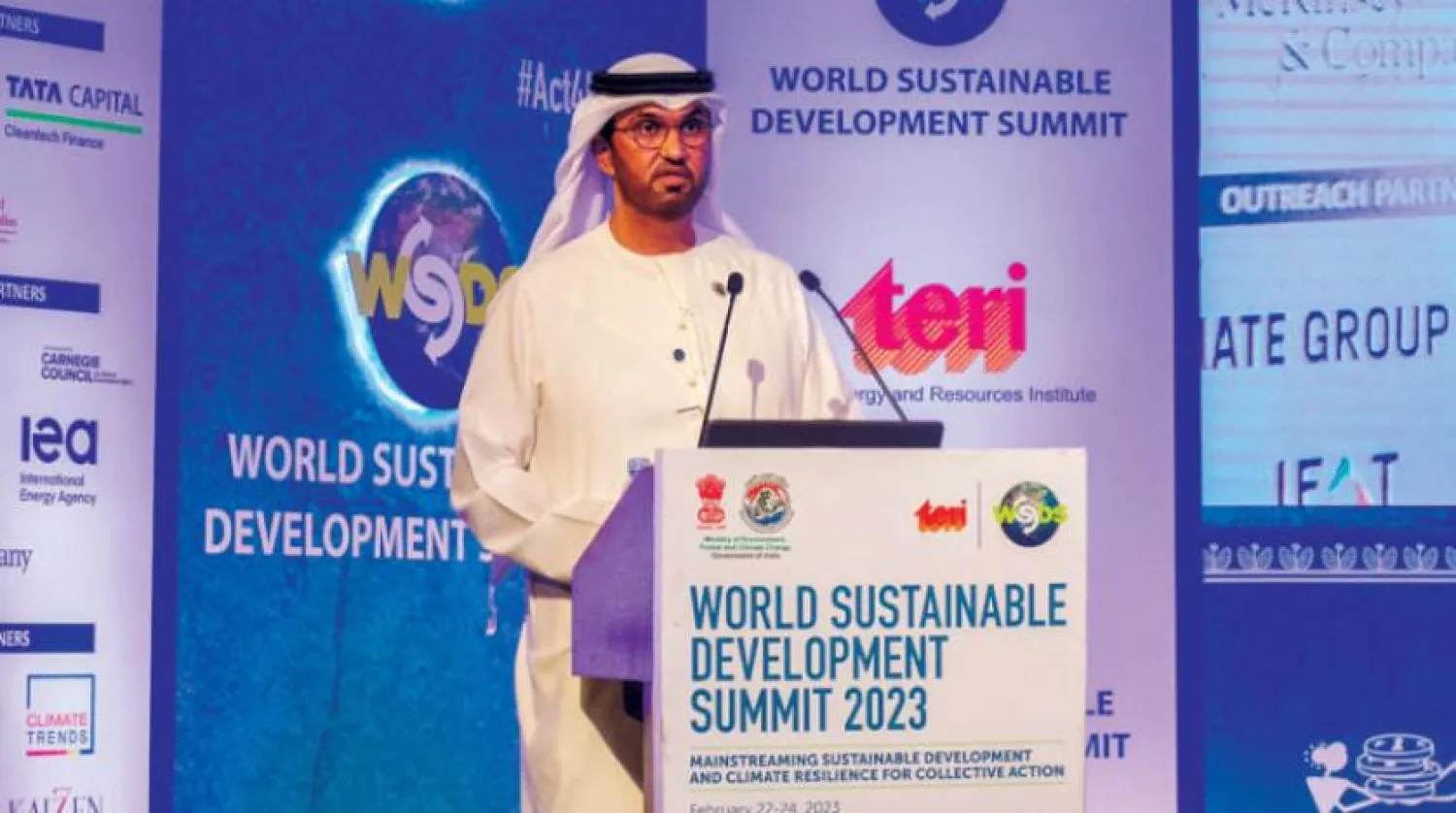

COP28 President-designate Says Paris Agreement Goal of 1.5°C Is ‘Non-negotiable'

Al Jaber speaking at the World Sustainable Development Summit in New Delhi. (WAM)
TT

COP28 President-designate Says Paris Agreement Goal of 1.5°C Is ‘Non-negotiable'

Al Jaber speaking at the World Sustainable Development Summit in New Delhi. (WAM)

Dr. Sultan Al Jaber, COP28 UAE President-Designate, emphasized the need to mobilize resources and partnerships toward a bold and transformative approach to climate action.

His remarks came during the World Sustainable Development Summit hosted by The Energy and Resources Institute (TERI) in New Delhi.

Al Jaber reaffirmed the UAE’s unwavering commitment to the Paris Agreement goal of limiting global temperature rise to 1.5 degrees Celsius but stressed that progress was far from what was needed.

“Let me make one thing absolutely clear: the goal of keeping 1.5 alive is non-negotiable. It is also clear that business as usual won’t get us there. We need a paradigm shift in our approach to mitigation, adaptation, finance, and loss and damage.”

Acknowledging the need to support those impacted by climate change, he also pointed to the need to boost support for adaptation, and to embrace nature-based solutions.

“On adaptation, COP28 must conclude the Global Goal on Adaptation, and finalize agreement around doubling adaptation finance. TERI has been at the forefront of pushing for this goal, which will help protect vulnerable communities across the Global South. Adaptation also means preserving ALL life on earth, protecting biodiversity, natural ecosystems, and endangered species. As a nation, and as the COP28 Presidency, we share India’s firm belief that safeguarding and respecting nature is a fundamental obligation. The UAE has always embedded environmental protection, respect for nature, and climate action into our development strategy,” state news agency WAM cited Al Jaber as saying.

The COP28 President-Designate emphasised that the step change in the climate progress needed cannot happen without accessible and affordable capital, noting that trillions, not billions, are required.

“A key enabler will be the reform of the International Financial Institutions and Multilateral Development Banks. We must mobilise much more concessional finance to unlock more private sector capital and target investments where they are needed most. As such, scaling and accelerating climate finance will be one of the key goals of the COP28 Presidency, and we will rally all relevant parties in an effort to get it done.”

Dr. Al Jaber expressed that progressive climate action represents an immense opportunity for the world: “An opportunity to create millions of jobs and invent new sectors, businesses, and industries. In fact, it will create the greatest leap in human development and prosperity since the first industrial revolution.”

“Let’s ensure that progress is truly inclusive… that no-one is left behind. Let’s keep 1.5 alive, while putting an end to energy and water poverty. Let’s unite around climate action that carries humanity forward. And let’s prove that you can be pro-climate and pro-growth at the same time.

“In the months to come, myself and the COP28 team, will continue to listen, consult, and engage with everyone. Everyone from civil society, Indigenous peoples, the private sector, governments, women, and youth," he added.

“Let’s unite everyone around a COP of action and a COP for all. Let’s remember that the world makes progress through partnership, not polarization."

“And let’s follow TERI’s motto: ‘the best way to predict the future is to create it.’ So, let’s get to work and create a sustainable future together.”



Taiwan Says Will Invest Up to US$4.4 bn in Alaska Gas Project

A snipers team provides security as US President Donald Trump boards Air Force One at Elmendorf Air Force Base in Anchorage, Alaska, on October 13, 2026. (Photo by Kent NISHIMURA / AFP)
TT

Taiwan Says Will Invest Up to US$4.4 bn in Alaska Gas Project

A snipers team provides security as US President Donald Trump boards Air Force One at Elmendorf Air Force Base in Anchorage, Alaska, on October 13, 2026. (Photo by Kent NISHIMURA / AFP)

Taiwan said Wednesday it will inject up to US$4.4 billion in the Alaska LNG project, after US President Donald Trump announced the island's investment in the to-be-built natural gas pipeline.

Taiwan imports nearly all of its energy supply and has sought to shore up Washington's support as China presses its claims of sovereignty over the island democracy.

"According to current plans, the cooperation will include the annual procurement of six million metric tons of Alaska LNG following production," the Ministry of Economic Affairs said in a statement.

It will also involve "participation in project development, with an estimated investment of up to US$4.4 billion," AFP quoted the ministry as saying.

"If the project progresses smoothly according to the planned timeline, it is expected to begin further supplementing domestic natural gas supplies as early as 2032," it added.

The statement came hours after Trump told a rally in Wasilla, Alaska, that Taiwan had agreed to buy 30 percent of the output from the pipeline over the next 20 year and also invest US$4.4 billion into the project.

Taiwan sources its LNG from multiple countries but the mix has changed dramatically this year after the start of the Middle East war when Iran claimed control of the Strait of Hormuz.


Saudi Arabia Drives September Surge in OPEC+ Output Despite Iran War Disruptions

An oil tanker at Ras Al-Khair port, north of Dammam, in 2019. REUTERS
TT

Saudi Arabia Drives September Surge in OPEC+ Output Despite Iran War Disruptions

An oil tanker at Ras Al-Khair port, north of Dammam, in 2019. REUTERS

OPEC+ crude output surged in September as Saudi Arabia ramped up production, despite continued disruption to oil shipments through the Strait of Hormuz caused by the Iran war, OPEC said in its monthly report on Tuesday.

The Organization of the Petroleum Exporting Countries raised its forecast for global oil demand growth in 2027 to 2.55 million barrels per day (bpd) from 2.36 million bpd, citing the need to replenish inventories depleted by war-related supply disruptions.

But it cut its demand growth forecast for this year for a sixth straight month, to 180,000 bpd from about 380,000 bpd in its August estimates.

OPEC+, which groups OPEC members and allies including Russia, pumped an average of 39.068 million bpd in September, up 903,000 bpd from 38.165 million bpd in August, the report showed.

Output has risen by about 1.36 million bpd since July, when it stood at 37.710 million bpd, according to the secondary sources OPEC uses to track production.

OPEC members drove the increase, raising output by about 920,000 bpd to 25.097 million bpd from 24.177 million bpd a month earlier. Production by participating non-OPEC countries fell by about 18,000 bpd.

Saudi Arabia leads surge

Saudi Arabia posted the alliance's largest production increase. Output climbed to 8.372 million bpd in September from 6.238 million bpd in August, a gain of more than 2 million bpd, according to figures the kingdom submitted to OPEC.

The increase comes as Saudi Arabia seeks to restore oil flows and strengthen the resilience of its exports against war-related disruptions. Aramco increased oil loadings at Gulf export terminals in September after an attack on the East-West pipeline disrupted shipments through the Red Sea.

Inventory rebuilding to support demand

OPEC expects global oil demand to rise by 2.55 million bpd in 2027 to average 108.3 million bpd, compared with 108.19 million bpd in last month's forecast.

The forecast assumes demand growth in 2026 will slow as currently expected, with the need to replenish depleted inventories supporting growth next year, OPEC said.

For 2026, the group expects demand growth of just 180,000 bpd. It also cut its fourth-quarter demand estimate to 107.73 million bpd from 107.85 million bpd in last month's report.

Demand in countries belonging to the Organisation for Economic Co-operation and Development is forecast to shrink by about 210,000 bpd this year, while demand in non-OECD economies is expected to grow by 390,000 bpd.

Oil supply from outside OPEC+ is forecast to grow by 640,000 bpd in 2026 and 620,000 bpd in 2027.

Russian output declines

Russian oil output fell by 38,000 bpd in September to 8.643 million bpd, the report showed, amid continued Ukrainian strikes on Russian energy infrastructure, including refineries.

Russian Deputy Prime Minister Alexander Novak said the country would trim oil production this year. Russia's Economy Ministry lowered its 2026 output forecast to a 17-year low amid the war with Ukraine.

Kazakhstan's production rose by 22,000 bpd in September to 1.851 million bpd, according to the OPEC report.


From Hydrogen to AI, Energy Leaders Map the Sector’s Global Future

A panel discussion examines challenges and opportunities at the World Petroleum Congress in Riyadh (Asharq Al-Awsat)
TT

From Hydrogen to AI, Energy Leaders Map the Sector’s Global Future

A panel discussion examines challenges and opportunities at the World Petroleum Congress in Riyadh (Asharq Al-Awsat)

Green hydrogen, artificial intelligence and strategic partnerships took center stage at the World Petroleum Congress in Riyadh, as sessions mapped the energy sector’s future amid rapid technological and industrial change.

Progress on clean energy projects, led by the NEOM Green Hydrogen Project, now 96% complete, intersected with the challenge of cutting emissions from transport, which accounts for about 30% of global energy demand.

The discussions highlighted a widening agenda: developing energy sources and reshaping how energy is produced and used to improve efficiency and sustain supplies.

Saudi Aramco said it plans to increase gas sales by 80% by 2030 compared with 2020 and 2021 levels, and to build and start operating six to seven gas and liquefied gas facilities between 2025 and 2027.

Decarbonization

Transport and logistics account for about 30% of global energy demand, Saudi Vice Minister of Transport and Logistics Services Rumaih Al-Rumaih told a conference session.

Decarbonization is a long journey that requires a broader energy mix, he said, stressing the need for available, reliable, affordable and safe supplies.

The Saudi Green Initiative provides a framework for reaching net-zero emissions by 2060, with transport playing a major role, Al-Rumaih said.

Saudi Arabia is expanding public transport and cutting urban emissions to meet its commitments, he added. The Riyadh Metro network spans 187 kilometers and has 85 stations.

Green hydrogen

National Development Fund Governor Abdulaziz Al-Arifi said the fund had provided financing and strategic support for the NEOM Green Hydrogen Project alongside local banks and other entities and organizations.

That support helped advance one of the clean energy sector’s leading projects, strengthening investment opportunities and local content, he told the conference.

ACWA Power Chairman Mohammad Abunayyan said local resources, knowledge and expertise accounted for about 90% of those used in new projects. He reaffirmed the company’s commitment to expanding investment and overcoming challenges on the ground in major global markets such as China.

At the same session, Saudi Aramco Executive Vice President of Gas Abdulkarim Al-Ghamdi discussed operational readiness and supply chains.

Resource localization under the company’s iktva program had reached levels ranging from more than 75% to 90%, he said, offering strong protection against external disruptions.

Saudi personnel and technological integration are the two pillars of sustained gas-sector growth and future resilience, he said.

Artificial intelligence

A panel at the 25th World Petroleum Congress explored how energy powers artificial intelligence, how the two sectors interact and how AI can sharpen decisions, improve operations and raise energy efficiency.

Speakers said development of the energy and electricity sectors under Vision 2030 aims to meet demand and attract investment, including in AI data centers that need reliable, competitively priced electricity.

The approach involves anticipating sectors’ needs and connecting them with investors. Speakers stressed the need to integrate infrastructure, data, technology and human expertise, drawing on Saudi Arabia’s strengths to develop solutions and bring them to global markets.

Smart meters

AI can improve forecasts of electricity loads and demand and detect grid faults early, helping planners respond faster, speakers said.

Smart meter data can track consumption, forecast bills, show electricity use by appliance and flag unusual usage.

In oil and gas exploration and resource development, particularly drilling, AI can analyze data in real time and combine engineering models with geological information.

This can speed up decisions, improve accuracy, shorten the gap between planning and execution, enhance safety and support risk assessments and investment decisions.

To expand these applications, companies must deliver tangible business value and integrate the tools into operations, speakers said.

They must also ensure data quality and timely collection, train personnel to assess outputs and keep people involved in final decisions, while using digital tools to reduce risks.