


Royal Commission for AlUla Begins Construction on Sharaan Resort, Int’l Summit Center

Royal Commission for AlUla Begins Construction on Sharaan Resort, Int’l Summit Center
TT

Royal Commission for AlUla Begins Construction on Sharaan Resort, Int’l Summit Center

Royal Commission for AlUla Begins Construction on Sharaan Resort, Int’l Summit Center

The Royal Commission for AlUla (RCU) has begun construction of its Sharaan Resort and International Summit Center designed by French architect Jean Nouvel, it said in a press release.

The project will be built directly into the mountains of Saudi Arabia’s Sharaan Nature Reserve and aims to meet ambitious sustainability goals for the construction phase and resort operations, RCU said Wednesday.

In a ceremony at Sharaan Nature Reserve, RCU signed an agreement with Bouygues Construction, a French engineering group, which will manage construction of the resort through a joint venture with Almabani, a leading Saudi engineering firm. Bouygues Construction brings a unique combination of experience in tunneling and construction of ultra-luxury hotels, both required for this complex development.

RCU's Development and Construction sector is spearheading this project with consultation from Canadian firm WSP and with program management support from Jasara, a Saudi firm. Together they will deliver the masterful vision which will immerse guests in the natural and cultural heritage of Sharaan Nature Reserve.

Just as the Nabataean civilisation carved structures into nearby sandstone more than 2,000 years ago, Sharaan resort will carve a new chapter in stone for AlUla's living museum while preserving the natural scenery and native flora and fauna at the heart of RCU's vision for Sharaan. RCU consulted with the world's top experts in mining and excavation to engineer solutions in line with the architectural vision.

Built into a mountain dating back 500 million years, the Sharaan resort will offer a memorable and timeless experience with 38 suites, a spa and wellness center, kids club, sport center, all-day dining restaurant and business center. In addition, a signature fine-dining restaurant will sit atop the mountain with panoramic views of Sharaan. A unique glass elevator will connect the resort with a geologic and artistic experience, offering views of ancient sedimentary layers and niches filled with art and engravings.

Inside an adjacent mountain, the Sharaan International Summit Center will host events and leaders from around the world. With a completely secure and private environment, its design will enable chance encounters and private interaction for guests with shared leisure activities in an informal setting. Facilities will include an auditorium, meeting rooms, majlis (sitting room), library, and a sport and leisure area.

The Summit Center will also have 13 total hospitality pavilions and two private villas will be constructed nearby, completing the project with 53 total hospitality keys.

Aligned with Saudi Arabia's Vision 2030 and the Sustainability Charter for AlUla, the Sharaan Resort and International Summit Center is designed in harmony with its natural environment. Discreet studies of the site have informed the design of passive strategies and natural geological heat transfer to efficiently cool the property in summer and provide warmth in the winter. The project also aims for zero wastewater by using potable water only when needed and by recycling all treatable wastewater for irrigation and other purposes.

Mohammed Altheeb, RCU Chief Development and Construction Officer, said: "The resort was designed with complete reverence for the human and natural history of AlUla, and we are committed to sustainable building practices in line with this same philosophy."

Deputy CEO of Bouygues Construction Pierre-Eric Saint-André, said: "We are grateful to be part of the ambitious cultural and tourism project of AlUla.”

“The bold vision of Jean Nouvel's architectural firm ... is a great source of inspiration for us, since the technical prowess it requires are absolutely unique and incredibly stimulating. We are confident that we will be able to bring our passion for challenges and our state-of-the-art expertise acquired over 70 years on all continents to ensure that this great project becomes an iconic reference in terms of exclusive tourist experience, respect for the environment and harmonious integration within grandiose landscapes."
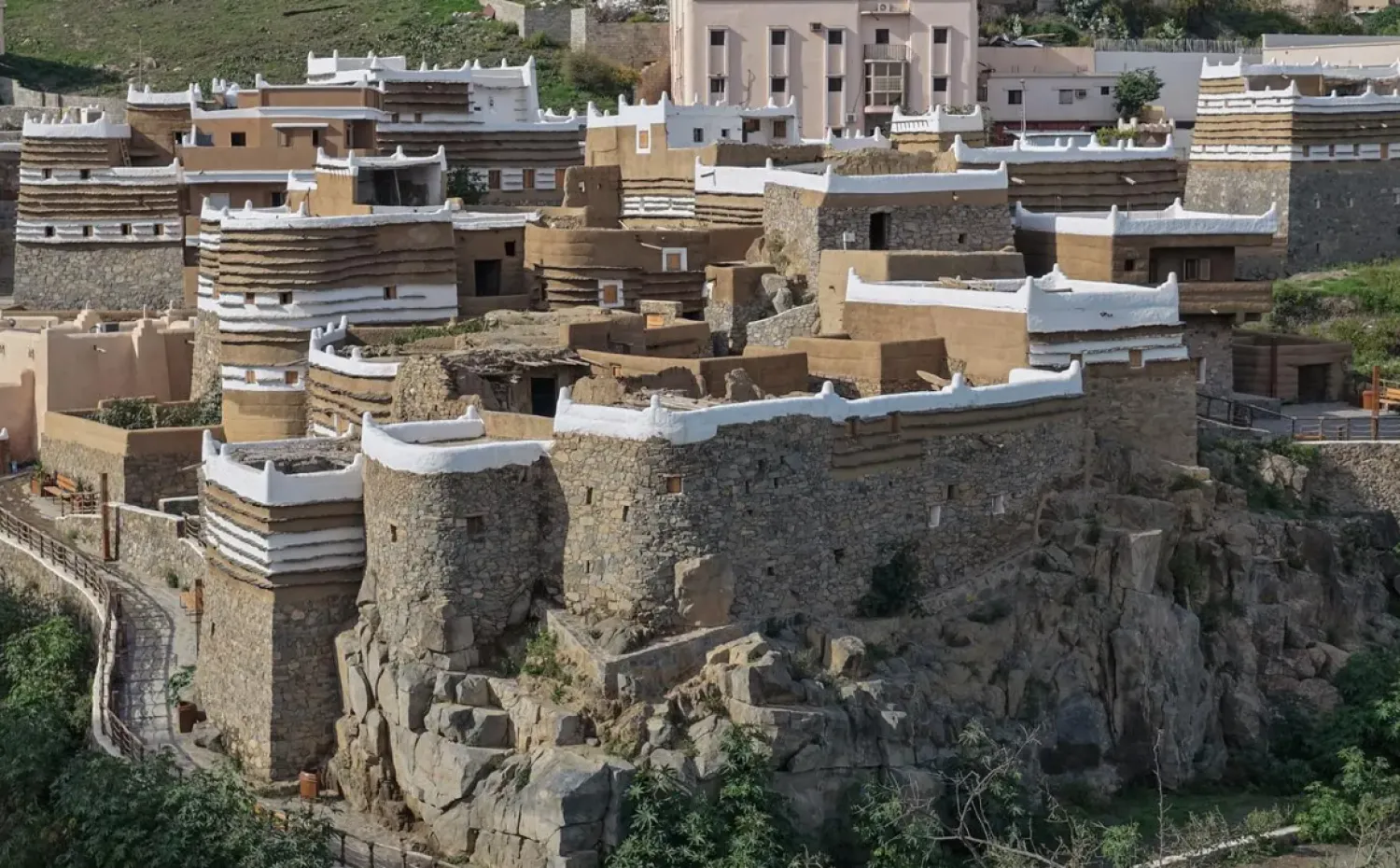



Heritage Commission Revives Al-Nasb Heritage District as Abha Cultural Tourism Destination

The district’s significance lies in its unique architectural composition - SPA
TT

Heritage Commission Revives Al-Nasb Heritage District as Abha Cultural Tourism Destination

The district’s significance lies in its unique architectural composition - SPA

Al-Nasb Heritage District in Abha is one of the most prominent living examples of traditional architecture in Aseer Region, preserving its long history and architectural details that embody people’s connection to their local environment and document the social and cultural patterns that have shaped the identity of the place across generations.

The district’s significance lies in its unique architectural composition, where mud and stone buildings stand side by side in visual harmony. They were built using local materials such as stone, clay, and juniper trunks, while the narrow alleyways and closely set buildings give the district a cohesive social character that reflects the spirit of past communities in the region and the close relationship between people and place.

The Heritage Commission has revived the district through an integrated restoration and rehabilitation project aimed at preserving its original elements and enhancing its sustainability, as part of national efforts to protect urban heritage and highlight it as a cultural and tourism asset, SPA reported.

The site is also distinguished by its natural setting, as the district overlooks the banks of Abha Valley and surrounding farms, giving it a distinctive visual and aesthetic dimension. Its narrow passageways and closely set buildings illustrate a traditional urban pattern that strengthens ties among residents and captures the nature of social life in that era.

The district is now a growing destination for culture and tourism in Abha, attracting visitors and heritage enthusiasts who come to explore the details of authentic architecture and learn about the traditional ways of life that have shaped Aseer Region’s identity across generations. The project helps raise awareness of the importance of preserving archaeological sites as a key pillar in forming national memory.

The project is part of the Kingdom’s efforts to protect and effectively manage cultural heritage, in line with the targets of Saudi Vision 2030, which gives special attention to the cultural sector. It seeks to turn heritage sites into vibrant spaces that support cultural tourism and sustainable development while reconnecting society with its historical roots.


Saudi Heritage Commission Enforces Strict Penalties Against Antiquities Violators

The fines varied according to the nature and circumstances of each violation
TT

Saudi Heritage Commission Enforces Strict Penalties Against Antiquities Violators

The fines varied according to the nature and circumstances of each violation

The Saudi Heritage Commission announced financial fines against 11 violators for dealing in portable antiquities without obtaining the required regulatory licenses, as part of its ongoing efforts to protect cultural heritage in the Kingdom and enhance compliance with regulations governing the sector.

The commission clarified that the violations involved displaying and selling antiquities on online platforms without registering or documenting them with the Heritage Commission or obtaining the necessary licenses, in explicit violation of the provisions of the Law of Antiquities, Museums and Urban Heritage.

The fines varied according to the nature and circumstances of each violation, reaching up to SAR15,000 in some cases.

The commission reaffirmed its commitment to monitoring violations related to heritage sites and collections across the Kingdom and taking the necessary legal and regulatory actions against all those proven to have contravened the regulations.

The Heritage Commission called on all citizens and residents to report any violations or non-compliant practices related to heritage sites or collections through its social media channels, by visiting its branches across the Kingdom, through the Archaeological Site Reporting platform, or by contacting the unified security operations center at 911.


Holy Quran Museum Showcases Rare 18th-Century Brass-Engraved Copy of the Quran

Among the museum’s distinctive exhibits is a copy of the Quran engraved on brass plates dating back to the 12th century AH - SPA
TT

Holy Quran Museum Showcases Rare 18th-Century Brass-Engraved Copy of the Quran

Among the museum’s distinctive exhibits is a copy of the Quran engraved on brass plates dating back to the 12th century AH - SPA

The Holy Quran Museum in the Hira Cultural District in Makkah offers a rich cultural and knowledge experience, enabling visitors to explore the history of the Holy Quran and its sciences, and view rare manuscripts and artifacts documenting the journey of its transcription through the ages, reflecting the care Muslims have given to the Holy Quran since the dawn of Islam to the present day, SPA reported.

Among the museum’s distinctive exhibits is a copy of the Quran engraved on brass plates dating back to the 12th century AH (18th century CE), showcasing the precision and mastery achieved in Islamic arts and the special attention given to Quranic transcription, combining beauty and scholarly accuracy.

This artwork embodies a continuation of deep-rooted traditions in Islamic calligraphy and decorative arts, utilizing various materials and techniques from parchment and paper to metals, highlighting Muslims’ profound connection to the Holy Quran and their commitment to preserving it in artistic forms that combine creativity and reverence.