


Greek Fire Officials Arrest 2 for Arson as Multiple Wildfires Continue to Burn across the Country

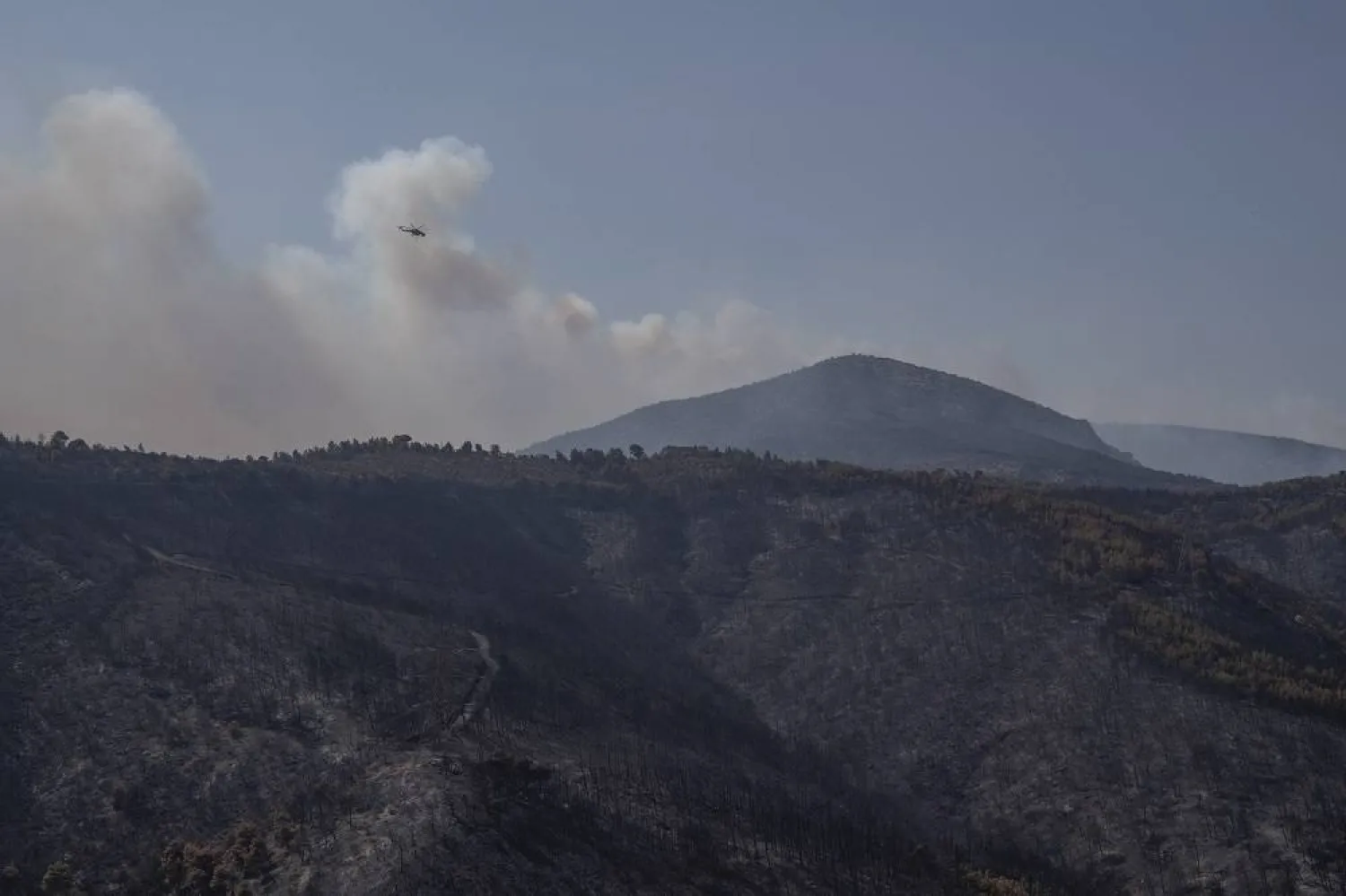
A helicopter operates near the Fyli suburb, northwest Athens, Greece, Friday, Aug. 25, 2023. (AP)
TT

Greek Fire Officials Arrest 2 for Arson as Multiple Wildfires Continue to Burn across the Country

A helicopter operates near the Fyli suburb, northwest Athens, Greece, Friday, Aug. 25, 2023. (AP)

Greek fire department officials arrested two men on Saturday for allegedly deliberately starting wildfires as hundreds of firefighters battle blazes that have been blamed for 21 deaths.

One man was arrested on Evia for allegedly deliberately setting fire to dried grass in the island's Karystos area. The fire department said the man confessed to having set four other fires in the area in July and August.

A second man was arrested in the Larissa area in central Greece, also for allegedly deliberately setting fire to dried vegetation. Judicial authorities were informed in both cases.

Officials have said arson has been to blame for several fires in Greece over the past week, although it is still unclear what sparked the country's largest blazes, including one in the northeastern region of Evros and Alexandroupolis where nearly all the fire-attributed deaths have occurred, and another on the fringes of Athens.

“Some ... arsonists are setting fires, endangering forests, property and above all human lives,” Climate Crisis and Civil Protection Minister Vassilis Kikilias said Thursday. “What is happening is not just unacceptable but despicable and criminal.”

The minister said nine fires had been set in the space of four hours Thursday morning in the Avlona area in the northern foothills of Mount Parnitha, a mountain on the northwestern fringes of Athens that is one of the capital's last green areas. A major fire was already burning on the southern side of the mountain at the time, and continued burning Saturday.

“You are committing a crime against the country,” Kikilias said. “We will find you. You will be held accountable to justice.”

Later that day, police arrested a 45-year-old man on suspicion of arson for allegedly setting at least three fires in the Avlona area. A search of his home revealed kindling, a fire torch gun and pine needles, police said.

Greece has been plagued by the daily outbreak of dozens of fires over the past week as gale-force winds and hot, dry summer conditions combine to whip up flames and hamper firefighting efforts. On Friday, firefighters were tackling 111 blazes, including 59 that had broken out in the 24 hours between Thursday and Friday evening, the fire department said.

Most are tackled in the early stages, but some have grown to massive blazes that have consumed homes and vast tracts of forest.

Storms were forecast for some areas of Greece Saturday, and there were reports of lightning causing several fires near the Greek capital that were being tackled by firefighters.

Greece's largest current blaze, blamed for 20 deaths, was burning for an eighth day Saturday in the country's northeast.

Firefighters found 18 bodies in woodland on Tuesday, one on Monday and another Thursday. With nobody reported missing in the area, authorities believe they could be migrants who recently crossed the border from Türkiye.

Greece’s Disaster Victim Identification Team has been activated to identify the remains, and a telephone hotline set up for potential relatives of the victims to call. One more victim — a man reportedly trying to save his livestock from advancing flames in central Greece — died on Monday.

More than 290 firefighters, backed by five planes and two helicopters, were battling the Evros blaze. By Thursday, the fire had scorched more than 75,000 hectares (185,000 acres, 750 square kilometers) of land, according to the European Union’s Copernicus Emergency Management Service. Copernicus is the EU space program’s Earth observation component and uses satellite imagery to provide mapping data.

A further 260 firefighters, four planes and three helicopters were tackling another fire that has been burning for days on Mount Parnitha, on the northwestern fringes of the Greek capital.

With firefighting forces stretched to the limit, Greece called on other European countries for help. Germany, Sweden, Croatia and Cyprus sent aircraft, while dozens of Romanian, French, Czech, Bulgarian, Albanian and Slovak firefighters helped on the ground.

Greece imposes wildfire prevention regulations, typically from the start of May to the end of October, to limit activities such as the burning of dried vegetation and the use of outdoor barbecues.

Since the start of this year’s fire season, fire department officials have arrested 163 people on fire-related charges, government spokesman Pavlos Marinakis said Friday, including 118 for negligence and 24 for deliberate arson. The police made a further 18 arrests, he added.



A Herd Stop: Train Kills 3 Rare Bison in Poland

30 May 2016. BIALOWIEZA, POLAND. REUTERS/KACPER PEMPEL
TT

A Herd Stop: Train Kills 3 Rare Bison in Poland

30 May 2016. BIALOWIEZA, POLAND. REUTERS/KACPER PEMPEL

Three wild European bison died on Sunday morning after being hit by a train in Poland's vast UNESCO-listed Bialowieza Forest in the east, the local police told AFP.

According to a police spokesman, a herd of Europe's largest mammals, whose male specimens can reach 900 kilograms (nearly 2,000 pounds), crossed onto the train tracks as a locomotive carrying some 50 passengers between Bialystock and Warsaw aboard was steaming ahead.

"No passenger was injured but three animals perished in this accident, which happened at 7:00 am, near the village of Witowo," spokesman Konrad Karwacki told AFP.

The "Zubr" line train, which takes its name from the Polish word for bison, did not derail and was able to resume its journey around an hour and a half after the collision.

Some 1,200 bison, an emblematic animal in the eastern European country, currently inhabit the Polish part of the great Bialowieza Forest, considered the last primeval woodland in Europe.

The forest, which is divided by the Poland-Belarus border, is a treasure of biodiversity and a giant carbon sink.

Yet several bison fall victim to road accidents in the region every year.

"They are sometimes hit by trains, but these are usually isolated incidents," Professor Rafal Kowalczyk, from a local branch of the Polish Academy of Sciences, told AFP.

"I don't recall an accident where three bison were killed at the same time, run over by a train," the specialist in the giant mammals added.

Devastated by hunting, deforestation and the expansion of agriculture, the European bison nearly became extinct at the beginning of the 20th century.

After disappearing from Bialowieza, its last habitat in Europe, before the outbreak of World War II, the species was saved at the 11th hour thanks to the release of bison reared in zoos back into the wild.


Can Nations Save the Shorebird that Flies 30,000 km a Year?

The Hudsonian godwit (Limosa haemastica) is one of the world's most remarkable travelers, but its population has plunged 95 percent in four decades due to a complex mix of environmental changes across multiple countries. Luke Seitz / Cornell Lab of Ornithology/AFP
TT

Can Nations Save the Shorebird that Flies 30,000 km a Year?

The Hudsonian godwit (Limosa haemastica) is one of the world's most remarkable travelers, but its population has plunged 95 percent in four decades due to a complex mix of environmental changes across multiple countries. Luke Seitz / Cornell Lab of Ornithology/AFP

Chasing an endless summer, one shorebird species undertakes a grueling annual journey from the Arctic to the tip of South America and back -- a feat increasingly fraught with peril.

The Hudsonian godwit (Limosa haemastica) is one of the world's most remarkable travelers, but its population has plunged 95 percent in four decades due to a complex mix of environmental changes across multiple countries, said AFP.

It is one of 42 species proposed for international protection at a meeting of parties to the UN Convention on the Conservation of Migratory Species (CMS) that starts in Brazil on Monday.

Iconic creatures like the snowy owl -- of Harry Potter fame -- striped hyena and hammerhead shark are also on the list deemed in danger of extinction and needing conservation by the countries they pass through.

Migratory birds are facing "rapid and dramatic declines," said Nathan Senner, an ecologist and ornithology professor at the University of Massachusetts Amherst who has studied the Hudsonian godwit for 20 years.

Scientists are still unraveling the mysteries of the shorebird -- which can fly up to 11,000 kilometers (6,800 miles) in one stretch without stopping to eat, drink, or sleep.

And it is only part of the 30,000 kilometers (18,600 miles) that the godwit travels every year from their breeding grounds in the Arctic to Patagonia where they spend the southern summer.

- Disrupted migrations -

In order to do this "epic flight," they need "really predictable, abundant food resources" at every step of the journey, Senner told AFP.

That predictability is crumbling.

In the Arctic, shifting spring timing attributed to climate change has created a mismatch between when chicks hatch and the peak availability of insects they feed on.

One of the puzzles Senner is currently working on is why Hudsonian godwits have begun migrating later by six days than they did a decade ago.

Something "has either disrupted the cues that they use to time their migrations or their ability to successfully and rapidly prepare for the migration," he said.

In southern Chile, a boom in salmon and oyster farming has led to a build-up of infrastructure and the presence of people in the intertidal zones where they feed.

And in the United States, changes in farming practices are making the shallow water wetlands that the godwits rely on rarer and less predictable -- meaning they spend more time looking for a place to stop and feed.

"I think that is emblematic of lots of species, that most species can respond to one kind of change, but not a whole bunch of them all at the same time," said Senner.

- Essential to ecosystems -

"Climate change is taking a heavy toll on species that rely on a 'geological clock' for their survival; many are disappearing," Rodrigo Agostinho, president of Brazil's environmental agency (Ibama), told AFP.

These are some of the issues CMS parties will tackle at their meeting in Brazil's biodiversity-rich Pantanal, one of the world's most important global meetings for wildlife conservation.

These countries are legally obliged to protect species listed as at risk of extinction, conserve and restore their habitats, prevent obstacles to migration and cooperate with other range states.

Nevertheless, among the species listed under CMS, a report released earlier this month showed that 49 percent now have populations that are declining, up from 44 percent two years ago.

Amy Fraenkel, CMS executive secretary, told AFP that most of the species doing worse were birds, such as the Hudsonian godwit.

She said the situation was also "particularly alarming" for fish species, with 97 percent of those listed under the treaty threatened with extinction.

Migratory species "are essential to healthy ecosystems and a healthy planet," playing a key role in pollination, pest control and transporting nutrients, she said.

In a piece of good news, the meeting will propose removing Central Asia's Bactrian deer from its list of animals needing high protection, due to an increase in its population.


Dog Finds Canadian Message in a Bottle on Aberdeenshire Beach

A message in a bottle (Shutterstock) 
TT

Dog Finds Canadian Message in a Bottle on Aberdeenshire Beach

A message in a bottle (Shutterstock) 

A message in a bottle dropped from a boat off Canada has been found washed up in the north-east of Scotland, according to BBC.

The short letter, written in French and dated in 2024, was found inside the bottle at St Cyrus in Aberdeenshire.

Having travelled across the Atlantic, it was found by one of Mike Scott's dogs during a beach walk.

The 60-year-old said he was “amazed” by the bottle's journey of about 2,700 miles (4,300km).

The professional photographer from Johnshaven takes his dogs to St Cyrus most days for a walk.

He described the weather as “wild” at the time they discovered the bottle.

“As I was walking, Maggie my dog was sniffing a bottle that was just washing up. It was a really dark glass bottle with a lid and something in it,” he said.

He explained: “I had found a message in a bottle before, but it was just from Dundee, so I was not expecting much. There was a zip bag in it, and a letter in French. I put it in my rucksack and put it on translate when I got home.”

The note - which appeared to be signed 'Annie Chiasson' - said the bottle had been put to sea from a ferry travelling between Prince Edward Island and Iles-de-la-Madeleine in August 2024.

Scott said, “So the small glass bottle has survived two winters at sea, travelling from the east coast of Canada, across the north Atlantic, over the top of Scotland and down into the North Sea for us to find at St Cyrus.”

“The sender was asking to let them know if found,” he said. “We found the woman on Facebook, my wife sent a message, but we have heard nothing back.”

BBC Scotland News has also tried to contact the sender.

Scott said, “It was such a weird thing to find, it's not just our own rubbish that washes up. It's amazing it was not smashed. I do not imagine she thought it would end up in Scotland across the Atlantic.”