Egypt’s Sisi Receives Sudan’s Burhan in el-Alamein 

Sudanese army chief Abdel Fattah Burhan visits the Flamingo Marine Base in Port Sudan on August 28, 2023. (Photo by AFP)
TT

Egypt’s Sisi Receives Sudan’s Burhan in el-Alamein 

Sudanese army chief Abdel Fattah Burhan visits the Flamingo Marine Base in Port Sudan on August 28, 2023. (Photo by AFP)

Sudan’s top military officer arrived in Egypt on Tuesday on his first trip abroad since the country plunged into a bitter conflict this year, authorities said. 

Gen. Abdel-Fattah Burhan, chairman of the ruling Sovereign Council, was received by Egyptian President Abdel Fattah al-Sisi at the airport in the Mediterranean city of el-Alamein, according to the council. 

The council said in an earlier statement the two leaders would discuss the latest developments in Sudan and the ties between the neighboring countries. 

Sudan plunged into chaos in mid-April when simmering tensions between the military, led by Burhan, and the powerful paramilitary Rapid Support Forces, commanded by Mohammed Hamdan Dagalo, exploded into open fighting in the capital, Khartoum, and elsewhere. 

The conflict has reduced the capital to an urban battlefield, with the RSF controlling vast swaths of the city. The military command, where Burhan has purportedly been stationed since April, has been one of the epicenters of the conflict. 

In his trip to Egypt, Burhan was accompanied by Acting Foreign Minister Ali al-Sadiq and Gen. Ahmed Ibrahim Mufadel, head of the General Intelligence Authority, and other military officers. 

Burhan managed last week to leave the military headquarters. He visited military facilities in Khartoum's sister city of Omdurman and elsewhere in the country. Burhan traveled to Egypt from the coastal city of Port Sudan on the Red Sea. 

Despite months of fighting, neither side has managed to gain control of Khartoum or other key areas in the country. Last week, large explosions and plumes of black smoke could be seen above key areas of the capital, including near its airport. 

In July, Sisi hosted a meeting of Sudan’s neighbors and announced a plan for a ceasefire. A series of fragile truces, brokered by the US and Saudi Arabia, have failed to hold. 

The conflict has turned Khartoum and other urban areas into battlefields. Many residents live without water and electricity, and the country’s health care system has nearly collapsed. 

The sprawling region of Darfur saw some of the worst bouts of violence in the conflict, and the fighting there has morphed into ethnic clashes. 

Clashes also intensified earlier this month in the provinces of South Kordofan and West Kordofan. 

The fighting is estimated to have killed at least 4,000 people, according to the UN human rights office, though activists and doctors on the ground say the death toll is likely far higher. 

More than 4.6 million people have been displaced, according to the UN migration agency. Those include over 3.6 million who fled to safer areas inside Sudan and more than 1 million others who crossed into neighboring countries. 


Iraq Warns of ISIS Resurgence after Attacks North of Baghdad

A member of the Iraqi security forces in Baghdad (AFP)
TT

Iraq Warns of ISIS Resurgence after Attacks North of Baghdad

A member of the Iraqi security forces in Baghdad (AFP)

Iraqi officials warned Wednesday of an ISIS resurgence after a series of attacks on security forces in rural areas north of Baghdad left several personnel dead or wounded, prompting authorities to impose a nighttime curfew in parts of Kirkuk province.

Security sources said the second battalion of the Popular Mobilization Forces’ 61st Brigade came under armed attack late Tuesday in the village of Al-Barghaliya–Al-Dandish in Hawija district, southwest of Kirkuk.

A sniper disabled a thermal imaging camera at a military position, triggering search operations in the village and surrounding areas to track down the attackers.

The assault came a day after an attack on the Federal Police’s Ninth Brigade in the same village killed one person and wounded four others. Several thermal imaging cameras were also destroyed, according to a security source.

The Federal Police Command identified the slain officer as Bakr Majid Mohammed, who was killed while confronting ISIS militants attempting to storm his guard post in Al-Barghaliya in Hawija district.

The position falls within the operational area of the third battalion of the Ninth Brigade, Federal Police Third Division.

Nighttime curfew

In response to the attacks, Federal Police authorities imposed a curfew across Hawija and its villages from 6 p.m. to 6 a.m.

The restrictions prohibit movement during those hours, with tighter controls on motorcycles, cars and cargo motorcycles. The latter may operate only in essential cases with official authorization.

Residents were urged to comply with the measures and cooperate with security forces, while authorities warned that violations could result in legal action.

Security was also tightened around farms and villages near Federal Police positions, with restrictions on the movement of farmers whose land lies close to security deployments.

Ahmed Ramzi Koprulu, chairman of the Kirkuk Provincial Council’s Security and Defense Committee, said that the Hawija attack underscored the continuing threat posed by ISIS sleeper cells.

He called for stronger intelligence gathering and intensified security operations to prevent further attacks.

Speaking to Shafaq News, Koprulu stressed the need to prevent militants from regrouping or exploiting remote areas to target security forces and civilians. He also urged closer coordination and intelligence-sharing among security agencies.

On Monday, ISIS claimed responsibility for an attack southwest of Kirkuk city that killed an Iraqi police officer and wounded others.

It was the group’s first attack on Iraqi security forces since US troops completed their withdrawal from Iraq on Sept. 30, bringing their military mission in the country to an end.

On the day of the withdrawal, Iraqi Prime Minister Ali al-Zaidi called for heightened vigilance, constant readiness and closer coordination among security forces.

He also asked security agencies to update their operational plans, procedures and databases and make greater use of modern technology to maintain stability nationwide.

How serious is the threat?

Despite the recent violence, security experts played down ISIS’s ability to regain control of territory.

Security analyst Sarmad al-Bayati told Asharq Al-Awsat that the group, or what remains of it, could still threaten military units in some areas because it possesses weapons and explosive belts.

However, he argued that it no longer poses a threat to Iraq’s overall national security.

Bayati described the Hawija incidents as limited attacks by sleeper cells, suggesting they could nevertheless be used for political purposes amid the debate over the US withdrawal and efforts to disarm armed factions.

Security expert Mukhlid Hazem also dismissed the prospect of ISIS staging a resurgence on the scale of its 2014 offensive.

He said the group’s capabilities were now largely confined to deploying small armed units in scattered areas, while Iraqi security forces worked to contain them through preemptive operations.

“The organization’s attacks coinciding with the US withdrawal are merely an attempt to demonstrate that it still exists,” Hazem told Asharq Al-Awsat.

He added that ISIS was no longer capable of carrying out attacks in city centers, even where it retained local support networks.

Still, he urged caution over the possibility of larger militant groups attempting to mobilize.

Political science professor Abbas Abboud pointed to significant improvements in Iraq’s intelligence capabilities compared with previous years, arguing that these advances reduced the likelihood of ISIS expanding its operations.

He cautioned, however, that threats could also emerge from other terrorist groups enlisted by various parties to advance specific objectives.


Houthis Accused of Stripping Western Yemen of Power Equipment, Property

The Houthis seized food aid in Mokha and redistributed it in exchange for loyalty (Houthi media)
TT

Houthis Accused of Stripping Western Yemen of Power Equipment, Property

The Houthis seized food aid in Mokha and redistributed it in exchange for loyalty (Houthi media)

The Houthis have expanded their systematic seizure of public and private property in areas under their control along Yemen’s western coast, including Hodeidah province and parts of Taiz, according to local sources, who accuse the group of treating cities and public facilities as spoils to be transferred to their strongholds.

The latest reported seizures involved equipment and solar panels from two power stations in the Hays and Al-Khawkhah districts of Hodeidah province. The installations were dismantled and their components transported to Saada, the group’s main stronghold, depriving thousands of residents of electricity and worsening hardship amid deteriorating services and high temperatures in coastal areas.

Informed sources told Asharq Al-Awsat that Gharsan al-Matari, a Houthi leader acting as Hodeidah’s electricity director, instructed members of the group several days ago to dismantle both solar power systems and transport all their components, equipment and technical supplies to Saada aboard large trucks.

The two installations had supplied approximately 20 megawatts of electricity, helping power homes and ease hardship for residents, particularly in coastal communities where temperatures are high.

According to the sources, the incident reflects a broader pattern of seizures targeting public utilities and private property in areas brought under Houthi control.

Other service infrastructure, equipment and networks are also being dismantled and transferred to Saada and Sanaa rather than remaining in the communities they were intended to serve, they added.

An economy of spoils

Activists from Hodeidah described the transfer of electricity equipment from Hays and Al-Khawkhah as an example of what they called an “economy of spoils,” accusing the Houthis of treating areas under their control as sources of assets to be appropriated.

Residents are paying the price through the loss of essential services, they argued, while resources are concentrated in the group’s centers of power.

In the coastal district of Mokha, local sources reported continuing seizures and looting that began within hours of the Houthis taking control of the city, targeting homes, government facilities, humanitarian organizations and charitable associations.

Sources told Asharq Al-Awsat that Houthi members raided dozens of houses and apartments, particularly in the Al-Hali neighborhood and December 2 City, removing furniture, household appliances and other belongings before loading them onto trucks and transporting them out of the city.

Government premises were also targeted, including the local authority headquarters and the city’s branch of the Central Bank of Yemen.

The reported looting extended to commercial establishments.

Eyewitnesses recounted seeing Houthi patrols repeatedly transporting food supplies and consumer goods from wholesale stores in central Mokha to locations outside the city.

Local activists indicated that the seizures took place under the supervision of unidentified individuals believed to be linked to the group’s security and intelligence agencies.

Shops broken into in Al-Turbah

In Al-Turbah, the administrative center of Al-Shamayatayn district in southwestern Taiz province, local sources accused the Houthis of following the same pattern, targeting government institutions, private homes and figures associated with the Yemeni government.

Several shopkeepers closed their businesses as the group entered the city, fearing looting. But residents reported that some of the shuttered premises were forcibly broken into.

According to their accounts, Houthi members broke down the doors of several shops and seized merchandise, apparently in retaliation for the owners’ decision to close their businesses during the group’s entry into the city.

The successive incidents point to what residents and activists describe as a recurring pattern of seizures extending beyond damage directly caused by fighting.

They accuse the Houthis of stripping cities of essential infrastructure and economic assets and transferring them to areas under the group’s control, further undermining public services and worsening living conditions.


Egypt, South Korea Seek to Expand Strategic Partnership

The Egyptian president on Wednesday stressed the importance of Korean companies considering expanding their investments (Egyptian Presidency’s Facebook page). 
TT

Egypt, South Korea Seek to Expand Strategic Partnership

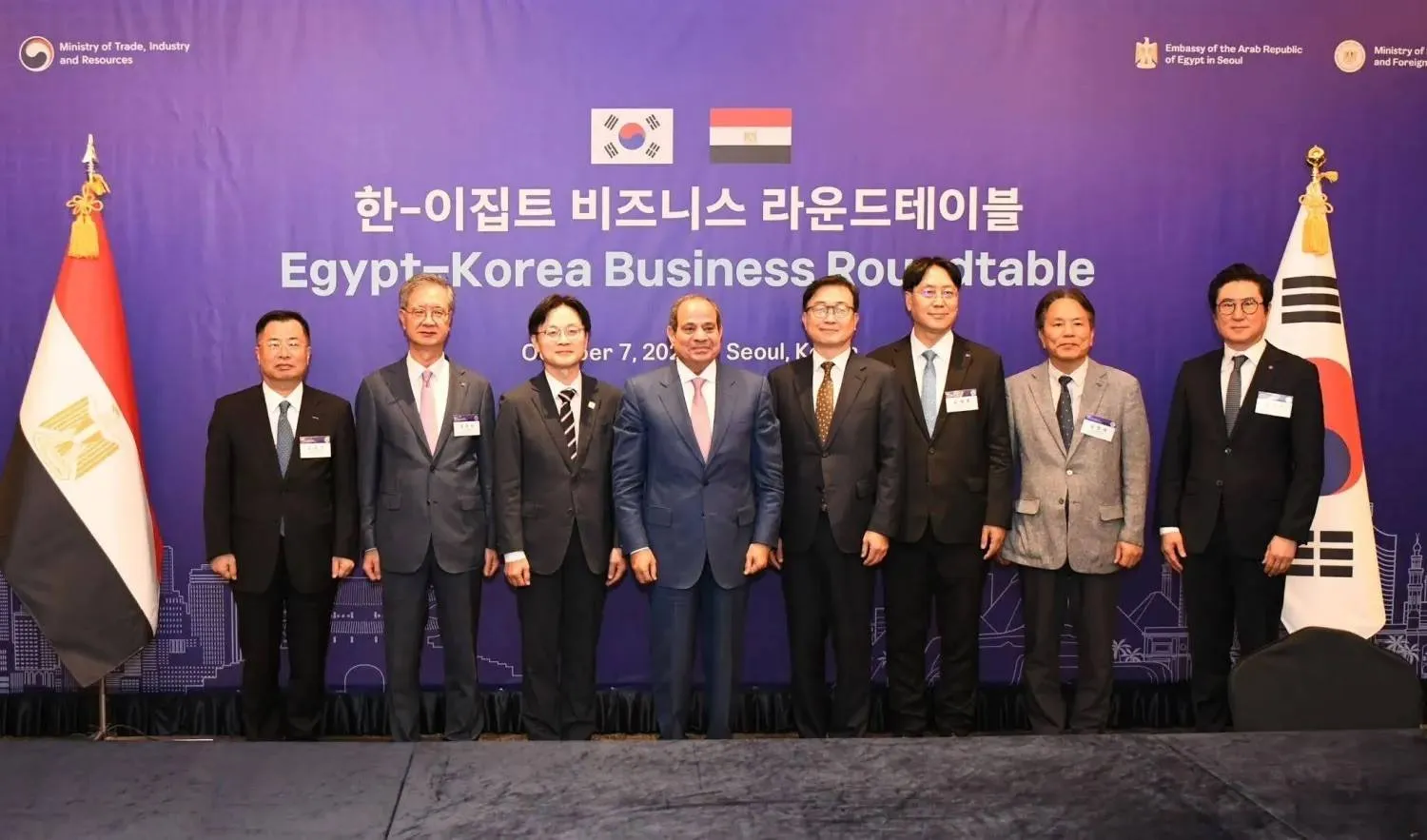
The Egyptian president on Wednesday stressed the importance of Korean companies considering expanding their investments (Egyptian Presidency’s Facebook page). 

Egyptian President Abdel Fattah al-Sisi’s first visit to Seoul in a decade has brought renewed commitments to strengthen bilateral ties and expand cooperation between the two countries.

On Wednesday, Sisi attended a roundtable with executives from major South Korean companies and business representatives, with 23 companies taking part, according to the Egyptian presidency.

The Egyptian president expressed his country’s determination to deepen cooperation with South Korea and take relations to more ambitious levels, highlighting Cairo’s strong political will to expand ties, particularly in investment, manufacturing, technology and the wider economy.

He also called for closer cooperation on strategically important projects and renewed his proposal to establish an integrated Korean industrial zone within the Suez Canal Economic Zone.

The proposed zone could serve as a regional production and export hub for Korean companies, supplying not only Egypt’s large domestic market but also regional and international markets through the country’s free trade agreements with African nations, the European Union and Arab states, he explained.

Sisi encouraged Korean companies to expand their investments in oil, gas and mining and explore opportunities in renewable and clean energy projects, including solar and wind power, green hydrogen, smart grids and energy storage technologies.

He also highlighted opportunities for Egyptian and Korean companies to undertake joint construction and infrastructure projects in Arab and African countries.

According to the presidency, the roundtable included discussions with South Korean business leaders on opportunities to establish sustainable strategic partnerships.

Former Egyptian Assistant Foreign Minister Mohamed Hegazy believes relations between Egypt and South Korea are poised for significant progress following the visit, which included efforts to broaden cooperation in projects and investment.

“South Korea has all the technological capabilities needed to provide what Egypt and Africa require,” Hegazy told Asharq Al-Awsat.

Amid regional instability, he expects Seoul and countries such as China, Indonesia and Malaysia to show greater interest in investing in Egypt and through it.

Sisi’s visit is part of an Asian trip that also includes Malaysia and Indonesia, according to a presidential statement issued Tuesday. It comes amid critical regional circumstances and disruptions to supply chains.

South Korean President Lee Jae Myung welcomed Sisi’s visit in a post on X.

“We are delighted to welcome the Egyptian president as an honored guest to the Republic of Korea for the first time in 10 years,” Lee wrote.

“Meeting the Egyptian president again in Seoul after our candid discussions in Cairo last year makes this encounter all the more significant and meaningful,” he added.

“I hope the Miracle on the Han River and the Miracle on the Nile will come together to further enhance the shared prosperity of our two countries.”

Hegazy described Sisi’s Asian trip as reflecting Egypt’s recognition of the importance of Asia in its foreign policy and a direct effort to put the comprehensive strategic economic partnership between the two sides into practice across several sectors.

According to Egypt’s Central Agency for Public Mobilization and Statistics (CAPMAS), trade with South Korea totaled $874 million in the first eight months of 2026, down from $920 million during the same period in 2025.

Sisi last visited South Korea in March 2016, when he held talks in Seoul with then-President Park Geun-hye.

The visit saw the signing of several agreements and memorandums of understanding, as well as the elevation of bilateral relations to a comprehensive partnership.