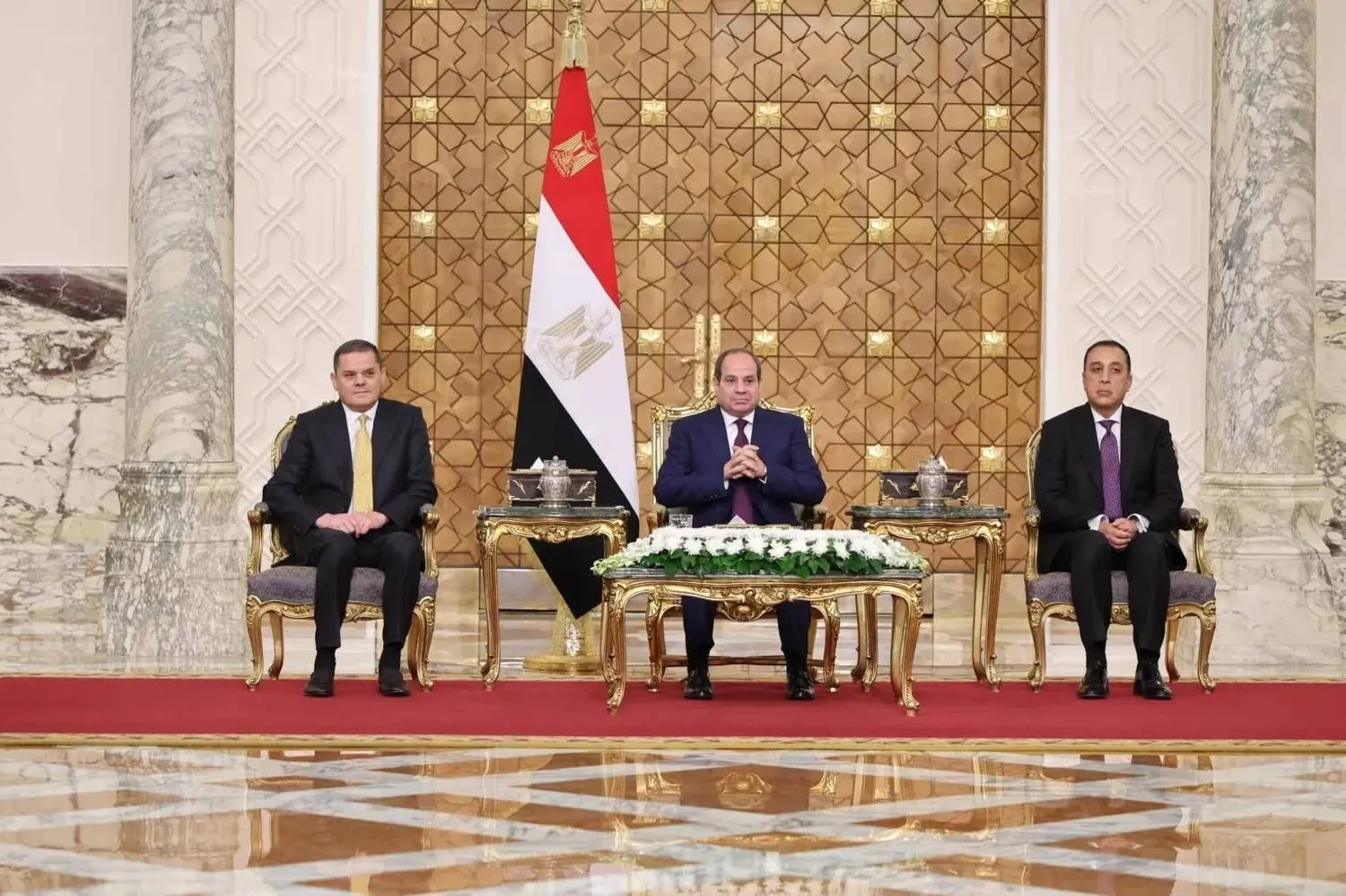
Egypt’s growing rapprochement with Libya’s interim Government of National Unity (GNU), led by Abdul Hamid Dbeibeh, has raised questions about whether Cairo is reassessing its longstanding priorities in a country divided by years of institutional rivalry.
After years of closer ties with the eastern-based Libyan National Army (LNA), commanded by Field Marshal Khalifa Haftar, Egypt has intensified contacts with Tripoli. The outreach culminated in President Abdel Fattah el-Sisi’s talks with Dbeibeh, their second meeting in recent months.
Thursday’s meeting followed separate visits to Tripoli by Egyptian Foreign Minister Badr Abdelatty and intelligence chief Hassan Rashad, at a time when political, security and economic challenges remain intertwined and disputes over institutional legitimacy continue to obstruct efforts to establish a unified government.
Yet Egyptian and Libyan diplomats interviewed by Asharq Al-Awsat cautioned against interpreting Cairo’s outreach as a shift from one camp to another.
Egypt has not abandoned its close ties with eastern Libya, they argued, while the security and geographic interests underpinning its relationship with the LNA leadership remain unchanged by renewed engagement with Tripoli.
Parallel Channels of Communication
Former Egyptian Assistant Foreign Minister Ezzat Saad traced Cairo’s approach to a broader policy that took shape in 2020, when Egypt adopted the Berlin Declaration as a comprehensive international framework for addressing the Libyan crisis.
The declaration encompasses political, military, security and economic tracks, as well as the arms embargo, human rights and international humanitarian law.
Saad explained that the framework, whose outcomes were endorsed by the UN Security Council, brings the various dimensions of Libya’s crisis under a single approach aimed at achieving a comprehensive settlement and unifying state institutions.
Egypt has maintained coordination with Libyan parties in recent years without developing formal alliances, he added, while keeping communication channels open with both eastern and western Libya.
Analysts therefore view Cairo’s continued engagement across the political divide less as a retreat from previous understandings than as an effort to preserve parallel channels of communication and avoid concentrating Egyptian influence within a single Libyan camp.
Eastern Libya’s Strategic Importance
Cairo’s rapprochement with the GNU has nevertheless prompted concern among politicians and activists in eastern Libya, particularly amid disagreements over a maritime boundary agreement with Türkiye.
Libya’s House of Representatives approved the agreement in October, but Egypt has rejected it.
Former Libyan diplomat Mohamed al-Jazwi, who previously served as consul in Cyprus, dismissed the prospect of a fundamental shift in Cairo’s priorities.
“Eastern Libya represents strategic depth for Egyptian national security,” he told Asharq Al-Awsat, arguing that relations with the LNA rest on considerations extending beyond current political disagreements, which he described as a passing cloud.
Those considerations date back to battles against extremist organizations in Benghazi and Derna, when developments in eastern Libya’s counterterrorism campaign were closely linked to security along Egypt’s western border.
From this perspective, the LNA’s role in combating terrorism carries regional significance beyond eastern Libya itself.
Al-Jazwi pointed to Rashad’s November 13 meeting in Cairo with Saddam Haftar, the LNA’s deputy commander-in-chief, as further evidence of continued cooperation.
The discussions addressed unifying political authority, advancing joint projects and holding permanent elections. The LNA portrayed the meeting as part of efforts to establish a unified, stable state and strengthen political and security stability.
A Broader Partnership
Former Libyan ambassador to Ukraine Adel Issa offered a different perspective, viewing Egypt’s outreach as an opportunity to reshape its role through closer engagement with all components of the Libyan state.
Rather than aligning itself with one faction or treating Libya’s internal divisions as permanent political calculations, Cairo could pursue a broader partnership, he argued.
Under this approach, Egypt’s interests would be better served by treating Libya as a single entity, helping bridge differences and overcome divisions while preserving institutional unity and promoting stability in both countries.
Libya remains divided politically and militarily between rival administrations: Dbeibeh’s GNU in the west and a parliament-appointed government led by Osama Hammad in the east, which is backed by the LNA.
Analysts believe the agenda of Thursday’s Sisi-Dbeibeh meeting offered practical indications of the broader engagement advocated by Issa.
Beyond reaffirming Libya’s security, unity and territorial integrity, the talks focused on expanding trade and investment, particularly in energy, natural gas, oil and reconstruction.