


South Africa Asks UN Court to Urgently Examine Israel’s Targeting of Rafah in Genocide Case

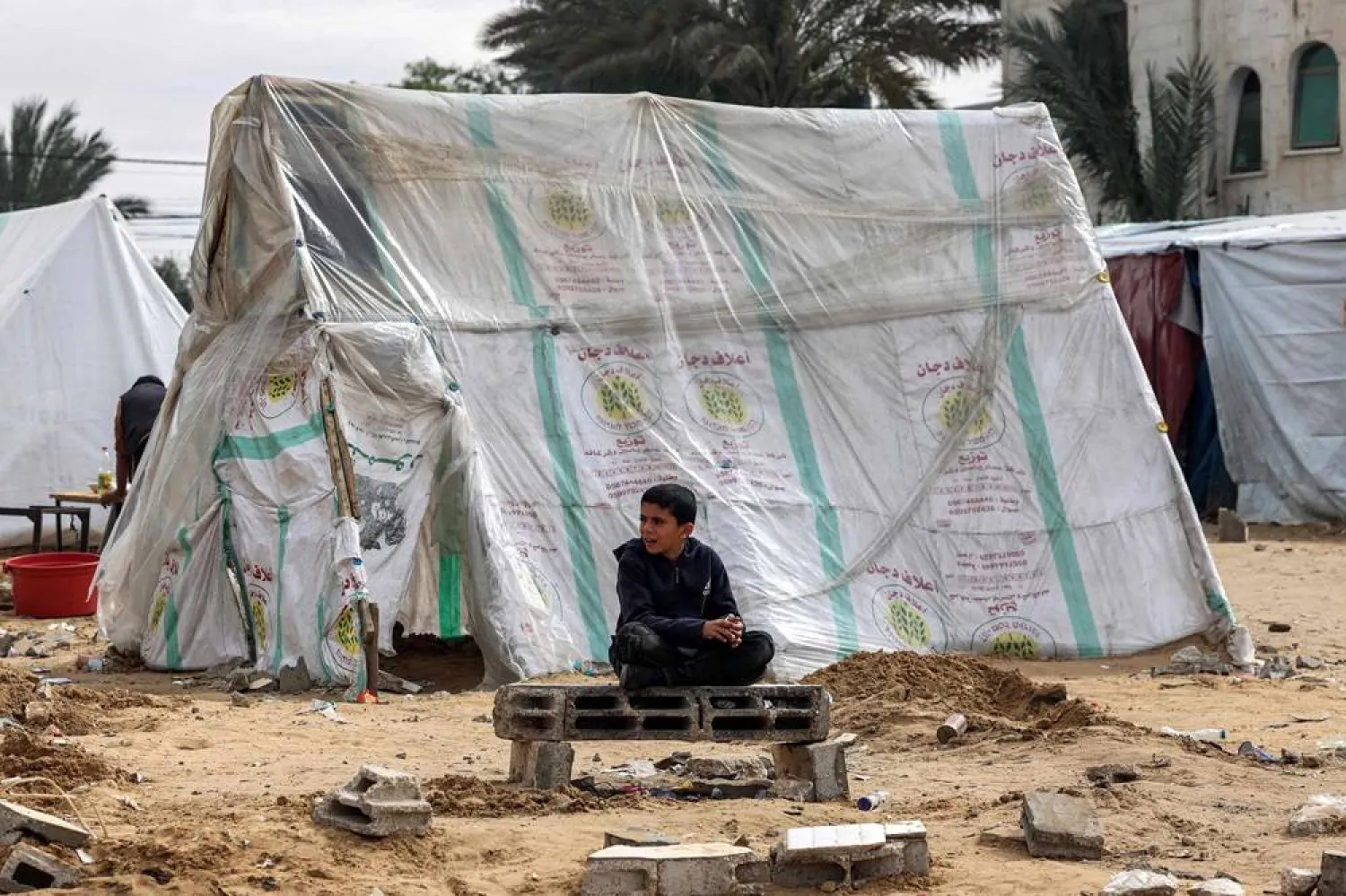
 A Palestinian boy sits near a tent for displaced people in Rafah, in the southern Gaza Strip, on February 13, 2024, amid the ongoing conflict between Israel and the Palestinian group Hamas. (AFP)
A Palestinian boy sits near a tent for displaced people in Rafah, in the southern Gaza Strip, on February 13, 2024, amid the ongoing conflict between Israel and the Palestinian group Hamas. (AFP)
TT

South Africa Asks UN Court to Urgently Examine Israel’s Targeting of Rafah in Genocide Case

 A Palestinian boy sits near a tent for displaced people in Rafah, in the southern Gaza Strip, on February 13, 2024, amid the ongoing conflict between Israel and the Palestinian group Hamas. (AFP)
A Palestinian boy sits near a tent for displaced people in Rafah, in the southern Gaza Strip, on February 13, 2024, amid the ongoing conflict between Israel and the Palestinian group Hamas. (AFP)

South Africa’s government said Tuesday it had lodged an "urgent request" with the UN’s International Court of Justice to consider whether Israel’s military operations targeting the southern Gaza city of Rafah are a breach of provisional orders the court handed down last month in a case alleging genocide.

South Africa said it asked the court to weigh whether Israel’s strikes on Rafah, and its intention to launch a ground offensive on the city where 1.4 million Palestinians have sought shelter, breaches both the UN Genocide Convention and preliminary orders handed down by the court last month in a case accusing Israel of genocide.

Rafah is on the border with Egypt, which has warned that an offensive on the city now holding more than half of Gaza's population would bring disaster.

South Africa's government said in a statement that Rafah was "the last refuge for surviving people in Gaza." It asked the top UN court to consider using its powers to issue additional preliminary orders telling Israel to halt the deaths and destruction there.

South Africa already alleged Israel is committing genocide against the Palestinian people in its war against the Hamas militant group in Gaza and filed a case with the world court in December. A ruling on the genocide allegation could take years.

South Africa also asked the court to order a ceasefire by Israel, but the justices stopped short of that.

In its new filing, South Africa's government said it was "gravely concerned that the unprecedented military offensive against Rafah, as announced by the State of Israel, has already led to and will result in further large scale killing, harm and destruction."

South Africa said it was asking that the matter be dealt with urgently "in light of the daily death toll in Gaza."

The court didn’t immediately confirm receipt of the new request. If it decides to hold another hearing on the request for further provisional measures, it would likely then rule within weeks.

Israel strongly denies committing genocide in Gaza and says it does all it can to spare civilians and is only targeting Hamas militants. It says Hamas' tactic of embedding in civilian areas makes it difficult to avoid civilian casualties.

Israel's assault has wrought destruction in Gaza, with more than 28,000 people killed, over 70% of them women and children, according to local health officials in the Hamas-controlled enclave. Around 80% of the population has been displaced and the UN says a humanitarian catastrophe has pushed more than a quarter of Palestinians in Gaza toward starvation.

Israel says it has killed thousands of militants in its aim of crushing Hamas in retaliation for the Oct. 7 attacks on southern Israel. About 1,200 people, mostly civilians, were killed and 250 were taken hostage.

South Africa has accused Israel of ignoring the court's preliminary ruling in the days after it was issued by continuing to kill civilians.

"Israel believes it has license to do as it wishes," Foreign Minister Naledi Pandor said.

South Africa's legal efforts are rooted in issues central to its identity: Its governing party, the African National Congress, has long compared Israel’s policies in Gaza and the West Bank to its own history under the apartheid regime of white minority rule, which restricted most Blacks to "homelands." Apartheid ended in 1994.

Israel's military assault in Gaza was described last week as "over the top" by US President Joe Biden, a strong criticism from a close ally.  

The White House said Biden has also warned Israeli Prime Minister Benjamin Netanyahu that Israel should not conduct a military operation against Hamas in Rafah without a "credible and executable" plan to protect civilians.



French, Japanese Ships Cross Strait of Hormuz in First Since War

A cargo ship in the Gulf, near the Strait of Hormuz, as seen from northern Ras al-Khaimah, near the border with Oman’s Musandam governance, amid the US-Israeli conflict with Iran, in United Arab Emirates, March 11, 2026. (Reuters)
TT

French, Japanese Ships Cross Strait of Hormuz in First Since War

A cargo ship in the Gulf, near the Strait of Hormuz, as seen from northern Ras al-Khaimah, near the border with Oman’s Musandam governance, amid the US-Israeli conflict with Iran, in United Arab Emirates, March 11, 2026. (Reuters)

One French- and another Japanese-owned vessel are among a handful of vessels to have crossed the war-torn Strait of Hormuz, maritime tracking data showed Friday.

The passage, a vital maritime route for oil and liquified natural gas, has been virtually blocked by Iran since the start of the war, said AFP.

But both ships made the crossing on Thursday, according to ship tracking company Marine Traffic's website.

The Maltese-flagged Kribi belonging to the French maritime transport group CMA CGM crossed the waterway to leave the Gulf on Thursday afternoon, Marine Traffic's data showed.

By early Friday, it was off Muscat, Oman, still broadcasting the message "owner France" on its transponder system in the field usually used to give the destination.

The vessel's navigation data showed it had crossed via an Iranian-approved route through its waters, dubbed the "Tehran Toll Booth" by leading shipping journal Lloyd's List.

- Southern route -

In addition, three tankers -- including one co-owned by a Japanese company -- crossed the Strait of Hormuz on Thursday by taking an alternative, southern route.

They hugged close to the shore of Oman's Musandam Peninsula -- a first in nearly three weeks according to Lloyd's List.

Before the war, which started more than a month ago, about a fifth of global oil and liquefied natural gas (LNG) passed through the Strait.

All three ships signaled they were an "OMANI SHIP" in the message broadcast by their transponder as they crossed the strait.

The Sohar LNG, which was empty when crossing, is co-owned by Japanese shipping company Mitsui O.S.K.

That makes it the first Japanese vessel to exit the Gulf since the start of the war, according to a company statement quoted by Japanese media.

The Hong-Kong flagged New Vision, which crossed the strait on March 1 right after the war started, is expected in the French port of Le Havre on Saturday evening.

Since the conflict started however, that has dwindled to a trickle as Iran selectively attacks ships and energy facilities throughout the Gulf in retaliation for US and Israeli attacks.

A few commercial ships crossing the Strait of Hormuz recently have passed through the Iranian-approved route in the north of the waterway.

- Down to a trickle -

Just 221 commodities vessels have crossed the Strait of Hormuz since March 1, some more than once, according to Kpler data up to Friday morning.

In peacetime, the same waterway handles around 120 daily transits, according to Lloyd's List.

Of the vessels that made the crossing, 60 percent either came from Iran or were heading there.

It was not clear from the data how many had been cleared to make the crossing by Tehran.

But it did show that, among the 118 crossings by ships carrying cargo, 37 had left the Gulf carrying crude oil.

Most of those oil tankers -- 30 of them -- came from Iran or sailed under the Iranian flag. And most ships carrying Iranian oil did not specify their destination on their transponder.

Of those who did, all but one reported they were heading to China.

In the early days of the war, transponder data showed dozens of ships broadcasting messages such as "Chinese crew" or "Chinese owner" in the field usually used for their destination.

This appeared to be an attempt by the ships to avoid being targeted by Iran.


Iran Executes Two Linked to Opposition Group

Executions in Iran have surged in recent years - AFP
TT

Iran Executes Two Linked to Opposition Group

Executions in Iran have surged in recent years - AFP

Iran on Saturday executed two men it said were convicted of links to an opposition group, the People's Mojahedin Organization of ‌Iran, and ‌of carrying out armed ‌attacks, ⁠domestic media reported.

The ⁠executions were the latest in recent days of individuals with PMOI links.

The PMOI confirmed ⁠Saturday's executions, saying ‌in ‌a statement that Iran was "trying ‌to hide its ‌weakness by executing political prisoners, especially PMOI members and supporters." Four PMOI ‌members were executed earlier this week, ⁠it ⁠said.

The group said the two men executed on Saturday were arrested in January 2024 and had their death sentences upheld in December 2025.


Earthquake Kills 8 Members of Same Family near Afghan Capital

Previous earthquake in Afghanistan (Archive-Reuters)
TT

Earthquake Kills 8 Members of Same Family near Afghan Capital

Previous earthquake in Afghanistan (Archive-Reuters)

An earthquake that struck Afghanistan overnight killed eight members of the same family in Kabul province, the health ministry said on Saturday.

The 5.8-magnitude quake struck at 8.42 pm (1612 GMT) on Friday at a depth of 186 kilometers (115 miles) at the epicenter in northeastern Badakhshan province, according to the US Geological Survey (USGS).

Shaking was felt in multiple parts of the country, including the capital Kabul, according to AFP journalists.

"In the Gosfand Dara area of Kabul Province, eight members of a family died as a result of the earthquake," Health Ministry spokesman Sharafat Zaman said in a message to media.

He added that a child aged around two years old was the only survivor from the household and the country's disaster management agency said the boy had been injured in the tremor.

Afghanistan is frequently jolted by earthquakes, particularly along the Hindu Kush mountain range near where the Eurasian and Indian tectonic plates meet.

In August, a shallow magnitude 6 earthquake wiped out mountainside villages and killed more than 2,200 people in eastern Afghanistan, making it the deadliest tremor in the country's recent history.